By The Star Queen · Star Queen Chronicles
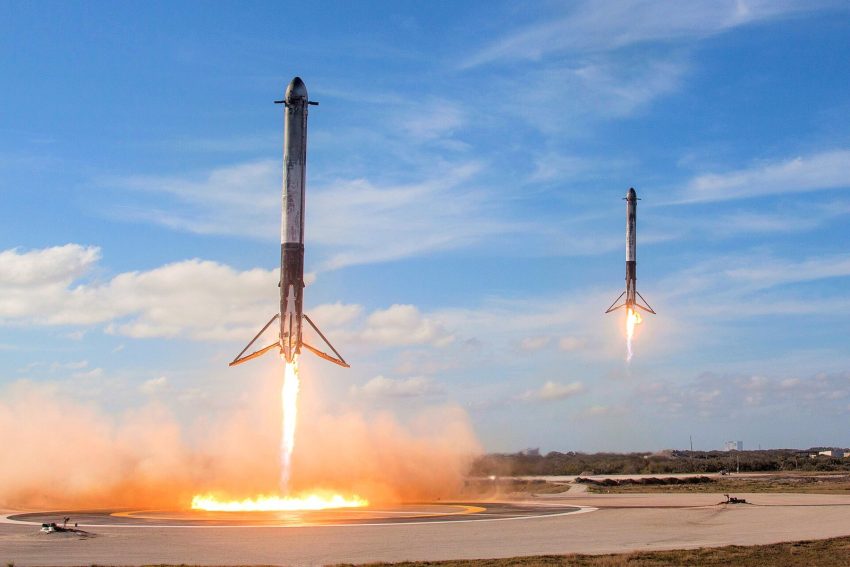
Falcon Heavy’s two side boosters landing at Cape Canaveral, February 6, 2018. Credit: SpaceX, CC0 (public domain dedication), via Wikimedia Commons
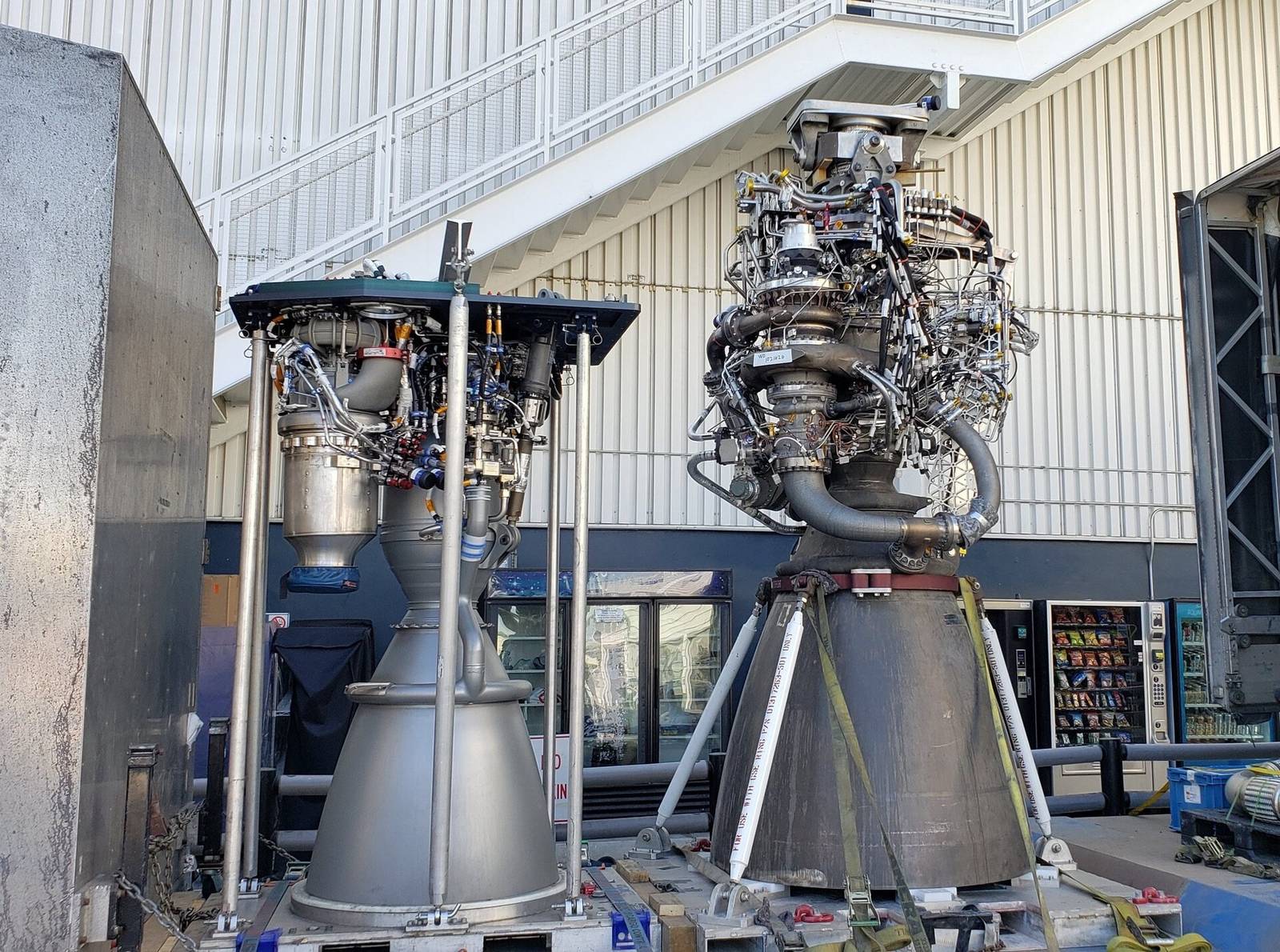
My loves, if Raptor is the glamorous future, Merlin is the workhorse that got SpaceX there. 🐴 It is not the most advanced engine, and it doesn’t pretend to be. It’s a kerosene-and-oxygen gas generator engine, a design family that goes back to the 1950s, polished until it became boringly reliable. And “boringly reliable” is exactly what you want when you’re landing the same booster dozens of times.
As of October 26, 2026, here is what I can back up. I tag numbers as official (SpaceX), reported, or my arithmetic, and I flag where sources disagree.
The Short Version
- Falcon 9’s first stage has nine Merlin 1D engines. The second stage has one Merlin Vacuum (MVac).
- Falcon Heavy has 27 Merlin 1Ds across its three cores, plus one MVac on the upper stage.
- SpaceX lists Merlin’s sea-level thrust at 845 kN (190,000 lbf) and MVac’s at 981 kN (220,500 lbf).
- Merlin is open-cycle: simple and robust, and a little less efficient than Raptor’s closed cycle.
Terms to know ✨
- RP-1: a highly refined kerosene rocket fuel.
- LOX: liquid oxygen, the oxidizer.
- Gas generator: a small combustion chamber that burns a little propellant to spin the turbopump. Its exhaust is then dumped overboard (open cycle).
- Turbopump: a turbine-driven pump that forces propellant into the chamber at high pressure.
- Pintle injector: a single central post that sprays propellants into the chamber in a conical sheet. It’s simple and stable.
- TEA-TEB: triethylaluminium and triethylborane, a pyrophoric mix that ignites on contact with oxygen, so it works as an igniter fluid.
- Throttling: running at reduced thrust.
- Octaweb: SpaceX’s layout of eight engines around one in the middle on the Falcon 9 first stage.
- Isp (specific impulse): efficiency in seconds. Higher is better.
- Radiative cooling: a nozzle that sheds heat by glowing, instead of being cooled by flowing propellant.
How a Merlin Works
Merlin burns RP-1 and liquid oxygen. Propellant flow follows a classic open-cycle pattern, which Wikipedia describes as similar in principle to the Saturn V’s F-1:
- A single turbopump with one shaft and two impellers pushes both propellants. The same turbopump also supplies high-pressure fluid for the hydraulic actuators that steer the engine, then that fluid recycles to the pump inlet. That avoids needing a separate hydraulic drive system.
- A small amount of propellant is burned in a fuel-rich gas generator, and that hot gas spins the turbine.
- The rest of the propellant goes to the main chamber, where it burns and exits through the nozzle. The turbine exhaust is released.
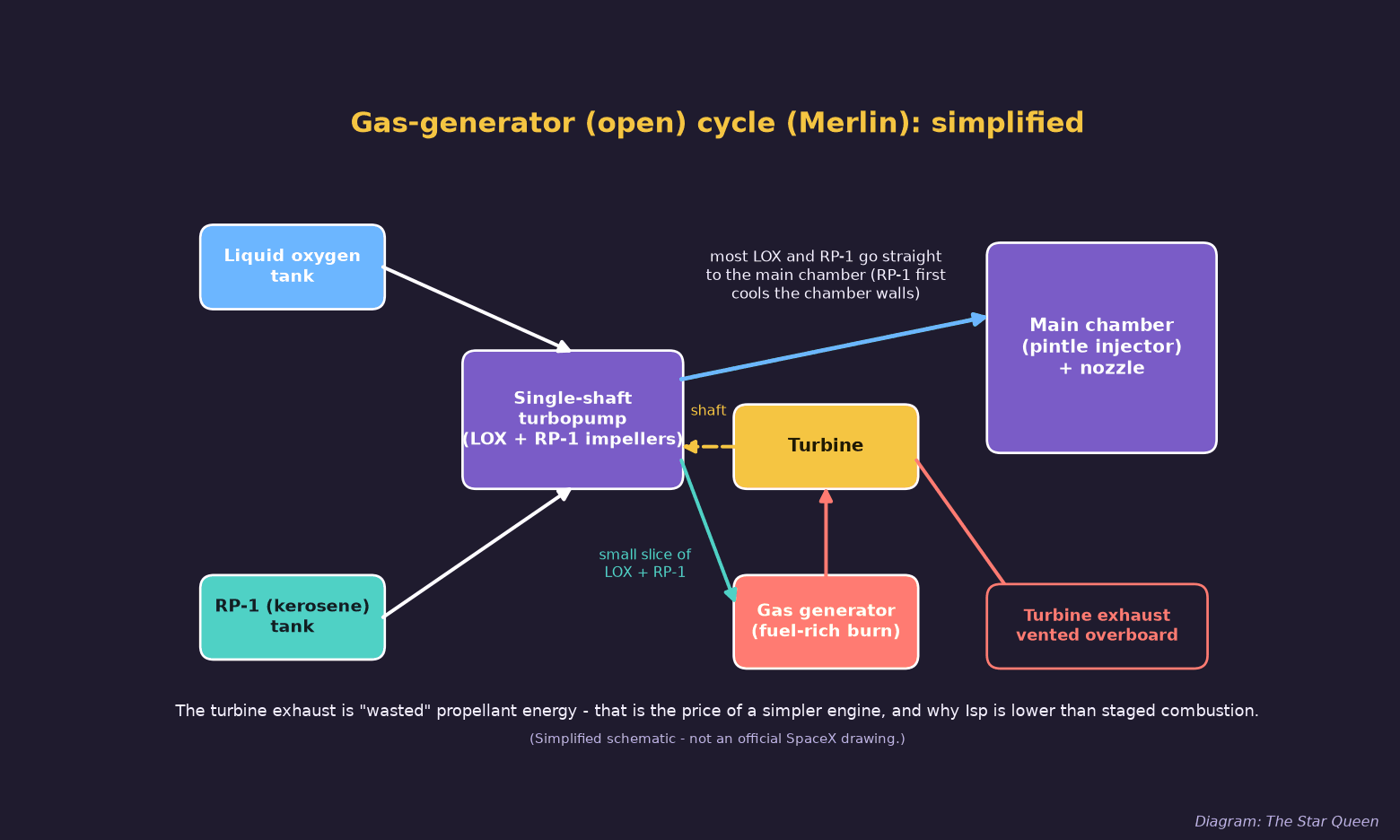
The mixture ratio is set mostly by the sizing of the supply tubes to each engine, with only a small share of flow trimmed by a servo-controlled butterfly valve. That’s a very “keep it simple” way to get repeatable performance.
The Pintle Injector
At the heart of Merlin is a pintle injector, the type first used on the Apollo Lunar Module’s descent engine. Tom Mueller, SpaceX’s propulsion chief, came from TRW, which built that engine. A pintle injector sprays propellants through a central post, which is stable and tends to resist combustion instability (nasty, potentially destructive pressure oscillations). It also helps when you need to throttle deeply, which is exactly what a landing booster does.
TEA-TEB Ignition
Merlin doesn’t use a spark. It uses TEA-TEB, which lights as soon as it meets oxygen. That gives a reliable start, and it comes with a limit: the ground and the vehicle carry a finite supply of the igniter for each engine. The Falcon Heavy debut showed it. During that February 6, 2018 flight, the center core ran out of ignition fluid before its landing burn and, as Space.com reported, didn’t light the three engines it wanted. The upper stage’s mission-extension kits carry extra TEA-TEB for the same reason: it’s a consumable.
Redundant Brains
Each Merlin has its own engine computer, built with three computers in each processing unit constantly checking one another, a fault-tolerant design described by Wikipedia from an Aviation Week report.
The Spec Sheet
| Spec | Merlin 1D (sea level) | Merlin Vacuum (MVac) |
|---|---|---|
| Where it flies | Falcon 9 first stage (9) and Falcon Heavy (27) | Second stage of Falcon 9 and Falcon Heavy (1) |
| Propellants and cycle | RP-1 and liquid oxygen, open-cycle gas generator | |
| Thrust | 845 kN / 190,000 lbf (SpaceX) | 981 kN / 220,500 lbf in vacuum (SpaceX) |
| Isp | 282 s sea level / 311 s vacuum (SpaceX figures from 2013; outdated) | about 348 s (Wikipedia, 2020; not an official SpaceX figure) |
| Chamber pressure | about 9.7 MPa / 1,410 psi (2011 design figure; not a current official number) | |
| Throttle | to about 40% (Wikipedia; early 1D was 70-100%) | to about 39% (SpaceX user guide, via Wikipedia) |
| Mass | 1,030 lb / about 467 kg, including steering actuators (Tom Mueller, 2015) | not given in my sources |
| Thrust-to-weight | about 184 (my arithmetic from 845 kN and the 2015 mass; the mass may not match today’s engine) | not computed |
| Size | about 0.92 m across | about 3.3 m across; niobium nozzle, expansion ratio about 165:1 |
| Full burn time | MVac: 397 s (SpaceX) | |
A few honest notes:
- Thrust conflict. SpaceX’s own materials say 845 kN (190,000 lbf) for the Merlin 1D, but the Falcon 9 Wikipedia article lists 854 kN (192,000 lbf). I’m using SpaceX’s number.
- Older Isp figures. The 282 s and 311 s numbers came from SpaceX’s website in 2013, and Wikipedia flags them as not reflecting the current engine. The Merlin 1D has been uprated since: 914 kN in vacuum was announced in 2016, and the 845 kN sea-level goal was reached in 2018 (an 8% increase, per Musk).
- Thrust-to-weight is my division, using the 2015 engine mass, so it’s a ballpark.
Merlin Vacuum and That Big Golden Nozzle
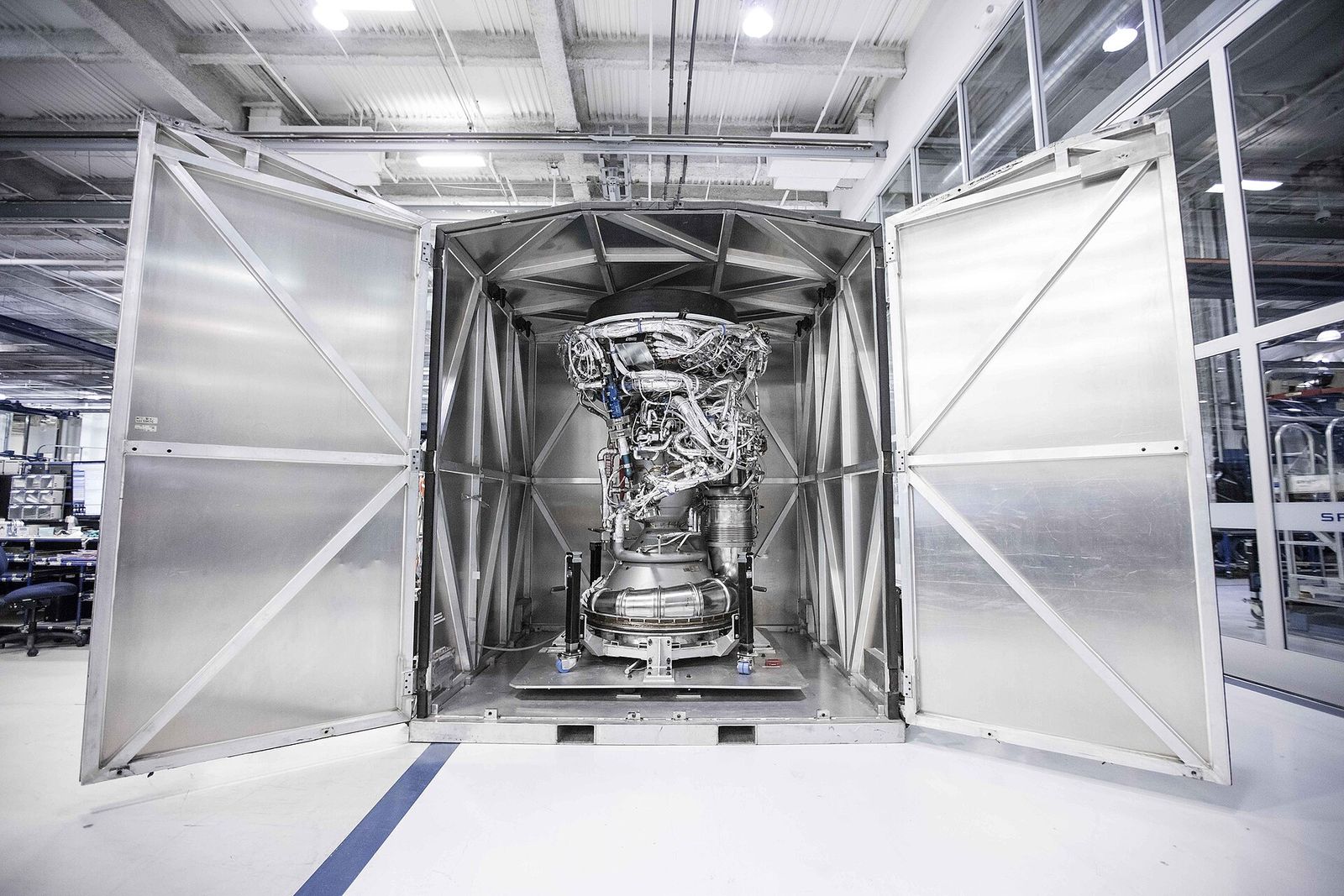
The second stage engine is a Merlin with a very large nozzle extension. The combustion chamber is regeneratively cooled, but the long niobium alloy nozzle is radiatively cooled: it’s thin and glows as it dumps heat. That’s very different from Raptor Vacuum’s regeneratively cooled nozzle.
Two fun nozzle stories:
- December 2010: two cracks were found in the roughly 9 ft (2.7 m) niobium nozzle just before the second Falcon 9 flight. SpaceX cut off the lower 4 ft (about 1.2 m) and launched two days later, because the mission didn’t need the extra performance. The stage reached an orbit around 11,000 km up.
- Transporter-7: SpaceX debuted a shorter MVac nozzle extension. It gives about 10% less thrust in space but uses 75% less niobium, so SpaceX can fly over three times as many missions with the same amount of rare metal. It’s used on lower-performance missions.
MVac can restart and throttle, which is what lets the upper stage deliver satellites to different orbits and even do deorbit burns. It isn’t invulnerable though: on July 11, 2024, an MVac failed explosively on a second relight attempt during a Starlink launch, though the stage still deployed its satellites.
A Short History of Merlin
- Merlin 1A (2006): ablatively cooled, 340 kN. It flew twice on Falcon 1. The first flight, on March 24, 2006, ended in failure after a fuel leak caused a fire.
- Merlin 1B: an uprated engine that never flew. It moved to TEA-TEB ignition from torch ignition.
- Merlin 1C: regeneratively cooled. It flew on Falcon 1’s fourth flight on September 28, 2008, the first privately developed liquid-fuel rocket to reach orbit, and on Falcon 9 starting in June 2010.
- Merlin 1D: developed in 2011-2012 with goals of better reliability, performance and manufacturability, and first flown in 2013. It’s the engine flying today.
- Merlin 2: a huge kerosene engine that was discussed but never built.
Throttling, Landing and Engine-Out
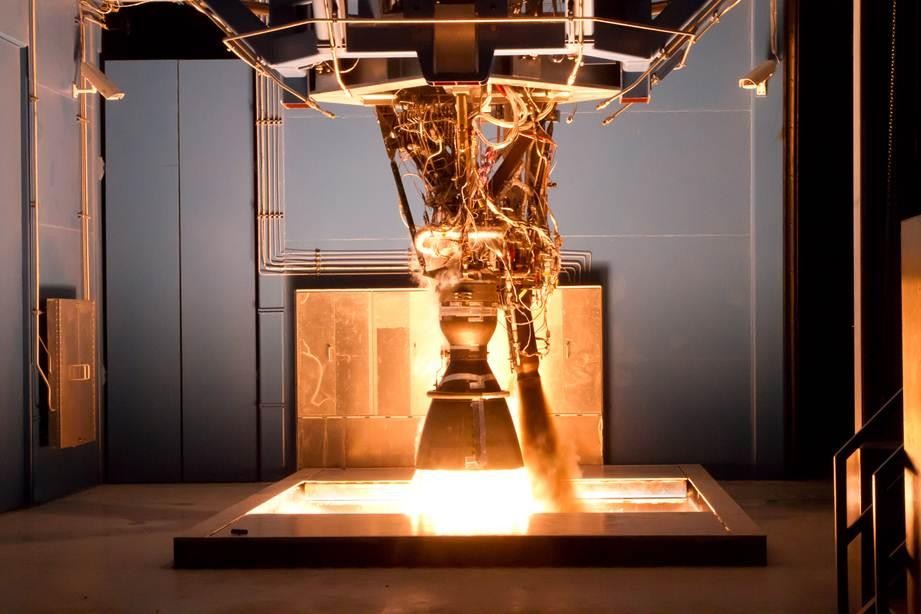
A Falcon 9 doesn’t land on nine engines. It lands on one (per Wikipedia’s Merlin article). Merlin 1D can throttle down to about 40% of full thrust, but a nearly empty booster is so light that even one engine at minimum throttle is still enough to push it up. That’s why the booster can’t hover; analyses from the spaceflight community (for example on Space Stack Exchange) put its thrust-to-weight above 1 even at minimum. So it performs a suicide burn, timed so the speed reaches nearly zero just as the legs touch down. I haven’t found an official SpaceX statement of the booster’s landing-mass figure, so treat that as well-supported analysis, not an official number.
Nine engines on ascent also gives engine-out capability. Real examples:
- October 2012, CRS-1: a Merlin 1C lost pressure about 80 seconds in and was shut down. The other engines burned longer and the Dragon capsule reached orbit, but the secondary payload was lost under NASA safety rules.
- March 18, 2020: a Starlink launch saw an engine shut down at 2 minutes 22 seconds. SpaceX found isopropyl alcohol cleaning fluid had been trapped and ignited. The payload reached orbit but the booster wasn’t recovered.
- October 2, 2020: a GPS III launch aborted at T-2 seconds when two engines started early. A blocked port in the gas generator was the cause, and SpaceX replaced the affected engines on other rockets too (reported by Ars Technica).
- February 16, 2021: an engine shut down early after hot exhaust passed through a damaged heat-shield cover. The mission succeeded but the booster was lost.
The pattern I like: a failure happens, the other engines cover, and SpaceX tracks down a tiny root cause (cleaning fluid, a blocked port, a cover).
Falcon Heavy: 27 Merlins Together
Falcon Heavy is three Falcon 9 cores strapped together. SpaceX says it has 27 Merlin engines in its first stage and generates over 5 million pounds of thrust, with a payload of 63,800 kg to low Earth orbit when expended. The center core throttles down after liftoff to preserve propellant while the side boosters burn, then throttles back up, which is the sort of thing a pintle-injected engine does happily.
Reuse Records
Merlin’s real superpower is that the rockets it flies come back.
- On August 25, 2026, Falcon 9 booster B1067 flew its 37th mission, a Starlink launch, and landed on the droneship (Space.com and Spaceflight Now reported it as a record).
- That was also SpaceX’s 100th Falcon 9 launch of 2026 (Space.com). The company flew Falcon rockets 165 times in 2025.
- Fan trackers show a couple of other boosters in the mid-30s. Counts differ slightly between sites, so check a tracker for today’s number.
- SpaceX doesn’t publish flight counts for individual engines. Wikipedia lists an engine with 22 flights as of February 2024, but that’s likely out of date, so I’m not counting on it.
The Block 5 booster was originally designed for 10 flights with minimal refurbishment, and SpaceX has said it could potentially go much longer. B1067 has now done almost four times the original goal.
Watch: Merlin in Action 🎥
Can’t see the video? Watch it on YouTube: Elon Musk Explains SpaceX’s Merlin Engine! (Everyday Astronaut)
And the Falcon Heavy test flight, because I’ll never get tired of those side boosters:
Can’t see the video? Watch it on YouTube: Falcon Heavy Test Flight (SpaceX)
The Star Queen’s Take
Merlin is proof that boring is a feature. Its design choices (a simple open cycle, a pintle injector, a one-shaft turbopump that also runs the hydraulics, tubes sized to set the mixture) all say: make it cheap, make it repeatable, make it tough. That’s why SpaceX could fly one basic design again and again.
Raptor will almost certainly beat it on efficiency. But the engine that flew a booster 37 times is the one that actually changed the economics of spaceflight, and the lessons it taught (about reuse, cadence and tracking down tiny failures) are the ones Raptor is now relying on. I’m giving Merlin a standing ovation. 👏
Also see: Raptor Explained: The Full-Flow Methane Engine Behind Starship, the closed-cycle successor that burns methane instead of kerosene. 🔥
Sources
- SpaceX, Falcon 9: https://www.spacex.com/vehicles/falcon-9/
- SpaceX, Falcon Heavy: https://www.spacex.com/vehicles/falcon-heavy/
- SpaceX, Falcon User’s Guide (April 2020, archived): https://web.archive.org/web/20201202093334/https://www.spacex.com/media/falcon_users_guide_042020.pdf
- Wikipedia, SpaceX Merlin: https://en.wikipedia.org/wiki/SpaceX_Merlin
- Wikipedia, Falcon 9: https://en.wikipedia.org/wiki/Falcon_9
- Wikipedia, Falcon 9 Block 5: https://en.wikipedia.org/wiki/Falcon_9_Block_5
- Wikipedia, Falcon Heavy: https://en.wikipedia.org/wiki/Falcon_Heavy
- Wikipedia, Pintle injector: https://en.wikipedia.org/wiki/Pintle_injector
- Wikipedia, Triethylaluminium: https://en.wikipedia.org/wiki/Triethylaluminium
- Space.com, Elon Musk explains Falcon Heavy core booster crash: https://www.space.com/39690-elon-musk-explains-falcon-heavy-core-booster-crash.html
- Space.com, SpaceX sets rocket-reuse record on 100th Falcon 9 launch of the year: https://www.space.com/space-exploration/launches-spacecraft/spacex-starship-record-37th-booster-flight-100-falcon-9-launches
- Spaceflight Now, Starlink mission on a Falcon booster’s record-breaking 37th flight: https://spaceflightnow.com/2026/08/24/live-coverage-spacex-to-launch-starlink-mission-on-a-falcon-boosters-record-breaking-37th-flight/
- Spaceflight Now, Falcon 9 overcomes engine failure to deploy Starlink satellites (March 2020): https://spaceflightnow.com/2020/03/18/falcon-9-rocket-overcomes-engine-failure-to-deploy-starlink-satellites/
- Ars Technica, how a tiny bit of lacquer grounded new Falcon 9 rockets (October 2020): https://arstechnica.com/science/2020/10/nasa-and-spacex-set-new-date-for-crew-launch-explain-merlin-engine-issue/
- SpaceX, CRS-1 mission update (archived): https://web.archive.org/web/20170412004145/http://www.spacex.com/press/2012/12/19/spacex-crs-1-mission-update
- Space Stack Exchange, can the Falcon booster hover during landing: https://space.stackexchange.com/questions/26781/can-spacex-falcon-1st-stage-hover-during-landing
- Images: Wikimedia Commons (credit and license in each caption). Diagram by The Star Queen.