By The Star Queen · Star Queen Chronicles
My loves, some launches are about the rocket and some are about the dust. 🌪️ On the morning of April 20, 2023, at 8:33 a.m. Central time (13:33 UTC, 9:33 a.m. Eastern), a 121-meter stack of stainless steel called Starship rose from Boca Chica, Texas for the first time, on the most thrust any rocket has ever produced. It cleared the pad. It also tore up the pad, lost engines along the way, tumbled, and was blown up on purpose four minutes later. Both things are true, and this post is about how SpaceX could look at that and say “we learned a lot.”
As of October 26, 2026, this is Flight 1 of 14 Starship integrated flights, and I’m starting here because everything later makes more sense once you know what went wrong first. I mark numbers as official, reported or my arithmetic, and I flag it when sources disagree.

The Short Version
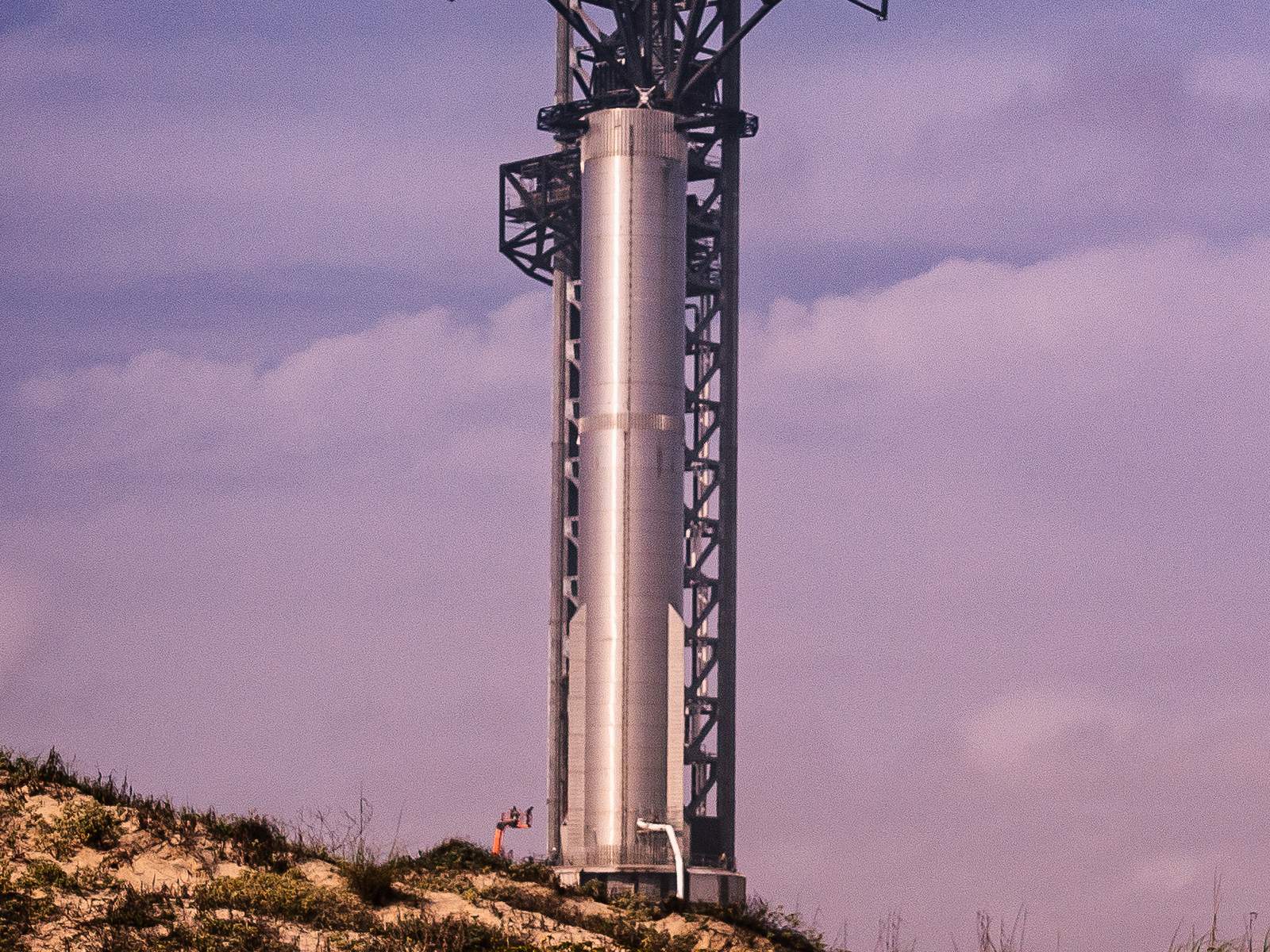
- What flew: Super Heavy Booster 7 with Ship 24 (the Starship upper stage), from Starbase’s Orbital Launch Pad 1 (OLP-1). Date: April 20, 2023 (official).
- What was supposed to happen: the booster would separate and splash down in the Gulf of Mexico, and the ship would go most of the way around the world before splashing down in the Pacific about 100 km (62 miles) northwest of Kauai, Hawaii, roughly 90 minutes after launch (planned, per the flight plan reported by Wikipedia and SpaceX).
- What happened: the vehicle lifted off with 3 of 33 booster engines not running, lost more engines during the climb, lost control of its steering around T+85 seconds, never separated, and broke up about 237.5 seconds after engine ignition (about 3 minutes 57 seconds, per SpaceX) after the flight termination system fired, at roughly 29 km altitude (reported).
- The twist: the rocket’s launch did clear the pad and the beach, and the apogee reached about 39 km (official), the highest of any Starship up to then. But the launch mount was wrecked, and the flight termination system was slow.
- The aftermath: an FAA-overseen SpaceX mishap investigation ended with 63 corrective actions and a redesigned pad.
Terms to know ✨
- Starship / Super Heavy: Starship is the upper stage (“the ship”). Super Heavy is the first-stage booster with 33 Raptor engines. Together they’re the “stack.” For the engine, see my Raptor deep dive.
- Raptor: SpaceX’s methane-and-oxygen engine. Methane is the fuel; read why methane.
- Max q: the moment of peak aerodynamic pressure on a rising rocket. Engines throttle down to ease the stress.
- TVC (thrust vector control): steering by tilting (gimbaling) the engines. On Flight 1, Super Heavy’s Raptors were tilted by hydraulic actuators that shared a common fluid system.
- MECO and staging: main engine cut-off, then the booster and ship separate.
- FTS / AFSS (flight termination system): explosives that deliberately break the vehicle apart if it veers off course. Starship’s is autonomous (SpaceX’s Autonomous Flight Safety System, or AFSS, decides on its own), which is meant to be fast.
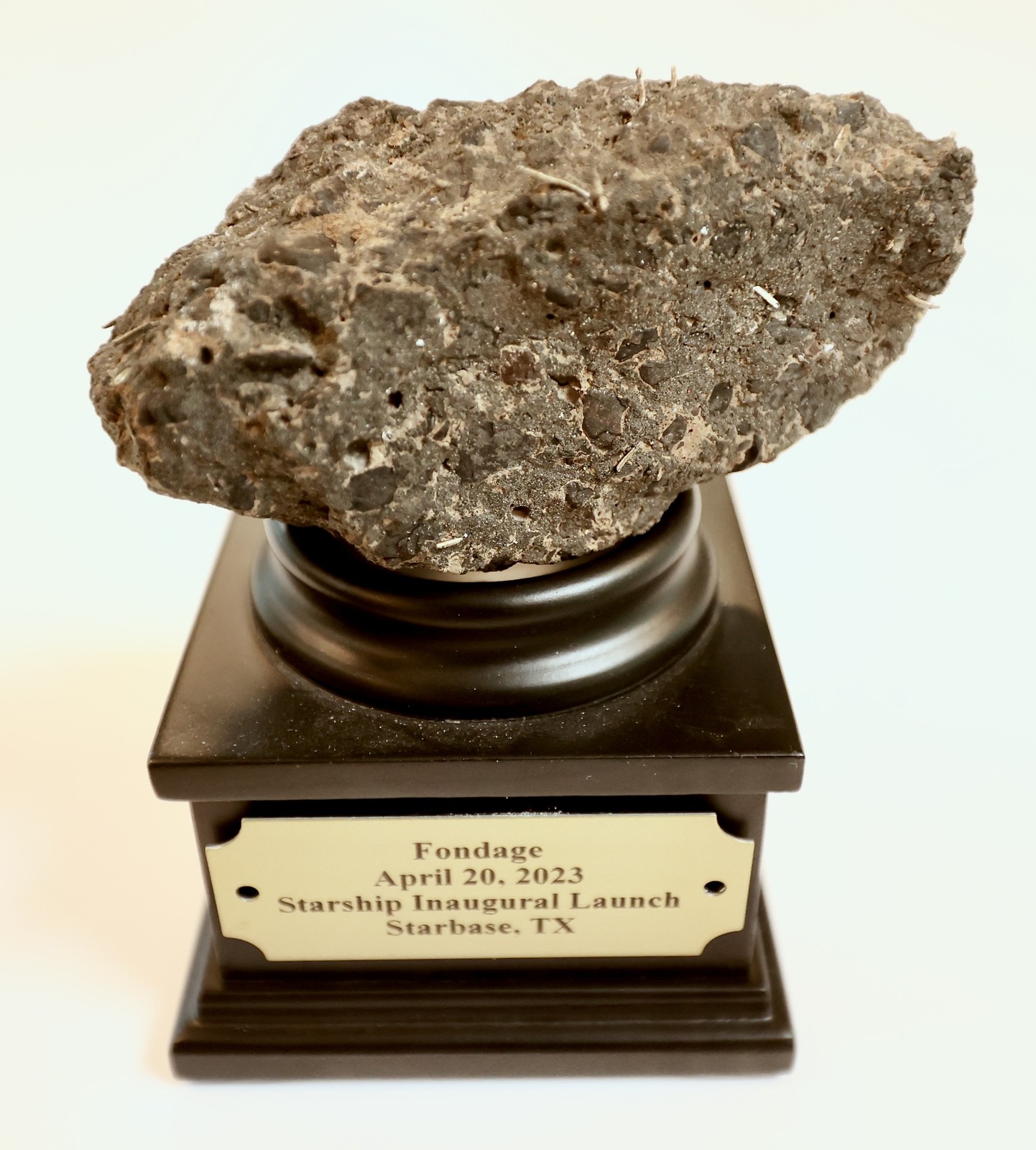
- Fondag (also spelled “Fondu” or “fondage”): the heavy-duty steel-reinforced concrete under the launch mount. SpaceX’s Musk said it was one of the toughest concretes in the world.
- Water deluge: a flood of water sprayed under the engines to absorb exhaust energy and sound. Flight 1 had none.
- Mishap investigation: the FAA’s process after an unplanned event. SpaceX leads it, the FAA oversees it, and a launch license can’t be granted until the results are accepted.
Flight at a glance
| Item | Detail |
|---|---|
| Date and time | April 20, 2023, 13:33 UTC (8:33 a.m. CDT local; 9:33 a.m. EDT) |
| Launch site | Starbase, Boca Chica, Texas (Orbital Launch Pad 1) |
| Vehicles | Super Heavy Booster 7 (33 Raptors) and Ship 24 (6 Raptors), Block 1 |
| Planned trajectory | Booster splashes down in the Gulf about 32 km (20 mi) off the Texas coast. Ship flies a near-orbital path and splashes down in the Pacific northwest of Kauai, about 90 minutes in. |
| Mission goals (SpaceX framing) | Clear the pad and gather data. SpaceX said success was measured by how much it could learn. |
| Result | Lifted off with 30 of 33 engines. Peak altitude about 39 km. Lost thrust vector control at T+85 s. Never staged. Flight terminated; vehicle broke up about 237.5 seconds after engine ignition (about 3 minutes 57 seconds, per SpaceX). |
| Classification | A “failure” in Wikipedia’s tally. SpaceX called it a test with major lessons. |
| Regulatory outcome | FAA mishap investigation closed Sept 8, 2023 with 63 corrective actions. |
The Road to Launch
The first attempt was set for April 17, 2023 and was scrubbed after a pressurization valve on Booster 7 froze (reported). SpaceX needed at least 48 hours for a retry. The FAA had issued the vehicle operator license on April 14, 2023, so the next try was cleared once the valve was sorted. Elon Musk had said ahead of time that he’d put the odds of success at roughly 50%, and that a main goal was to not blow up the launch pad (as reported at the time). The first half of that prediction is a matter of opinion. The second half did not go to plan, as you’ll see.
Play-by-Play
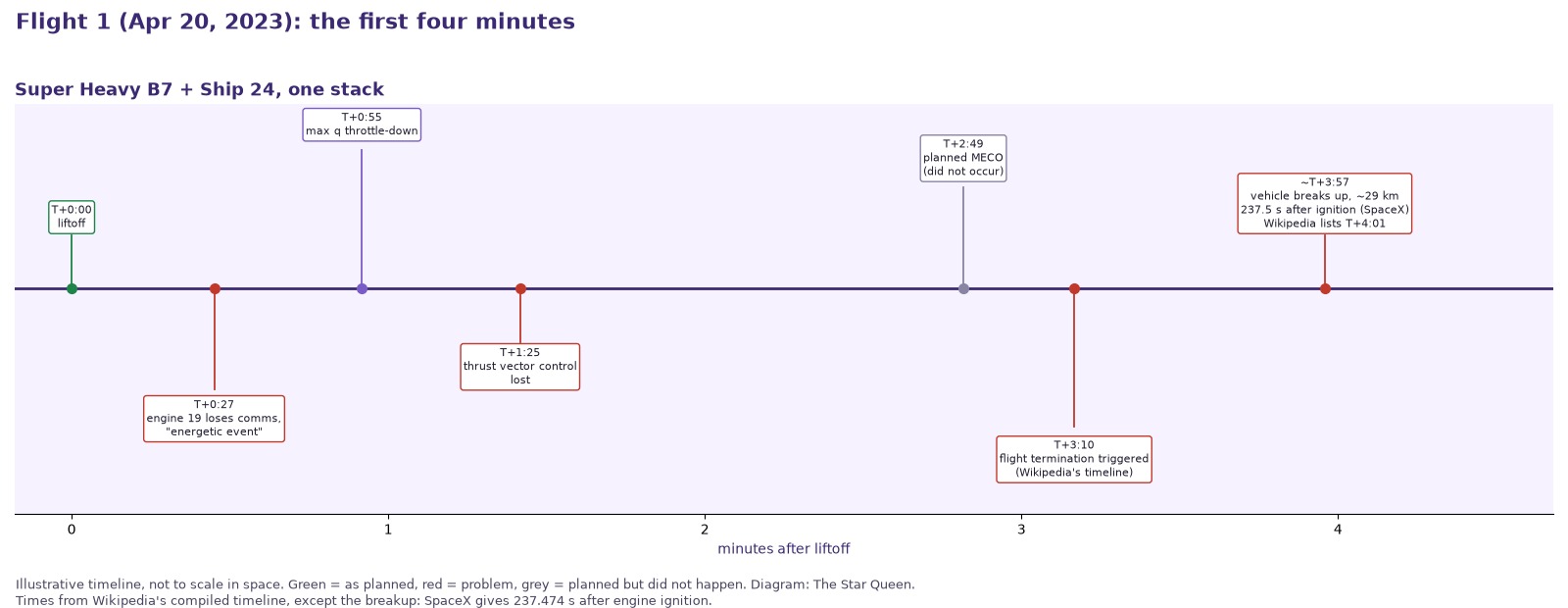
All times are “T+” from liftoff and come from SpaceX’s published timeline, as compiled by Wikipedia, plus SpaceX’s and Musk’s later statements. I have only included events with a source.
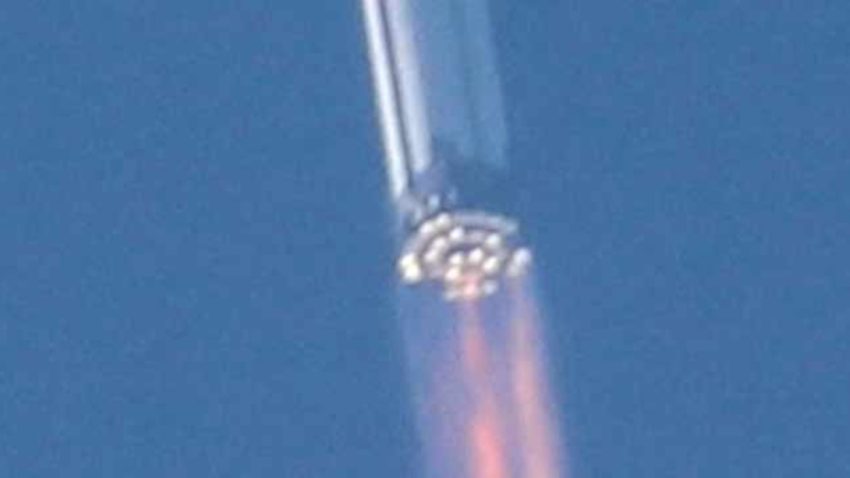
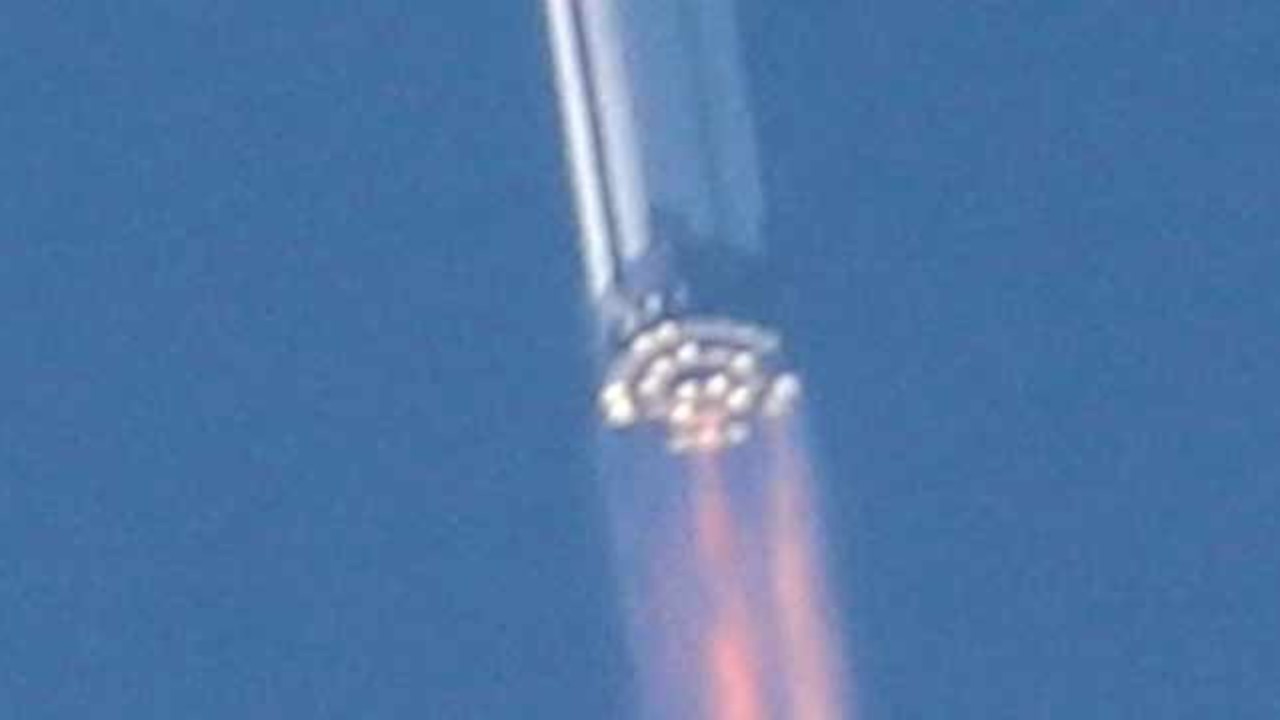
- T-0 to T+0:05, ignition and liftoff. Three engines did not start, or aborted at ignition, because flight software judged them not healthy enough. That left 30 of 33 (SpaceX/Musk, reported by Ars Technica), which Musk described as the minimum allowable to fly. The rocket rose slowly while the engines blasted the concrete beneath it.
- T+0:27, engine 19 loses comms. Musk later said an “energetic event” took out engine 19’s communications and knocked the outer heat shields off engines 17 to 20. A small explosion was visible around T+0:30. Some analysts suggested it was a hydraulic power unit, but that is not confirmed by SpaceX.
- T+0:55, max q. The booster throttled down for peak aerodynamic pressure.
- T+1:02, more damage. Musk said more aft heat-shield damage showed up near engine 30, but the engine kept running.
- T+1:25 (85 seconds), steering lost. Musk: “T-plus 85 seconds is where things really hit the fan.” The vehicle lost thrust vector control of the 13 central engines.
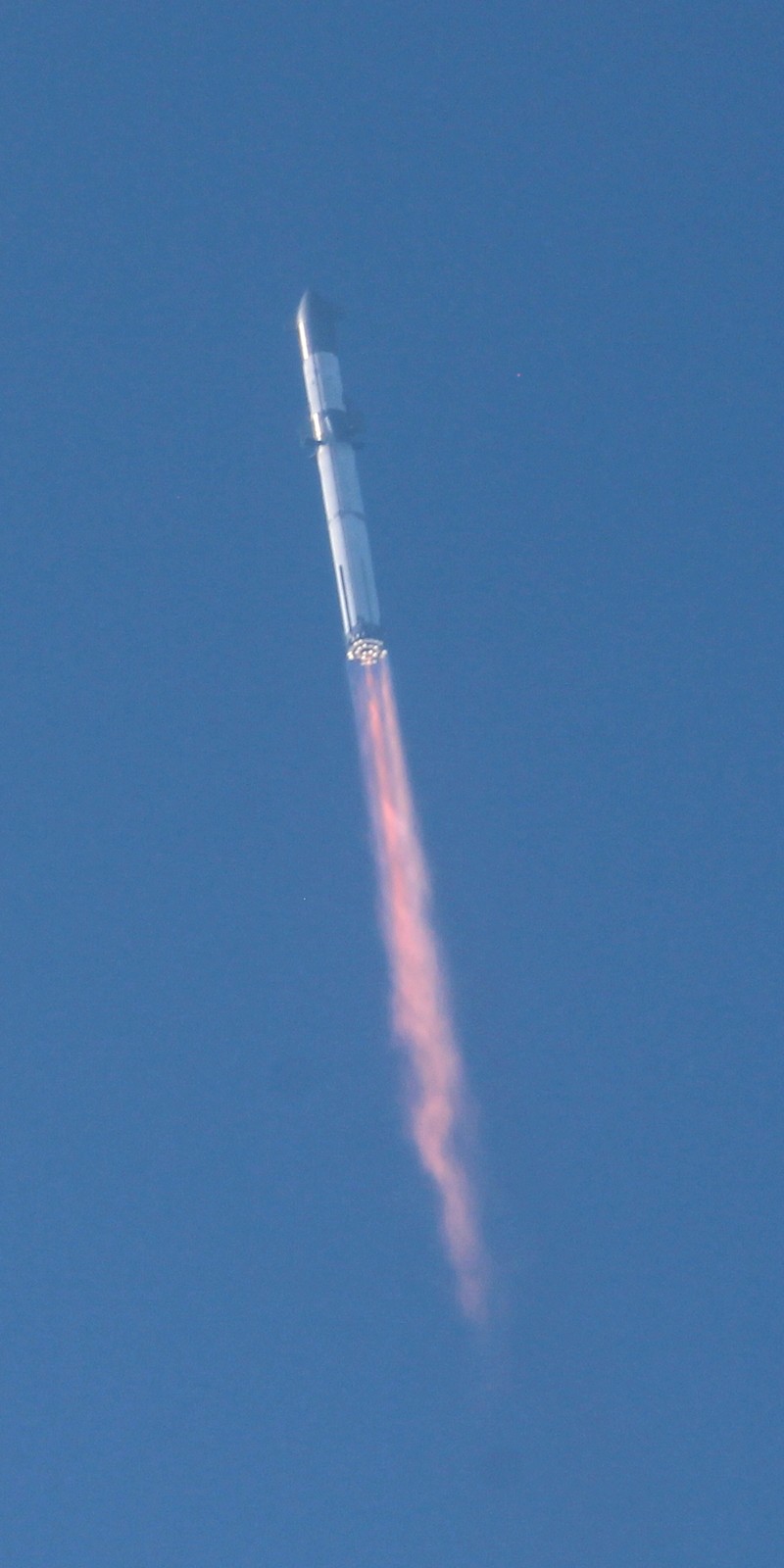
- T+2:49 and T+2:52, planned MECO and stage separation. They did not happen. The vehicle was tumbling and looping, peaking at about 39 km (24 mi), then losing altitude.
- About T+3:10, flight termination triggered (Wikipedia’s timeline). The autonomous system fired. Wikipedia’s timeline says it took roughly 40 seconds for the vehicle to actually break apart; SpaceX itself only calls it “an unexpected delay following AFSS activation,” and both SpaceX and the FAA flagged the delay as a problem. (Note: the Ars article from May 2023 phrases the timing loosely; I’m using the timeline published on Wikipedia, which cites the SpaceX webcast and other reporting. See my notes at the end.)
- About 237.5 seconds after engine ignition (about 3 minutes 57 seconds), vehicle breaks up (SpaceX’s figure; Wikipedia’s timeline lists this as T+4:01) at around 29 km altitude (18 mi), over the Gulf of Mexico.


What Went Right
- It lifted off, cleared the pad and the beach, and climbed. That alone is hard for a vehicle with 33 engines. SpaceX’s own flight page says the vehicle cleared the pad and beach and reached an apogee of about 39 km.
- It flew through max q. Max q is the structural exam of a launch. Passing it with a fully stacked vehicle gave SpaceX real flight data on a Starship-scale airframe.
- It kept flying through damage. The stack lost several engines and had visible fires in the aft end, yet it still climbed. Musk cited this as evidence that engine redundancy works, and that isolation between engines is the key.
- The flight termination system worked. Slowly, yes, but it did destroy the vehicle offshore, and the FAA reported no injuries or public property damage.
- Records: it briefly took the title of most powerful rocket stage ever flown from the Soviet N1 (reported).
What Went Wrong (and Why It Happened)
1. The pad ate itself
Starship’s launch mount sits on a concrete foundation. On Flight 1, there was no flame diverter and no water deluge under the engines. The exhaust excavated a crater underneath the mount, and chunks of concrete and sand were thrown across the area: debris scattered across roughly 385 acres (156 hectares), dust drifted as far as Port Isabel, about 6.5 miles (10.5 km) away, and a 3.5-acre fire started in the state park (reported). Later lab testing by university labs found the dust was ordinary beach sand, not a health hazard (reported).
Musk’s explanation after the flight: SpaceX had started a water-cooled steel plate about three months earlier but it was not ready, and the team had judged from static-fire data that the concrete would hold (reported). It did not hold. Musk also said, “weirdly, we did not see evidence of the rock tornado actually damaging engines,” although the FAA later pointed to the pad foundation failing at liftoff as one of the problems to fix.

2. Engines out, then fires, then no steering
The root cause that SpaceX published in September 2023 was this: fires from leaking propellant in the aft end of Super Heavy eventually severed the connection to the primary flight computer, so the vehicle lost control of most engines (SpaceX blog, Sept 8, 2023, as summarized by Wikipedia and trade press). Without the flight computer’s commands, the engines couldn’t gimbal or throttle as needed.
SpaceX’s own write-up calls the move to electric steering a performance upgrade “unrelated to any issues observed during the first flight test,” so I’m treating what Musk says next as his view of why electric is better, not as SpaceX’s finding about what went wrong. Musk explained that Booster 7’s engines were tilted by hydraulic actuators on a common manifold, so a problem in one place can spread. His fix for the next booster: electric actuators, which are far more isolated. “If you have extremely good engine isolation and an engine fails, it does not cause a failure of neighboring engines,” he said. (Quotes from Ars Technica’s summary of his talk.)
3. The flight termination system was too slow
Wikipedia’s timeline has the autonomous system firing at about T+3:10 and taking around 40 seconds to destroy the stack (SpaceX only says there was “an unexpected delay following AFSS activation”). Musk said the fix might be a longer detonation cord to “unzip” the tanks faster, and that requalifying the FTS with the FAA would be the longest lead item before another flight.
The Paperwork: FAA, Lawsuits and the Long Wait
The FAA grounded Starship pending a mishap investigation led by SpaceX. In August 2023 SpaceX submitted its report and the FAA closed the investigation on September 8, 2023, listing 63 corrective actions: hardware redesigns to prevent leaks and fires, a redesign of the launch pad, extra design reviews, additional analysis and testing of safety-critical systems (including the flight termination system), and tighter change control (FAA and trade press). In May 2025, a heavily redacted version of the FAA’s investigation report was released to Bloomberg.
Separately, environmental groups (the Center for Biological Diversity, Surfrider, the American Bird Conservancy, Save RGV and the Carrizo/Comecrudo Nation) sued the FAA on May 1, 2023 over the environmental review of the launch site. Per Wikipedia, that suit was dismissed in September 2025 by Judge Carl Nichols. I flagged that as a single-source claim in my notes.
What Changed Next
This is the “what was fixed” list that led straight to Flight 2:
- A reinforced pad and a water-cooled flame deflector. SpaceX says it significantly reinforced the pad foundation and added a flame deflector (which I take to be the water-cooled steel plate). Install of the water-cooled steel plate ran from about July 5 to 17, 2023, with the first full-pressure test around July 28.
- Electric TVC on Super Heavy instead of hydraulic, for better engine isolation.
- Hot staging. SpaceX built a hot-staging ring for the ship, and the booster was redesigned to stage with it. This is the new trick Flight 2 would debut (see the Flight 2 post).
- Re-qualified flight termination. The FAA required SpaceX to analyze and test the system.
- More fire protection in the booster’s aft end.
The Star Queen’s Take
Here’s my honest read, my loves. If you judge Flight 1 by “did the mission work,” it didn’t. The ship never separated, and the vehicle was lost. If you judge it by “did we learn what to fix,” it was a goldmine, and the 63 FAA corrective actions are proof of how much there was to fix. 🛠️
What I find most interesting is the pad. Everyone talks about the rocket, but the loudest lesson of Flight 1 was about the ground. A launch pad is part of the rocket. The concrete wasn’t just damaged; it became ammunition. The “mega steel pancake” with a water deluge that came next is one of the least glamorous and most important upgrades in the whole program.
And then there’s the termination delay (about 40 seconds on Wikipedia’s timeline; SpaceX itself just says “an unexpected delay”). A flight termination system that takes that long to work is a system that is not really doing its job. That is the kind of thing that only shows up in real flight, which is why SpaceX flies early and often.
It’s also fair to point out the opposite view: critics said launching a vehicle that couldn’t survive its own pad was irresponsible and that the environmental impact was underestimated. Both sides have a point, and the regulators required real changes. I’m keeping my tone cautious on the environmental claims because the lawsuit is a single-source item in my notes.
Watch
Official recap from SpaceX, then Scott Manley’s breakdown of what happened to the pad and the rocket.
If the video doesn’t load, watch it on YouTube: SpaceX: Starship’s First Flight Test
If the video doesn’t load, watch it on YouTube: Scott Manley: SpaceX’s Massive Rocket Explodes Due to Rapid Unscheduled Digging
Keep Reading
- Next: Starship Flight 2 explained, the first hot-staging attempt.
- The engines: Raptor, the full-flow methane engine and why SpaceX chose liquid methane.
- A comparison: Merlin, the Falcon 9 workhorse, the engine family that taught SpaceX to land boosters.
Sources
- SpaceX, Starship’s First Flight Test (flight page): https://www.spacex.com/launches/starship-flight-test
- Wikipedia, Starship flight test 1 (timeline, engine out details, FAA and lawsuit details): https://en.wikipedia.org/wiki/SpaceX_Starship_integrated_flight_test_1
- Ars Technica, Eric Berger, “Elon Musk provides detailed review of Starship’s first launch and what’s next” (May 1, 2023): https://arstechnica.com/space/2023/05/elon-musk-provides-detailed-review-of-starships-first-launch-and-whats-next/
- FAA, “FAA Closes SpaceX Starship Mishap Investigation” (Sept 8, 2023): https://www.faa.gov/newsroom/faa-closes-spacex-starship-mishap-investigation
- Via Satellite, “FAA’s mishap investigation into Starship launch ends with 63 action items” (Sept 8, 2023): https://www.satellitetoday.com/launch/2023/09/08/faas-mishap-investigation-into-starship-launch-ends-with-63-action-items/
- NASASpaceflight, Chris Bergin, “Elon Musk pushes for orbital goal following data gathering objectives during Starship debut” (May 3, 2023): https://www.nasaspaceflight.com/2023/05/musk-orbital-goal-starship-debut/
- Related posts on this site: Raptor, liquid methane, Merlin
- Images: Wikimedia Commons (credit and license in each caption). Diagrams by The Star Queen.