By The Star Queen · Star Queen Chronicles
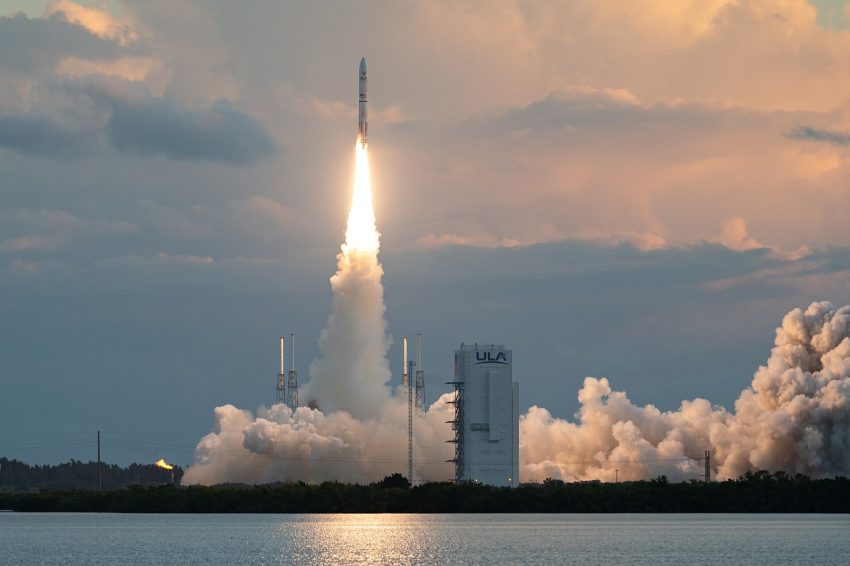
A ULA Vulcan lifts off from Cape Canaveral on October 4, 2024, its first stage powered by two methane-burning BE-4 engines. Image: U.S. Space Force (public domain, via Wikimedia Commons)
My loves, look at the biggest new rockets of this decade and you will notice a pattern. 🔍 Starship: methane. New Glenn: methane. Vulcan’s first stage: methane. Terran R, Nova’s booster, China’s Zhuque rockets: methane. Twenty years ago almost nobody flew it. So what changed? Methane is the “goldilocks” fuel: not as efficient as hydrogen, not as dense as kerosene, but good enough at both that it wins on the things that matter now, which are reuse and cost.
Everything here is as of October 26, 2026. I label numbers as official, reported, unofficial, or my arithmetic, and I flag conflicts. This is part two of my rocket-fuels series; part one is RP-1 kerosene.
The Short Version
- Methalox is liquid methane (CH₄) burned with liquid oxygen. Methane boils at −161.6 °C and has a density of about 0.423 g/mL (Braeunig).
- In theory it beats kerosene by roughly 10 s of vacuum Isp (369 s versus 358 s) and gives up roughly 17 to 20% of the density impulse (JANNAF and Braeunig figures below).
- It burns clean: little soot, no tarry coking, so it is easier on reusable engines.
- It can, in principle, be made on Mars from local carbon dioxide and water using the Sabatier reaction.
- Not every methane engine is high-tech. Relativity’s Aeon 1 and Aeon R are simple gas-generator engines; Raptor and Zenith are full-flow staged combustion.
Terms to know ✨
- Methalox: methane plus liquid oxygen as propellants. Also written LCH₄/LOX.
- LNG: liquefied natural gas, which is mostly methane. Stoke and Relativity both describe their fuel as LNG.
- Cryogenic: stored at extremely low temperatures. Here that means colder than about −150 °C.
- Sabatier reaction: CO₂ + 4 H₂ → CH₄ + 2 H₂O, run hot over a nickel catalyst.
- ISRU: in-situ resource utilization, meaning making propellant (or air, or water) from local materials.
- Isp (specific impulse): seconds of thrust per unit of propellant weight flow. Higher is more efficient.
- Density impulse: Isp multiplied by bulk density. It rates how much push fits in a tank.
- Subcooling: chilling a liquid below its normal boiling point so it is denser and resists bubbling.
- Coking: fuel baking into carbon or tar on hot metal.
- Full-flow staged combustion: a cycle that sends all the fuel and all the oxidizer through turbines before the main chamber.
- Autogenous pressurization: using a bit of the propellant itself, boiled into gas, to pressurize its own tank.
What Is Methane, Chemically?
Methane is the simplest hydrocarbon: one carbon atom and four hydrogens. Complete combustion looks like this:
CH₄ + 2 O₂ → CO₂ + 2 H₂O
By mass that needs 4.0 kg of oxygen per kg of methane (my arithmetic, from 64 g O₂ per 16 g CH₄). Engines run fuel-rich of that, as with all rockets. The JANNAF-style optimum is 3.21 at sea level and 3.45 in vacuum (Wikipedia). Running rich leaves lighter exhaust molecules, which fly out faster. Methane’s high hydrogen-to-carbon ratio helps here: the exhaust is lighter than kerosene’s, which is the root of its Isp edge (my reading of the chemistry). Its heat of combustion is about 55.5 MJ/kg (Braeunig).
Where Does Rocket Methane Come From?
Today, mostly from natural gas, which is largely methane (Wikipedia). It is purified and liquefied, which is why Stoke and Relativity say “LNG.” Real rocket-grade methane has tighter purity limits than pipeline gas, but I could not find any official specification to quote, so I won’t invent one. Cost is a mess, so here is the honest range:
| Source | Methane | LOX |
|---|---|---|
| Marspedia, “Cost of transportation” (2016) | about $0.20/kg | about $0.16/kg |
| Spaceinsider (US defense moving-average prices) | about $8.8/kg | about $0.27/kg |
For a 100-tonne load at the vacuum mixture ratio (22.5 t methane and 77.5 t LOX, my arithmetic), that gives something like $17,000 to $219,000. The spread is wide because the sources define “price” differently, and launch companies don’t publish what they pay. Either way, propellant is tiny next to the cost of building and flying the rocket.
The Key Numbers
| Property | Methane + LOX | Source and label |
|---|---|---|
| Methane density (boiling point) | 0.423 g/mL | Braeunig |
| Boiling / melting point | −161.6 °C / −182.5 °C | Braeunig |
| LOX boiling point | −183.0 °C | Braeunig |
| Bulk density (fuel and LOX together) | 0.83 g/mL | JANNAF, via Wikipedia |
| Best theoretical mixture ratio (O/F) | 3.21 sea level; 3.45 vacuum | JANNAF, via Wikipedia |
| Theoretical Isp (68 atm chamber) | about 309 s sea level; about 369 s vacuum | JANNAF, via Wikipedia |
| Chamber flame temperature | about 3,260 to 3,290 °C | JANNAF, via Wikipedia |
| Density impulse | 235 kg·s/L (sea level); about 306 (vacuum) | Braeunig; vacuum value is my arithmetic (369 × 0.83) |
| Flammability in air | 5.4 to 17% | Braeunig |
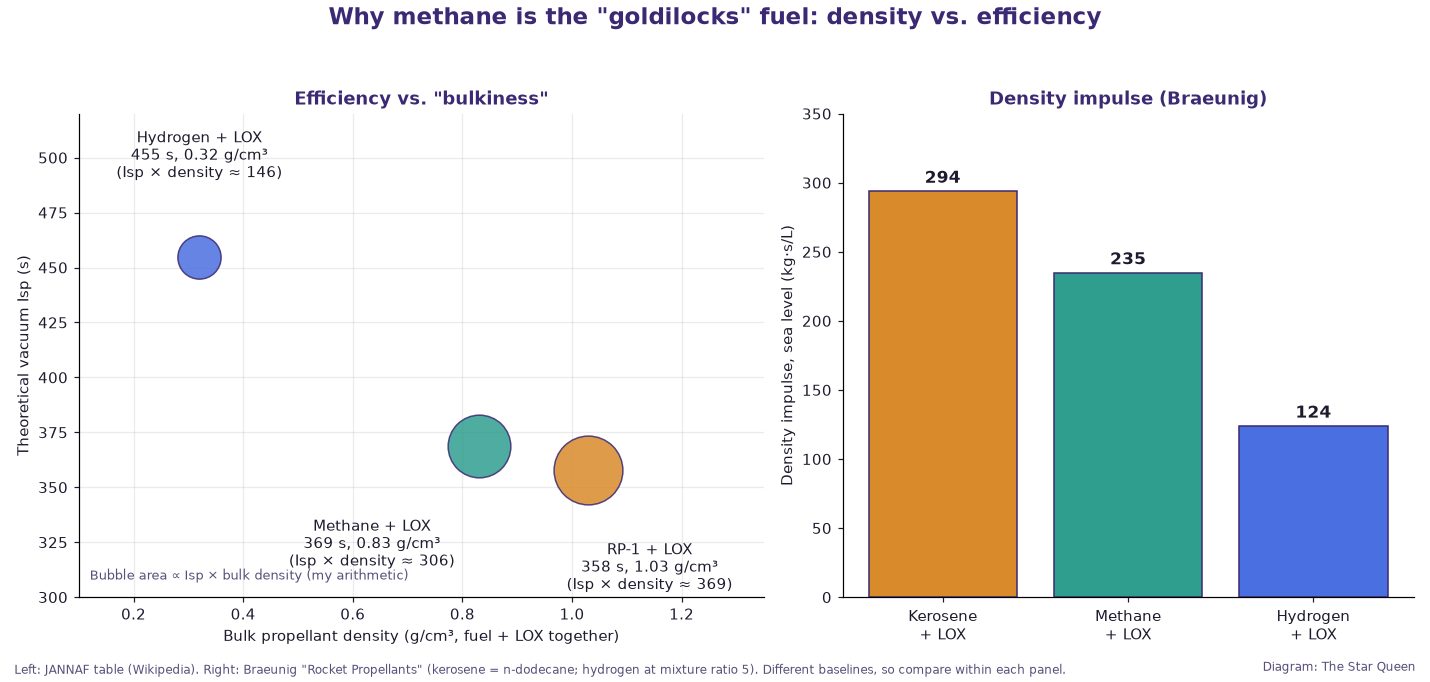
Reading the chart
Hydrogen has the best Isp but the worst density. Kerosene is the reverse. Methane’s density impulse (235) is about 20% lower than kerosene’s (294) but almost double hydrogen’s (124). For a first stage, which fights gravity and wants compact tanks, that is a decent compromise. For a stage that needs only Isp, hydrogen still wins; I cover that in my hydrogen post.
Why the Industry Switched
1. Cleaner burning, easier reuse. Coking is kerosene’s curse. Wikipedia notes that methane, with a single carbon atom, is “technically not a chain at all”; breakdown products are gases, and residues simply evaporate. NASA’s heated-tube tests found natural gas had the lowest deposition rate, and propane the highest (NTRS 19840004157). For an engine you want to fly over and over, less cleaning and teardown is the whole game.
2. Better Isp than kerosene. A modest edge on paper: 369 s versus 358 s in vacuum, an 11 s gap (JANNAF, via Wikipedia).
3. Handling is similar to LOX. Methane is cryogenic, but its temperature is close to oxygen’s. Wikipedia sums it up: a methalox rocket is nearly as easy to handle as a kerolox rocket, with better efficiency and cleanliness, though hydrogen remains better for efficiency. Since the two propellants sit at similar temperatures, tanks can share walls and insulation ideas (my reading; check each vehicle’s own design).
4. Self-pressurizing. Like other cryogenics, methane can boil off a bit of itself to pressurize its own tank, so no separate helium system is needed (Wikipedia). Relativity’s Aeon 1 does exactly this (“autogenous pressurization,” per Relativity’s 2020 spec page).
5. One fuel for the whole stack. Wikipedia observes that methane’s balance makes it well-suited to a single-fuel rocket, and single-fuel rockets have proven more economical than dual-fuel ones because there is less complexity.
6. Mars. This is the romantic one. Keep reading.
Methane on Mars: The Sabatier Reaction
Mars’s atmosphere is about 95.5% carbon dioxide, and some soils hold water (NASA says the top meter in some regions may be 8 to 10% water by mass, from Mars Odyssey data; DRA 5.0). The Sabatier reaction combines CO₂ with hydrogen:
CO₂ + 4 H₂ → CH₄ + 2 H₂O at about 300 to 400 °C and roughly 3 MPa, over a nickel catalyst (Wikipedia).
Here is the clever bit and the catch. Electrolyze the water and you get oxygen for the engine and hydrogen to recycle. But electrolysis returns only half the hydrogen the reactor needs, so you must bring (or mine) extra. NASA’s Design Reference Architecture 5.0 says this directly: with Sabatier, only half of the hydrogen needed is recovered from the water electrolysis.
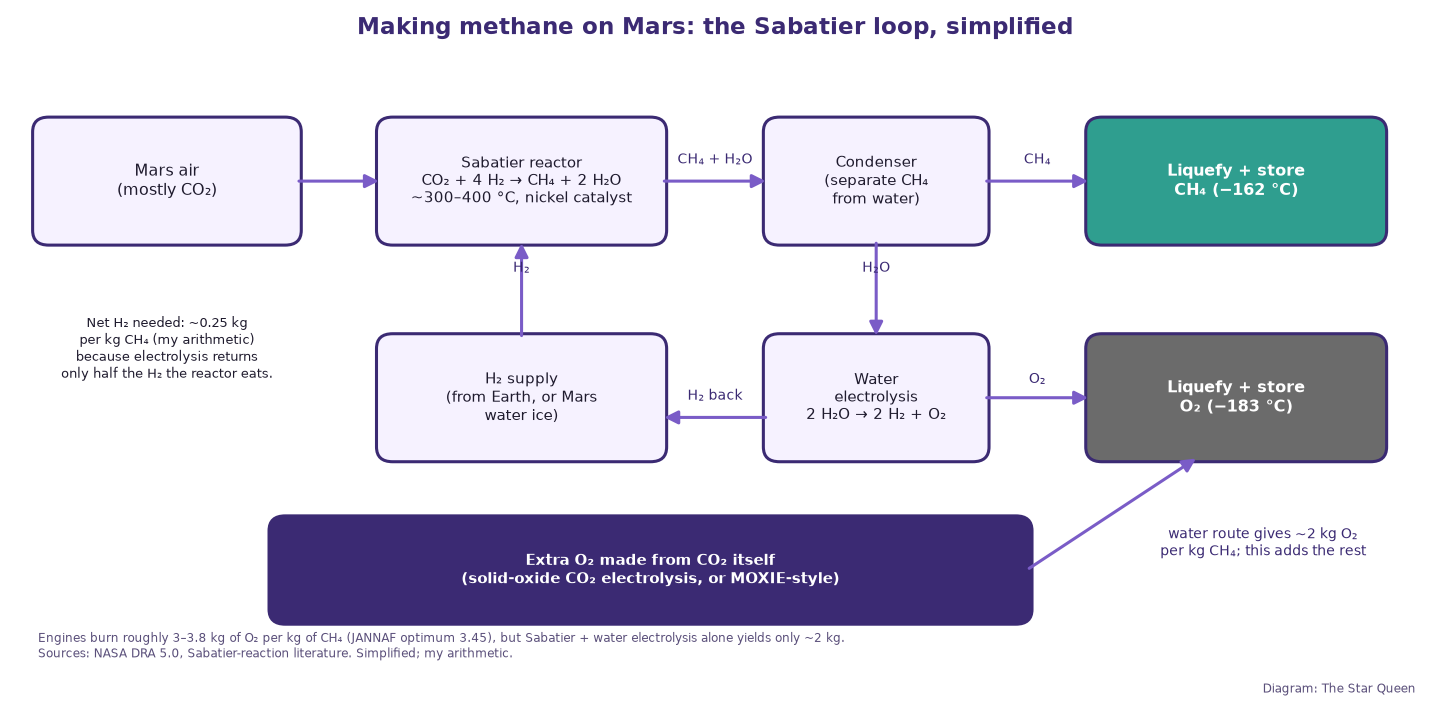
The oxygen math (my arithmetic)
- Per 16 g of methane made, the reactor produces 36 g of water (2 H₂O).
- Electrolyzing that water gives 32 g of oxygen and 4 g of hydrogen.
- So the water route yields about 2 kg of O₂ per kg of CH₄.
- But engines burn about 3.2 to 3.5 kg of O₂ per kg of CH₄ (the optimum mixture ratios above).
The gap has to come from splitting CO₂ directly. NASA’s MOXIE experiment on Perseverance showed that is possible on Mars: it made 122 grams of oxygen over 16 runs, with a peak of about 12 g per hour at 98%+ purity (NASA). A 2021 Nature Communications paper on Martian propellant says the same thing about Sabatier: it does not give enough oxygen by itself. Earlier lab work agrees with my numbers: a 1996 brassboard unit made 0.25 kg of methane and 0.5 kg of oxygen per day, the same 1:2 ratio (ASCE).
One caution: Wikipedia’s Sabatier page includes an optimistic mass-gain claim that does not match this stoichiometry, so I am using my own arithmetic and the NASA/Nature statements instead.
The Engines
Methane engines span the whole range of cycles:
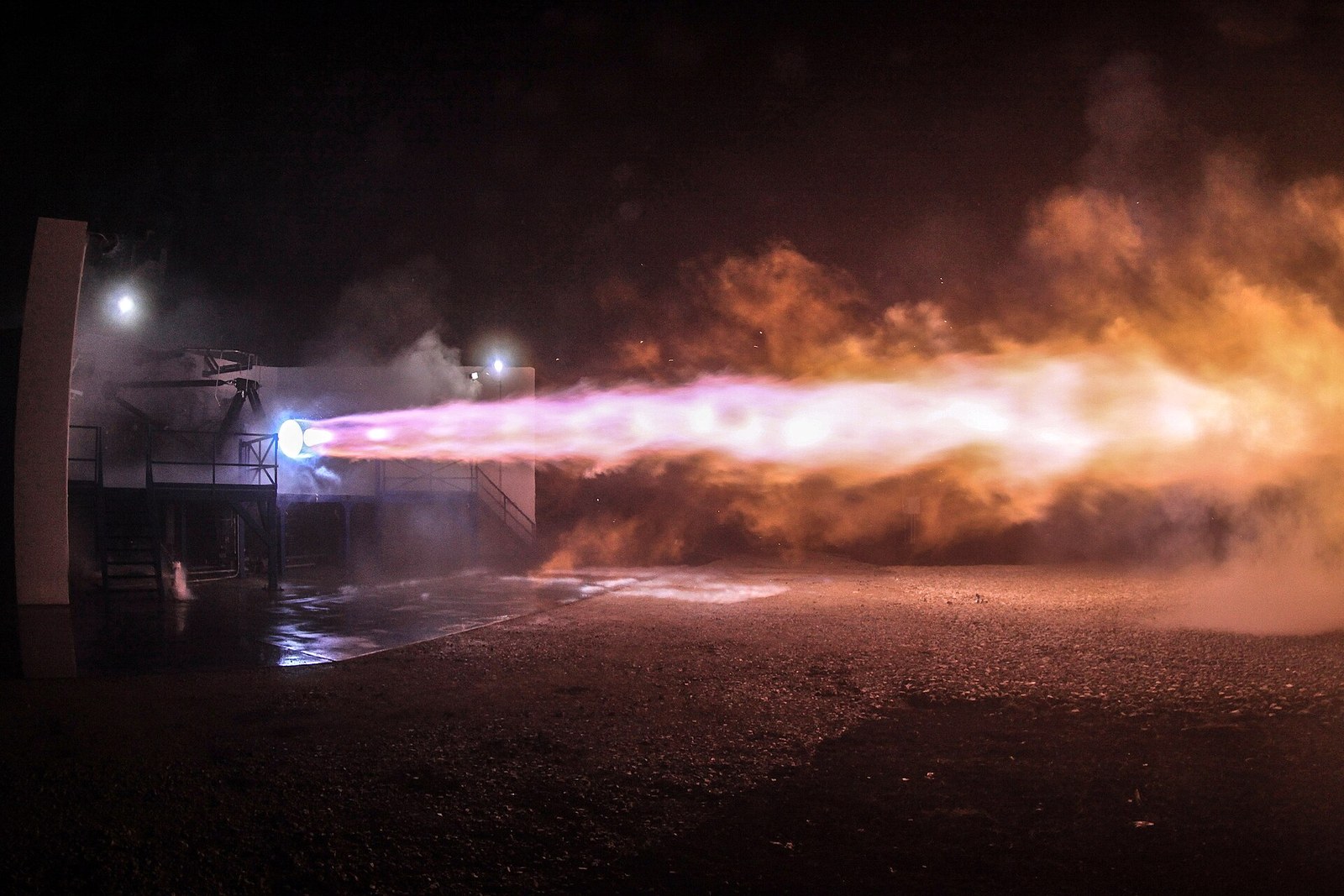
- Raptor (SpaceX): full-flow staged combustion. See my Raptor deep dive. SpaceX’s first Raptor test firing was on September 25, 2016.
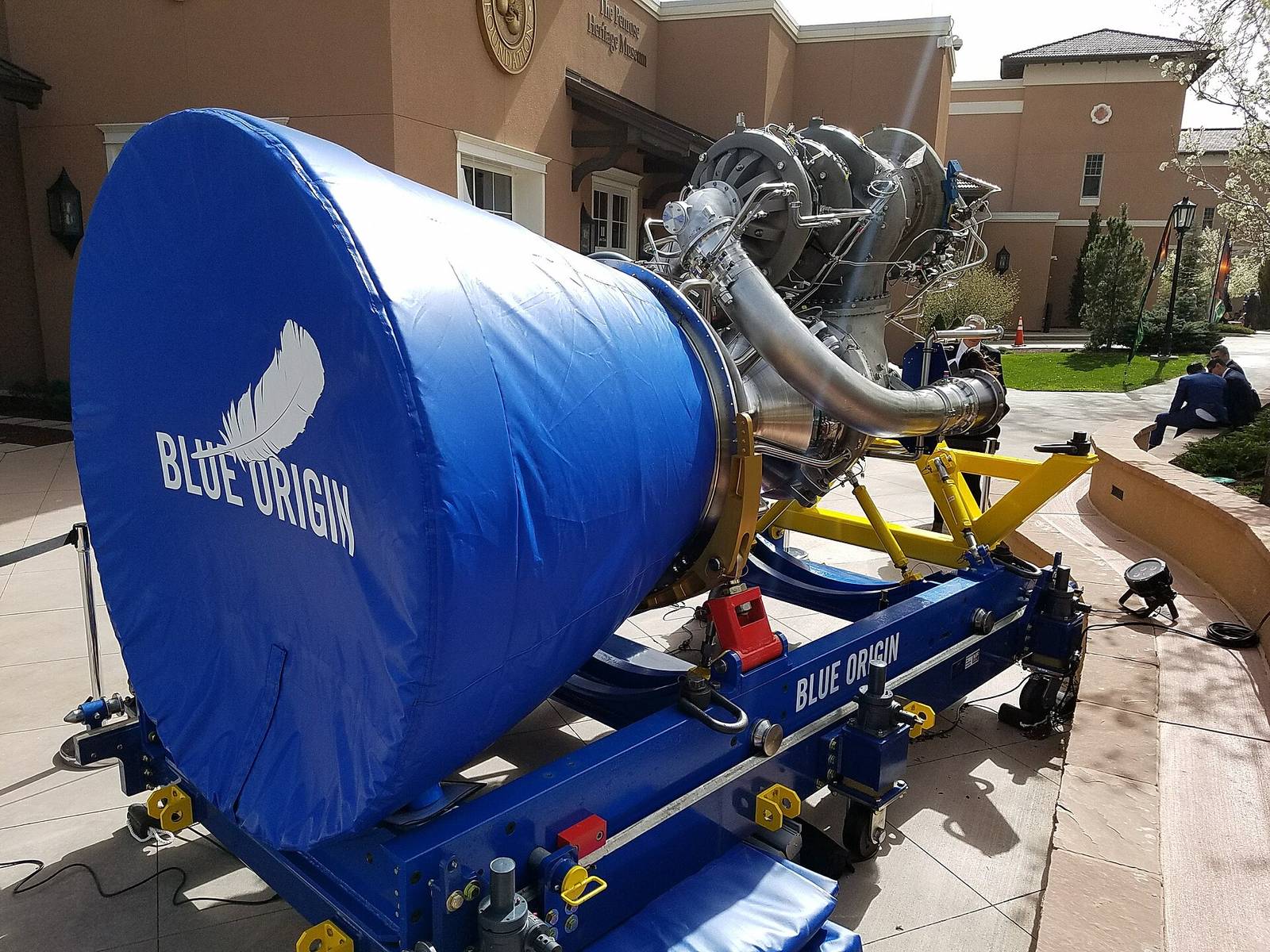
- BE-4 (Blue Origin): oxygen-rich staged combustion. 550,000 lbf class, with subcooled propellant raising capability toward 640,000 lbf; 625,000 lbf already demonstrated on the test stand (Blue Origin, November 20, 2025). My BE-4 deep dive has the rest.
- Zenith (Stoke): full-flow, LNG and LOX, over 100,000 lbf, 345 s. See Zenith.
- Aeon 1 and Aeon R (Relativity): gas generators. Aeon 1 powered Terran 1’s one flight on March 22, 2023; Aeon R makes 269,000 lbf.
- TQ-12 (LandSpace): a gas-generator engine for Zhuque-2, which reached orbit in July 2023 (Wikipedia).
Subcooling methane
Cryogenic propellants can be chilled below their boiling points to make them denser. SpaceX’s Raptor and Blue’s BE-4 both use subcooled propellant. Blue says so officially for BE-4 (above); for Raptor see my Raptor post. Methane has a catch: its liquid range is narrow. It freezes at −182.5 °C, a mere 0.5 °C above where LOX boils (−183.0 °C, Braeunig), so you cannot chill it very deep without turning it to slush. I could not find official methane subcooling temperatures, so I won’t quote any.
Which engines use it?
Here is my full roster, with methalox engines starred ⭐:
| Engine | Flies on | Propellants | Cycle | Headline numbers |
|---|---|---|---|---|
| Raptor ⭐ | SpaceX Starship and Super Heavy | Methane + LOX | Full-flow staged combustion | Raptor 3: 250 tf sea level / 275 tf vacuum (SpaceX). Isp about 350 s, conditions unstated (SpaceX, Aug 2024) |
| Merlin 1D | SpaceX Falcon 9 and Falcon Heavy | RP-1 + LOX | Gas generator | 845 kN sea level / 981 kN vacuum (Wikipedia). Merlin Vacuum about 348 s (Wikipedia, unofficial) |
| BE-4 ⭐ | ULA Vulcan, Blue Origin New Glenn | Methane + LOX | Oxygen-rich staged combustion | 550,000 lbf class, uprated toward 640,000 lbf (625,000 lbf demonstrated). Isp about 340 s (Bezos, unofficial) |
| BE-3PM | Blue Origin New Shepard | Hydrogen + LOX | Tap-off | 110,000 lbf, throttles down to 20,000 lbf |
| BE-3U | Blue Origin New Glenn upper stage | Hydrogen + LOX | Expander bleed | 200,000 lbf listed (211,658 lbf demonstrated, Nov 2025). Isp about 445 s (Bezos, unofficial) |
| BE-7 | Blue Origin Blue Moon lander | Hydrogen + LOX | Dual expander | 10,000 lbf, throttles down to 2,000 lbf |
| RL10 | Centaur upper stage (Atlas V, Vulcan) | Hydrogen + LOX | Closed expander | RL10C-1-1: 23,825 lbf, 453.8 s |
| RD-180 | ULA Atlas V first stage | RP-1 + LOX | Oxygen-rich staged combustion | 3,830 kN sea level / 4,150 kN vacuum; 311 s / 338 s |
| Aeon 1 ⭐ | Relativity Terran 1 (retired) | LNG (methane) + LOX | Gas generator | About 23,000 lbf sea level (my arithmetic); more than 310 s (Relativity) |
| Aeon R ⭐ | Relativity Terran R | Methane + LOX | “Uniquely high-pressure” gas generator | 269,000 lbf sea level; Isp not published |
| Zenith ⭐ | Stoke Space Nova booster | LNG (methane) + LOX | Full-flow staged combustion | More than 100,000 lbf; 345 s (Stoke, conditions unstated) |
| Andromeda | Stoke Space Nova upper stage | Hydrogen + LOX | “Expander cycle” (Stoke wording) | Pathfinder: 25,000+ lbf and 400+ s (Stoke) |
| Draco and SuperDraco | SpaceX Dragon | MMH + NTO (hypergolic) | Pressure-fed | Draco about 400 N; SuperDraco about 71 kN |
| F-1 (context) | Saturn V first stage (S-IC) | RP-1 + LOX | Gas generator | 1.5 Mlbf; 263-265 s sea level / 304 s vacuum |
| RD-170 (context) | Energia boosters, Zenit | RP-1 + LOX | Oxygen-rich staged combustion | 7,250 kN sea level / 7,900 kN vacuum; 309 s / 337 s |
| RS-25 (context) | Space Shuttle, SLS core stage | Hydrogen + LOX | Fuel-rich staged combustion | 418,000 lbf sea level / 512,300 lbf vacuum; 366 s / 452.3 s |
| Vulcain (context) | Ariane 5 and Ariane 6 core stage | Hydrogen + LOX | Gas generator | Vulcain 2.1 cut nozzle part count by 90% and cost by 40% (Wikipedia) |
| Vinci (context) | Ariane 6 upper stage | Hydrogen + LOX | Expander | 180 kN |
| LE-9 (context) | Japan H3 first stage | Hydrogen + LOX | Expander bleed | 1,471 kN (Wikipedia) |
| TQ-12 (context) ⭐ | LandSpace Zhuque-2 | Methane + LOX | Gas generator | Designed for 670 kN at sea level; Zhuque-2 reached orbit in July 2023 (Wikipedia) |
Note that the Draco and SuperDraco thrusters burn a hypergolic pair (not methane); see my Draco post and my hypergolics post.
Safety and Ground Handling
- Cryogenic. Methane is not as cold as hydrogen, but at about −162 °C it can cause severe cold burns, and hardware must handle thermal contraction.
- Flammable. It burns in air between about 5.4% and 17% (Braeunig). Leaks of cold methane gas form flammable clouds.
- Plumbing. Because methane and LOX are both cryogenic, ground systems can share parts of the same cold infrastructure (my reading of Wikipedia’s comparison).
- Contrast with hydrogen. Methane does not embrittle metals the way hydrogen does; I’ll leave the full contrast to the hydrogen post.
- Environment. Burning methane releases CO₂, like any hydrocarbon, though cleaner than kerosene.
A Short History
- Early 1980s. NASA-sponsored heated-tube tests compared RP-1, propane and natural gas (NTRS 19840004157) and found natural gas coked the least.
- 2012. SpaceX announces a large new engine, which later is confirmed as methane-fueled (per my Raptor post).
- 2016 to 2017. First Raptor firing (Sept 25, 2016). BE-4’s first hot fire was on October 18, 2017 (Wikimedia Commons file description).
- 2023. Terran 1 flies with Aeon 1 on March 22; Zhuque-2 reaches orbit in July.
- 2024 to 2025. Vulcan flies its first certification mission on January 8, 2024 and its second on October 4, 2024. New Glenn’s first launch is January 16, 2025.
- 2026. Raptor 3 flies on Starship V3 (May 2026, per my Raptor post).
Pros and Cons
Pros
- ✅ Clean burn. Low soot, little coking, which helps reuse.
- ✅ Good Isp, better than kerosene.
- ✅ Middle-of-the-road density, much denser than hydrogen.
- ✅ Self-pressurizing, and well matched to oxygen’s temperature.
- ✅ Can be made on Mars, at least in principle.
Cons
- ⚠️ Cryogenic. Needs insulation, venting and careful loading, unlike kerosene.
- ⚠️ Less dense than RP-1, so tanks are about 65% bigger for the fuel alone (53 versus 32 m³ per 100 t of propellant, my arithmetic).
- ⚠️ Narrow liquid range, which limits subcooling.
- ⚠️ Less flight heritage. The first big methalox flights are all very recent.
- ⚠️ Mars production is hard. Sabatier needs hydrogen, extra oxygen and lots of power.
Watch: Why Methane? 🎥
Real Engineering explains the case for SpaceX’s switch:
Can’t see the video? Watch it on YouTube: Why SpaceX is Using a New Fuel (Real Engineering)
And a look at Raptor from Everyday Astronaut. This one is older, so treat its numbers as dated and trust my table above:
Can’t see the video? Watch it on YouTube: Is SpaceX's Raptor engine the king of rocket engines? (Everyday Astronaut)
The Star Queen’s Take
Methane did not win because it is best at any single thing. It won because it is never bad. 😄 It is clean enough for reuse, dense enough for a booster, efficient enough for an upper stage, and handled with the same cold-chain tools as oxygen. And then there is Mars: even if the ISRU math is harder than the slogans, “we can make the fuel there” is a powerful design constraint.
My scorecard: methalox is the 2020s default for reusable boosters, with hydrogen keeping the upper-stage crown and kerolox surviving where heritage matters. I’m watching the first multiple-reuse numbers for methane engines, because that’s where the clean-burn promise gets tested.
Also see: Beyond the Big Five: Hybrids, Green Monopropellants and the Propellant Cheat Sheet, RP-1 Explained, Liquid Hydrogen Explained, Hypergolic Propellants Explained and Solid Rocket Propellant Explained. 🌟
Sources
- Braeunig, Rocket Propellants (densities, melting and boiling points, density impulse, flammability): http://www.braeunig.us/space/propel.htm
- Wikipedia, Liquid-propellant rocket (JANNAF performance table): https://en.wikipedia.org/wiki/Liquid-propellant_rocket
- Wikipedia, RP-1 (comparison with methane, residues): https://en.wikipedia.org/wiki/RP-1
- Wikipedia, Liquid methane and Methane: https://en.wikipedia.org/wiki/Liquid_methane and https://en.wikipedia.org/wiki/Methane
- Wikipedia, Sabatier reaction: https://en.wikipedia.org/wiki/Sabatier_reaction
- NASA NTRS, Deposit formation and heat transfer in hydrocarbon rocket fuels (19840004157): https://ntrs.nasa.gov/citations/19840004157
- NASA, Human Exploration of Mars Design Reference Architecture 5.0 (SP-2009-566): https://www.nasa.gov/wp-content/uploads/2015/09/373665main_nasa-sp-2009-566.pdf
- NASA, MOXIE completes Mars mission: https://www.nasa.gov/missions/mars-2020-perseverance/perseverance-rover/nasas-oxygen-generating-experiment-moxie-completes-mars-mission/
- Pulling Propellants Out of Thin Air (ASCE, 1996): https://ascelibrary.org/doi/10.1061/40177%28207%2997
- Designing the bioproduction of Martian rocket propellant (Nature Communications, 2021): https://doi.org/10.1038/s41467-021-26393-7
- Blue Origin, Upgraded Engines and Subcooled Components Drive Enhanced Performance (Nov 20, 2025): https://www.blueorigin.com/news/new-glenn-upgraded-engines-subcooled-components-drive-enhanced-performance
- Relativity Space, Terran 1 (archived, Aeon 1 specs): https://web.archive.org/web/20201122215131/https://www.relativityspace.com/terran
- Relativity Space, Terran R: https://www.relativityspace.com/terran-r
- Stoke Space, Nova: https://www.stokespace.com/nova
- Wikipedia, TQ-12: https://en.wikipedia.org/wiki/TQ-12
- Marspedia, Cost of transportation: https://marspedia.org/Cost_of_transportation
- Spaceinsider, How much does rocket fuel cost: https://spaceinsider.tech/2023/06/13/how-much-does-rocket-fuel-cost/
- Images: Vulcan launch, U.S. Space Force (public domain); BE-4 photo by N2e, CC BY-SA 4.0; Raptor test photo, SpaceX, CC0; diagrams by The Star Queen