By The Star Queen · Star Queen Chronicles
My loves, if rocket engines had a hard mode, it would be full-flow staged combustion. Every ounce of fuel and every ounce of oxidizer goes through a turbine before it ever reaches the main chamber, and the hot gas on the oxygen side is hungry to eat the metal around it. Stoke Space looked at that and said: yes, that one, for our first booster engine. 🔥
The engine is Zenith, and it powers the first stage of Stoke’s fully reusable Nova rocket. In this deep dive I’ll explain the cycle in plain language, lay out the numbers Stoke has shared (and which I had to do math on), cover the test history, and flag where the figures don’t line up. For the whole rocket, my Nova Pathfinder post has the big picture, and the Block 2 post explains why there is no Stoke “super heavy.”
How I label things: Official is from Stoke or NASA, Reported is from journalists or third parties, and My math is mine.
Terms to know ✨
- Full-flow staged combustion (FFSC): a cycle that burns all the fuel and all the oxidizer in two preburners first, spins the turbines with the gas, then sends all of it into the main chamber to burn together.
- Preburner: a small combustion chamber whose only job is to make gas to spin a turbine. FFSC has two: one fuel-rich, one oxygen-rich.
- Turbopump: a pump driven by a turbine, raising propellant pressure for the chamber.
- Methalox: methane plus liquid oxygen. Stoke says Zenith burns LNG (liquefied natural gas), which is mostly methane.
- Specific impulse (Isp): seconds of thrust per pound of propellant per second. A measure of efficiency.
- Deep throttling: running an engine at a small fraction of full thrust, which a booster needs for a gentle landing.
- Hot fire: a test where an engine really burns propellant on a stand.
- lbf: pounds-force, the thrust unit Stoke uses. 1 lbf ≈ 4.448 newtons.
Zenith at a Glance
| Item | Value | Label and source |
|---|---|---|
| Cycle | Full-flow staged combustion | Official, Stoke |
| Propellants | LNG and liquid oxygen | Official, Stoke (Ars calls it “methane”) |
| Thrust per engine | Over 100,000 lbf at full power | Official, Stoke, June 2024 |
| Isp | 345 s | Official, Stoke’s Nova page (the page does not say sea level or vacuum) |
| Engines, Nova Pathfinder | 7 on stage 1; stage 1 thrust “700,000+ lbf” | Official, Stoke |
| Engines, Nova Block 2 | 14 on stage 1; “1,700,000+” thrust, no unit given | Official; unit unclear |
| First hot fire | June 5, 2024 at Moses Lake, Washington (announced June 11) | Official, Stoke |
| Development time | 18 months from start to first hot fire | Official, Stoke |
| Starting-power claim | “350,000 Hp” reached in under a second (about 261 MW, my math) | Official; conversion is my math |
| Printed parts? | Not stated for Zenith | Not confirmed |
| Gimbal on Pathfinder | Not stated in the Stoke pages I read | Not confirmed |
How Full-Flow Works (and Why It Is Hard)
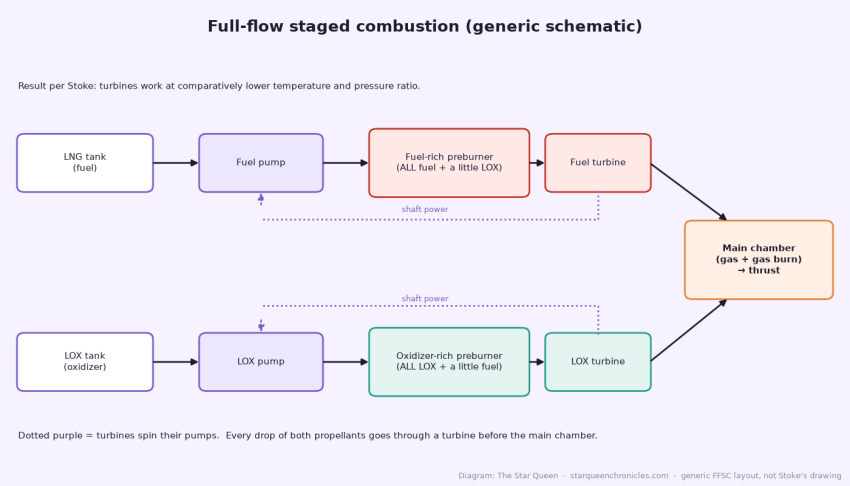
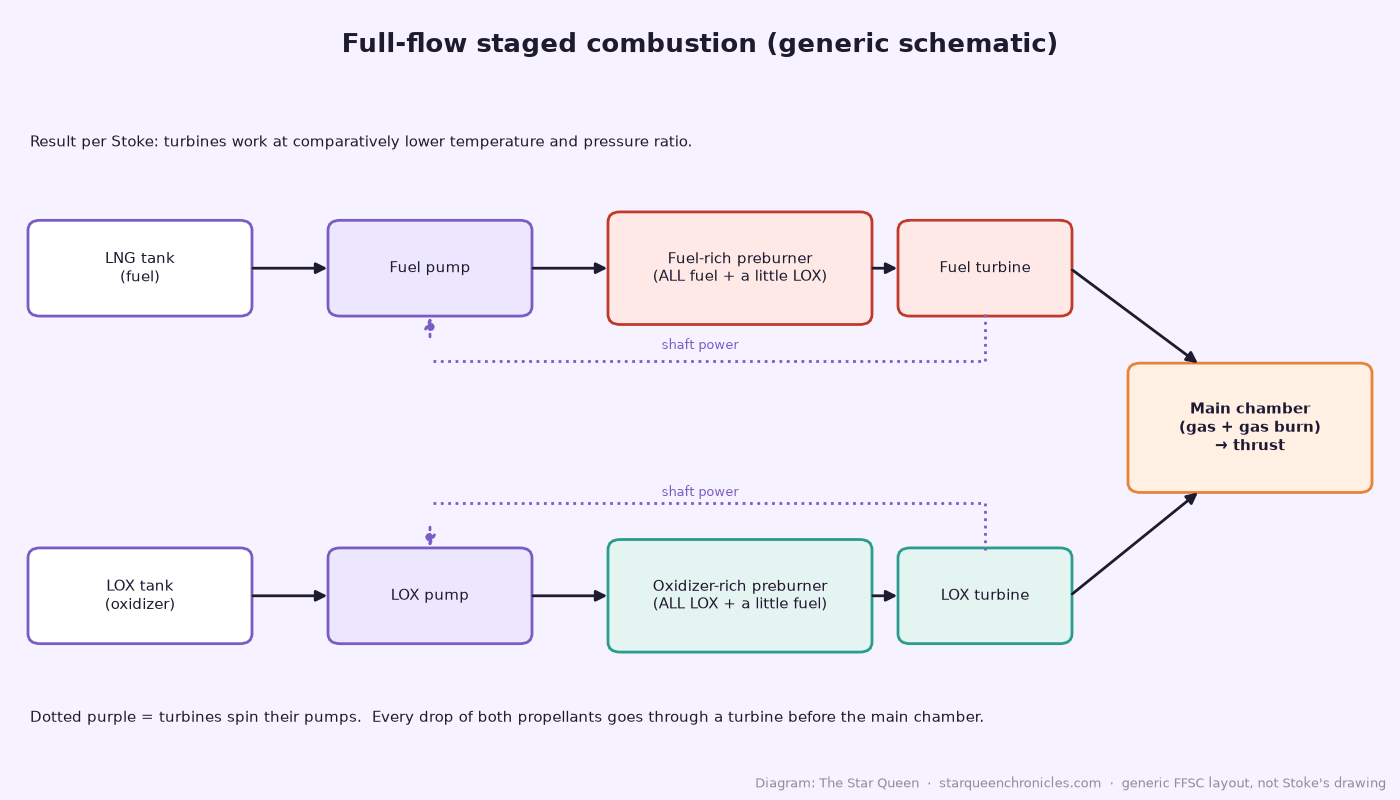
Start with the simple version. Every pump-fed engine needs turbines to drive its pumps, and turbines need hot gas. In a gas-generator engine, a little propellant is burned for that gas and thrown away. In an ordinary staged-combustion engine, one preburner makes that gas and then it all flows on into the main chamber so nothing is wasted. Full-flow takes it further, which I explain in my own words (general engineering, not Stoke’s wording):
- The fuel-rich preburner burns all of the fuel with a small amount of oxygen. The gas runs the fuel turbopump.
- The oxygen-rich preburner burns all of the oxidizer with a small amount of fuel. That gas runs the oxygen turbopump.
- Both gas streams, now hot and mostly gaseous, are injected into the main chamber and finish burning there. Nothing is dumped overboard.
Stoke’s own explanation, from its September 2026 “Scaling Nova” post, is that because the work is spread across the full fuel and oxidizer flow, the turbines can make the required power “at comparatively lower temperatures and pressure ratios than in other high-performance engine cycles.” That gives “the highest-possible performance while minimizing the thermal and mechanical stress placed on critical components.” For a booster meant to fly many times, lower stress is the whole point.
The price is development difficulty. Stoke itself calls FFSC “perhaps the most difficult rocket engine cycle to develop, particularly through startup, shutdown, and deep throttling.” In general terms, the oxygen-rich side is the scary part: hot, oxygen-rich gas can corrode or even ignite metal, so the materials and the start sequence both have to be handled with care. Few engines of this type have ever flown. As background (not from Stoke): SpaceX’s Raptor is the best-known one flying, and earlier programs like the Soviet RD-270 and the American Integrated Powerhead Demonstrator tested the concept. Ars Technica’s October 2026 survey calls Stoke’s choice “ambitious for a first engine design,” which I think is fair.
Stoke adds one more reason: LNG burns cleaner than kerosene, leaves fewer residuals, and cuts soot buildup, which Stoke says eliminates cleaning cycles after tests or flights. That matters for turnaround time.
The Numbers, and My Math
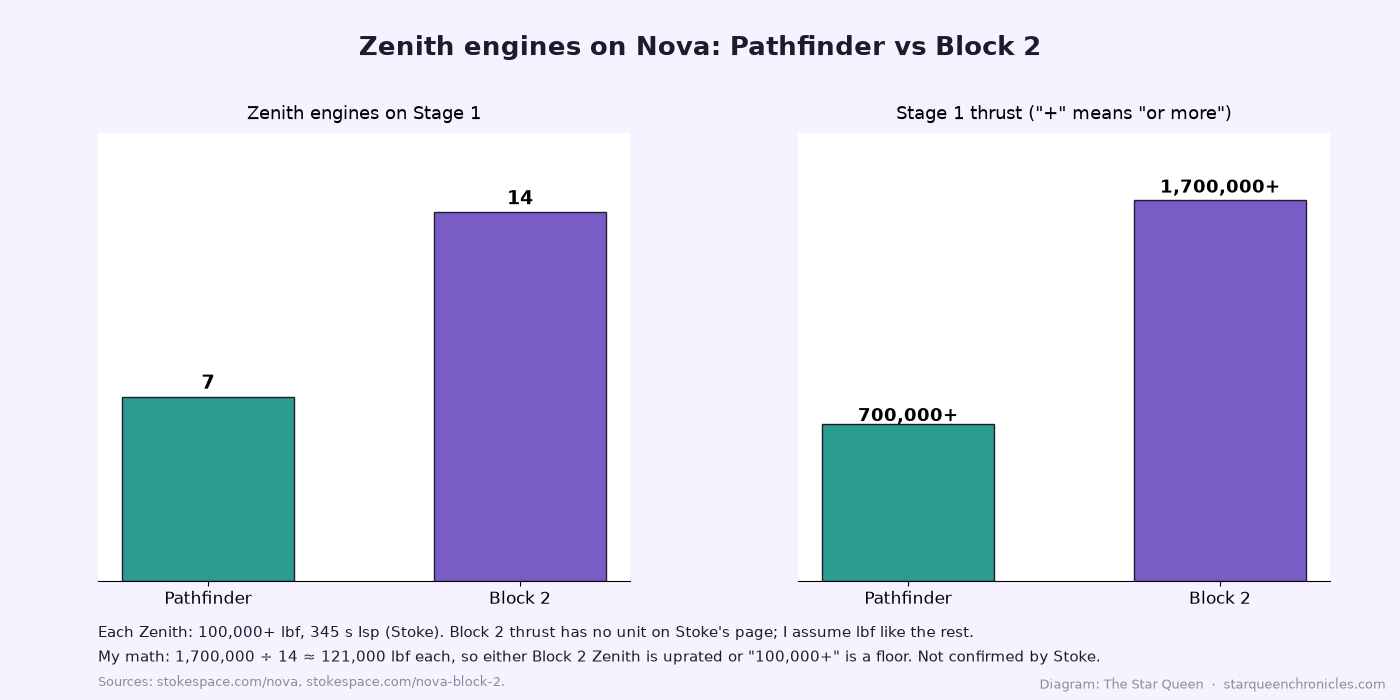
Official: Stoke’s Nova page lists Pathfinder’s stage 1 as seven Zenith engines with 345 s of Isp and “700,000+” lbf of thrust, and Stoke’s 2024 release says each engine produces over 100,000 lbf. My math: 7 × 100,000 = 700,000, so the stage figure and the per-engine figure agree. NASASpaceFlight’s June 2026 summary says 3,110 kN at liftoff, which is about 699,000 lbf by my conversion, so it is the same number in metric.
Block 2 is where it gets interesting. Stoke says Block 2 flies 14 Zenith engines and lists thrust as “1,700,000+.” I read that as pounds-force, but the page gives no unit. My math: 1,700,000 ÷ 14 ≈ 121,000 lbf per engine. Stoke says Pathfinder and Block 2 share the same Zenith architecture, so either the Block 2 engine runs uprated, the “100,000+” is a floor, or the unit is something else. I do not know which, and I have not seen Stoke explain it.
For scale, my math: Relativity’s Aeon R makes 269,000 lbf per engine, about 2.7 times Zenith’s 100,000-plus. But Stoke is betting on a more efficient cycle at a smaller size. Comparing the two is like comparing a pickup truck to a Formula 1 car: different jobs. For more on the competitor, see my Aeon R deep dive.
Test History
- Official: first hot fire on June 5, 2024 at Moses Lake. The engine went from rest to its starting power level in under a second, held it, and shut down. Stoke says the team designed and built the engine in 18 months.
- Reported: around early June 2025, Stoke shared a 200-second, full mission-duration burn across the full range of power levels and mixture ratios. I found this through social-media posts surfaced by search and could not open a Stoke page confirming it.
- Reported (NASASpaceFlight, June 10, 2026): Zenith has racked up “hours of vertical hot-fire testing” in the twin-cell stand at Moses Lake, and Stage 1 will receive its engines in the coming months.
- Official: Stage 1 finished proto-qualification structural testing on June 8, 2026 (46 test objectives). That tests the stage, not the engines.
The caution here is simple. A stand firing is not a flight. Zenith’s full-flow engines have not yet powered a Nova into the air, and I could not find a public qualification result or reliability number. Stoke has not said how many Zenith engines have been built, how many hot fires they have logged, or how deep the throttle goes.
A short clip of Zenith hot-fire and gimbal testing. It is from a third-party channel (MechDesignTV), and I could not confirm whether the footage is Stoke’s own, so treat it as an illustration. Its title mentions gimbal testing, which Stoke’s pages do not describe. If the player does not load, watch “Stoke Space Conducts Zenith Engine Hotfire and Gimbal Testing – #rocket #space” by MechDesignTV on YouTube.
Where Zenith Flies: Pad 14
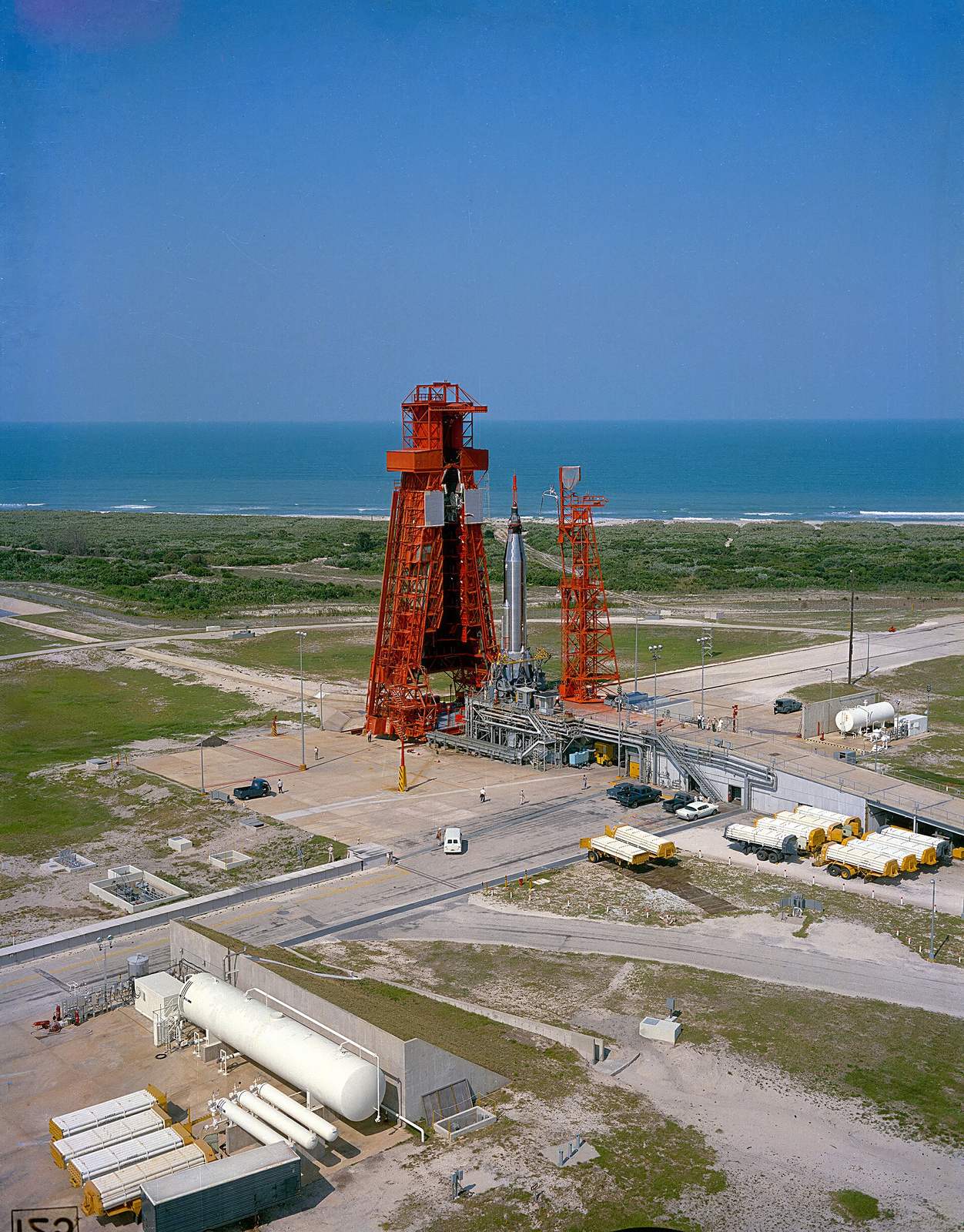
Nova launches from Space Launch Complex 14 at Cape Canaveral, the pad that sent John Glenn to orbit in 1962. Stoke says the launch mount there is built to react up to 1.2 million pounds of thrust, which is comfortably above Pathfinder’s 700,000-plus (that headroom is my guess at the intent).
Where My Sources Disagree
- Fuel: Stoke says LNG. Ars Technica and Everyday Astronaut say methane. LNG is mostly methane, so this is a naming difference, not a contradiction.
- Block 2 thrust: no unit on Stoke’s page, and the implied per-engine thrust (about 121,000 lbf, my math) is higher than the “over 100,000 lbf” in 2024.
- Isp: 345 s, with no statement about altitude. I would not compare it with vacuum figures from other engines.
- Not public: engine mass, chamber pressure, throttle range, restart limits, material list, and whether Zenith’s main parts are printed.
- 200-second test: found in social posts only, so it stays reported.
The Star Queen’s Take 👑
I love that Stoke picked the hardest option because the economics of reuse demanded it, and then said so out loud. If Zenith works, a booster that burns cleaner, runs cooler and needs less cleaning is exactly the kind of boring, repeatable machine that makes spaceflight cheaper. If it does not, it will be because of the same startup and throttling problems the cycle is famous for. Either way, the engine is worth watching: seven of them on one stage, with a stand record and a launch window coming into view. When Nova flies, that is the first flight of seven full-flow engines at once. ✨
Related Reading
- Andromeda: Stoke’s Heat Shield That Is Also an Engine
- Stoke Space’s Nova Pathfinder
- Is Stoke Building a “Super Heavy”?
- Aeon R: The 269,000-lbf Engine Behind Terran R
Sources
- Nova Pathfinder — Stoke Space product page (undated)
- Nova Block 2 — Stoke Space product page (undated)
- Scaling Nova — Stoke Space, Sep 8, 2026
- Stoke Space Completes First Successful Hotfire Test of Full-Flow, Staged-Combustion Engine — Stoke Space, Jun 11, 2024
- Nova Stage 1 Completes Proto-Qualification Testing — Stoke Space, Jun 8, 2026
- From Mercury to Nova: Launching the Future at Space Launch Complex 14 — Stoke Space, Jul 28, 2025
- Stoke Space completes Nova Stage 1 structural verification — NASASpaceFlight, Jun 10, 2026
- Does anyone actually want to win the medium-lift race in the United States? — Ars Technica, Oct 20, 2026
- Full Reusability By Stoke Space — Everyday Astronaut, Feb 4, 2023
- Go Zenith (200-second burn post, found via search, not opened) — LinkedIn post, about June 2025
- Stoke Space Conducts Zenith Engine Hotfire and Gimbal Testing — MechDesignTV, YouTube
- KSC-81pc-0057 (Columbia static firing, Feb 20, 1981) — NASA Kennedy Space Center, NASA Image and Video Library
- Aerial View of Launch Complex 14 (GPN-2000-000609) — NASA, May 7, 1963, via Wikimedia Commons
