By The Star Queen · Star Queen Chronicles
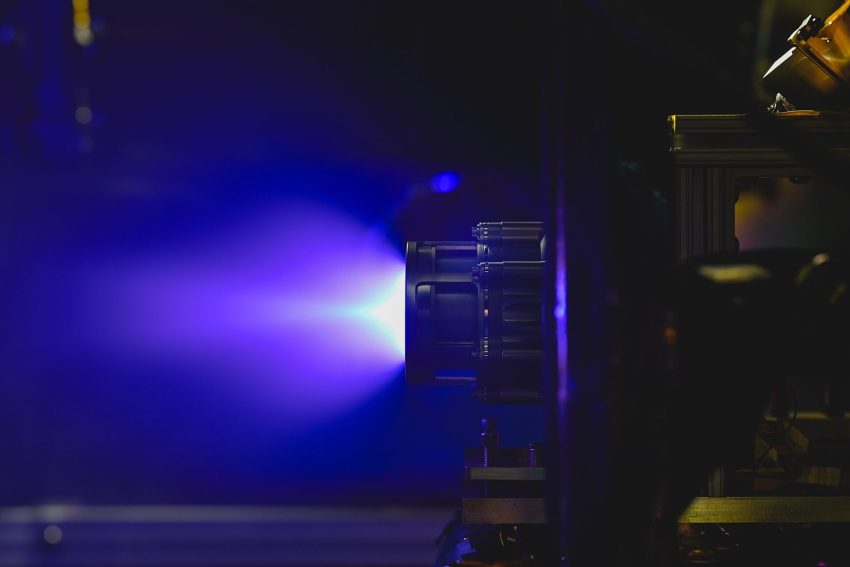
An Orbion Hall-effect thruster firing on krypton. Photo: MrAdamJohnson, CC BY-SA 4.0, via Wikimedia Commons.

My loves, in the other posts in this series I take one propellant at a time: kerosene, methane, hydrogen, hypergolics and solids. But rocketry has a whole zoo outside those five, and some of the cleverest tricks live there. 🦄 This is my guide to the zoo, ending with a comparison table you can screenshot.
I label claims official, reported or my arithmetic, and I say when sources disagree. Status as of October 26, 2026.
The Short Version
- Oxidizers are half the story: LOX (cold, powerful), NTO (storable, toxic), N2O (self-pressurizing, mild) and hydrogen peroxide (storable, tricky).
- Hybrids burn a solid fuel with a liquid/gas oxidizer: throttleable and shut-down-able, but with their own headaches.
- Monopropellants use one liquid and a catalyst. Hydrazine is the old standard; HAN (AF-M315E/ASCENT) and ADN (LMP-103S) blends are the “green” challengers.
- Cold gas is just pressurized gas: low performance, very safe, very simple.
- Nuclear thermal might roughly double efficiency; electric propulsion is a different game (non-chemical).
- All numbers are approximate and depend on engine, pressure and nozzle.
Terms to know ✨
- Oxidizer: the chemical that supplies oxygen (or an equivalent) so the fuel can burn.
- Monopropellant: a single liquid that decomposes (often over a catalyst) to make hot gas.
- Hybrid motor: solid fuel plus a liquid or gas oxidizer.
- HTPB: hydroxyl-terminated polybutadiene, a rubbery fuel binder also used as hybrid fuel.
- HAN / ADN: hydroxylammonium nitrate and ammonium dinitramide, the energetic salts in green monopropellants.
- Cold gas: thrust from expanding an inert pressurized gas, with no combustion.
- Density impulse: Isp times propellant density. Tells you how much “oomph” per liter of tank.
- Storable: stays liquid at ordinary temperatures, no boil-off.
The Oxidizers: Meet the Four
A rocket needs fuel and something to burn it with. Four oxidizers dominate the world beyond solids. These properties are from Braeunig’s tables.
| Oxidizer | Density (g/mL) | Melts at | Boils at | In a nutshell |
|---|---|---|---|---|
| LOX (liquid oxygen) | 1.14 | −218.8 °C | −183.0 °C | Cold, powerful, ubiquitous |
| NTO (N2O4) | 1.45 | −9.3 °C | 21.15 °C | Storable, hypergolic with hydrazines, toxic |
| N2O (nitrous oxide) | 1.22 | −90.8 °C | −88.5 °C | Self-pressurizing, mild |
| H2O2 (peroxide) | 1.44 | −0.4 °C | 150.2 °C | Storable, decomposes to steam and oxygen |
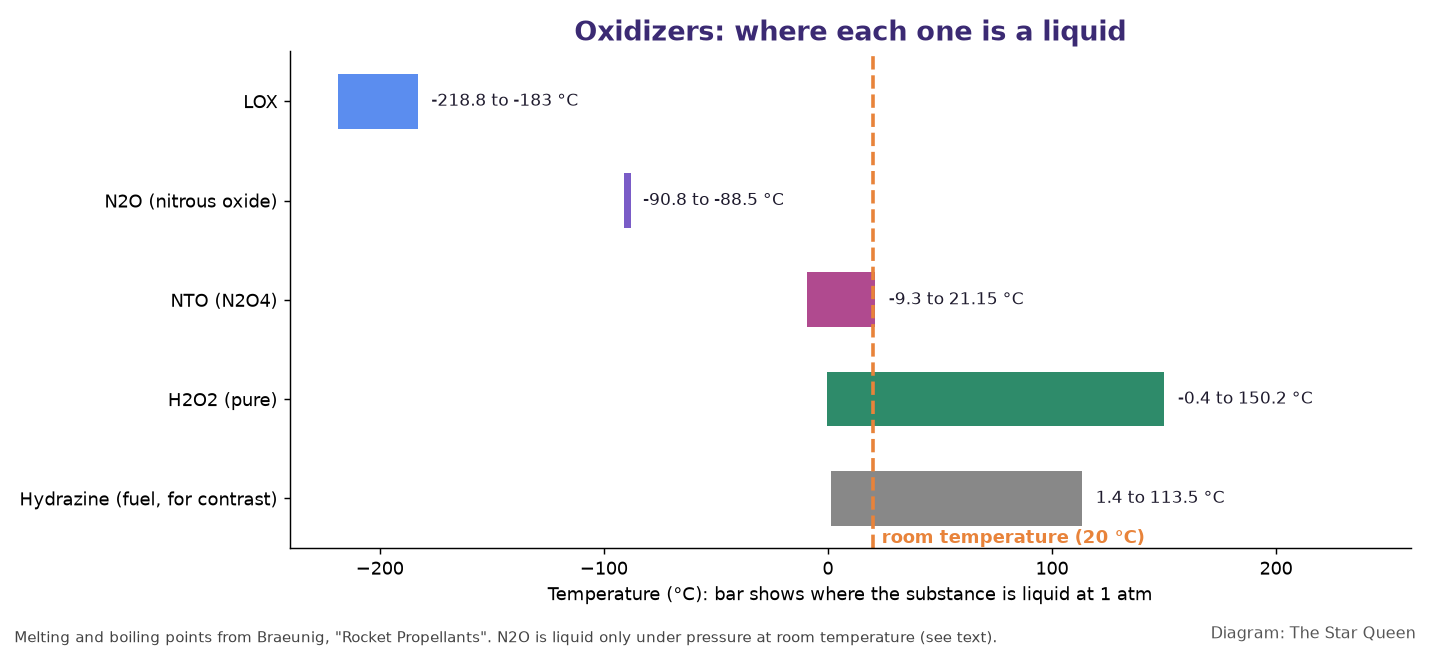
LOX is the workhorse for kerosene, methane and hydrogen engines. It boils at −183 °C, so it needs insulated tanks and a timely launch. NTO I covered in the hypergolic post: dense, storable and toxic. Nitrous oxide is the friendly one. Wikipedia says it’s “much less toxic and more stable at room temperature” than most oxidizers, and Wikipedia gives its saturated vapor pressure at 20 °C as about 50.5 bar, so it pressurizes itself. That’s why hybrids and amateur rocketeers love it. But it’s not harmless: Wikipedia notes N2O “deflagrates at approximately 600 °C at a pressure of 21 atmospheres,” and that ignition energy drops steeply with pressure.
Hydrogen peroxide in rocket grades (HTP) is 85 to 98% concentrated (Wikipedia). On contact with a catalyst it decomposes into steam and oxygen. It was the oxidizer for Germany’s Me 163 rocket fighter, for Britain’s Blue Steel missile, and for the Black Arrow launcher, which burned HTP (85% peroxide) with kerosene and put a satellite in orbit in 1971. It is “still in use on the Russian Soyuz rocket” at 82% concentration to drive turbopumps (Wikipedia), and Wikipedia lists Blue Origin among the private companies using it (without saying for what, so I won’t guess).

Hybrids: Solid Fuel, Liquid Oxidizer 🧬
I covered hybrids in detail in my solid propellant post, so here’s the quick version. A hybrid stores a solid fuel grain (often HTPB or a plastic) and a separate liquid or gas oxidizer (N2O or LOX), and you meter the oxidizer down the grain’s central port.
- Why: they can throttle and shut down, they’re simple, and fuel and oxidizer “do not burn when brought together” without a heat source (Wikipedia’s SpaceShipOne page).
- Why not: slow fuel regression, drifting mixture ratio (O/F shift), combustion instability, and bulky multi-port grains.
- Performance: all over the map. N2O/HTPB is 248 s theoretical (Braeunig), around 180 s delivered in one small-motor report (Wikipedia citing US Rockets), and 215 to 300 s for small hybrids in NASA’s survey. AMROC tested a LOX/HTPB hybrid with 312 kN thrust for 70 seconds, and GIRD-9 flew in 1933.
- Famous: SpaceShipOne’s N2O/HTPB motor, and SpaceShipTwo’s polyamide-then-HTPB history. (One source wrinkle: Wikipedia’s SS1 page lists both 88 kN and 73.5 kN for the thrust.)
Wikipedia also mentions a “blow-back” risk with N2O/H2O2 hybrids, where combustion can propagate back into the oxidizer feed, a good reason hybrids are engineered carefully.
Monopropellants: One Liquid, One Catalyst ⚗️
Hydrazine monoprop (details in my hypergolic post) decomposes over an iridium catalyst at about 800 to 1,100 °C into ammonia, nitrogen and hydrogen, for roughly 200 to 240 s of Isp depending on who you ask. It freezes at about 1.4 °C and is toxic and carcinogenic (Wikipedia).
N2O can also be a monopropellant: Wikipedia says it decomposes over a catalyst at about 577 °C and gives “up to 180 s” in vacuum. HTP monoprop is about 150 s (Braeunig). Both are less efficient than hydrazine, but much milder.
The “green” challengers 🌱
Two salt-based blends have grown up in the last 15 years.
- AF-M315E (now called ASCENT), a HAN-based blend from the U.S. Air Force Research Laboratory. Wikipedia lists its Isp as 257 s, and the Green Propellant Infusion Mission (GPIM) said it offered “nearly 50% higher performance for a given propellant tank volume” than hydrazine. I’ve read AFRL’s density figure as about 1.47 g/mL vs. 1.00 for hydrazine. GPIM launched on a Falcon Heavy on June 25, 2019, with a projected cost of $45 million,. NASA’s GPIM pages cover the flight results.
- LMP-103S, an ADN-based blend from Sweden’s ECAPS. Wikipedia’s ECAPS page lists a density of 1.24 g/cm³ and an Isp of about 253 s, ~6% higher than hydrazine. It first flew on PRISMA in 2010, called the first operational flight of an ADN-based system, and has since flown on SkySat and Astroscale’s ELSA-d.
| Monopropellant | Isp | Density | Notes |
|---|---|---|---|
| Hydrazine | about 200 to 240 s | 1.004 g/mL | Toxic, freezes at about 1.4 °C |
| AF-M315E / ASCENT (HAN) | 257 s | about 1.47 g/mL | GPIM flew it in 2019 |
| LMP-103S (ADN) | about 253 s | 1.24 g/cm³ | Flown since PRISMA 2010 |
| N2O monoprop | up to 180 s (vacuum) | 1.22 g/mL (liquid) | Mild, needs about 577 °C catalyst |
| HTP monoprop | about 150 s | 1.44 g/mL | Steam and oxygen exhaust |
Why switch? Hydrazine has been on Europe’s REACH list of substances of very high concern since 2011, and ESA has a whole “hydrazine-free satellite propulsion” effort. Wikipedia says AF-M315E is expected to be “significantly less harmful to the environment.” I haven’t verified how much ground-handling cost that saves, so I’ll leave it as a promise rather than a number.
Cold Gas: The Quiet Option 🌬️
A cold gas thruster expands pressurized, typically inert gas through a nozzle, with no combustion at all. Wikipedia notes it is “predominantly used to provide stabilization for smaller space missions,” that CubeSats favor it because they restrict “pyrotechnics and hazardous materials,” and that it is “one of the safest possible rocket engines” when using inert gas. NASA’s survey puts performance at about 40 to 110 s.
You’ll find it in unexpected places. SpaceShipOne had a cold gas reaction control system (Wikipedia). Relativity’s Terran R first stage uses nitrogen cold gas for its booster flip (Relativity). And Wikipedia says Starship uses cold-gas thrusters fed by leftover tank gas for attitude control in unpowered flight (see my Draco post, which flagged that as a weaker source).
The Cheat Sheet: Every Propellant Side by Side 📊
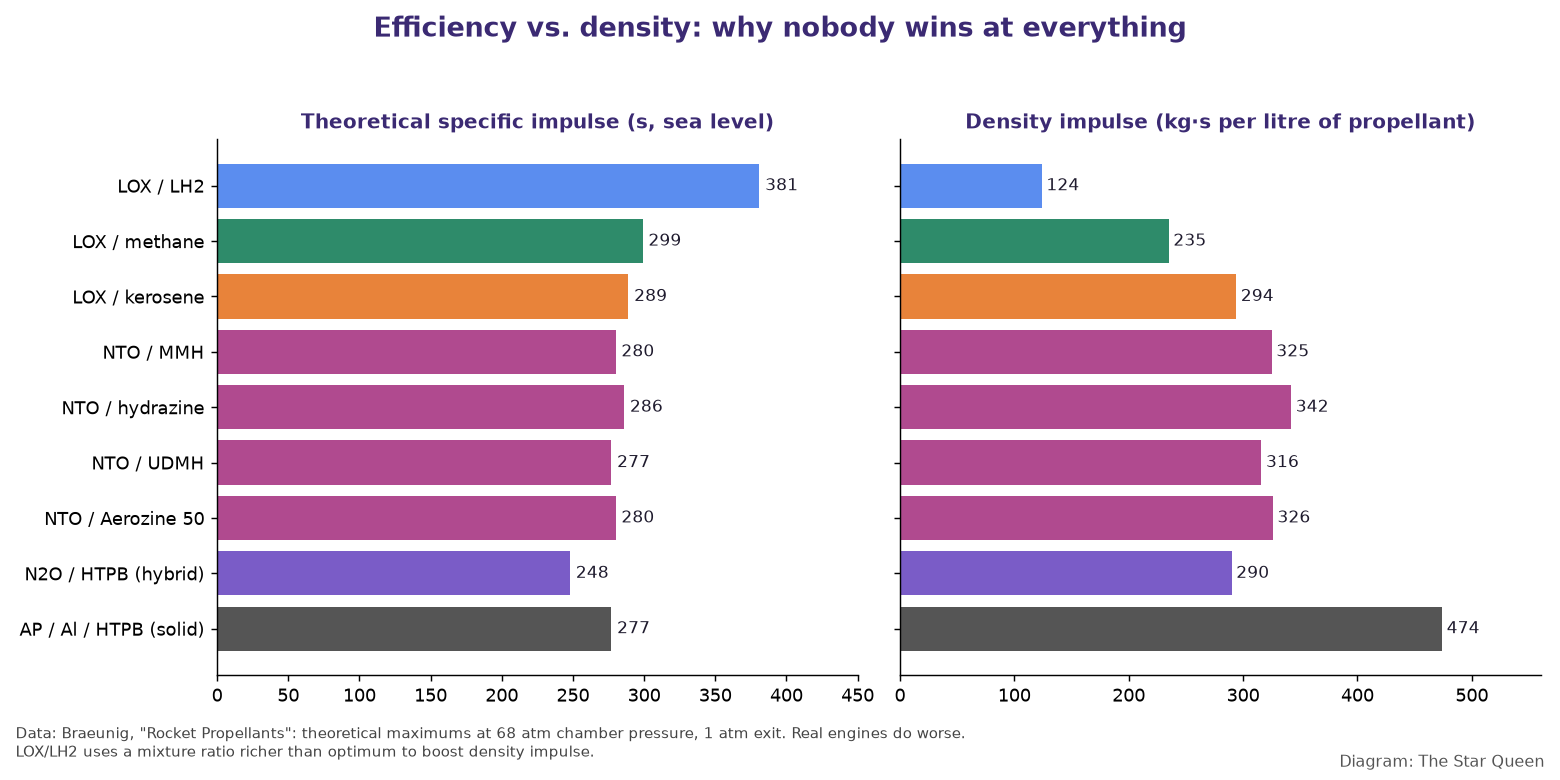
This is my matrix. All values are approximate or typical ranges, not exact. The “theoretical” column uses Braeunig’s numbers at 68 atm chamber pressure with a sea-level nozzle (a hobbyist-compiled reference, but internally consistent), and “real engines” shows what flight hardware actually reports. “Density impulse” is Isp × propellant density, in kg·s/L (higher means more thrust per liter of tank).
| Propellant | Real engines, Isp | Theoretical Isp (s) | Density impulse | Storability |
|---|---|---|---|---|
| LOX / RP-1 (kerosene) | about 270 to 360 s (Wikipedia) | 289 | 294 | RP-1 stores; LOX is cryogenic (−183 °C) |
| LOX / methane | Raptor reported 347 to 350 s (SpaceX, test conditions unstated) | 299 | 235 | Both cryogenic (methane boils at −161.6 °C) |
| LOX / hydrogen | about 370 to 465 s (Wikipedia) | 381 | 124 | Extreme cryogenic (−253 °C), huge tanks, boil-off |
| NTO / hydrazine-family (hypergolic) | about 285 to 320 s in vacuum (Titan II, Apollo SPS, OMS, Delta II) | 277 to 286 | 316 to 342 | Storable at room temperature, toxic |
| AP / Al / HTPB or PBAN (solid) | about 240 to 270 s (big boosters) | 277 | 474 to 476 | Cast and storable, no throttle, no shutdown |
| N2O / HTPB (hybrid) | about 180 to 250 s (sources disagree) | 248 | 290 | N2O self-pressurizing, fuel solid, throttleable |
| Hydrazine monoprop | about 200 to 240 s | not in table | not in table | Storable, freezes at about 1.4 °C |
| AF-M315E monoprop | 257 s | not in table | not in table | Storable (density about 1.47 g/mL) |
| Cold gas | about 40 to 110 s | not applicable | not applicable | Gas, safe, low performance |
A few lessons from the matrix:
- Hydrogen wins on Isp and loses on density. That’s why it’s used on upper stages (RL10, BE-3U, BE-7).
- Kerosene wins on density among liquids (see Merlin); methane sits in the middle (Raptor, BE-4, Aeon R, Zenith).
- Solids top the density chart by a mile but bring a low Isp and no throttle.
- Hypergolics sit in the middle on both counts, with the storability bonus.
- Real engines don’t match the theoretical column. Nozzle area ratio, pressure and losses all change the answer. Treat the matrix as a map, not a spec sheet.
Peeking Ahead: Nuclear and Electric 🔮
Nuclear thermal propulsion (NTP) replaces combustion with a reactor that heats liquid hydrogen. Wikipedia puts the potential at roughly 850 to 1,000 s, and the U.S. Department of Energy says its target is about 900 s versus about 450 s for the best LOX/LH2 chemical engines. The NERVA program (1961 to 1973, per Wikipedia) ground-tested engines in Nevada, and Wikipedia says Kiwi-B4’s design Isp was 825 s. None of them flew.
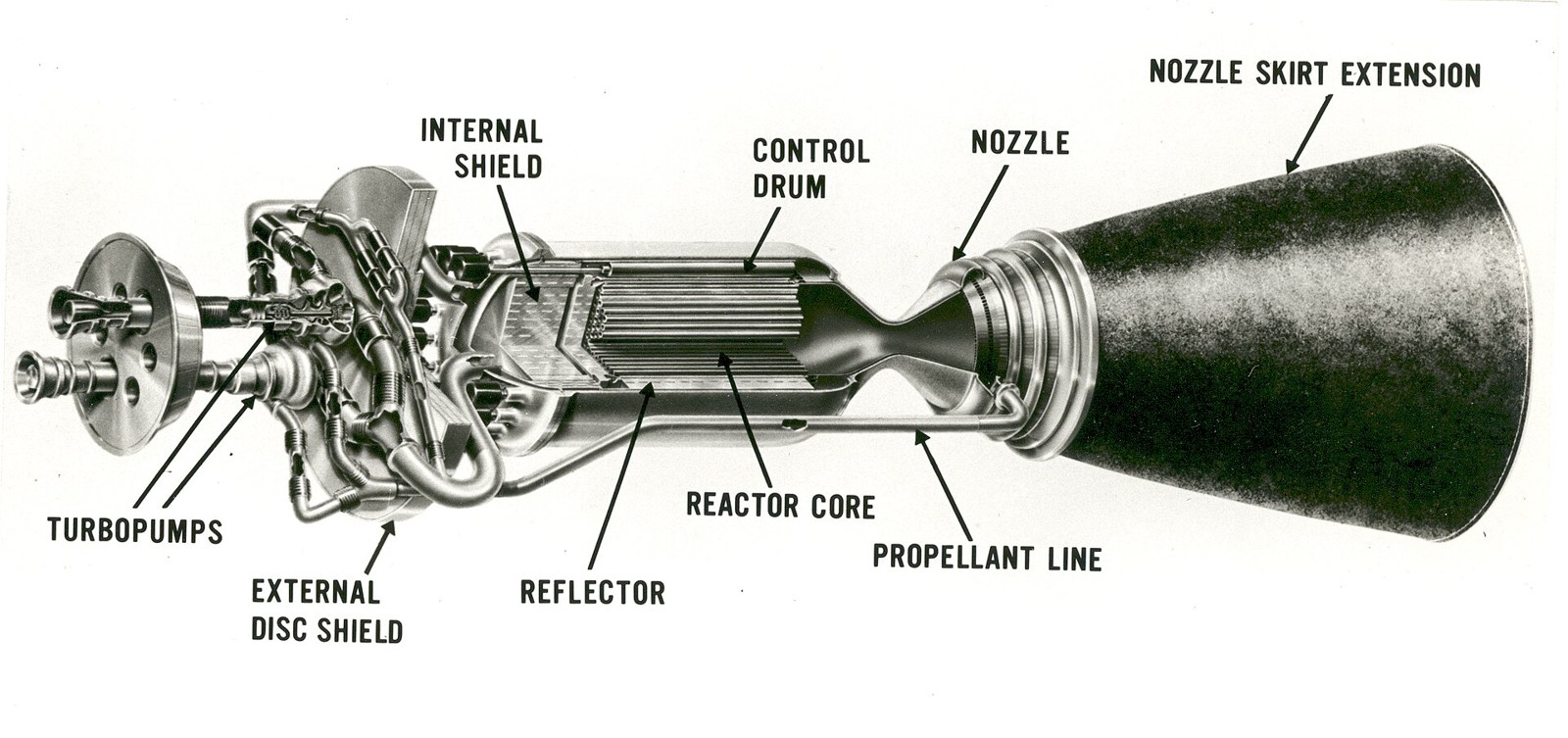

More recent news: the DARPA/NASA DRACO nuclear thermal demonstrator was canceled in 2025 (SpaceNews and Breaking Defense; I read these as summaries, so please check them before quoting). And I read that a 2026 NASA plan involves a nuclear-electric “SR-1 Freedom” vehicle (Ars Technica, March 2026). I haven’t verified details, so I’m only flagging it.
Electric propulsion isn’t chemical, but it’s worth a note. Hall thrusters (see the photo at the top) use xenon or krypton; Wikipedia says Starlink satellites use Hall thrusters with krypton or argon. Gridded ion thrusters like NASA’s NEXT-C (used on DART) reach up to about 4,220 s with xenon, per NASA’s fact sheet. That’s amazing efficiency, but with tiny thrust: great in space, useless on a launch pad.
PROS and CONS (of the “other” options)
PROS 👍
- Hybrids: throttle, shutdown, safer handling.
- Green monopropellants: higher density-Isp than hydrazine and far lower toxicity.
- Cold gas: extremely safe and simple.
- Peroxide and nitrous: milder oxidizers, simple plumbing.
- Nuclear and electric: potentially huge efficiency gains.
CONS 👎
- Hybrids: O/F shift, instability, low regression.
- Green monopropellants: newer, with less flight heritage and thrusters designed specifically for each blend.
- Cold gas: low performance (about 40 to 110 s).
- Peroxide: decomposes if contaminated; handling needs care.
- Nitrous oxide: can deflagrate under pressure.
- Nuclear and electric: regulation, cost and low thrust.
Which Engines Use It 🚀
| Engine / vehicle | Propellant type | Notes | Source |
|---|---|---|---|
| Draco / SuperDraco | MMH + NTO (hypergolic) | Draco post | SpaceX |
| GEM 63XL (Vulcan), AJ-60A (Atlas V) | HTPB solid | GEM 63XL post | Northrop, Wikipedia |
| Titan II, Apollo SM and LM, Shuttle OMS | NTO + hydrazine-family | Famous hypergolic users | Wikipedia, Braeunig |
| Aerobee (original engine) | Nitric acid + aniline | Sounding rocket | Wikipedia |
| Shuttle SRB, SLS booster | PBAN solid | See solids post | NASA |
| SpaceShipOne | N2O / HTPB hybrid | Unthrottleable, cold gas RCS | Wikipedia |
| Black Arrow Gamma 8 | HTP + kerosene | Eight chambers, 127 s | Wikipedia |
| GPIM thrusters | AF-M315E (HAN) | Flew June 25, 2019 | NASA |
| PRISMA, SkySat, ELSA-d | LMP-103S (ADN) | Green monoprop | Wikipedia (ECAPS) |
| Vulcan Centaur V RCS | Hydrazine | Per ULA’s user guide | ULA |
| Blue Moon Mk1 RCS | Gaseous H2/O2 from main tanks | Not a separate propellant | Blue Origin |
| Terran R booster flip | Nitrogen cold gas | See Aeon R post | Relativity |
| Stoke Andromeda thrusters | Integrated thrusters, no separate RCS found | Andromeda post | Stoke (not sourced beyond that) |
| Impulse Space Mira / Saiph | N2O + ethane bipropellant, 290 s | Tom Mueller’s company | Wikipedia |
| Dawn Aerospace B20 | N2O + propylene, 20 N | Hydrazine replacement | Wikipedia |
| Starlink satellites | Krypton or argon Hall thrusters | Electric | Wikipedia |
| NEXT-C (DART) | Xenon gridded ion | Electric | NASA |
| NERVA / Kiwi | Hydrogen, nuclear heated | Ground-tested only | Wikipedia |
Watch: Nuclear Thermal and a Hybrid Test 🎥
The U.S. Department of Energy explains nuclear thermal propulsion in under a minute:
Can’t see the video? Watch it on YouTube: How Does a Nuclear Thermal Propulsion Rocket Work? (U.S. Department of Energy)
And a 2014 hybrid motor test for SpaceShipTwo (the nylon-fuel version), via the news site Spaceflight Insider:
Can’t see the video? Watch it on YouTube: Virgin Galactic Hybrid Rocket Motor Test May 8 2014 (Spaceflight Insider)
The Star Queen’s Take 👑
My loves, I love this corner of rocketry because every propellant is a trade. Hybrids buy safety and throttle and pay with complexity. Green monopropellants buy safer handling and pay with newness. Cold gas buys simplicity and pays in performance. Nothing is free, and that is the whole point of engineering. ✨
Where do I think this goes? I’d bet on methane and hydrogen for big engines, green monopropellants quietly replacing hydrazine on satellites, and electric propulsion for anything patient. Nuclear thermal is the long shot I most want to see fly. That’s my opinion, not a forecast, and this post will be wrong somewhere in two years, which is why I label everything.
If you read just one of the others next, try the kerosene post for the density story and the hydrogen post for the efficiency one.
Sources
- Braeunig, Basics of Space Flight: Rocket Propellants (properties and theoretical Isp tables): http://braeunig.us/space/propel.htm
- NASA, Small Spacecraft State of the Art, in-space propulsion: https://www.nasa.gov/smallsat-institute/sst-soa/in-space_propulsion/
- NASA, Green Propellant Infusion Mission overview: https://www.nasa.gov/missions/tech-demonstration/green-propellant-infusion-mission-gpim-overview/
- NASA, GPIM nears completion: https://www.nasa.gov/missions/tech-demonstration/nasas-green-propellant-infusion-mission-nears-completion/
- NASA NTRS, GPIM: https://ntrs.nasa.gov/api/citations/20140012587/downloads/20140012587.pdf
- GPIM results papers (AIAA): https://doi.org/10.2514/6.2020-3826 and https://doi.org/10.2514/6.2020-3810
- AFRL, ASCENT propellant fact sheet: https://afresearchlab.com/wp-content/uploads/2020/07/AFRL_ASCENT-Propellant_FS_0922.pdf
- ESA Clean Space, Considering hydrazine-free satellite propulsion: https://www.esa.int/Space_Safety/Clean_Space/Considering_hydrazine-free_satellite_propulsion
- ESA Clean Space, Green technologies: https://www.esa.int/Space_Safety/Clean_Space/Green_technologies
- ESA Clean Space, Space missions taking account of the fast-changing chemical world: https://www.esa.int/Space_Safety/Clean_Space/Space_missions_taking_account_of_fast-changing_chemical_world
- Eurospace on REACH and hydrazine: https://eurospace.org/asd-eurospace-reinforces-reach-exemption-position-for-hydrazine-and-other-liquid-propellants/
- DLR / EUCASS 2017, Götzig, green propellants: https://elib.dlr.de/119357/1/Gotzig_2017_EUCASS%5B1%5D.pdf
- NASA Glenn, NEXT-C fact sheet: https://www1.grc.nasa.gov/wp-content/uploads/NEXT-C_FactSheet_11_1_21_rev4.pdf
- U.S. Department of Energy, How does a nuclear thermal propulsion rocket work? (video): https://www.youtube.com/watch?v=U1g2aSj9ZTc
- SpaceNews, DARPA cancels DRACO: https://spacenews.com/darpa-says-decreasing-launch-costs-new-analysis-led-it-to-cancel-draco-nuclear-propulsion-project/
- Breaking Defense, DRACO: https://breakingdefense.com/2025/06/darpas-draco-nuclear-propulsion-project-roars-no-more/
- Ars Technica, NASA’s plan for nuking Gateway: https://arstechnica.com/space/2026/03/here-is-nasas-plan-for-nuking-gateway-and-sending-it-to-mars/
- ULA, Vulcan User Guide (2023): https://www.ulalaunch.com/docs/default-source/rockets/2023_vulcan_user_guide.pdf
- Blue Origin, Blue Moon Mark 1: https://www.blueorigin.com/blue-moon/mark-1
- Relativity Space, Terran R announcement: https://www.relativityspace.com/press-release/2025/3/7/rycbar123
- Stoke Space, Nova: https://www.stokespace.com/nova-block-2
- Wikipedia: Hybrid-propellant rocket, Scaled Composites SpaceShipOne, SpaceShipTwo, Nitrous oxide, High-test peroxide, Black Arrow, Hydroxylammonium nitrate, Green Propellant Infusion Mission, ECAPS, Ammonium dinitramide, Cold gas thruster, Nuclear thermal rocket, NERVA, Hall-effect thruster, Ion thruster, Starlink, Dawn Aerospace, Impulse Space (all at https://en.wikipedia.org/)
- Related posts on this site: Hypergolic propellants, Solid rocket propellant, Draco and SuperDraco
- Images: Wikimedia Commons and NASA (credit and license in each caption). Diagrams by The Star Queen.