By The Star Queen
My loves, if you want to understand why two rival launch companies are tied together by one engine, you have to understand the BE-4. 🚀 It is the muscle behind Blue Origin’s New Glenn, it is the booster engine on United Launch Alliance’s Vulcan, and in May 2026 a New Glenn exploded during a static fire in an accident Blue Origin traced to a BE-4 valve. All numbers below are as of October 26, 2026. I’ll tell you which are official, which come from Wikipedia or interviews, and where sources disagree.
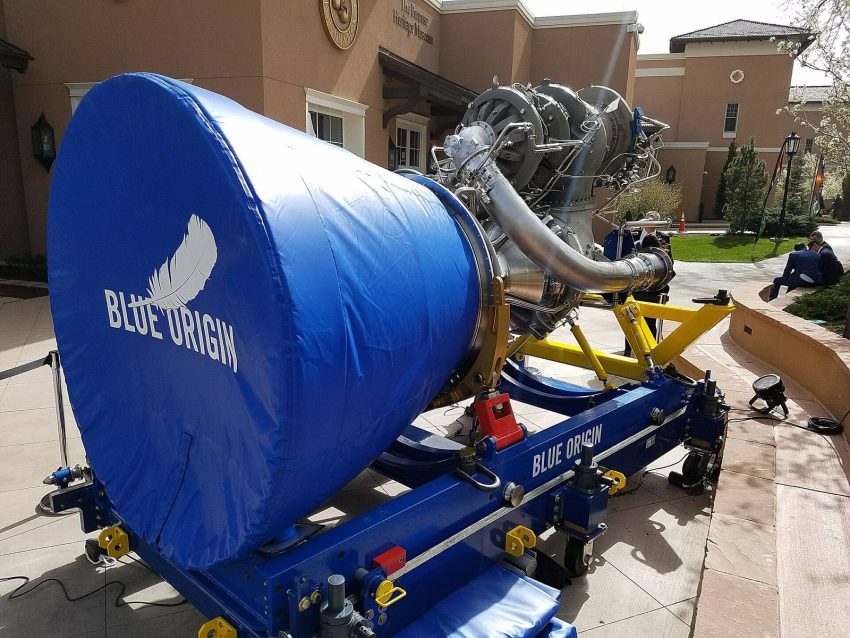
The first BE-4 to be hotfire tested (serial number 103) at the Space Symposium in Colorado Springs, April 2018, seen from the methane inlet side. Image: N2e, CC BY-SA 4.0, via Wikimedia Commons.

The Short Version
- What it is: a liquid methane and liquid oxygen engine using an oxygen-rich staged combustion cycle.
- Where it flies: seven on New Glenn’s first stage (the “7×2” version), nine planned for the super-heavy “9×4,” and two on each Vulcan. For the rocket-level story, see my New Glenn 7×2 vs 9×4 explainer and Vulcan Centaur explainer.
- Why it matters: it is the American-built replacement for the Russian RD-180 that powered Atlas V (more in my RD-180 deep dive).
Terms to know ✨
- Methalox: methane fuel burned with liquid oxygen (LOX). Methane is the main ingredient of natural gas.
- Staged combustion: a design where some propellant burns first in a small “preburner” to spin a turbine, and then all of that gas flows into the main chamber, so nothing is wasted.
- Oxygen-rich: the preburner runs with extra oxygen, so the hot gas pushing the turbine is mostly oxygen.
- Turbopump: a turbine-driven pump that pushes propellants into the engine at very high pressure.
- Throttling: running an engine at less than full thrust. Deep throttling is needed to land a booster gently.
- lbf: pounds-force, the unit most US engine thrust figures use. 1 lbf is about 4.45 newtons.
- Hydrostatic bearing: a bearing that floats the spinning shaft on a thin film of fluid instead of using balls or rollers.
The Numbers (With Honest Labels)
| Spec | Value | Source |
|---|---|---|
| Propellants | Liquid methane + liquid oxygen | Blue Origin; ULA |
| Cycle | Oxygen-rich staged combustion, one preburner, one turbine driving both pumps | Wikipedia (citing Blue Origin) |
| Thrust, sea level (current listing) | 640,000 lbf (about 2,847 kN) | Blue Origin engines page; Blue Origin news, Nov 20, 2025 (640,000 was a target then; 625,000 lbf demonstrated on the test stand) |
| Thrust, original spec | About 550,000 lbf (2,460 kN) | Wikipedia; ULA |
| Throttle range | Down to 220,000 lbf on Blue Origin’s page (about 34%, my arithmetic); Wikipedia lists 40 to 100% | Blue Origin; Wikipedia |
| Chamber pressure | About 140 bar (about 2,030 psi) | Wikipedia (not confirmed by Blue Origin) |
| Specific impulse | About 340 s | Wikipedia, citing a Bezos interview (unofficial) |
| Dry mass | About 5,400 kg (about 11,900 lb) for the original design | Wikipedia, citing a Dave Limp post (unofficial) |
| Gimbal | Plus or minus 5 degrees | Wikipedia |
| First flight | Jan 8, 2024 (Vulcan); Jan 16, 2025 (New Glenn) | Wikipedia |
Thrust conflict, explained: you will see 550,000 lbf in older articles and 640,000 lbf in newer ones. On November 20, 2025, Blue Origin said the BE-4 had “already demonstrated 625,000 lbf on the test stand” and would “achieve 640,000 lbf later this year,” with propellant subcooling lifting capability from the existing 550,000 lbf. Its engines page now lists 640,000. I haven’t found a Blue Origin statement confirming a 640,000 lbf demonstration, so treat 640,000 as the current rating Blue Origin lists, not a number I’ve seen proven. Seven engines at 640,000 lbf is about 4.48 million lbf (my arithmetic), which matches the 4.5 million lbf first-stage figure in the same announcement and in my New Glenn post. ULA’s own Vulcan materials have long used about 550,000 lbf, and I haven’t found a ULA statement that Vulcan’s engines were upgraded. Spaceflight Now reports Vulcan’s BE-4s aren’t identical to New Glenn’s, so don’t assume the same number for both rockets.
How Oxygen-Rich Staged Combustion Works
Most rocket engines make power in one of a few ways. Everyday Astronaut’s guide to engine cycles is a great tour, and I’ll borrow its framing. In a gas generator engine, a small fraction of propellant is burned just to drive the turbine, and that exhaust is dumped overboard. Easy, but wasteful. In a staged combustion engine, you burn some propellant in a preburner, push the hot gas through the turbine, and then feed all of it into the main chamber. You get more thrust and efficiency from the same propellant, at the price of nasty pressures and temperatures in the plumbing.
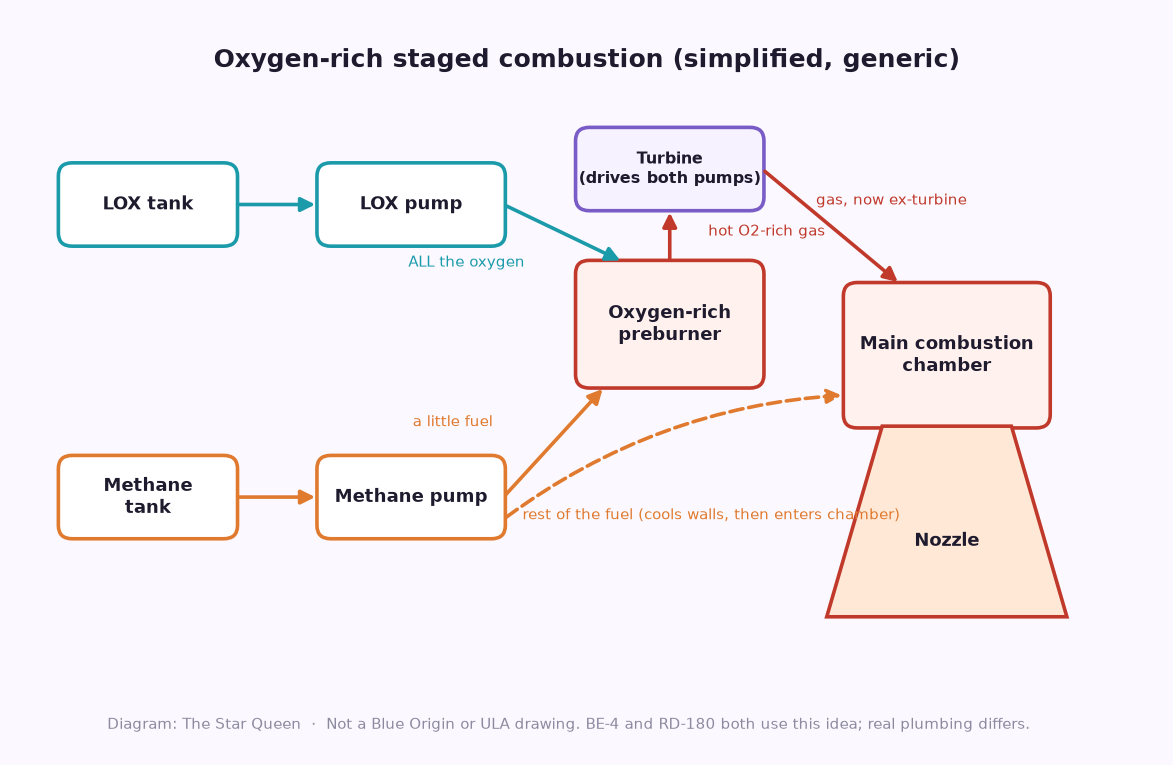
The “oxygen-rich” part means the preburner burns all the oxygen with just a little fuel. The turbine therefore spins in a stream of hot, high-pressure, oxygen-heavy gas. That is a gift for power, but a danger for metal, because hot gaseous oxygen can make ordinary metals burn. The Russian RD-180 handles this with an inert enamel coating on surfaces that touch the hot oxygen (Wikipedia). Blue Origin hasn’t published how the BE-4 solves it, so I won’t guess. Everyday Astronaut also gives a handy rule of thumb that preburner pressure runs roughly double the main chamber pressure, so the plumbing between the stages lives at truly punishing pressures.
Here is what Wikipedia (summarizing Blue Origin material) says about the BE-4’s specific design choices:
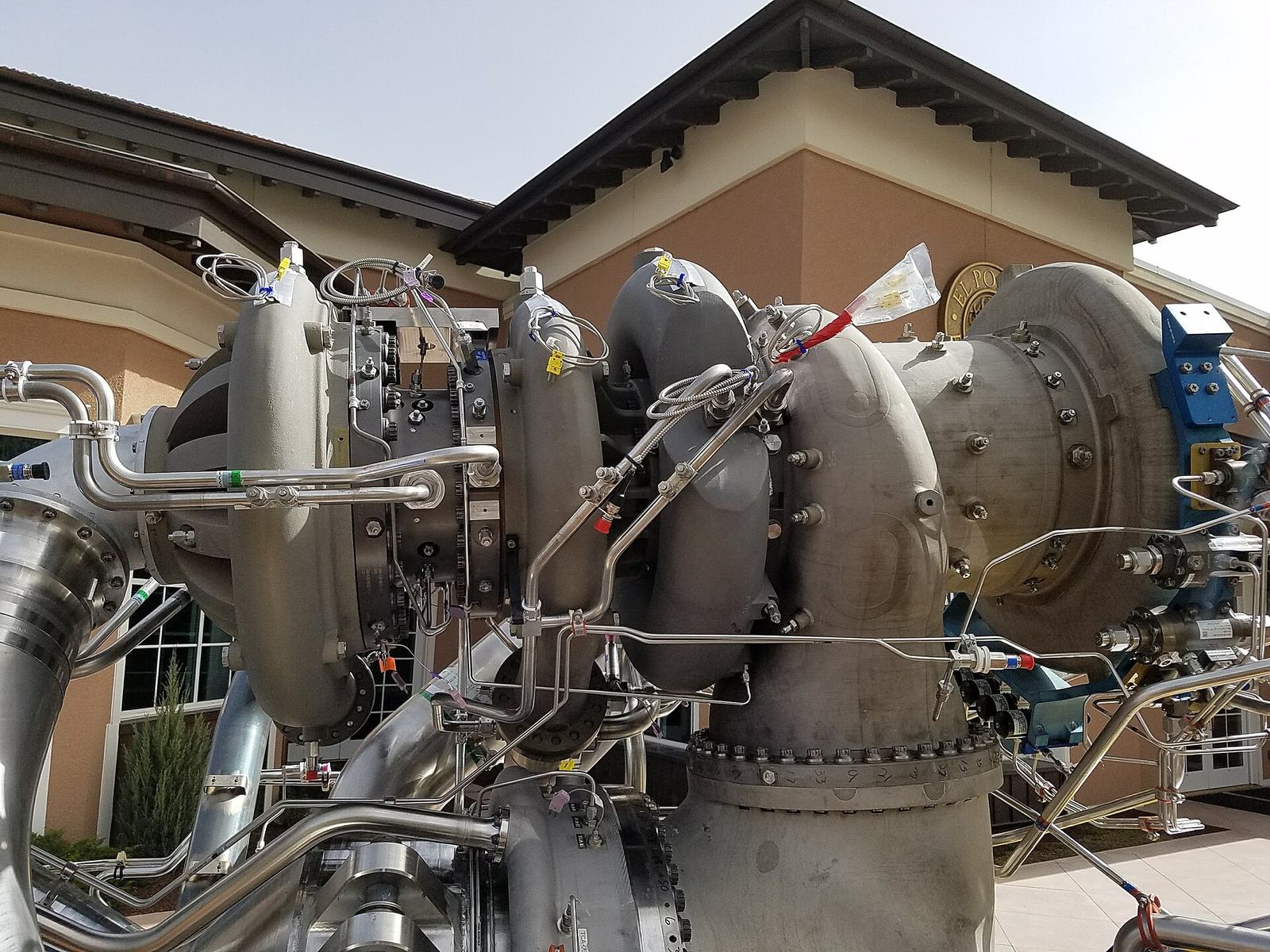
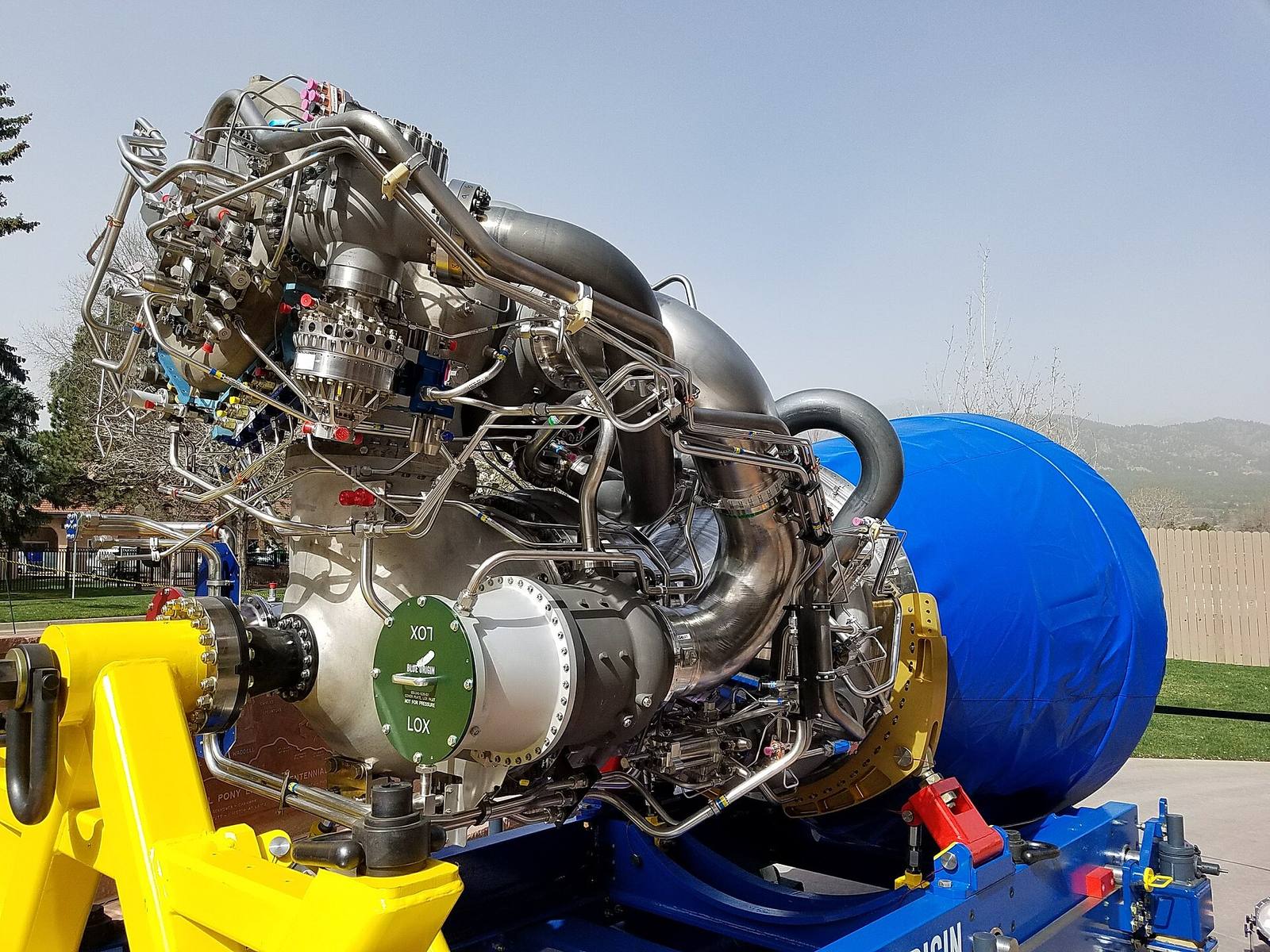
- One preburner and one turbine for both pumps. Simpler than a twin-turbine layout.
- Hydrostatic bearings in the turbopumps rather than balls and rollers, to add reliability and life.
- A “medium-performing version of a high-performance architecture.” That is a quote reported by Wikipedia, and it tells you the goal: durability first, record-chasing second.
- Autogenous pressurization. Methane can be boiled by the engine to pressurize its own tank, so the rocket doesn’t need to carry helium for that job.
- In-flight relight by starting the turbine from propellant head pressure, plus testing of deep throttling for landing.


Why Methane?
Methane gives up a lot of performance per pound compared with kerosene, burns cleaner (less soot inside the engine, which helps reuse), and, unlike hydrogen, it is dense enough that tanks don’t have to be giant. It also stores at a temperature much closer to liquid oxygen’s, which keeps stage design simple. As noted above, it can pressurize itself. Blue Origin has long described its engines as designed for reuse, and Wikipedia lists a design goal of up to 100 flights, which I’m treating as a stated design aim, not something demonstrated.
A Long Road: The Development Story
The timeline below is from Wikipedia and the reports it cites, with my own labels on the shaky parts.
- 2011: Blue Origin starts BE-4 work. It is the company’s first methane and LOX engine.
- September 2014: the engine is announced publicly, and ULA picks it as the replacement for the RD-180 on its future rocket. Blue Origin said at that time the BE-4 would be “ready for flight” by 2017.
- June 2017: Huntsville, Alabama is chosen as the site of the engine factory.
- October 2017: first hotfire, at 50% thrust for about 3 seconds. By March 2018 the engine had run at 65% for 114 seconds, and Wikipedia says full power was reached by August 2019.
- September 2018: ULA finalizes its choice of the BE-4.
- July 2020: the first pathfinder engine is delivered to ULA.
- Late 2022 to April 2023: two engines are integrated onto a Vulcan, and ULA’s CEO says qualification testing was complete.
- June 30, 2023: a BE-4 exploded about 10 seconds into a test and damaged the stand (reported by CNBC).
- January 8, 2024: BE-4s fly for the first time on Vulcan’s first launch.
- January 16, 2025: New Glenn’s debut.
Ars Technica’s Eric Berger wrote in August 2021 that the engine was more than four years late, and listed reasons including hardware shortages, resource priorities, COVID-19 and ULA and Space Force qualification demands. Turbopump problems were a particular headache, and ULA’s CEO said in 2020 that Blue Origin was still working on them; Wikipedia says the issue lasted until 2022. Combustion stability is another classic worry: methane at this scale in a new cycle meant a lot of proving work. I want to be fair here: delays on a first-of-its-kind engine are common, and the engine did eventually fly as designed.
🎬 Test Stand 4670: Building on a Legacy (Blue Origin). Blue Origin’s own video about the first BE-4 hotfire at the historic Test Stand 4670 in Huntsville, Alabama, completed in February 2024. Watch on YouTube
The Landing Engine: Deep Throttling and Reuse
New Glenn’s booster has to come back and land, which means the BE-4s must throttle far below their full-power setting. Blue Origin’s engines page lists a throttle floor of 220,000 lbf. Wikipedia says “tested deep throttling capability to at least 40% power.” A landing needs a very low final thrust-to-weight ratio, so engineers typically shut most engines down and use a few at low throttle. New Glenn landed its first booster on NG-2 in November 2025, and on NG-3 on April 19, 2026 it flew that booster again for the first time. Per Spaceflight Now and NASASpaceflight, Blue Origin replaced all seven BE-4s on the reflown booster and kept the NG-2 engines for future flights, and it flew thermal protection on one engine nozzle as a test. The booster’s turnaround was about 157 days. So the first reflight reused the stage but not the engines, which is a smart caution on a first try, and my read is that the real test of the “designed for reuse” claim still lies ahead.
Production: What I Can and Can’t Tell You
Blue Origin opened its Huntsville engine factory in February 2020. SpaceNews reported that it was designed for up to 42 engines per year, across both BE-4 and BE-3U, after a ramp-up of two to three years. At a later event, Jeff Bezos said Blue Origin planned to produce one BE-4 every three days in 2025 (reported by Payload). That works out to roughly 122 a year by my arithmetic. NASASpaceflight reported in 2024 that there were two production lines, one for ULA and one for New Glenn. I couldn’t find a verified count of engines actually built in 2025 or 2026. Treat the numbers above as targets and capacity, not output.
When Things Go Wrong: May 2026
On May 28, 2026, a New Glenn exploded during a static fire at Launch Complex 36. Blue Origin said on August 5 that the anomaly “originated at the main oxygen valve on one of the BE-4 engines.” The company said it was making small valve modifications that can be retrofitted to existing engines. ULA told Spaceflight Now that Blue Origin will modify Vulcan’s BE-4s too, even though they aren’t identical to New Glenn’s. I covered the details and the schedule fallout in my LC-36 explosion and rebuild post. This is one of those moments when “one engine for two rockets” cuts both ways: shared learning, shared risk.
The Star Queen’s Take 👑
I love the BE-4 as an engineering bet. Oxygen-rich staged combustion on methane is hard, and Blue Origin chose it for an engine meant to fly many times, with deliberately conservative touches like hydrostatic bearings. Getting it onto both Vulcan and New Glenn broke the United States’ dependence on a Russian engine, which was the whole point in 2014. The cost was years of delay and, lately, a serious valve problem. What I’m watching now: whether the retrofitted valve ends the story, whether a reflown booster can ever reuse its own engines, and whether the production numbers ever get published. Nothing proves an engine like flying it on schedule. 💜
Sources
- Blue Origin, Engines; New Glenn Update: Upgraded Engines and Subcooled Components Drive Enhanced Performance (Nov 20, 2025)
- Wikipedia, BE-4 and RD-180
- Everyday Astronaut, Rocket engine cycles
- Ars Technica, Blue Origin’s powerful BE-4 engine is more than four years late (Aug 2021)
- SpaceNews, Blue Origin opens Huntsville engine factory; Payload, Jeff Bezos opens up about New Glenn
- NASASpaceflight, Blue Origin works towards New Glenn debut, ramps BE-4 deliveries (Jun 2024)
- Spaceflight Now, Third flight of New Glenn to feature first reuse of booster (Apr 19, 2026) and Blue Origin identifies engine issue behind New Glenn explosion (Aug 6, 2026)
- CNBC, Blue Origin rocket engine explodes during testing (Jul 2023)
- Video: Blue Origin on YouTube