By The Star Queen · Star Queen Chronicles
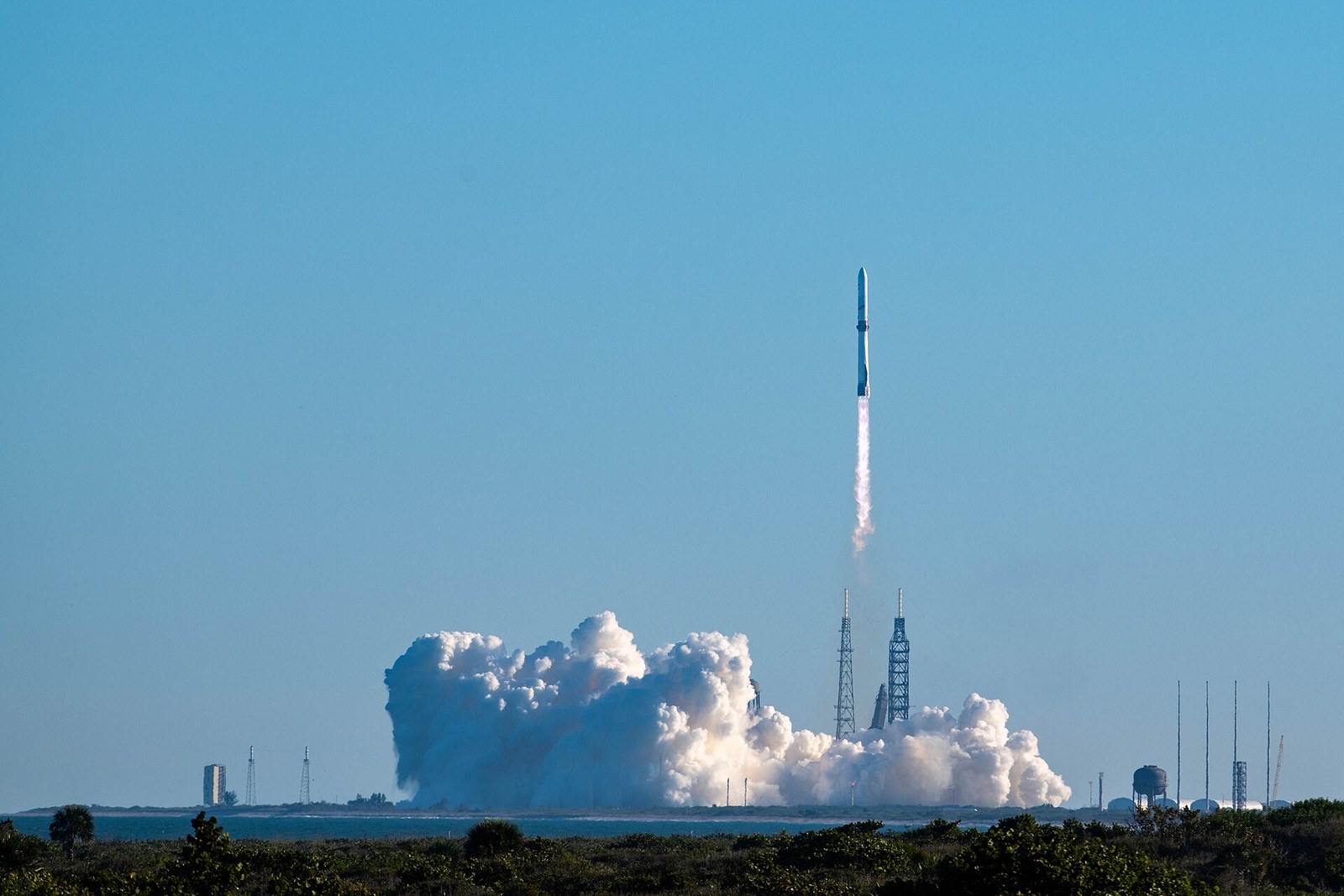
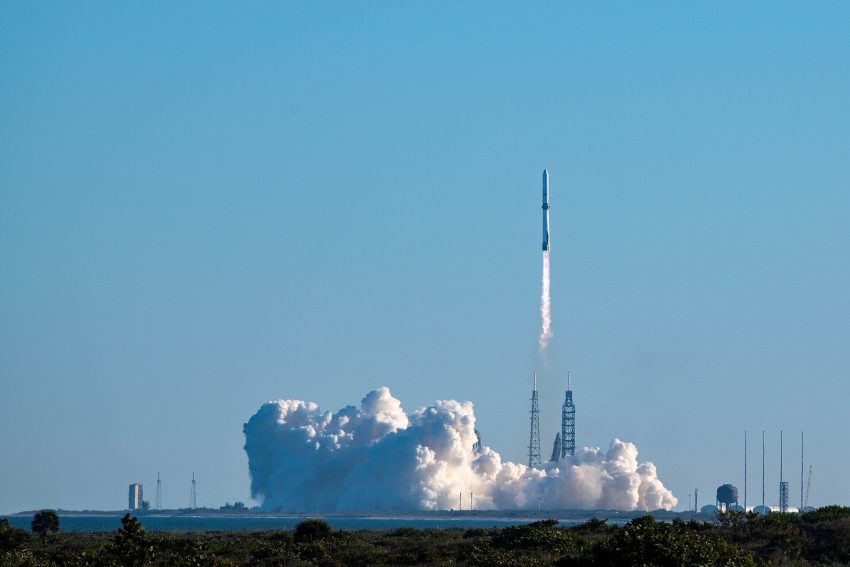
My loves, Blue Origin’s big rocket has a lot going on. 🌟 It’s flown three times, landed a booster twice, been grounded by a pad explosion, and already has a bigger version announced. If “7×2” and “9×4” sound like a secret handshake, don’t worry. I’ll break them down.
Everything below is as of October 25, 2026. I’ll label what’s official (from Blue Origin, NASA or another primary source), what’s reported by news outlets, and what’s my own arithmetic.
The Short Version
- 7×2 is the New Glenn that flies today: 7 BE-4 engines on the first stage, 2 BE-3U engines on the upper stage.
- 9×4 is the planned super-heavy version: 9 BE-4s and 4 BE-3Us, with a wider fairing. Blue Origin hasn’t given a debut date.
- Blue Origin says both versions will fly side by side.
- New Glenn has been grounded since a static-fire explosion on May 28, 2026. Blue Origin says it will fly again before the end of the year, but reports differ on whether that’s realistic.
Terms to know ✨
- BE-4: Blue Origin’s liquid methane and liquid oxygen engine. It powers New Glenn’s first stage, and two of them power ULA’s Vulcan.
- BE-3U: the vacuum-optimized hydrogen and oxygen engine on New Glenn’s upper stage.
- LEO / GTO / TLI: low Earth orbit, geostationary transfer orbit, and trans-lunar injection (the push that sends a payload toward the Moon). Rockets can lift very different amounts to each.
- Fairing: the nose cone that protects the payload during launch.
- Static fire: a test where the rocket is held down on the pad while its engines run.
- lbf: pounds of force, the unit most US engine thrust figures use.
What the Names Mean
The first number is how many BE-4 engines are on the first stage. The second is how many BE-3U engines are on the second stage. So 7×2 is the rocket you’ve seen launch from the Cape, and 9×4 adds two engines below and two above. 😄
The Numbers Side by Side
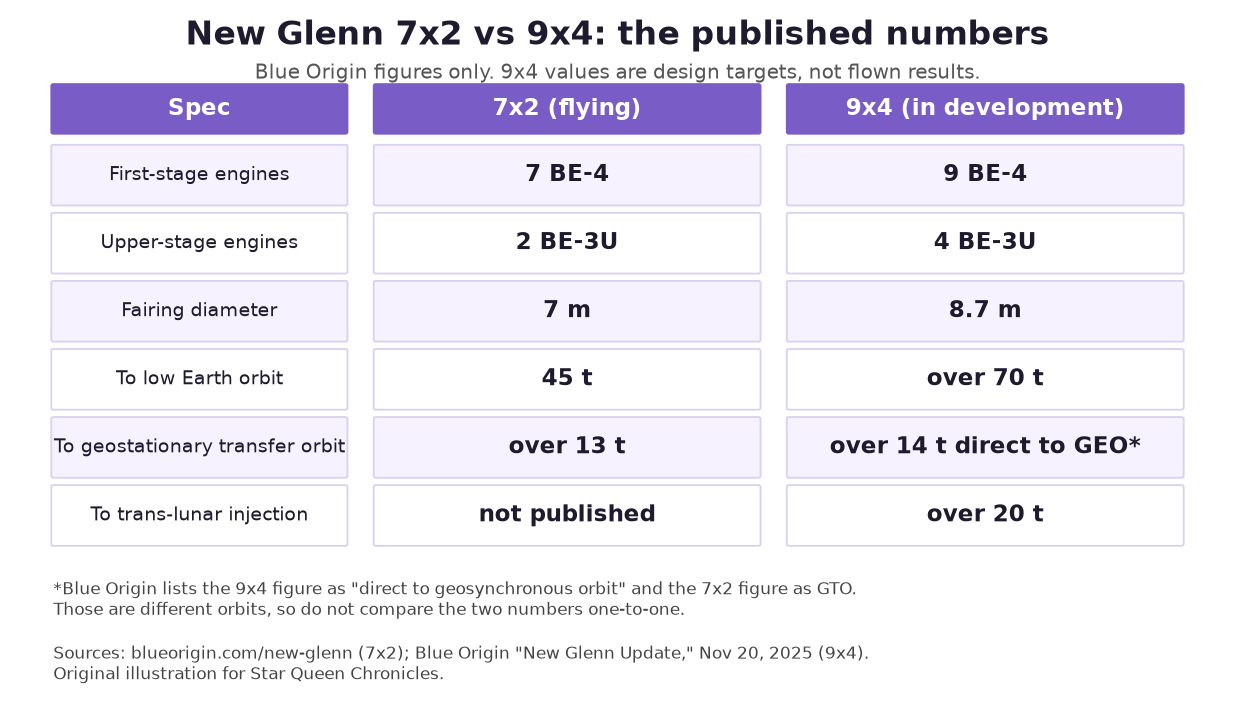
Official figures:
- 7×2: 45 metric tons to LEO and more than 13 metric tons to GTO, with a 7-meter fairing. The rocket stands more than 320 feet (98 m) tall, and the booster is designed for a minimum of 25 flights.
- 9×4: more than 70 metric tons to LEO, more than 14 metric tons direct to geosynchronous orbit, more than 20 metric tons to trans-lunar injection, and an 8.7-meter fairing.
Two cautions. First, Blue Origin’s 14-ton 9×4 number is “direct to geosynchronous orbit,” while the 7×2 number is to GTO. Those are different targets, so don’t compare them one-to-one. Second, I couldn’t find an official TLI number for the 7×2, so I’m not going to guess one.
My own arithmetic: 70 tons versus 45 is about 56 percent more to LEO. Space.com described it as “about 50%.”
What Actually Changes on the 9×4
Beyond the extra engines, the 9×4 gets the wider 8.7-meter fairing, compared with 7 meters on the 7×2. Blue Origin’s engine page lists four BE-3Us on the 9×4. Spaceflight Now reports that LC-36A serves the 7×2, while a second pad, LC-36B, is under construction for the 9×4.
On timing, sources don’t agree. Blue Origin told Ars Technica in 2025, “We aren’t disclosing a specific timeframe,” and said the iterative design means it can build the rocket quickly. One unnamed source told Ars then that 2027 was possible. NASA slides reported by Space.com in October show Blue Origin planning a 9×4 first flight in Q4 2027. But Ars’s October 16 piece says the 9×4 could debut in 2028. Treat any date as a target, not a promise.
Upgrades Both Versions Get
In November 2025, Blue Origin announced upgrades that it said would be phased in starting with NG-3:
- First-stage thrust rising from 3.9 million to 4.5 million lbf. The BE-4 is now listed at 640,000 lbf, up from 550,000. (My arithmetic: seven engines at 640,000 lbf is about 4.48 million, so the numbers agree.)
- Upper-stage thrust rising from 320,000 to 400,000 lbf.
- A reusable fairing, a lower-cost tank design, and a reusable heat shield.
Reuse: “Never Tell Me The Odds”
New Glenn’s first stage is built to land on a ship at sea. NG-2 (November 13, 2025) landed its booster on the ship Jacklyn. Then came NG-3 on April 19, 2026, which flew that same booster again. NASASpaceflight reported a turnaround of about 157 days, and noted that SpaceX’s first reused Falcon 9 booster had a 356-day gap. That is a genuine milestone. 🎉

The Flight Record
- NG-1, January 16, 2025. Reached orbit with the Blue Ring Pathfinder. The booster was lost during descent (Blue Origin).
- NG-2, November 13, 2025. Sent NASA’s twin ESCAPADE Mars probes on their way, and the booster landed (Blue Origin).
- NG-3, April 19, 2026. First booster reflight and landing. But the upper stage’s BE-3U underperformed, and AST SpaceMobile’s BlueBird 7 satellite ended up in a too-low orbit and was lost (Ars Technica, NASASpaceflight).
- FAA closure, May 22, 2026. The FAA said the direct cause was a cryogenic leak that froze a hydraulic line and caused a thrust anomaly in the second-stage burn. Blue Origin listed nine corrective actions (via Florida Today/USA Today).
Reports differ on how to count. Spaceflight Now says Blue Origin flew three New Glenn missions before May 28. Ars Technica’s October 16 piece says Blue Origin “has launched to orbit twice,” which fits if you don’t count NG-3’s payload as delivered. I’ll say three launches, with one payload lost.
May 28 and Return to Flight
On May 28, 2026, a New Glenn exploded during a static fire at LC-36, ahead of what would have been the fourth flight. Blue Origin said the anomaly began at the main oxygen valve of one BE-4, and it said on August 5 that updated hardware would be ready by the end of August. The payload for that flight, 48 Amazon Leo satellites, was safe elsewhere. I'm saving the full story of the pad damage and the rebuild for my next post (it'll be at starqueenchronicles.com/new-glenn-lc-36-explosion-rebuild-and-return-to-flight/ once it's published).
The status today: Blue Origin says it will fly again before the end of 2026. Jeff Bezos has told Fox News he still wants December, per NASASpaceflight and Spaceflight Now. Ars Technica calls December “unlikely” and expects the first few months of 2027. I haven’t seen a firm launch date from Blue Origin.
How It Stacks Up
Published figures use different assumptions, so treat this as a rough guide.
- Falcon Heavy (SpaceX): 63,800 kg to LEO, 26,700 kg to GTO, 5.2 m fairing, 70 m tall. My arithmetic: the 9×4’s “over 70 t” would be roughly 10 percent more to LEO, if it hits its target.
- Starship (SpaceX): SpaceX lists 100+ tons to orbit in a fully reusable configuration, 124 m tall, 9 m diameter, 33 Raptors on the booster. That’s well above the 9×4.
- Vulcan VC6 (ULA): 27,200 kg to LEO, 14,500 kg to GTO, 11,500 kg to TLI, 5.4 m fairing. My arithmetic: the 7×2’s 45 t is about 65 percent more than that LEO figure, and the 9×4’s “over 20 t” TLI is roughly 1.7 times Vulcan’s.
- SLS Block 1 (NASA): more than 27 t to trans-lunar injection, 8.8 million lbf of thrust, 322 ft tall. My arithmetic: nine BE-4s at 640,000 lbf is about 5.76 million lbf, around two-thirds of that thrust.
Ars Technica wrote that the 9×4 would have a lift capacity “nearly on par” with SLS but a reusable first stage, and would likely cost less than one-tenth of SLS’s “estimated $2.2 billion” cost. That’s Ars’s estimate, not a NASA or Blue Origin figure. The sources I read don’t say whether the 9×4’s numbers assume the booster is recovered.
What to Watch Next
- A New Glenn return-to-flight date. The pad rebuild is the gating item. Watch for a launch date and what’s on top.
- The FAA’s decision on LC-36A. The FAA is weighing a change from 12 to 50 launches a year at that pad. The comment period closes October 30.
- More booster reflights. A second reflight would show whether 157 days was a fluke.
- Progress on LC-36B and the 9×4. Any official debut date would be big news.
- A published TLI figure for the 7×2.
The Star Queen’s Takeaway 👑
New Glenn is one of the most capable rockets flying on paper, and it has already done something very hard: it landed a booster and flew it again. But it’s flown just three times, and one of those left a satellite in the wrong orbit. The 9×4 is exciting, but today it’s a set of design targets. I’m cheering for Blue Origin to get the 7×2 back in the air first. 🚀
Sources
- Blue Origin, New Glenn (undated page): https://www.blueorigin.com/new-glenn
- Blue Origin, New Glenn Update (Nov 20, 2025): https://www.blueorigin.com/news/new-glenn-upgraded-engines-subcooled-components-drive-enhanced-performance
- Blue Origin, Engines: BE-4, BE-3U, BE-7 (undated): https://www.blueorigin.com/engines/be-7
- Blue Origin, NG-1 mission (Jan 16, 2025): https://www.blueorigin.com/news/new-glenn-ng-1-mission
- Blue Origin, NG-2 launches ESCAPADE, lands booster (Nov 13, 2025): https://www.blueorigin.com/news/new-glenn-launches-nasa-escapade-lands-fully-reusable-booster
- Blue Origin, GS1-3 hotfire updates (May 28 to Aug 5, 2026): https://www.blueorigin.com/news/gs1-3-hotfire-updates
- Ars Technica, errant upper stage spoils New Glenn booster reuse (Apr 19, 2026): https://arstechnica.com/space/2026/04/errant-upper-stage-spoils-blue-origins-success-in-reusing-new-glenn-booster/
- NASASpaceflight, BlueBird 7 declared lost after New Glenn launch (Apr 19, 2026): https://www.nasaspaceflight.com/2026/04/ast-bluebird-7-lost-new-glenn-launch/
- Florida Today/USA Today, FAA clears Blue Origin after NG-3 mishap (May 23, 2026): https://www.usatoday.com/story/tech/science/space/2026/05/23/faa-oks-blue-origin-new-glenn-rocket-launches-amid-600m-brevard-expansion-project-on-merritt-island/90235453007/
- Spaceflight Now, Blue Origin identifies engine issue behind New Glenn explosion (Aug 6, 2026): https://spaceflightnow.com/2026/08/06/blue-origin-identifies-engine-issue-behind-new-glenn-explosion/
- Ars Technica, Blue Origin’s plans for New Glenn (Nov 20, 2025): https://arstechnica.com/space/2025/11/blue-origin-says-its-just-getting-started-with-the-new-glenn-rocket/
- Space.com, Blue Origin will build a “super heavy” New Glenn (Nov 20, 2025): https://www.space.com/space-exploration/launches-spacecraft/jeff-bezos-blue-origin-will-build-a-super-heavy-version-of-its-powerful-new-glenn-rocket
- Ars Technica, Blue Origin is going all in on New Glenn (Oct 16, 2026): https://arstechnica.com/space/2026/10/blue-origin-is-going-all-in-on-the-new-glenn-rocket/
- Spaceflight Now, Blue Origin to add Florida launch pads (Oct 16, 2026): https://spaceflightnow.com/2026/10/16/blue-origin-to-add-new-florida-launch-pads-seeks-aggressive-increase-in-new-glenn-flight-rate/
- NASASpaceflight, Blue Origin LC-36 rebuild (Oct 11, 2026): https://www.nasaspaceflight.com/2026/10/blue-origin-lc-36-rebuild-new-glenn/
- Space.com, when will SpaceX and Blue Origin fly to the Moon (Oct 21, 2026): https://www.space.com/space-exploration/artemis/when-will-spacex-and-blue-origin-fly-to-the-moon-nasa-reveals-lunar-lander-timelines-and-an-artemis-iii-update
- FAA, Blue Origin New Glenn environmental review (undated page): https://www.faa.gov/space/stakeholderengagement/blue-origin-new-glenn
- SpaceX, Falcon Heavy (undated page): https://www.spacex.com/vehicles/falcon-heavy/
- SpaceX, Starship (undated page): https://www.spacex.com/vehicles/starship/
- ULA, Vulcan Centaur (undated page): https://www.ulalaunch.com/rockets/vulcan-centaur
- NASA, Space Launch System fact sheet (Dec 2021): https://www.nasa.gov/wp-content/uploads/2021/12/sls_fact_sheet.pdf