By The Star Queen
My loves, a bonus engine post, because these “engines” deserve it. 🔥 When Vulcan lifts off, most of the roar at the start doesn’t come from the two BE-4s. It comes from up to six giant solid rocket boosters called GEM 63XLs, each about 72 feet long. They have no pumps, no turbines and no throttle: just a huge tube of solid propellant that, once lit, burns until it’s gone. They are also at the center of Vulcan’s current grounding. Here is how they work and what’s special about them, as of October 26, 2026. (For the full grounding timeline and what officials have said, see my booster problem status post. This post is about the engineering.)
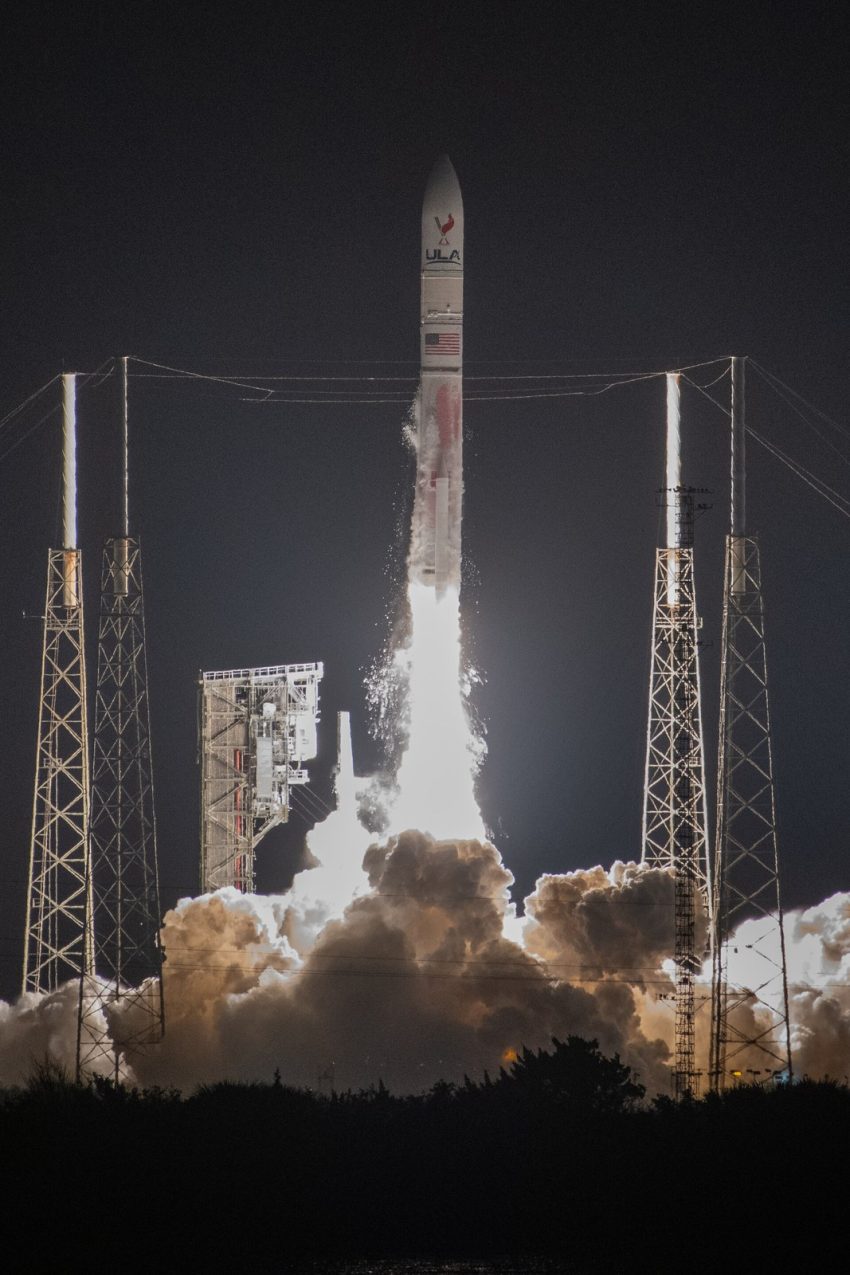
Vulcan’s first certification flight (Cert-1) leaving the pad on January 8, 2024, with two GEM 63XL boosters. Image: U.S. Space Force photo by Airman 1st Class Spencer Contreras, public domain, via Wikimedia Commons.

The Short Version
- Maker: Northrop Grumman, in the long-running Graphite-Epoxy Motor (GEM) family.
- Role: strap-on boosters for Vulcan Centaur, in groups of 0, 2, 4 or 6 (see my Vulcan Centaur explainer).
- Record claim: Northrop’s datasheet calls the GEM 63XL “the longest monolithic, single-cast solid rocket motor ever produced,” a title it says the shorter GEM 63 held before it.
- Siblings: the liquid engines in this series are the BE-4 on the first stage and the RL10 on the upper stage.
Terms to know ✨
- Solid rocket motor (SRM): a rocket whose fuel and oxidizer are mixed into a solid block, like a giant firework. It can’t be turned off once lit.
- GEM: Graphite-Epoxy Motor, Northrop Grumman’s family of strap-on boosters (the “63” is the diameter in inches).
- Monolithic, single-cast: the propellant is poured in as one piece instead of stacked segments, so there are no joints between segments.
- Propellant grain: the block of solid propellant inside the case.
- Nozzle: the bell at the bottom that turns hot gas into thrust.
- Insulator: a heat shield inside the nozzle (here made of carbon composite) that protects the metal structure.
- Static fire: firing a motor bolted down on the ground to test it.
The Numbers (And Where They Disagree)
| Spec | Value | Source |
|---|---|---|
| Total length | 864 in (2,195 cm), about 72 ft | Northrop Grumman datasheet, 2025 (ULA lists 71.8 ft) |
| Diameter | 63 in (160 cm) | Northrop Grumman |
| Total mass | 117,700 lb (53,400 kg) | Northrop Grumman (Wikipedia: about 117,000 lb) |
| Propellant mass | 105,900 lb (48,000 kg) | Northrop Grumman (Ars Technica: more than 105,000 lb) |
| Burn time | 87.3 s | Northrop Grumman (ULA lists a nominal 90 s) |
| Maximum thrust | 463,249 lbf | Northrop Grumman (ULA lists a peak vacuum thrust of 459,600 lbf) |
| Exit plane diameter | 56 in (142 cm) | Northrop Grumman |
| Propellant | HTPB binder, ammonium perchlorate oxidizer, aluminum powder fuel (family description) | Wikipedia, GEM family article |
| Case | Carbon-fiber composite (graphite epoxy) | Wikipedia; Northrop Grumman |
Why there are two sets of numbers: Northrop’s datasheet gives 463,249 lbf and 87.3 s. ULA’s Vulcan page lists 459,600 lbf and a “nominal” 90 s burn. The small differences come from different measurements (peak thrust, burn time definitions, test conditions), and I don’t have the definitions, so treat both as correct for their own purposes. My arithmetic: six boosters at 463,249 lbf peak is about 2.78 million lbf, versus about 1.1 million lbf for two BE-4s at the older 550,000 lbf figure. That’s why Vulcan’s six-booster version (VC6) is the heavy lifter, though the peak thrust only occurs for part of the burn and the average is lower.
The datasheet’s history: Northrop’s 2020 version of the datasheet said the GEM 63XL was “scheduled for first flight in 2023.” Its September 2025 update has the same specification table (I checked both) and says the motor was “tested and qualified for use in 2021” and first flew on Vulcan’s Cert-1 in January 2024. The first qualification static test (QM-1) was held on August 13, 2020, with the motor chilled to 40 °F, per Northrop’s test sheet.
What Makes It Interesting
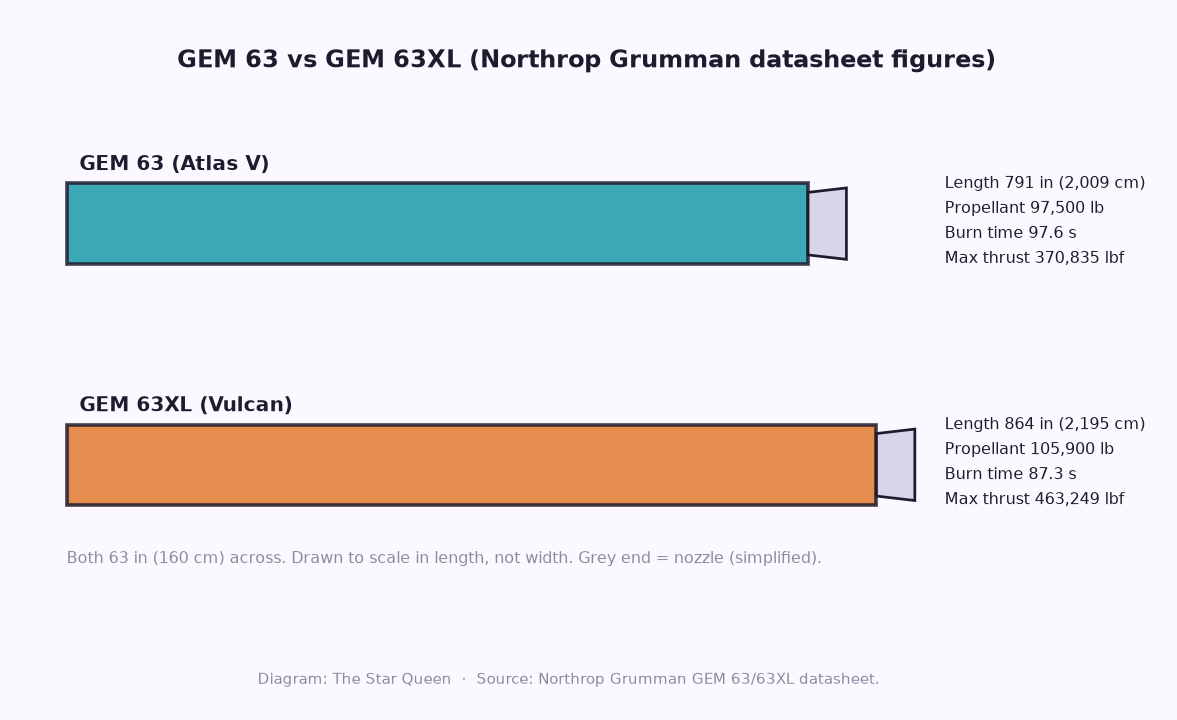
1. It is stretched on purpose. The GEM 63XL is the GEM 63 made longer: 864 inches versus 791 (Northrop). Wikipedia says that’s about 73 inches longer. It holds about 8,400 lb more propellant (105,900 versus 97,500, my subtraction from the datasheet), gives about 25% more peak thrust (463,249 versus 370,835 lbf, my arithmetic), and burns about 10 seconds shorter (87.3 versus 97.6 s). A shorter burn with a higher thrust is the natural trade for a booster that has to get a heavy rocket off the pad quickly.
2. It’s cast as one piece. Many large solid motors, including the Space Shuttle’s boosters, were built from stacked segments, and joints between segments have historically been a hazard. A single-cast motor avoids those joints. That is what “monolithic” means, and it’s the feature Northrop highlights.
3. It has a composite case. The case is made of carbon-fiber composite rather than steel, which reduces weight. Wikipedia says the first GEM (the GEM 40, flown in 1990) replaced steel Castor 4 casings and used the weight savings to lengthen the booster. That is the family’s design idea in a nutshell: composite cases and bigger propellant loads.
4. It has no pumps. There’s no turbopump, preburner or cycle to explain, which is why I couldn’t write a cycle diagram. Instead, the engineering lives in the chemistry of the propellant, the geometry of the grain (the shape of the hollow channel down the center decides how thrust changes over time) and the nozzle. This is not described in the Northrop sheet, so I’m giving you the general principle, not their design details.
5. The nozzle is fixed. The thrust-vectoring GEM 63XLT was under development for the cancelled OmegA rocket (Wikipedia), which implies that Vulcan’s GEM 63XL does not steer its own thrust. I did not find a direct statement of this in a ULA source, so I’m marking it as an inference. On Vulcan, the BE-4s’ gimbaling does the steering.
The Family Tree
The GEM story begins with the GEM 40 on the Delta II in 1990, then the GEM 46 (Delta III and Delta II Heavy) and the GEM 60 (Delta IV). The GEM 63 was a “drop-in” replacement for Aerojet Rocketdyne’s AJ-60A on Atlas V, at about half the cost, according to ULA via Wikipedia. It first flew on NROL-101 in November 2020. Wikipedia reports 77 GEM 63 boosters flown with no failures, and the motor retired in 2026 after the final Atlas V with satellites launched. The GEM 63XL is the only current GEM motor in use, according to Wikipedia. The motors have changed hands from Hercules to Alliant Techsystems to Orbital ATK to Northrop Grumman, which has made them since 2017.
For the Atlas side of this story, see my Atlas V final chapter post and my RD-180 deep dive.
🎬 GEM 63XL Static Test (Northrop Grumman). Northrop Grumman’s own video of a GEM 63XL static test. Watch on YouTube
The Two Nozzle Anomalies
Because solid motors can’t be shut down, a failure inside one is a big deal. Vulcan has had two nozzle problems in four flights. In brief:
- Cert-2, October 4, 2024. About 35 to 37 seconds after liftoff, one GEM 63XL lost its nozzle. Wikipedia says about 35 seconds. My earlier booster post gave about 37 seconds. I’m not sure which is more precise, so I’m giving the range. The rocket still reached orbit, and the failure was later attributed to manufacturing defects, per Wikipedia. Ars Technica said investigators traced it to a carbon composite insulator that failed to protect the metal structure from the exhaust.
- USSF-87, February 12, 2026. A ULA vice president said “early during flight, the team observed a significant performance anomaly on one of the four solid rocket motors.” Again, the mission reached orbit.
Since then, Northrop has run a static fire on April 15 and said on its July 21 earnings call that a “component redesign” was proven in a successful static fire and that it expected to begin delivering redesigned motors by the end of the year. I don’t know the root cause beyond that, and I’m not going to guess. My status post has the sources and quotes.

Why Use Solids at All?
It’s a fair question after two anomalies. Solids are mechanically simple, can be stored ready to go and give a lot of thrust at liftoff for relatively low cost, which is exactly when a heavy rocket needs help. The drawback is that you can’t throttle or shut them off, and a defect can’t be corrected in flight. That’s why booster qualification is so careful. ULA says Vulcan can fly with 0, 2, 4 or 6 boosters, so its heaviest missions rely on them most. That’s partly why a booster problem hits the rocket’s schedule so hard.
🎬 Vulcan Cert-1 Launch Highlights (United Launch Alliance). ULA’s own highlights from Vulcan’s first flight, showing the solid boosters in action. Watch on YouTube
The Star Queen’s Take 👑
I’m fascinated by the GEM 63XL because it is simple in concept and unforgiving in practice. A rocket engine with a pump can sometimes be tuned, throttled or shut down; a solid can’t. 💜 The good news is that Vulcan survived both nozzle problems and still reached orbit, which says something about the rocket’s margin. The honest news is that the root cause isn’t public beyond a manufacturing defect in the first case, and the second has only a redesign announcement. I’ll be watching for a delivered redesigned motor, a clean static fire and, of course, a Vulcan return to flight.
Sources
- Northrop Grumman, GEM 63 and GEM 63XL datasheet (2025 version; the 2020 version has the same specifications) and QM-1 static test sheet (Aug 2020)
- Wikipedia, Graphite-Epoxy Motor
- ULA, Vulcan Centaur (via my Vulcan explainer)
- Ars Technica, ULA’s Vulcan launcher still has a solid rocket booster problem (Feb 12, 2026)
- Spaceflight Now, Vulcan suffers solid rocket booster problem during USSF-87 launch (Feb 12, 2026)
- Northrop Grumman Q2 2026 earnings call transcript, as cited in my booster status post (Jul 21, 2026)
- Videos: Northrop Grumman and ULA on YouTube