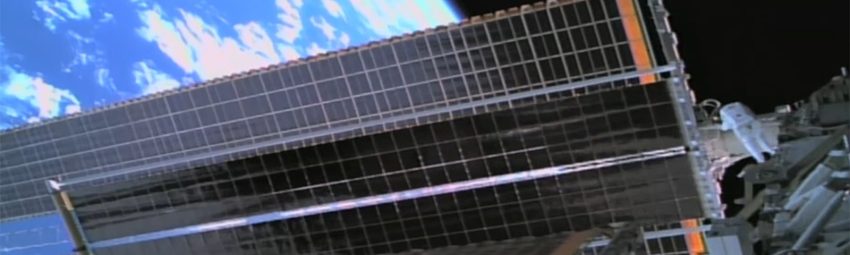
Friends, remember when I told you one more spacewalk would finish the station’s big solar upgrade? They did it. 🙌
On Thursday, Nov. 5, NASA astronaut Anil Menon and Canadian Space Agency astronaut Joshua Kutryk floated out of the Quest airlock and installed the eighth and final International Space Station Roll-Out Solar Array, or IROSA. When that last wing unfurled on the starboard end of the truss, a campaign that started in February 2021 was finally done.
How the Day Went
The spacewalk began at 8:36 a.m. EST, when the pair switched their suits to battery power, and ended at 3:35 p.m. EST. Total time outside: 6 hours and 59 minutes.
Their job was the hardest of the set. The mounting point sits at the far starboard end of the main truss, beyond the reach of Canadarm2. After Kutryk freed the folded, roughly 750-pound array from its carrier, Menon rode the robotic arm partway out, then the two handed the array back and forth and walked the last stretch themselves. Inside, NASA astronauts Luke Delaney and Jessica Watkins flew the arm with help from the ground.
They seated the array on its bracket, swung it open to about 20 feet wide, and waited for orbital night to mate the power cables. Connecting live solar hardware in sunlight is a no-go, so every cable job waits for Earth’s shadow.
The Mid-Walk Snag
About four and a half hours in, Mission Control saw a problem: the newly connected array was delivering only about half the electrical current engineers expected. NASA astronaut Nichole Stilwell, working as the spacewalk officer in Houston, told the crew they were not necessarily go to deploy.
Because they could only safely touch those connectors again in darkness, Kutryk and Menon cleaned up the worksite and parked the arm while they waited for the next night pass. When the station slipped into shadow again, Kutryk disconnected one cable, inspected both ends, and plugged it back in firmly. After sunrise, Stilwell radioed the words every space fan loves: good currents, go for deploy.
Kutryk released the last restraint bolts, and the array unrolled on its own to its full length of about 63 feet. No motor. Just strain energy stored in carbon-fiber composite booms, the same clever trick as the earlier IROSAs. Deployment took about 10 minutes. “Josh, deployment is complete,” Mission Control called. Menon’s reply at the end of the day was even better: “We got it done!”
Why This Upgrade Matters
According to NASA, the eight roll-out arrays raise the station’s power generation capacity from about 160 kilowatts to roughly 215 kilowatts, an increase of up to 30 percent. The original wings, delivered by space shuttles between 2000 and 2009, were designed for about 15 years. Rather than rip them off, NASA mounts the thinner, more efficient IROSAs in front of them so the station keeps producing power from both.
It took 18 spacewalks over more than five years to prepare the channels and install all eight arrays. The final pair rode up in a SpaceX cargo Dragon trunk, which always makes my SpaceX heart happy. 🚀 Extra power keeps the science humming and supports the station through its planned retirement and controlled deorbit around 2030.
Thursday was U.S. spacewalk 101 and the 286th spacewalk for station assembly, maintenance and upgrades. It was Menon’s fifth spacewalk and Kutryk’s second. Next U.S. spacewalks are eyed for early January to work on the Alpha Magnetic Spectrometer.
From My Front Yard to Orbit
I’ll be volunteering my time on the CCSFS bus tours this MAX POWER weekend, and I’m looking forward to it. Knowing the ISS just got its last new solar wing feels like the perfect send-off into that busy Space Coast weekend. Clear skies up there. ✨
The Star Queen
Sources
- NASA Space Station Blog, “Spacewalkers Install Final Roll-Out Solar Array” (Nov. 5, 2026)
- NASA Space Station Blog, “Spacewalk Begins to Install Last Roll-Out Solar Array” (Nov. 5, 2026)
- Spaceflight Now, “Spacewalkers complete five-year effort to upgrade space station power supply” (Nov. 5, 2026)
- Space.com / collectSPACE, “‘We got it done!’ Spacewalking astronauts finish installing next-gen ISS solar arrays” (Nov. 5, 2026)
- Canadian Space Agency, “Second spacewalk for CSA astronaut Joshua Kutryk” (Nov. 5, 2026)