By The Star Queen · Star Queen Chronicles
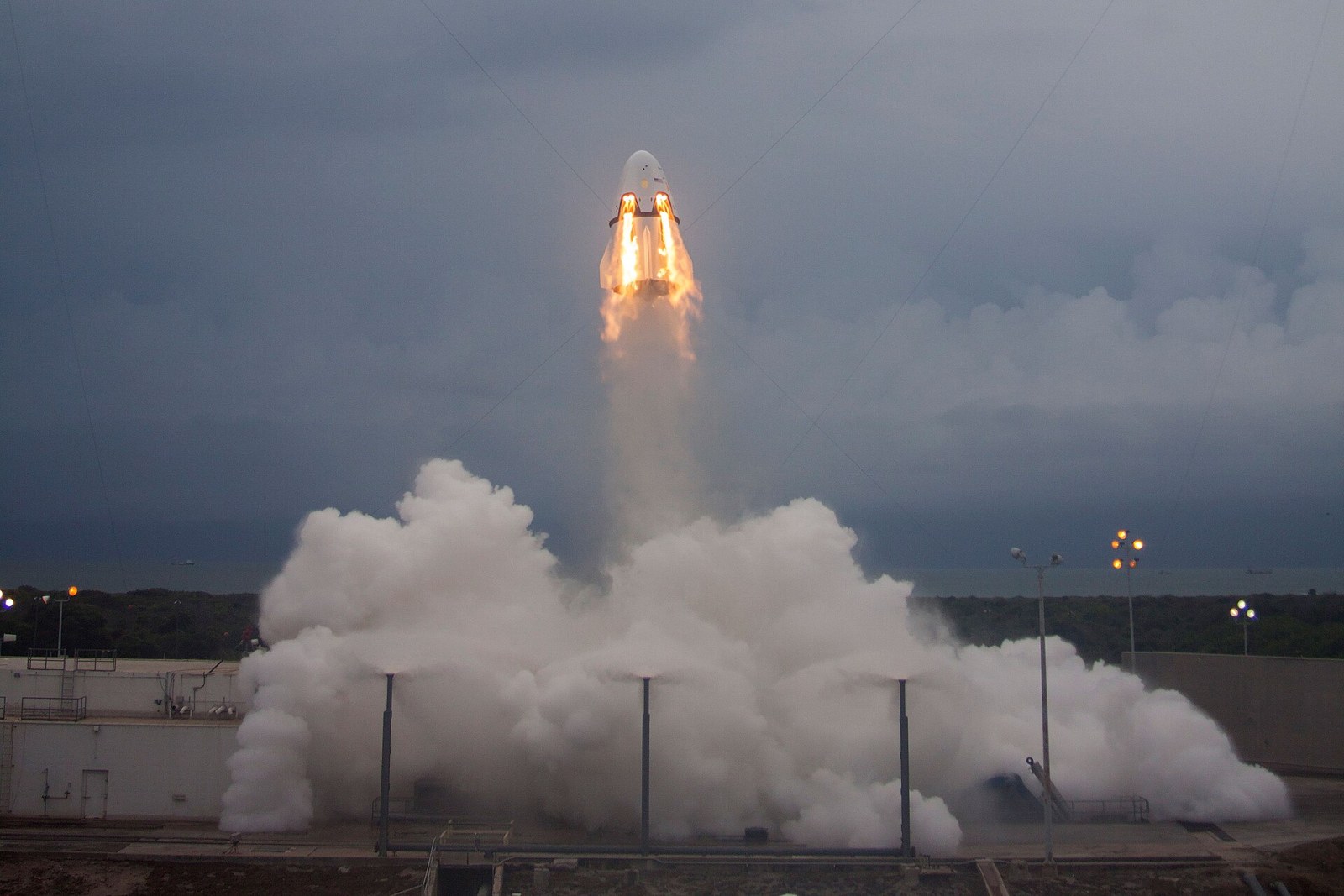

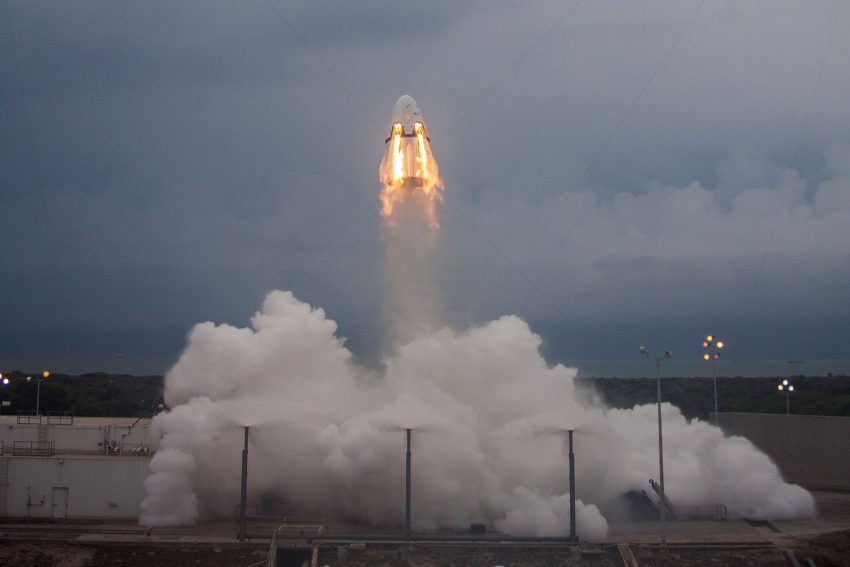
My loves, imagine a rocket engine with no match, no spark and no igniter. You open two valves, two liquids meet, and there is fire. 🔥 That’s a whole family of propellants called hypergolics. They’ve flown to the Moon, sat in missile silos, and pushed a test capsule away from its launch pad in 2015. They’re also some of the nastiest chemicals in aerospace, which is the other half of the story.
As of October 26, 2026, here is what I can back up. I mark numbers as official, reported or my arithmetic, and I flag it when sources disagree.
The Short Version
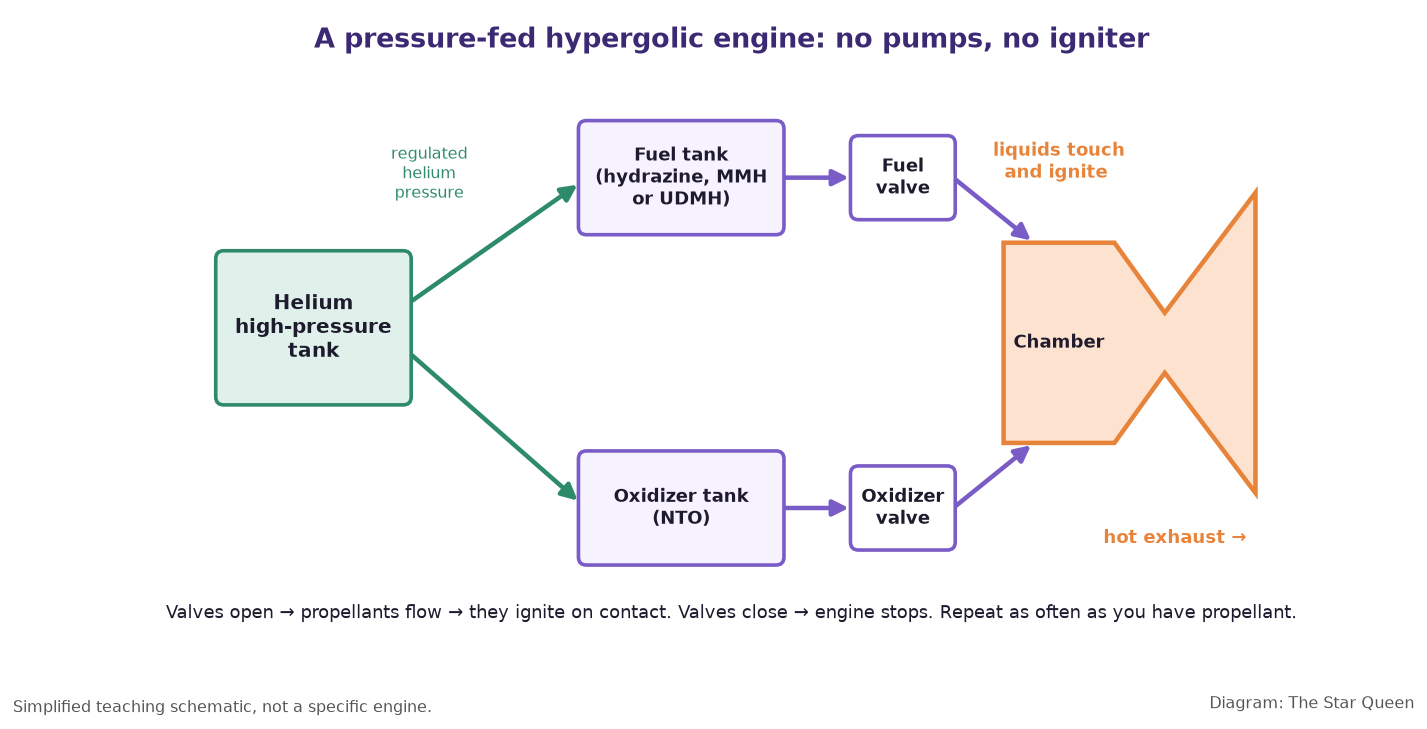
- Hypergolic means the fuel and oxidizer ignite spontaneously on contact. The classic pair is a hydrazine-family fuel (hydrazine, MMH, UDMH or a blend) with nitrogen tetroxide (NTO) as the oxidizer.
- The big wins: no igniter, unlimited restarts, years of storability at room temperature, and dense propellants that fit in small tanks.
- The big costs: very toxic and corrosive, and lower performance than methane or hydrogen. Braeunig’s table puts NTO/hydrazine at about 286 s theoretical Isp at sea level, against 381 s for LOX/LH2.
- Monopropellant hydrazine is a related trick: one liquid, one catalyst bed, no oxidizer at all.
- Dragon is not hydrazine-free in the chemistry sense: it burns MMH (a hydrazine derivative) with NTO.
Terms to know ✨
- Hydrazine (N2H4): the simplest hydrazine fuel. Freezes at about 1.4 °C, which is why spacecraft tanks and lines get heaters.
- MMH (monomethylhydrazine): a hydrazine derivative with a much lower freezing point. The spacecraft favorite.
- UDMH (unsymmetrical dimethylhydrazine): a hydrazine derivative that tolerates heat well. A launch-vehicle favorite, especially in Russia.
- Aerozine 50: a 50/50 mix of hydrazine and UDMH.
- NTO (nitrogen tetroxide, N2O4): the usual oxidizer. MON-3 is NTO with about 3% nitric oxide added by weight to lower its freezing point.
- Pressure-fed: tank pressure, usually helium, pushes the propellants. No turbopumps.
- Monopropellant: one liquid that decomposes over a catalyst.
- Isp (specific impulse): how long one unit of propellant can produce one unit of thrust, in seconds. Higher is more efficient.
How Two Liquids Light Themselves 🧪
Normal engines burn fuel and oxidizer, but they need something to start the fire: a spark torch, a pyrotechnic charge, or a chemical igniter. Hypergolic engines skip that step. Wikipedia’s hypergolic article covers most of these (the soft-start point is the standard engineering explanation, not something I read there):
- Reliability. No ignition system means one fewer thing to fail.
- Restarts. The engine can “fire any number of times by opening and closing the propellant valves until the propellants are exhausted.”
- Soft starts. Because ignition is instant on contact, unburned propellant doesn’t pool in the chamber and then go off all at once (a “hard start”).
- Simplicity. Most hypergolic engines are pressure-fed with helium, though some large ones use turbopumps.
How old is the idea? In 1935 Hellmuth Walter found that hydrazine hydrate ignites with high-test peroxide, and in 1940 U.S. researchers built engines burning aniline and red fuming nitric acid (Wikipedia). That pair powered the WAC Corporal, and the first Aerobee’s engine was a nitric acid/aniline design too.
The Cast: Fuels and Oxidizers
All numbers below are from Braeunig’s propellant tables unless I say otherwise. They’re a hobbyist-compiled but well-cited reference, so treat them as handy approximations.
| Substance | Role | Density (g/mL) | Melts at | Boils at | Notes |
|---|---|---|---|---|---|
| Hydrazine | Fuel | 1.004 | 1.4 °C | 113.5 °C | Best performance, but a high freezing point |
| MMH | Fuel | 0.866 | −52.4 °C | 87.5 °C | Best choice when freezing is a problem |
| UDMH | Fuel | 0.791 | −58 °C | 63.9 °C | Lowest freezing point, good thermal stability |
| NTO (N2O4) | Oxidizer | 1.45 | −9.3 °C | 21.15 °C | Less corrosive than nitric acid |
| Liquid oxygen (for contrast) | Oxidizer | 1.14 | −218.8 °C | −183 °C | Not hypergolic with common fuels |
Braeunig’s take: hydrazine “gives the best performance as a rocket fuel” but freezes easily and is “too unstable for use as a coolant.” MMH is the pick for spacecraft where freezing matters. UDMH has “enough thermal stability to be used in large regeneratively cooled engines,” so launchers use it despite the lowest efficiency of the three. Aerozine 50 blends hydrazine and UDMH.
On the oxidizer side, NTO freezes at about −9 °C. Adding nitric oxide makes MON mixtures: MON-3 freezes around −15 °C and MON-25 around −55 °C (Braeunig). Nitric acid in the form called IRFNA was the older oxidizer, and Braeunig notes NTO and nitric acid are both hypergolic with hydrazine, MMH and UDMH.
What do they actually deliver?
Braeunig’s theoretical sea-level Isp at 68 atm chamber pressure: NTO/hydrazine 286 s, NTO/MMH 280 s, NTO/Aerozine 50 280 s, NTO/UDMH 277 s. Real vacuum engines do better thanks to big nozzles: Apollo’s service engine is listed at 314 s (Wikipedia), the Shuttle’s OMS engine at 316 s (Wikipedia) or 313 s (Braeunig), and Titan II’s second stage at 312 s vacuum (Braeunig). Those two Shuttle numbers are a small source conflict.
Why “Storable” Is a Superpower 📦
Cryogenic propellants boil. Liquid oxygen sits at −183 °C and liquid hydrogen at −253 °C, so a rocket full of them has to be fueled shortly before launch and kept topped up. Hypergolics don’t care. Wikipedia’s Proton article makes the point plainly: because UDMH and NTO “can be stored at ambient temperatures,” Proton can “remain on the pad indefinitely,” while cryogenic rockets “need periodic replenishment as they boil off.”
Density helps too. Wikipedia says hydrazine/UDMH mixtures are “at least 10 times” denser than liquid hydrogen, so tanks (and fairings) can shrink. For the other side of that trade, see my liquid hydrogen explainer.
Titan II: The Missile That Lived in a Hole 🕳️
Titan I burned kerosene and liquid oxygen, so it had to be fueled before launch. Titan II switched to hydrazine-based hypergolics, and Wikipedia says that made it “storable and reliably ignited,” cutting time to launch and letting it fire from its silo. Braeunig lists NTO/Aerozine 50 for both stages: first stage engines at 259 s sea level / 285 s vacuum, second stage at 312 s vacuum.
Titan II’s first flight was in March 1962, and it reached initial operating capability in October 1963 (Wikipedia). It also became a space launcher: Wikipedia lists a “Titan II GLV” version, the Gemini Launch Vehicle, and efforts to human-rate it are part of the story. A pogo vibration problem needed fixes first.
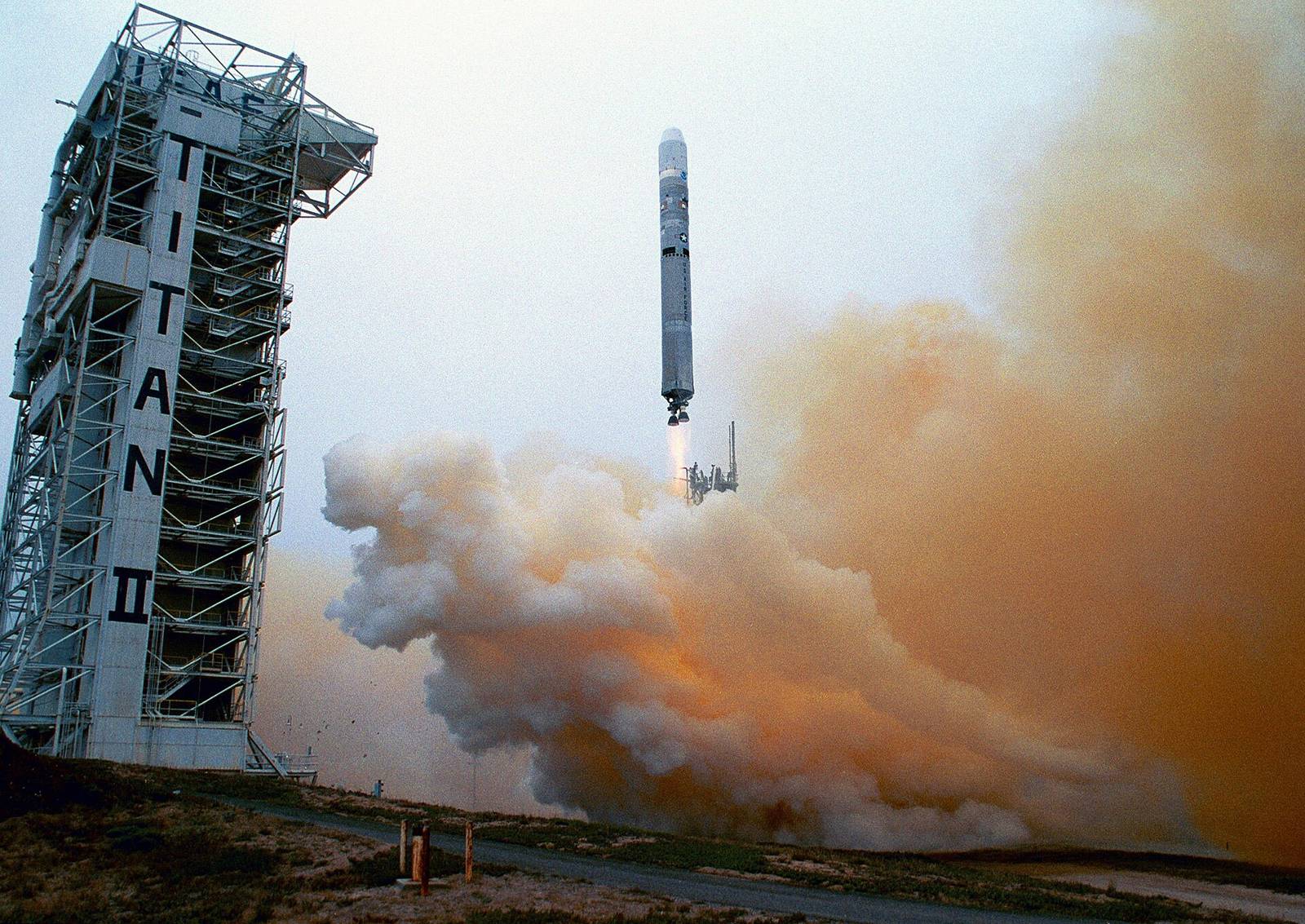

Storing hypergolic propellants comes with real risks. In September 1980, a maintenance accident at a Titan II missile site in Damascus, Arkansas, led to a fuel leak and an explosion, and an airman lost his life. I include it because honest hypergolic stories include the accidents, and because it is why these fuels are handled so carefully.
Proton: “Devil’s Venom” ☠️
The Soviet and Russian Proton family is, in Wikipedia’s words, a “hypergolic expendable heavy-lift launch vehicle family.” Proton-K burns UDMH and NTO and flew 310 missions from 1967 to 2012. Its first launch was in 1965. A Proton-M crash on July 2, 2013, carrying three GLONASS satellites, ended a 30-year run without a first-stage failure.
Wikipedia’s hydrazine article adds that in the Soviet program, UDMH with nitric-type oxidizers was nicknamed “devil’s venom” because of how dangerous it was. And Russia’s planned Proton replacement, Angara, is described as a kerolox rocket that “will not use hypergolic fuels.” The trend is clear: big launchers are moving away.
Apollo: Three Hypergolic Engines and a Moon Landing 🌕
Apollo leaned on hypergolics for almost everything that had to work on the first try.
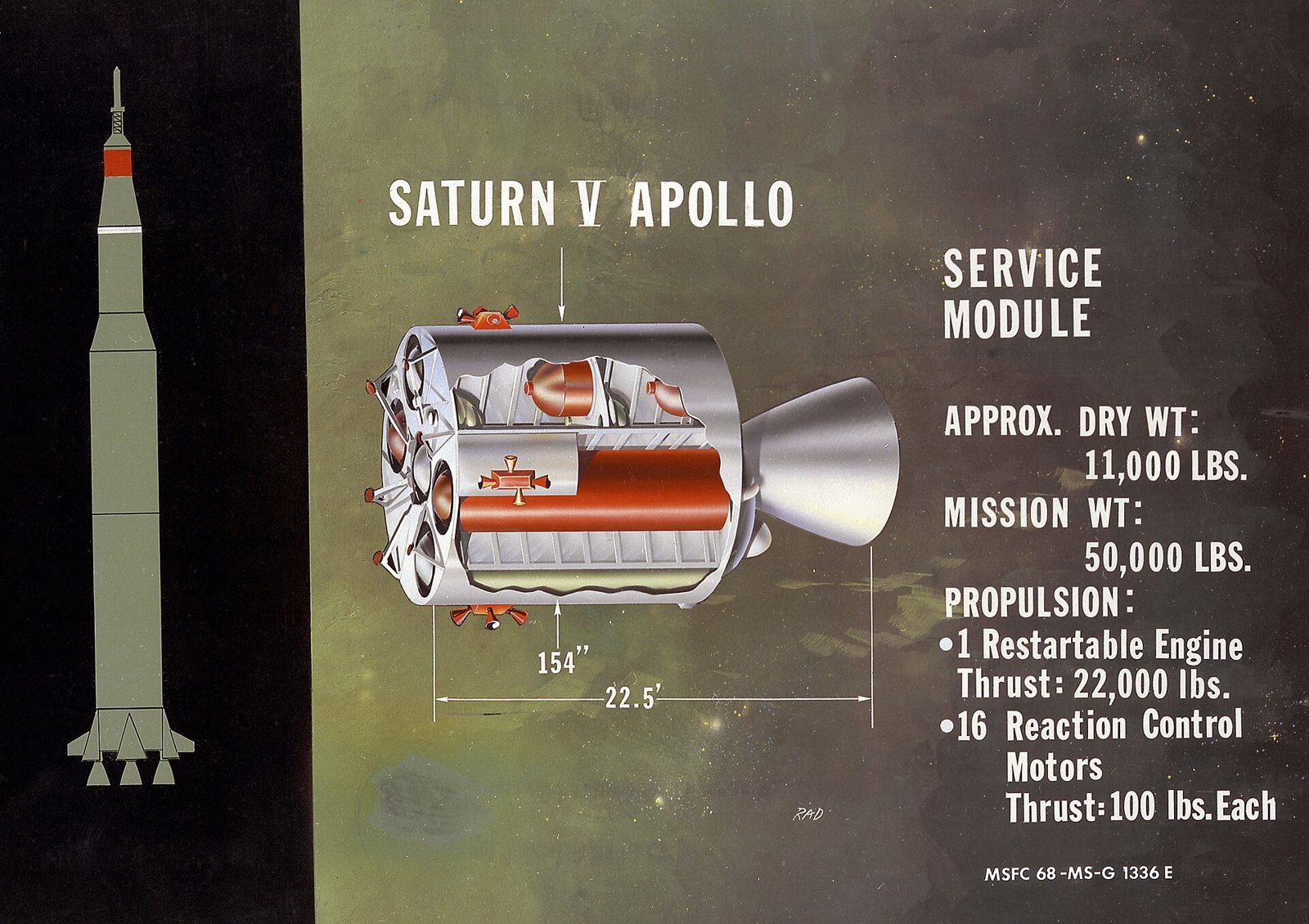
- The Service Propulsion System (SPS). Aerojet’s AJ10-137 burned Aerozine 50 and NTO for 20,500 lbf (91 kN), pressure-fed by helium at 3,600 psi. It was originally sized to lift the whole spacecraft off the Moon in the old “direct ascent” plan, so it was about twice the thrust the final lunar-orbit rendezvous plan needed. It did the course corrections, the burns into and out of lunar orbit, and the trip home. Wikipedia lists its Isp at 314 s. One NASA service-module chart even says 22,000 lbf, another small source conflict I’ve noted below.
- The Lunar Module descent engine. TRW’s throttleable engine could run from 1,050 to 10,125 lbf (4.67 to 45.04 kN). Wikipedia notes that operation between 65% and 92.5% thrust was avoided to prevent nozzle erosion. It was pressure-fed with helium, loaded as a cryogenic liquid. Wikipedia quotes NASA’s history Chariots for Apollo: “The lunar module descent engine probably was the biggest challenge and the most outstanding technical development of Apollo.”
- The Lunar Module ascent engine. It also used hypergolics (Wikipedia). It had to light once, on the Moon, with no second chance.
- The thrusters. The service module carried sixteen R-4D thrusters in four “quads,” and the command module’s twelve 93 lbf (410 N) thrusters burned MMH and N2O4.

The Shuttle’s Pods and Orion’s Engine
The Space Shuttle’s Orbital Maneuvering System was two AJ10-190 engines, one per pod. Wikipedia lists 26.7 kN (6,000 lbf) each, an Isp of 316 s, and a design life of 100 missions and 1,000 starts, with MMH and MON-3. Wikipedia says the same engine was repurposed for Orion’s service module. (Wikipedia calls MON-3 “3% nitric acid,” while Braeunig says nitric oxide. I trust Braeunig and flagged it in my notes.)
Draco, SuperDraco and Starliner 🐉
Now the modern stars. SpaceX’s Draco thrusters (about 400 N, MMH/NTO) steer Dragon, dock it, reboost the station and bring it home. SuperDraco, built into Crew Dragon’s walls, is the escape engine: eight of them, about 71 kN each by SpaceX’s figures. I covered both in my Draco and SuperDraco deep dive, including the April 2019 test-stand explosion. That one came from liquid NTO leaking past a check valve into the helium lines, and a titanium valve igniting, not from the engines themselves.
Is Dragon hydrazine-free? No. MMH is a hydrazine derivative, so Dragon’s chemistry is firmly in the family. (One source I read described a Dragon boost kit as carrying “hydrazine and nitrogen tetroxide,” which is loose wording for MMH/NTO.)
Boeing’s Starliner is hypergolic too. Wikipedia lists 52 MMH/NTO thrusters on its service module: 28 RCS thrusters (380 N), 20 OMAC thrusters (6.7 kN) and four RS-88 abort engines. The 2024 test flight’s thruster problems were traced, per a February 2026 report summarized on Wikipedia, to oxidizer heating and valve seal deformation: heat inside a thruster “doghouse” partly vaporized the NTO before it reached the chamber, and Teflon seals in the oxidizer valves swelled. That’s Wikipedia-only for me, so check NASA’s report before quoting it. “No igniter” doesn’t mean “no engineering.”
Why Hypergolics Rule the Abort Button 🛑
A launch escape system has one job. When the rocket fails, light up now, push the crew away and keep working. Hypergolics fit like a glove:
- Instant ignition. No chill-down, no spark timing, no igniter to fail.
- Waits forever, fueled. The engines can sit loaded through weeks of pad time and then months in orbit as a lifeboat.
- Few moving parts. Pressure-fed with helium means no turbopump spin-up to wait for.
- Dense. Small tanks fit inside a capsule’s skin.
- Restartable and, in Dragon’s case, throttleable. Wikipedia lists SuperDraco’s throttle range as 20 to 100%.
The competing design is the solid escape tower of Mercury, Apollo and Orion (Wikipedia): simple and powerful, but one-shot and jettisoned. Dragon’s pusher engines stay with the capsule. More on solids in my solid rocket propellant explainer.
In the 2015 pad abort, all eight engines burned about six seconds (NASA). The January 2020 in-flight abort is covered in the Draco post.
Monopropellant Hydrazine: One Liquid, One Catalyst ⚗️
Take the oxidizer away and hydrazine still has a trick. Pass it over a catalyst and it decomposes into hot ammonia, nitrogen and hydrogen gas. Wikipedia says the usual catalyst is iridium on alumina. That’s a monopropellant thruster: one tank, one valve, one catalyst bed.
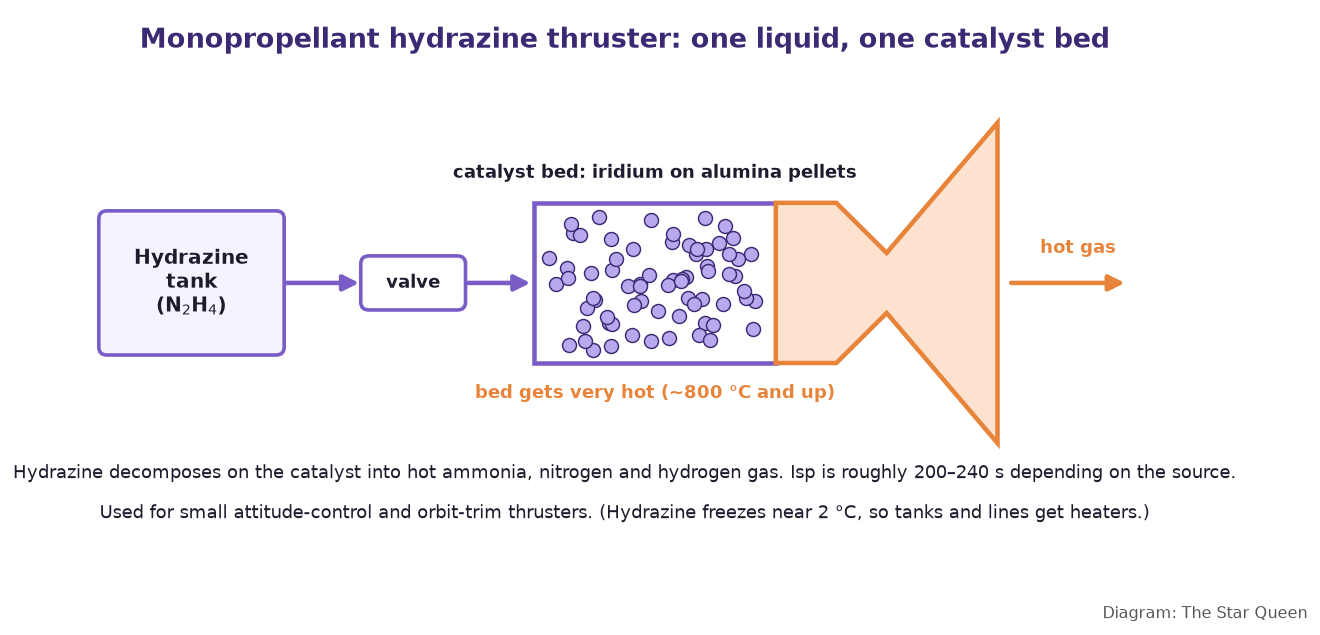
The numbers depend on who you ask, so here’s the range I found:
| Quantity | Value | Source |
|---|---|---|
| Isp | about 220 s | Wikipedia |
| Isp | about 230 to 240 s | Braeunig |
| Isp | about 235 s | NASA AF-M315E paper |
| Isp | about 200 to 235 s | NASA Small Spacecraft State of the Art |
| Bed temperature | about 800 °C | Wikipedia (Braeunig says up to about 1,100 °C) |
So: “about 200 to 240 s,” and don’t trust one number to the second. Hydrazine monoprop appears everywhere:
- Landers. Wikipedia says terminal-descent engines flew on Viking, Phoenix, Curiosity and Perseverance.
- Shuttle hydraulics. Hydrazine powered the Shuttle’s auxiliary power units, which drove engine gimbaling and control surfaces (Wikipedia).
- Aircraft emergency power. The F-16 and U-2 use hydrazine-based emergency systems.
- Starliner. Its capsule carries twelve MR-104J thrusters, 100 lbf each, using hydrazine monopropellant for re-entry orientation (Wikipedia).
The newer “green” monopropellants that aim to replace it have their own section in my beyond the big five post.
The Dark Side: Toxic, Corrosive, Carcinogenic ☣️
This is where I stop being breezy. Hydrazine is highly hazardous, and the exposure rules show how seriously people take it. Per Wikipedia:
- IARC rates it “2A, probably carcinogenic to humans.”
- NTP says it’s “reasonably anticipated to be a human carcinogen.”
- NIOSH calls it a “potential occupational carcinogen” and recommends a 0.03 ppm 2-hour ceiling. ACGIH sets a threshold limit of 0.01 ppm over 8 hours. OSHA’s older limit is 1 ppm.
- The odor threshold is about 3.7 ppm, so if you can smell it, you’re likely already over the limits.
NTO and the other fuels are also highly toxic and corrosive (Wikipedia), which is why recovery crews check capsules for leaks after splashdown (NASASpaceflight on Polaris Dawn, as noted in my Draco post).
Hydrazine has been on Europe’s REACH list of substances of very high concern since 2011, and ESA and industry are working on both alternatives and exemptions (ESA Clean Space, Eurospace). I can’t verify who is exempt for what, so I’d call it “pressure is real, outcome unsettled.”
PROS and CONS
PROS 👍
- Instant, igniter-free ignition, so fewer failure points.
- Unlimited restarts until the propellant runs out.
- Storable for years at room temperature, ideal for missiles, probes and lifeboats.
- Dense, so tanks stay small.
- Proven heritage, Apollo to Dragon.
CONS 👎
- Toxic, corrosive and carcinogenic, with expensive, slow ground handling.
- Lower Isp than methane or hydrogen engines (theoretical 277 to 286 s versus about 381 s for LOX/LH2 at sea level).
- Leaks are dangerous, as Titan II in 1980 and Dragon in 2019 showed.
- Freezing and heater needs in cold environments.
- Chemistry surprises: NTO in helium lines, titanium reacting, seals swelling.
- Regulatory pressure in Europe.
Which Engines Use It 🚀
| Engine / vehicle | Propellants | What it does | Source |
|---|---|---|---|
| Draco (Dragon) | MMH + NTO | Steering, docking, reboost, deorbit | SpaceX / my Draco post |
| SuperDraco (Crew Dragon) | MMH + NTO | Escape, backup landing | SpaceX / NASA |
| Titan II LR87 / LR91 | NTO + Aerozine 50 | ICBM and Gemini launch | Braeunig, Wikipedia |
| Proton (UR-500) | UDMH + NTO | Heavy-lift launcher | Wikipedia |
| Apollo SPS (AJ10-137) | NTO + Aerozine 50 | Course corrections, lunar orbit | Wikipedia |
| Apollo LM descent and ascent | Hypergolic | Landing and liftoff from the Moon | Wikipedia |
| Shuttle OMS (AJ10-190) | NTO/MON-3 + MMH | Orbit insertion and deorbit | Wikipedia |
| Delta II second stage (AJ10-118K) | NTO + Aerozine 50 | Upper stage, 320 s vacuum | Braeunig |
| Starliner service module | MMH + NTO | RCS, OMAC, RS-88 abort | Wikipedia |
| Aerobee (early engine) | Nitric acid + aniline | Sounding rocket | Wikipedia (later engines’ propellants not verified by me) |
| Hydrazine monoprop thrusters | Hydrazine | Viking, Curiosity, Perseverance, Shuttle APU | Wikipedia |
What about the newer rockets? Raptor and Merlin aren’t hypergolic (see my Raptor and Merlin posts), though Merlin’s TEA-TEB igniter fluid lights on contact with oxygen. Blue Moon Mk1’s RCS uses gaseous hydrogen and oxygen (Blue Origin). Relativity’s Terran R uses cold-gas nitrogen for its booster flip (Relativity), and I found no hypergolic use at Stoke. I can’t prove a negative, so please check before quoting.
Watch: Dragon’s Hypergolic Escape in Action 🎥
SpaceX’s own point-of-view video of the 2015 pad abort:
Can’t see the video? Watch it on YouTube: Pad Abort Test | Point of View (SpaceX)
And SpaceX’s video on the Crew Dragon launch escape demonstration:
Can’t see the video? Watch it on YouTube: Crew Dragon | Launch Escape Demonstration (SpaceX)
The Star Queen’s Take 👑
My loves, hypergolics are the “emergency button” chemistry of spaceflight. They’re not the best-performing or the cleanest, and they’re hard on the people who handle them. But when an engine must sit fueled for a year and light instantly, nothing else is as simple. That’s why Apollo trusted them with the trip home, and why Dragon trusts them with the worst day of a mission.
Big launchers are moving to kerolox, methalox and hydrolox, and satellite makers are testing greener monopropellants. My bet is that hypergolics keep one job for a long time: abort and maneuvering systems on crew vehicles, where reliability beats efficiency. That’s an opinion, not a forecast.
For the other propellants, start with my kerosene, methane and hydrogen posts, then read about solids and the rest of the propellant zoo.
Sources
- Braeunig, Basics of Space Flight: Rocket Propellants (properties, theoretical Isp tables, selected rockets): http://braeunig.us/space/propel.htm
- Wikipedia, Hypergolic propellant: https://en.wikipedia.org/wiki/Hypergolic_propellant
- Wikipedia, Hydrazine: https://en.wikipedia.org/wiki/Hydrazine
- Wikipedia, Titan II: https://en.wikipedia.org/wiki/Titan_II
- Wikipedia, 1980 Damascus Titan missile explosion: https://en.wikipedia.org/wiki/1980_Damascus_Titan_missile_explosion
- Wikipedia, Proton (rocket family): https://en.wikipedia.org/wiki/Proton_(rocket_family)
- Wikipedia, Apollo Service Module: https://en.wikipedia.org/wiki/Apollo_command_and_service_module
- Wikipedia, Apollo Lunar Module Descent propulsion system: https://en.wikipedia.org/wiki/Descent_propulsion_system
- Wikipedia, Space Shuttle Orbital Maneuvering System: https://en.wikipedia.org/wiki/Space_Shuttle_orbital_maneuvering_system
- Wikipedia, Boeing Starliner: https://en.wikipedia.org/wiki/Boeing_Starliner
- Wikipedia, Aerobee: https://en.wikipedia.org/wiki/Aerobee
- Wikipedia, Launch escape system: https://en.wikipedia.org/wiki/Launch_escape_system
- NASA, SpaceX demonstrates astronaut escape system for Crew Dragon: https://www.nasa.gov/news-release/spacex-demonstrates-astronaut-escape-system-for-crew-dragon-spacecraft/
- SpaceX, Draco thrusters (2013, archived): https://web.archive.org/web/20151124010749/http:/www.spacex.com/news/2013/04/04/draco-thrusters
- Spaceflight Now, SpaceX points to leaky valve as culprit in the Crew Dragon test accident: https://spaceflightnow.com/2019/07/15/spacex-points-to-leaky-valve-as-culprit-in-crew-dragon-test-accident/
- NASA Lessons Learned: https://llis.nasa.gov/lesson/2196
- NASA NTRS, hypergolic propellant handling and properties: https://ntrs.nasa.gov/api/citations/20100042352/downloads/20100042352.pdf
- Everyday Astronaut, How to start a rocket engine: https://everydayastronaut.com/how-to-start-a-rocket-engine/
- NASA, Small Spacecraft State of the Art, in-space propulsion: https://www.nasa.gov/smallsat-institute/sst-soa/in-space_propulsion/
- ESA Clean Space, Considering hydrazine-free satellite propulsion: https://www.esa.int/Space_Safety/Clean_Space/Considering_hydrazine-free_satellite_propulsion
- Eurospace, REACH exemption position for hydrazine and other liquid propellants: https://eurospace.org/asd-eurospace-reinforces-reach-exemption-position-for-hydrazine-and-other-liquid-propellants/
- Related posts on this site: Draco and SuperDraco, Merlin, Raptor
- Images: Wikimedia Commons and NASA (credit and license in each caption). Diagrams by The Star Queen.