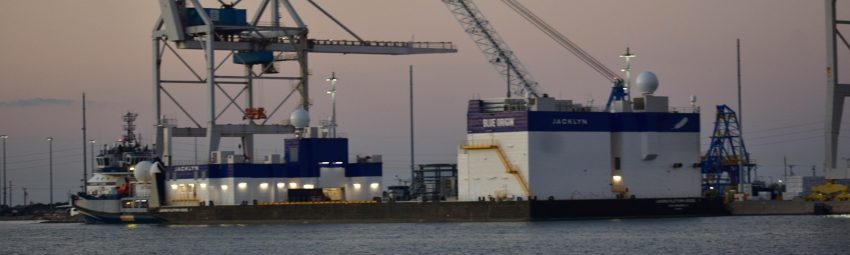
Last time, we toured SpaceX’s wonderfully named fleet. But SpaceX isn’t the only company sending ships out to sea to catch rockets. Today, I want to introduce you to Jacklyn, Blue Origin’s landing platform, and then take a quick spin around the world to meet the other rocket ships that actually sail.
Meet Jacklyn: Named for Mom
Blue Origin’s big orbital rocket, New Glenn, has a reusable first stage designed to fly at least 25 times. Like a Falcon 9, it usually lands on a platform out in the Atlantic, and that platform is named Jacklyn.
The name is a tribute to Jacklyn Bezos, Jeff Bezos’ mother. I love that. Out of all the clever, nerdy names a space company could pick, Bezos chose to name the place where his rockets come home after his mom. 💕
The First Jacklyn: A Former Ferry
Here’s a twist many people don’t know: there have been two Jacklyns.
The first was a real ship, the former roll-on/roll-off cargo ferry Stena Freighter (also known as Sea Chieftain), which Blue Origin bought in 2018. The original plan was ambitious. Rather than landing on a stationary barge, New Glenn boosters would land on a ship that was moving, with stabilizers keeping the deck steady in rough seas. The ship was taken to Port Pensacola, Florida, for conversion.
That conversion never finished. Blue Origin changed its plans, and the original Jacklyn was scrapped in 2022.
The Second Jacklyn: Landing Platform Vessel 1
The name lived on. Blue Origin built a purpose-made barge called Landing Platform Vessel 1 (LPV1). Its hull was laid down at a shipyard in Romania in February 2023 and launched in January 2024. It was then towed to Damen’s yard in Brest, France, for finishing, and sailed for Florida in August 2024. On September 2, 2024, Blue Origin announced that LPV1 would carry the name Jacklyn, keeping the tribute to Bezos’ mother.
And Jacklyn has been busy since then:
- NG-1 (January 16, 2025): New Glenn reached orbit on its very first try. The booster was named “So You’re Telling Me There’s a Chance,” a Dumb and Dumber reference, but it was lost during descent and never reached Jacklyn.
- NG-2 (November 13, 2025): New Glenn launched NASA’s twin ESCAPADE Mars probes, and the booster “Never Tell Me the Odds” (yes, a Han Solo quote!) landed on Jacklyn. CEO Dave Limp joked that it “had perfect odds.”
- NG-3 (April 19, 2026): The same booster flew again, this time with new engines, and landed on Jacklyn a second time. It was Blue Origin’s first reused-booster landing. The flight did have a hiccup, though: Space.com reported that the BlueBird 7 satellite was deployed into the wrong orbit.
So while SpaceX names its droneships after science fiction, Blue Origin names its boosters after movie lines about beating the odds, and its landing ship after family. Both are adorable, if you ask me.
Then came a tough day. On May 28, 2026, a New Glenn being readied for its fourth flight exploded during a static-fire test at Launch Complex 36. The rocket was lost and the pad was badly damaged, but thankfully no one was hurt. Blue Origin traced the problem to the main oxygen valve on one of the BE-4 engines and is retrofitting a modified valve. It’s also rebuilding the pad around a new process: the stages are mated horizontally, and the rocket is then lifted upright on the pad. Jacklyn will be waiting when New Glenn flies again. 💙
Does Blue Origin Have Other Ships?
I went looking for other named Blue Origin recovery or transport vessels and couldn’t find any verified, publicly named ones. Like most launch companies, Blue Origin almost certainly uses chartered tugs and support boats, but Jacklyn is the star of its fleet. If you know of a named Blue Origin vessel, tell me in the comments with a source!
The Rest of the Rocket Navy
I thought about writing a whole separate post for the other companies, but there are only a handful of real, named ships right now, so here’s a quick tour:
Rocket Lab: “Return On Investment”
Rocket Lab is building Neutron, a reusable medium-lift rocket. For missions that need extra performance, Neutron will land at sea on a modified 400-foot (122 m) barge named, wonderfully, “Return On Investment.” You can’t get more on-the-nose for a reusable rocket than that! Rocket Lab revealed the platform in February 2025. It’s built on a barge previously called Oceanus, after the Greek Titan who personified the ocean, and Bollinger Shipyards is doing the conversion. Rocket Lab has had a bumpy road, though. On October 14, 2026, it announced that Neutron’s first launch has slipped to 2027, so no Neutron has landed on Return On Investment yet. CEO Peter Beck has said the first flight will test reentry with a soft ocean splashdown, and the company won’t risk the barge until the second flight.
China: Launching from the Sea
China uses ships in a different way. The heavy-load carrier Dong Fang Hang Tian Gang (“Oriental Spaceport”) serves as a floating launch pad. It has launched Orienspace’s Gravity-1, a powerful solid-fuel rocket, from the East China Sea. In April 2026, the South China Morning Post reported plans to launch a Jielong-3 from it in international waters in the South China Sea. Not a landing ship, but definitely part of the rocket navy!
Europe: A Sailing Ship for Ariane 6
My favorite non-landing ship might be Canopée (French for “canopy”), which carries Ariane 6 rocket stages from Europe to the spaceport in Kourou, French Guiana. It’s a 121-meter hybrid cargo ship with four giant sails that ESA says cut fuel use by about 30%. A sailing ship delivering rockets? That’s a sentence I’ll never get tired of.
A Note on History: Sea Launch
Ocean launching isn’t new. The international Sea Launch venture sent Zenit rockets to orbit from a converted floating oil platform starting in the 1990s, until it stopped operating in 2014.
What About Firefly?
I checked, and I couldn’t find a verified Firefly Aerospace recovery ship, so I’m not going to invent one!
Why Ships Matter
Every one of these vessels points to the same future: rockets that come home and fly again, launch sites that aren’t tied to a crowded coastline, and hardware that’s simply too big for highways. As launch rates climb, the ocean becomes part of the launch pad, and I can’t wait to see what names come next.
Which ship name makes you smile the most? I’m torn between Jacklyn and Return On Investment. 🚀
— The Star Queen
Sources
- Blue Origin, “New Glenn Launches NASA’s ESCAPADE, Lands Fully Reusable Booster” (Nov 13, 2025): https://www.blueorigin.com/news/new-glenn-launches-nasa-escapade-lands-fully-reusable-booster
- Blue Origin, Orbital missions page (NG-1, NG-2, NG-3): https://www.blueorigin.com/missions/by/orbital
- Blue Origin, “New Glenn Reaches Orbit” (NG-1): https://www.blueorigin.com/news/new-glenn-ng-1-mission
- Spaceflight Now, NG-1 coverage (Jan 2025): https://spaceflightnow.com/2025/01/15/live-coverage-blue-origin-to-launch-blue-ring-pathfinder-on-new-glenn-rocket-inaugural-launch-from-cape-canaveral/
- Space.com, NG-3 reuse and landing (Apr 19, 2026): https://www.space.com/space-exploration/launches-spacecraft/blue-origin-reuses-new-glenn-rocket-landing-success-1st-time-on-april-19-2026-video
- Reuters, first landing of a reused New Glenn booster (Apr 19, 2026): https://www.reuters.com/business/media-telecom/blue-origin-says-it-has-landed-reused-new-glenn-rocket-booster-2026-04-19/
- GeekWire, “Ahoy, Jacklyn! Jeff Bezos names Blue Origin’s rocket recovery ship after his mom” (2020): https://www.geekwire.com/2020/ahoy-jacklyn-jeff-bezos-names-blue-origins-rocket-recovery-ship-mom/
- Universe Today, “Meet Jacklyn, The Barge That Changed Blue Origin’s Plans”: https://www.universetoday.com/articles/meet-jacklyn-the-barge-that-changed-blue-origins-plans
- Wikipedia, “Jacklyn (LPV1)”: https://en.wikipedia.org/wiki/Jacklyn_(LPV1)
- Rocket Lab, “Rocket Lab Reveals Ocean Platform for Neutron Rocket Landings at Sea” (Feb 27, 2025): https://rocketlabcorp.com/updates/rocket-lab-reveals-ocean-platform-for-neutron-rocket-landings-at-sea/
- Aviation Week, Rocket Lab taps Bollinger Shipyards: https://aviationweek.com/space/launch-vehicles-propulsion/rocket-lab-taps-bollinger-shipyards-sea-based-landing-barge
- Maritime Executive, Gravity-1 launch from the East China Sea: https://maritime-executive.com/article/chinese-space-firm-launches-commercial-rocket-from-e-china-sea
- South China Morning Post, Jielong-3 South China Sea launch plan (Apr 10, 2026): https://www.scmp.com/news/china/science/article/3349638/china-about-launch-rocket-south-china-sea-international-waters
- ESA, “Shipping rockets: Ariane on board” (Canopée): https://www.esa.int/Enabling_Support/Space_Transportation/Ariane/Shipping_rockets_Ariane_on_board
- NASASpaceflight, “Blue Origin’s New Glenn explodes during Static Fire test at LC-36” (May 28, 2026): https://www.nasaspaceflight.com/2026/05/blue-origin-new-glenn-explodes/
- Blue Origin, “GS1-3 Hotfire Updates”: https://www.blueorigin.com/news/gs1-3-hotfire-updates
- SpaceNews, “New Glenn explosion linked to rocket engine valve”: https://spacenews.com/new-glenn-explosion-linked-to-rocket-engine-valve/
- Rocket Lab, Neutron page: https://rocketlabcorp.com/launch/neutron/
- SpaceOdysseyHub, Neutron slips to 2027 (Oct 2026): https://spaceodysseyhub.com/articles/rocket-lab-neutron-2027-backlog-outlook-2026
Image credit — Banner image: Landing Platform Vessel 1 “Jacklyn” at Port Canaveral. Photo via Wikimedia Commons, CC0 (public domain).
