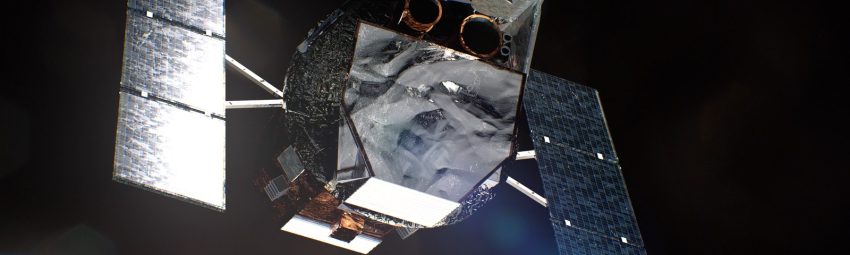
Some spacecraft go out with a landing. Swift is going out with a glow. 💫
NASA’s Neil Gehrels Swift Observatory, the little telescope that spent nearly 22 years hunting gamma-ray bursts, re-entered Earth’s atmosphere at 7:39 a.m. EST today, Wednesday, Nov. 4, 2026, over the North Sumatra region of Indonesia, the U.S. Space Force confirmed. NASA expected most of the roughly 3,200-pound spacecraft to burn up on the way down. And yes, I’m a little sentimental about this one, because Swift started its journey right here on the Space Coast, launching from Cape Canaveral aboard a Delta II rocket back in November 2004.
Built for two years, worked for twenty-two
Swift was designed for a two-year mission. It kept going for more than two decades. Its job was to catch gamma-ray bursts, brief and incredibly intense flashes of radiation that are the most powerful explosions in the cosmos, then swing its telescopes around fast and tell astronomers on the ground where to look.
The scorecard is jaw-dropping. According to NASA, Swift observed more than 2,000 gamma-ray bursts and studied more than 1,400 supernova explosions. It watched stars get shredded by black holes, monitored active galaxies, ran an all-sky X-ray survey, and even studied comets and asteroids in our own solar system. Its data has fed about 7,000 published scientific papers.
It was still making headlines this year, too. In July, the Swift team reported spotting a “wandering” supermassive black hole tearing apart a star far from the center of its galaxy, an event that briefly outshone its entire host galaxy in ultraviolet light.
In 2018, the observatory was renamed for Neil Gehrels, its first principal investigator, who died in 2017.
The rescue mission that almost was
Here’s the part that makes this story extra bittersweet. Swift has no thrusters to fight atmospheric drag, and recent solar activity puffed up the upper atmosphere and dragged it down faster. So in September 2025, NASA gave Katalyst Space a $30 million contract to try something nobody had done before: send a commercial robotic spacecraft to grab a satellite that was never designed to be serviced and push it to a higher orbit.
Katalyst built its LINK spacecraft in about nine months, and it launched on July 3, 2026, aboard a Northrop Grumman Pegasus XL. Then trouble hit. During commissioning, LINK suffered an anomaly that sent it into a multi-axis spin, and a power-system fault took out two of its three reaction wheels. The team got it stabilized, but steering with thrusters burned through propellant too quickly. In August, NASA and Katalyst agreed LINK no longer had enough fuel to safely capture and boost Swift.
LINK still got within about 12 to 15 kilometers of Swift, tested its three robotic arms, and gathered rendezvous data before it re-entered on Sept. 25. As NASA said the day LINK came home, “this was a high-risk, high-reward mission.” I love that they tried. That’s how we learn to fix satellites in orbit someday.
The final chapter
With the boost off the table, Swift went back to doing science, observing hundreds more targets. But observing increased drag, and on Oct. 20 Swift reached about 171 miles (275 kilometers) up, entered safe mode, and the operations team at Penn State sent the command that ended its mission.
If you’re wondering about safety: because of Swift’s low-inclination orbit, any surviving pieces can only come down between about 20.6 degrees north and 20.6 degrees south latitude, a band that’s mostly ocean. NASA put the chance of harm to anyone at about 1 in 2,100. (Here in Florida we’re north of that band, so no Swift sightings from my front yard this time. 😉)
Why it matters
Swift’s archive will keep producing discoveries for decades. And the LINK attempt, even without a capture, gave the industry real flight data on how to rendezvous with and service old satellites.
Thank you, Swift, for 22 years of catching the universe’s biggest fireworks. Clear skies on your final trip home. 🌟
— The Star Queen
Sources
- NASA’s Swift Observatory to Re-Enter Atmosphere (NASA Science, Nov. 2, 2026)
- NASA’s Swift Mission Ends Ahead of Re-Entry (NASA Science, Oct. 23, 2026)
- NASA’s Swift Mission Ends, Leaves Behind Scientific Bonanza (NASA Science)
- Katalyst Concludes LINK Mission (Katalyst Space, Sept. 25, 2026)
- NASA ends Swift space telescope mission after failed rescue attempt (Space.com)
- Nasa telescope launched in 2004 to plunge back to Earth after failed rescue mission (The Guardian)
- NASA’s Swift Space Telescope Expected to Re-enter Earth’s Atmosphere (Aju Press)
Illustration: NASA’s Goddard Space Flight Center/Chris Smith (KBRwyle).