By The Star Queen · Star Queen Chronicles · Basic Rocket Science, Part 1 of 5
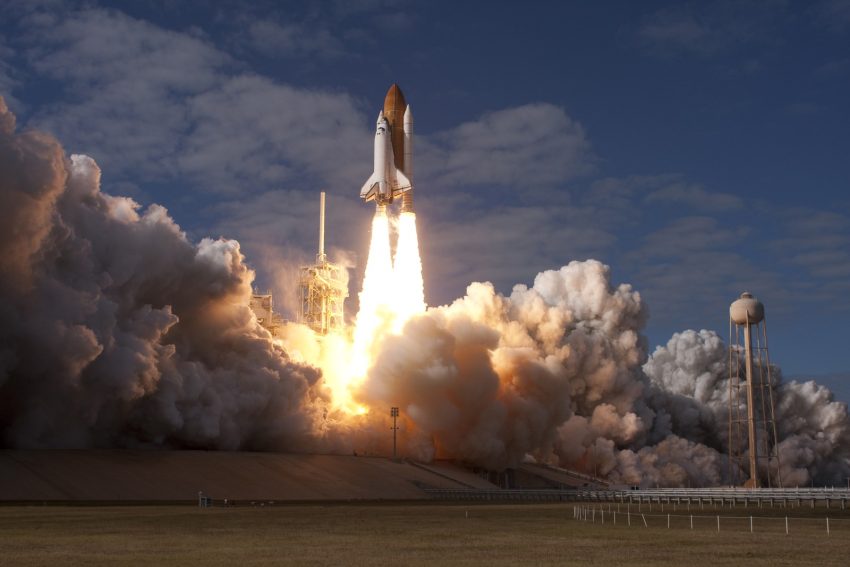
Header photo: Space Shuttle Atlantis emerging from its own exhaust cloud at liftoff on STS-129 (November 2009). Credit: NASA/Scott Andrews
My loves, if you’ve ever felt a launch in your chest on the Space Coast, you’ve felt the question this whole series is about: how does something that heavy climb into the sky? 🌟 Back in January I wrote a quick Basic Rocket Science primer. Now let’s slow down and go one idea at a time, no PhD required. Today: the engine and the push.
The Biggest Rocket Myth
Lots of people picture a rocket pushing off the launch pad, or shoving against the air behind it. If that were true, rockets couldn’t work in space, where there’s no air at all.
But they do work in space. So what is a rocket pushing against? Its own exhaust.
Newton’s Third Law, in Plain English
Isaac Newton’s third law says that for every action there is an equal and opposite reaction. NASA’s Glenn Research Center explains that rocket thrust is produced exactly this way: the engine throws exhaust gas out the back, and the rocket is pushed the other way.
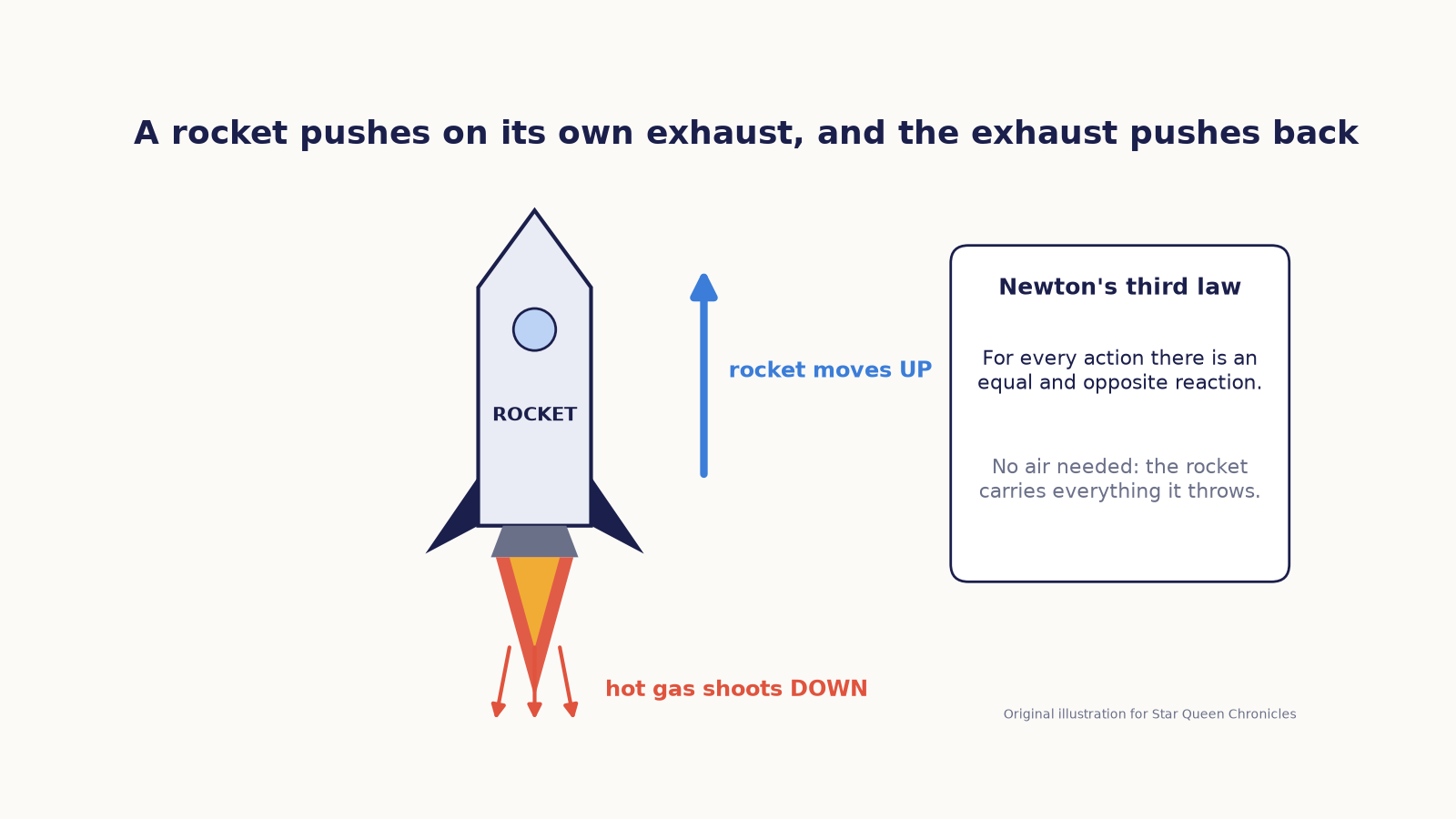
Here are two ways to feel it:
- The balloon. Blow one up and let go. The air rushes out one end and the balloon zips the other way. It isn’t pushing on the room. It’s pushing on the air it just threw.
- The office chair. Sit on a rolling chair holding something heavy and hurl it away from you. You roll backward. A rocket does the same thing, only it throws gas and does it millions of times a second.
What Thrust Depends On
NASA’s thrust equation has two main ingredients: how much gas leaves per second and how fast it leaves. There’s also a smaller term for pressure at the nozzle, but the big idea is simple. Throw more mass, or throw it faster, and you get a bigger shove.
Think of a garden hose and a fire hose. A fire hose kicks back much harder because it sends out a lot more water, much faster. A rocket engine is a fire hose made of flame.
Why Rockets Work in a Vacuum
A jet engine or a propeller needs outside air to work with. A rocket doesn’t. NASA Glenn puts it plainly: because the rocket carries its oxidizer on board, it can generate thrust in a vacuum, which is why it works in space where a turbine or propeller won’t.
Engines built for space are even shaped for it. SpaceX’s Starship uses three regular Raptor engines and three Raptor Vacuum engines, the latter designed for the vacuum of space. Falcon 9’s second stage uses a single Merlin Vacuum engine.
Propellant: Fuel Plus Oxidizer
Fire needs fuel and something to burn it with. On Earth, we borrow oxygen from the air. A rocket brings its own, usually as liquid oxygen, or “LOX.” Together, fuel and oxidizer are called propellant.
Here’s the basic flow:
- Propellants are pumped into the combustion chamber and burned.
- The burning makes extremely hot, high-pressure gas.
- That gas is squeezed through a narrow throat and then flares out the bell-shaped nozzle, which speeds it up.
- The gas leaves the back, and the rocket goes the other way.
Falcon 9’s first stage, for example, has nine Merlin engines burning LOX and rocket-grade kerosene (RP-1). SpaceX says it produces more than 1.7 million pounds of thrust at sea level.
Thrust Has to Beat Weight
To leave the pad, a rocket’s thrust must be bigger than its weight. SpaceX lists Falcon 9’s mass at about 1.2 million pounds (549,054 kg). Compare that with more than 1.7 million pounds of thrust, and you get a ratio of roughly 1.4 to 1. That’s my back-of-the-envelope math from SpaceX’s published numbers, not an official figure.
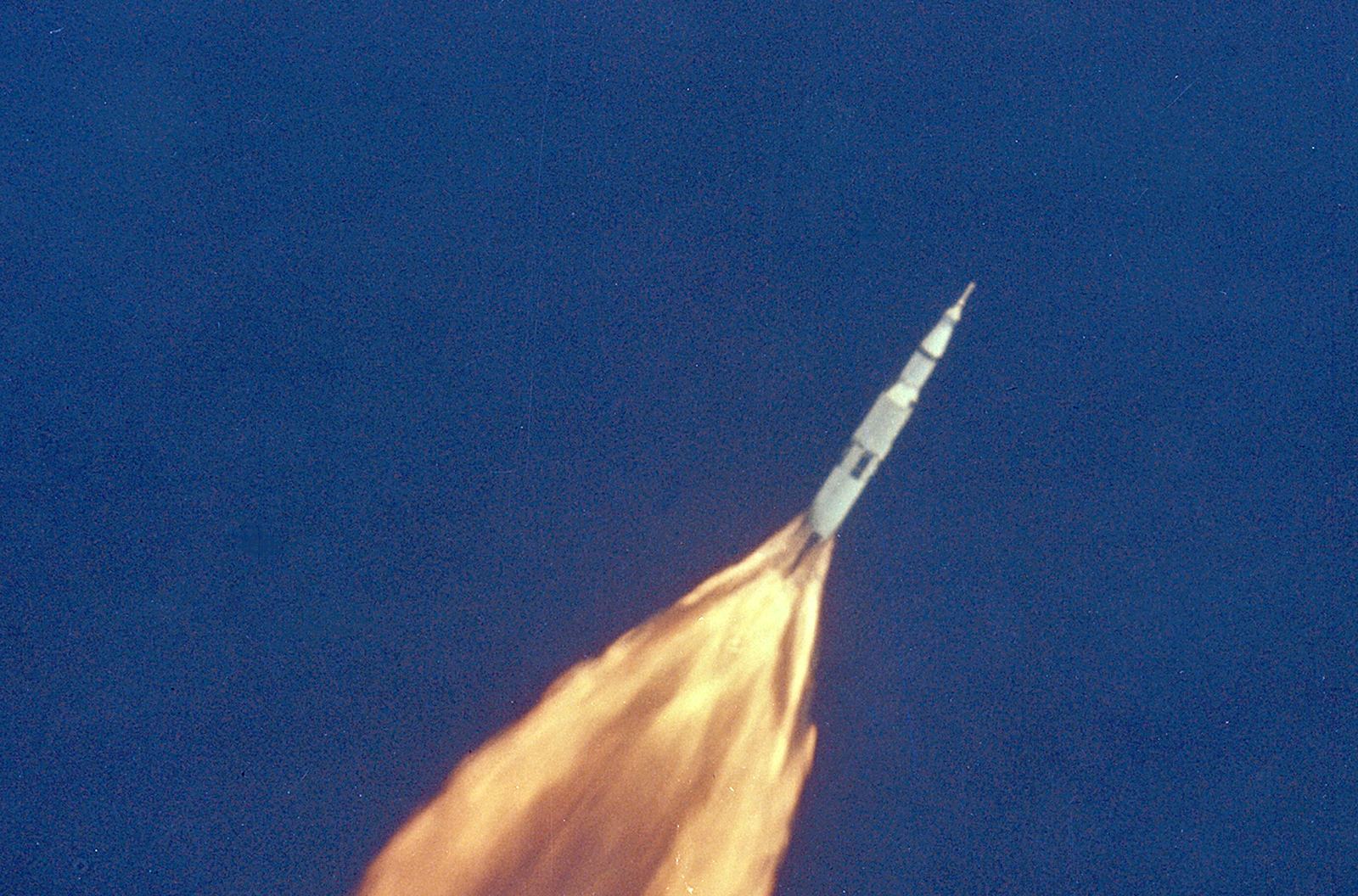
That’s why a launch starts almost gracefully. The rocket isn’t leaping, it’s just barely winning the tug-of-war with gravity. Then it burns propellant, gets lighter, and accelerates faster and faster. 🔥
The same physics scales up. SpaceX describes Starship and Super Heavy, about 124 meters tall, as the most powerful launch vehicle ever developed, with 33 Raptor engines on the booster alone. NASA’s SLS uses four RS-25 engines plus two solid boosters. Different sizes, same third law.
Try It Yourself 🎈
Make a balloon rocket:
- Thread a string through a drinking straw and tie the string across a room.
- Tape an inflated (pinched-shut) balloon to the straw.
- Let go, and watch it race along the string.
Then experiment. Does a bigger balloon go farther? What if you pinch the opening smaller so the air comes out more slowly? You’re testing mass flow and exhaust speed, the same two things NASA’s equation cares about. (Please use air only. Real rocket propellant is for professionals.)
The Star Queen’s Takeaway 👑
A rocket works by throwing mass backward as hard and fast as it can. No air or ground required, just a lot of propellant and a very good nozzle. Next time, we’ll tackle the big question that follows: if that’s all it takes, why are rockets mostly fuel tanks? See you in Part 2, coming Saturday, Nov. 7! 💫
Next: Part 2, “The Rocket Equation: Why Rockets Are (Almost) All Fuel,” coming Saturday, Nov. 7.
Keep reading: See Raptor engines at work in my Starship post.
Sources
- NASA Glenn Research Center, Rocket Thrust: https://www1.grc.nasa.gov/beginners-guide-to-aeronautics/rocket-thrust/
- NASA Glenn Research Center, Rocket Principles: https://www.grc.nasa.gov/WWW/K-12/TRC/Rockets/rocket_principles.html
- NASA Glenn Research Center, Guide to Rockets: https://www1.grc.nasa.gov/beginners-guide-to-aeronautics/guide-to-rockets/
- SpaceX, Falcon 9: https://www.spacex.com/vehicles/falcon-9/
- SpaceX, Starship: https://www.spacex.com/vehicles/starship/
- NASA, SLS RS-25 core stage engine: https://www.nasa.gov/reference/space-launch-system-rs-25-core-stage-engine/
- Star Queen Chronicles, "Basic Rocket Science: How Rockets Defy Gravity and Reach the Stars" (Jan. 4, 2026): https://starqueenchronicles.com/basic-rocket-science-how-rockets-defy-gravity-and-reach-the-stars/