By The Star Queen · Star Queen Chronicles
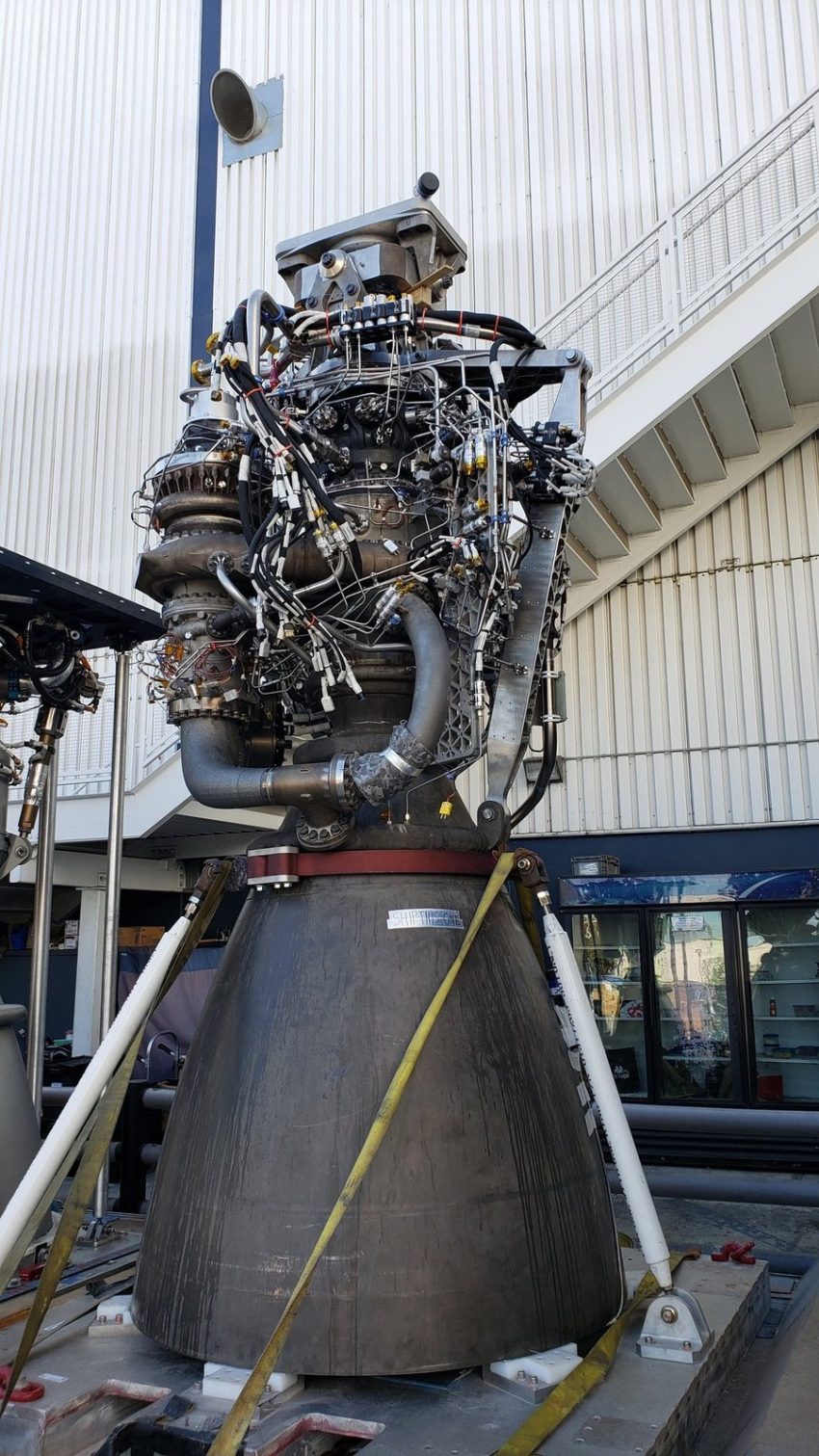
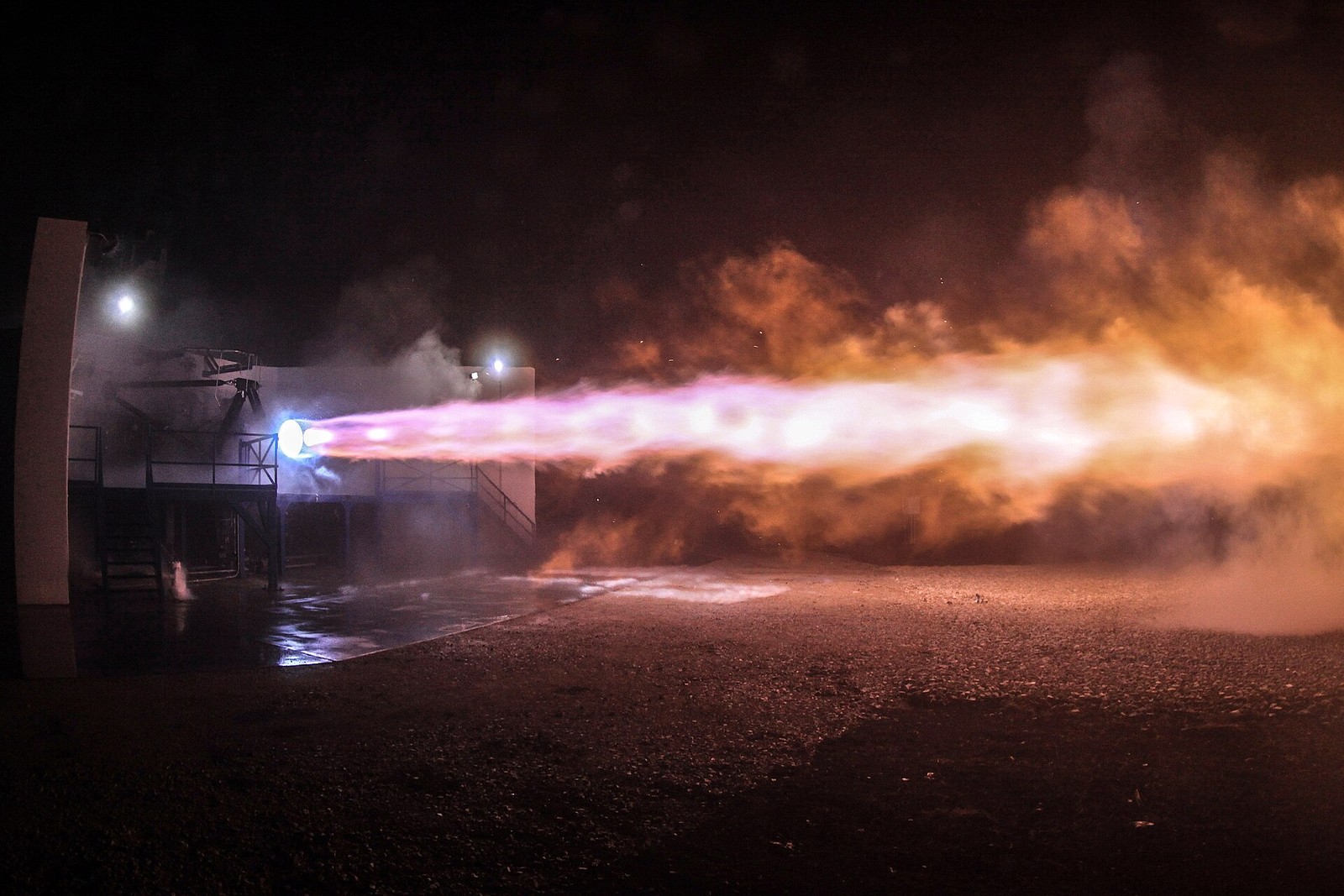
A sea-level Raptor at SpaceX’s Hawthorne, California headquarters (May 21, 2020). Credit: Brandon De Young, CC BY-SA 4.0, via Wikimedia Commons
My loves, if you only learn one rocket engine this year, make it Raptor. 🌟 It burns methane and liquid oxygen, it runs on a cycle that engineers argued about for fifty years, and on a good day 33 of them lift the biggest rocket ever built. This is the nerdy deep dive: what’s inside, how it changed from version to version, and how much of the hype I can actually back up with sources.
Everything here is as of October 26, 2026. I tag numbers as official (SpaceX itself), reported (credible outlets), Musk’s claim (a statement, not a measurement), or my arithmetic. Where sources disagree, I say so.
The Short Version
- Raptor is a full-flow staged combustion engine burning subcooled liquid methane and liquid oxygen.
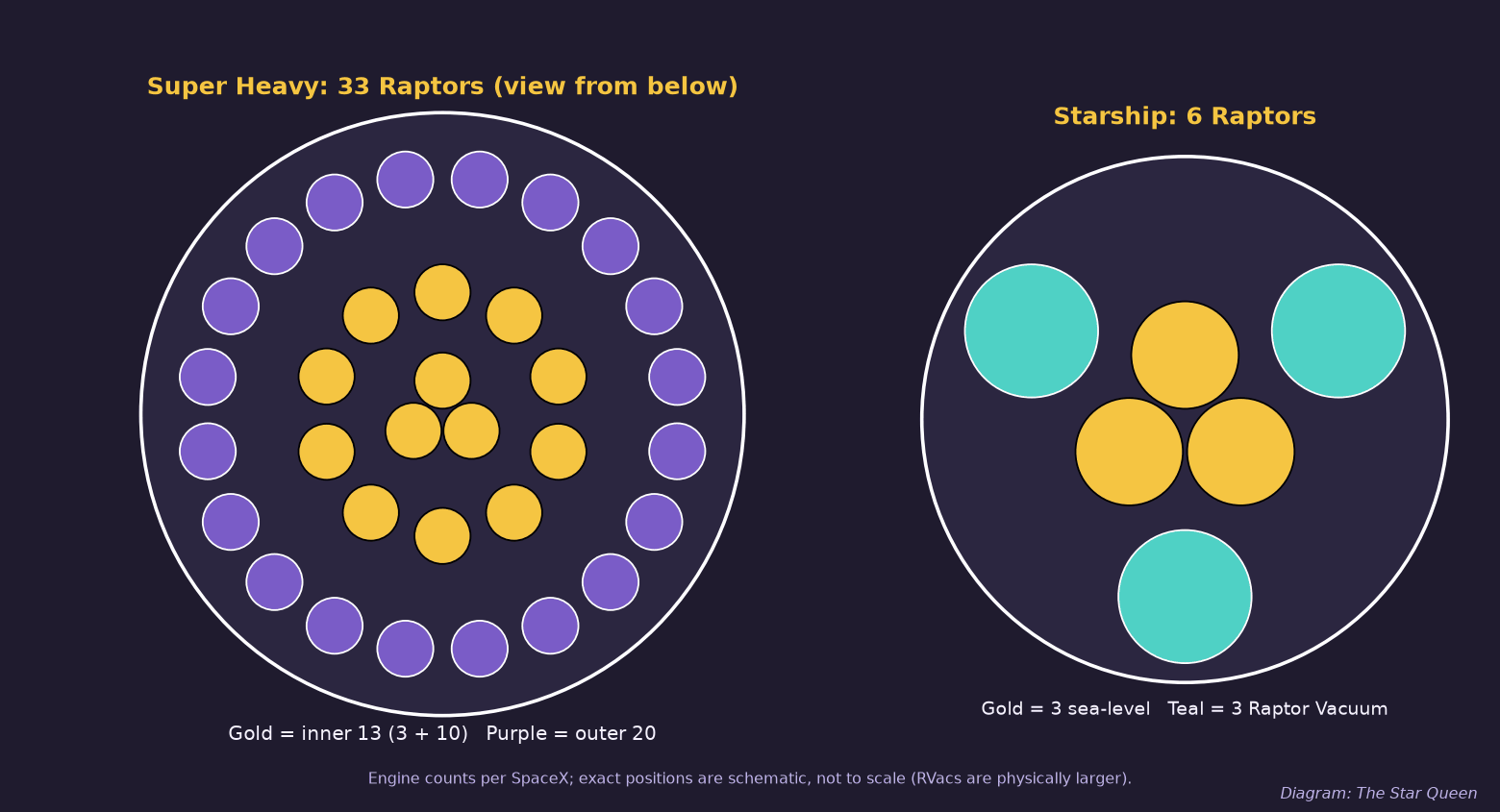
- Super Heavy carries 33 Raptors. Starship carries 6: three sea-level engines and three Raptor Vacuum (RVac) engines.
- Raptor 3 first flew on Starship V3 in May 2026. SpaceX’s own figures are 250 tf (sea level) and 275 tf (vacuum), with a 1,525 kg sea-level engine.
- Cost, chamber-pressure and efficiency figures are mostly Musk’s claims or reports, not audited numbers.
Terms to know ✨
- Staged combustion: a closed engine cycle where the turbine exhaust is burned in the main chamber instead of being dumped overboard.
- Preburner: a small combustion chamber that makes hot gas to spin a turbine.
- Full-flow: all the oxygen goes through one preburner and all the fuel through another, so every drop passes through a turbine.
- Methalox: liquid methane plus liquid oxygen as propellants.
- Subcooled: chilled well below the boiling point so it is denser.
- Isp (specific impulse): engine efficiency in seconds. Higher means more push per kilogram of propellant.
- tf / kN / lbf: tonnes-force, kilonewtons, pounds-force. 1 tf is about 9.8 kN, or about 2,205 lbf.
- Chamber pressure: how hard the burning gas is squeezed in the main chamber, in bar. Higher usually means a more efficient, more compact engine.
- Hot staging: lighting the upper stage’s engines before the booster has fully separated.
- Engine-out: an engine shuts down early and the vehicle keeps flying on the rest.
Why Methane, and Why “Full-Flow”?
Raptor’s story starts with Mars. SpaceX announced a big new engine in 2012, and by November of that year Musk said it would burn methane. Methane can, in principle, be made on Mars from local water and carbon dioxide, and it burns cleaner than kerosene, leaving less soot inside an engine you want to reuse many times.
Now the cycle. Merlin is an open-cycle gas generator: a small slice of propellant is burned to spin the pumps, then that exhaust is thrown away. Simple and robust, but a little wasteful. Raptor’s full-flow staged combustion keeps everything:
- an oxygen-rich preburner burns a little fuel with lots of oxygen, and that hot gas spins the oxygen turbopump;
- a fuel-rich preburner burns a little oxygen with lots of fuel, and that gas spins the methane turbopump;
- both streams are now gases, and they flow into the main chamber to finish burning together.
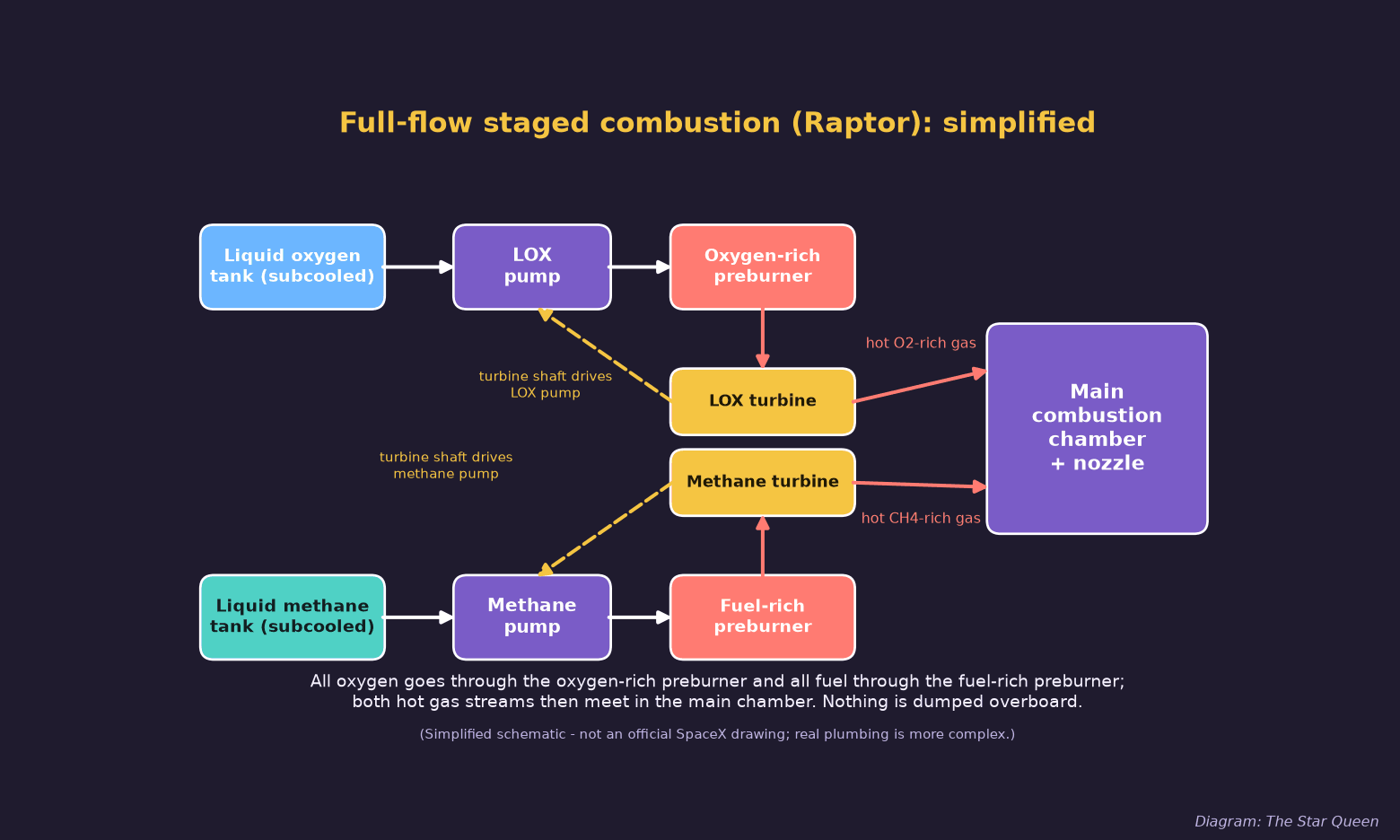
Why bother? Because the pump-driving energy is spread across the entire propellant flow, the turbine gas can be as cool as possible, and cooler turbines should last longer. Both propellants also arrive in the chamber already as gas, so they mix and burn fast. The price is complexity, which is why almost nobody had flown one.
Before Raptor, only two full-flow designs had reached a test stand: the Soviet RD-270 in the 1960s and Aerojet Rocketdyne’s Integrated Powerhead Demonstrator in the mid-2000s. Raptor became the first full-flow engine to fly, on the Starhopper test vehicle in July 2019. 🚀
A few more neat details:
- Raptor uses subcooled methane and oxygen. Denser propellant means more in each tank and happier pumps.
- The mixture is roughly 3.6 parts oxygen to 1 part methane by mass.
- Raptor 2 has no igniter in the main chamber, because the preburner exhaust is hot enough to light it. Torch igniters light the preburners. Compare that with Merlin’s chemical igniter, TEA-TEB, in my Merlin post.
The Numbers: Raptor 1 vs 2 vs 3
| Spec | Raptor 1 | Raptor 2 | Raptor 3 |
|---|---|---|---|
| Sea-level thrust | 185 tf (SpaceX) | 230 tf (SpaceX) | 250 tf (SpaceX, May 2026) |
| Vacuum (RVac) thrust | 200 tf (shared by Musk, Apr 2024) | 258 tf (SpaceX) | 275 tf (SpaceX, May 2026) |
| Sea-level engine mass | 2,080 kg (SpaceX) | 1,630 kg (SpaceX) | 1,525 kg (SpaceX) |
| Thrust-to-weight, sea level | about 89 (my arithmetic) | about 141 (my arithmetic) | about 164 (my arithmetic) |
| Chamber pressure | about 250 bar (design goal) | about 300 bar (Musk’s goal, 2018) | 350 bar in one 2023 test (Musk’s claim) |
| Isp (SpaceX Aug 2024 post) | 350 s | 347 s | 350 s |
| Isp, vacuum-optimized | about 380 s (target for RVac, per Wikipedia citing SpaceX/Musk) | ||
| Cycle and propellants | Full-flow staged combustion, subcooled methane and liquid oxygen | ||
| Size (Raptor 2 era, SpaceX) | Sea-level: about 1.3 m wide, 3.1 m tall. RVac: about 2.3 m wide, 4.6 m tall. | ||
Honest notes on that table:
- Thrust-to-weight is my math: thrust divided by engine mass using SpaceX’s own figures. Wikipedia’s version table arrives at the same 89, 141 and 164. One satellite-news article claimed Raptor 3 “exceeds 180”. I can’t reproduce that from SpaceX’s published numbers, so I’m using about 164.
- Raptor 3 thrust has moved. In April 2024 SpaceX’s stated target was 280 tf at sea level (306 tf vacuum), and its August 2024 post still listed 280 tf. In the May 2026 Starship V3 update, SpaceX’s numbers for the flight engines are 250 tf and 275 tf. I’m using the later ones; if you see 280 tf online, that’s the older target.
- Chamber pressure is the shakiest row. The first version was designed for about 250 bar. In 2018 Musk said they were aiming for roughly 300 bar. In May 2023 he posted that a Raptor V3 had reached 350 bar and 269 tf. SpaceX hasn’t published a measured, in-flight chamber pressure for any version.
- Isp numbers have no stated test conditions. SpaceX’s 2024 post lists 350 / 347 / 350 s for the sea-level variant without saying where. Older reports quote around 327 s at sea level, and RVac targets about 380 s. Treat all of them as ballpark.
Raptor Vacuum: The Long-Nozzle Cousin
In space nothing pushes back on the exhaust, so a much larger nozzle squeezes out more efficiency. Raptor Vacuum (RVac) is the same engine family with an extended, regeneratively cooled nozzle: propellant flows through channels in the nozzle wall to carry heat away. (That’s different from Merlin Vacuum, whose huge nozzle extension is a thin niobium skin that glows to shed heat. More in the Merlin post.)
The RVac engines don’t need to gimbal, and they do the heavy lifting once Starship is out of the thick air. The sea-level engines are the ones that fire in the atmosphere and handle the landing flip and burn. Each Raptor generation has a matching RVac. A full-duration test of the first RVac happened in September 2020, and its first in-flight ignition was on Starship’s second flight, in November 2023.
33 + 6: The Whole Stack
Super Heavy has 33 Raptors: 13 in the center and 20 around the perimeter. Starship has three sea-level and three vacuum engines.
My arithmetic, not an official liftoff figure: 33 engines at the Raptor 3 rating of 250 tf is about 8,250 tf, or roughly 18 million pounds-force. At the Raptor 2 rating of 230 tf it’s about 7,590 tf. A Starship V3 ship, by the same math, is 3 × 250 + 3 × 275 = 1,575 tf. Musk’s 2023 post implied 33 × 269 tf = 8,877 tf, but that rested on a single test. Real flights may run engines below their maximum, so none of these is a measured liftoff thrust.
The Raptor Timeline
- 2014-2015: component testing at NASA’s Stennis Space Center, including 76 preburner tests totaling about 400 seconds.
- August-September 2016: the first engine ships to SpaceX’s McGregor, Texas site, and the first full test firing takes place on September 25, 2016.
- 2019: Starhopper hops on a single Raptor.
- December 2021: Raptor 2, a full redesign with many flanges converted to welds, has started production. Musk later said it cost roughly half as much as Raptor 1 to make (his claim).
- April 20, 2023: Starship’s first flight with 33 Raptor 2 engines, three of which had shut down before liftoff.
- November 18, 2023: Flight 2, the first Starship hot staging and the first in-flight RVac ignition.
- August 2, 2024: Raptor 3 SN1 is revealed, with far fewer visible pipes.
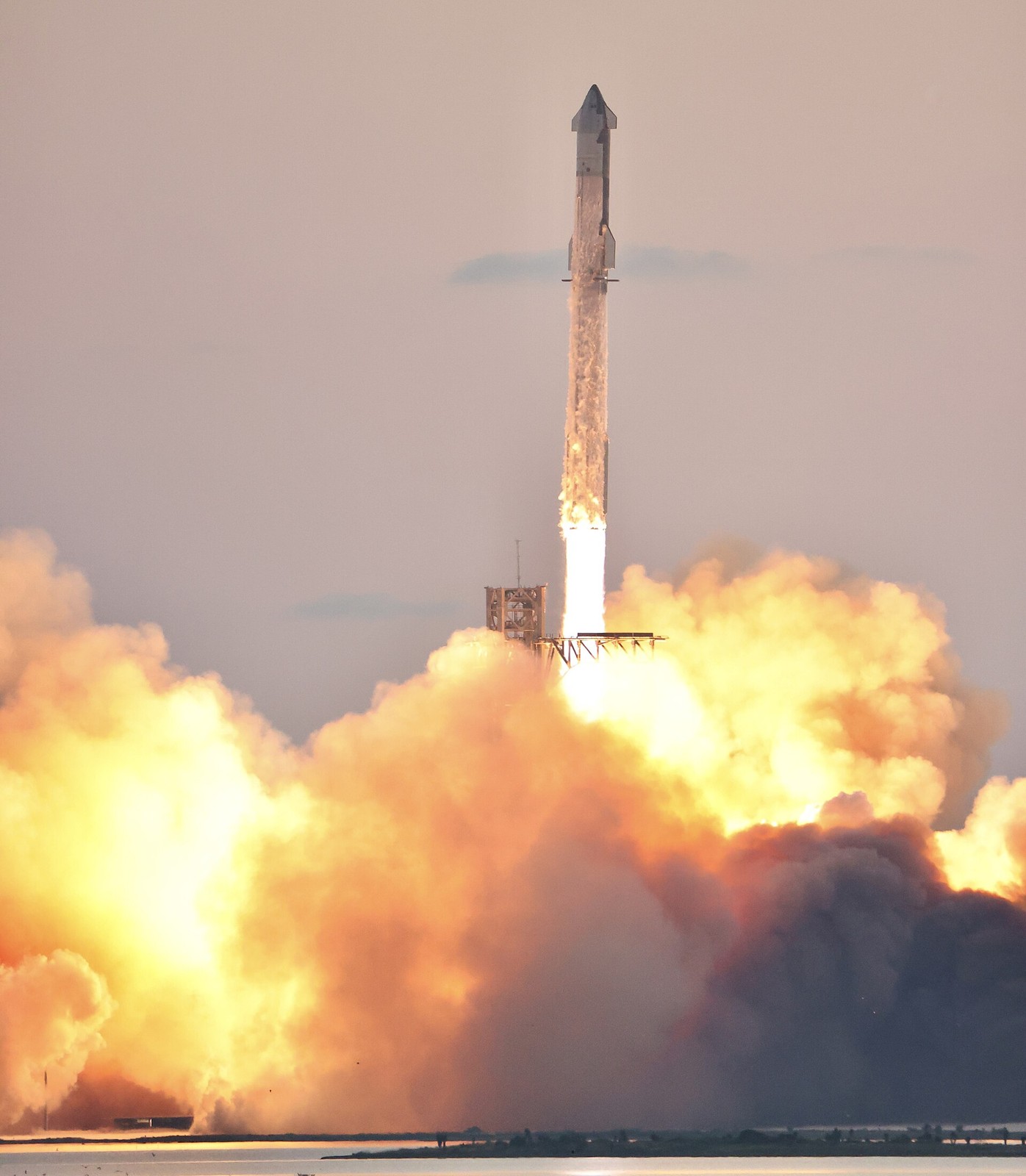
- May 22, 2026: Flight 12, the first flight of Starship V3 and of Raptor 3.
What Raptor 3 Changed
If Raptor 2 was a redesign of Raptor 1, Raptor 3 is a “remove everything that isn’t essential” upgrade:
- No more engine shrouds. Raptor 1 and 2 need heat shrouds to protect pipes and wiring during re-entry heating. Raptor 3 moves most plumbing and sensors into the engine’s structure, where the regenerative cooling already protects them. SpaceX’s May 2026 update also drops the booster’s engine shrouds and its carbon-dioxide fire-suppression system.
- Less mass. 1,630 kg down to 1,525 kg for the engine, and SpaceX says simplifying engine and vehicle hardware saves about a tonne per engine at the vehicle level.
- A redesigned ignition system on all variants (SpaceX).
- More welds, fewer bolts. Wikipedia, citing a 2024 interview with Musk, notes this makes servicing harder, since some parts now lie beneath welds.
- All 33 booster engines can start together, thanks to a redesigned fuel transfer tube, according to SpaceX’s V3 update.
When Raptor 3 SN1 appeared, ULA’s CEO Tory Bruno said SpaceX was showing a “partially assembled engine without controllers, fluid management, or TVC systems.” SpaceX’s Gwynne Shotwell replied, “Works pretty good for a ‘partially assembled’ engine.” The controllers and plumbing were simply inside now. 😄
Hot Staging and Engine-Out
Hot staging means the ship lights its engines while still attached to the booster. Starship first did it on Flight 2. Super Heavy shuts down all but five inner engines at staging, and on V3 the hot stage is built into the booster’s forward dome instead of being a separate throwaway ring.
Engine-out is where having 33 engines pays off, though it isn’t proof of reliability. Recent V3 flights:
- Flight 12 (May 22, 2026): one booster engine shut down about 1 minute 42 seconds into ascent. After separation, several engines failed to relight, the boostback burn ended early, and the booster made a hard splashdown. The FAA-accepted mishap report named heat effects on propulsion components and erroneous engine-alarm settings as the most probable root causes. One of the ship’s three RVacs also shut down, but the ship reached its planned trajectory.
- Flight 13 (July 24, 2026): all 33 ran through ascent and the high-thrust boostback.
- Flight 14 (September 28, 2026): Starship’s first orbital flight, with 26 Starlink V3 satellites deployed. The booster lost one engine early, then, per NASASpaceflight, 31 of 33 relit for boostback and 11 of 13 for the landing burn before engines dropped out and it made a soft Gulf splashdown (no catch was attempted). On the ship, one RVac shut down early; SpaceX first said the ship wouldn’t commit to orbit, then reversed after evaluating it, and one sea-level Raptor performed a short insertion burn. The flight was cut short, and the ship deorbited and splashed down about 3 hours 8 minutes after liftoff.
NASASpaceflight noted that an RVac going out on ascent has now happened on two of the first three V3 flights. That is exactly the pattern engineers will chase.
Static Fires and Reuse
Before flying, SpaceX holds a booster down and lights the engines. A February 9, 2023 static fire used 31 engines (33 were intended), and an August 25, 2023 test ran all 33. Reuse has now begun: Flight 7 flew the first reflown Raptor, and 29 reflown engines flew on Booster 14 during Flight 9.
Manufacturing and Cost Claims (Handle With Care) 💸
- 2019: Musk said Raptor was approaching $1 million per engine and talked of mass-producing 500 engines a year at under $250,000 each.
- 2021: SpaceX announced a second Raptor factory, aiming at 800 to 1,000 engines a year (a plan, not output).
- November 2022: SpaceX was reportedly producing more than one Raptor a day.
- June 2024: Musk said Raptor 3 “looks like a LEET engine” (his shorthand for a roughly $1,000-per-ton-of-thrust design) “but its way more expensive because it still has printed parts.”
These are statements, not audited unit costs, and SpaceX hasn’t published a current figure. If someone tells you Raptor 3 costs exactly some dollar amount, ask for the source. 😉
Watch: Raptor in Motion 🎥
Can’t see the video? Watch it on YouTube: Starship V3: Everything you need to know! (Everyday Astronaut)
And if you want the cycles explained from scratch, this primer is great:
Can’t see the video? Watch it on YouTube: Rocket engine cycles: How do you power a rocket engine? (Everyday Astronaut)
The Star Queen’s Take
Raptor is one of those machines where the engineering ambition is almost rude. 😄 A full-flow cycle is the hard way to build an engine, and SpaceX built it, flew it, and then redesigned it twice to make it simpler. The direction is always the same: fewer parts, fewer joints, less mass, more thrust.
What I’m watching next: whether the engine-outs on the V3 flights turn out to be a few unlucky events or a design pattern, and whether reuse really reaches the “hundreds of flights” dream. For now my scorecard is: spectacular, genuinely novel, still maturing. The chamber pressures and costs in headlines are mostly Musk’s claims, and I’ll believe them when they’re measured.
Also see: Merlin Explained: The Kerosene Workhorse Behind Falcon 9 and Falcon Heavy, the engine that taught SpaceX how to reuse a rocket. 🚀
Sources
- SpaceX, Starship vehicle page (Raptor and Raptor Vacuum specs, archived August 31, 2024): https://web.archive.org/web/20240831164843/https://www.spacex.com/vehicles/starship/
- SpaceX, updates page (May 12, 2026 Starship V3 update): https://www.spacex.com/updates
- SpaceX, Starship Flight 12: https://www.spacex.com/launches/starship-flight-12
- SpaceX, Starship Flight 14: https://www.spacex.com/launches/starship-flight-14
- Muskularity, summary of SpaceX’s May 12, 2026 V3 update: https://muskularity.com/updates/starship-v3/
- Wikipedia, SpaceX Raptor: https://en.wikipedia.org/wiki/SpaceX_Raptor
- Wikipedia, SpaceX Starship: https://en.wikipedia.org/wiki/SpaceX_Starship
- Wikipedia, Starship flight test 12: https://en.wikipedia.org/wiki/Starship_flight_test_12
- Wikipedia, Full-flow staged combustion cycle: https://en.wikipedia.org/wiki/Full-flow_staged_combustion_cycle
- Wikipedia, Hot staging: https://en.wikipedia.org/wiki/Hot_staging
- NASASpaceFlight, “Ship 41 Makes it to Orbit, Booster 21 Nearly Perfect”: https://www.nasaspaceflight.com/2026/09/starship-flight-14-orbit/
- NASASpaceFlight, “Starship makes orbit, Flight 15 preps in full swing”: https://www.nasaspaceflight.com/2026/09/starship-14-orbit-flight-15/
- Ars Technica, “SpaceX’s Starship goes orbital, deploying first next-gen Starlinks”: https://arstechnica.com/space/2026/09/starships-first-orbital-launch-gives-lift-to-spacexs-next-gen-starlinks/
- Space.com, “The world’s biggest rocket: How SpaceX’s new Starship ‘V3’ differs from its predecessors”: https://www.space.com/space-exploration/launches-spacecraft/the-worlds-biggest-rocket-how-spacexs-new-starship-v3-differs-from-its-predecessors
- SpaceNews, “SpaceX launches first Starship V3”: https://spacenews.com/spacex-launches-first-starship-v3/
- Spaceflight Now, FAA mishap investigation (May 27, 2026): https://spaceflightnow.com/2026/05/27/faa-requires-spacex-led-mishap-investigation-before-resumption-of-starship-launches/
- NASASpaceFlight, “Musk outlines Starship progress towards self-sustaining Mars city” (Raptor 2, Feb 2022): https://www.nasaspaceflight.com/2022/02/starships-self-sustaining-city-mars/
- Elon Musk on X, May 13, 2023 (Raptor V3 350 bar / 269 tf; archived copy): https://web.archive.org/web/20230526002156/https://twitter.com/elonmusk/status/1657249739925258240
- Images: Wikimedia Commons (credit and license in each caption). Diagrams by The Star Queen.