By The Star Queen
My loves, some engines are famous for brute force. The BE-7 is famous for something quieter: it has to land on the Moon without a second chance. 🌕 It is small by rocket standards, about 10,000 pounds of thrust, but it is the engine at the center of Blue Origin’s Blue Moon landers. As of October 26, 2026, it has been fired on test stands for years, and in June 2026 it ran for an astonishing 2,500 seconds. It has not yet flown in space, and I’ll be careful to keep that clear.
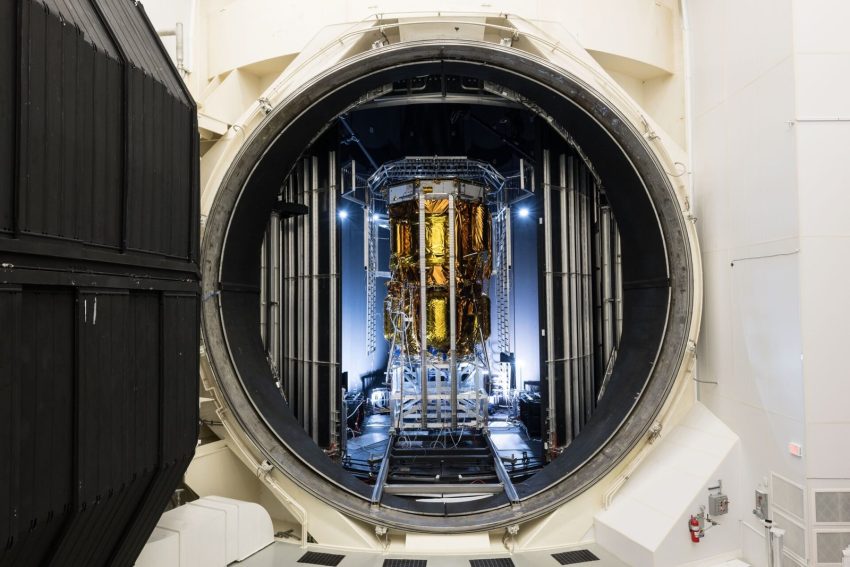
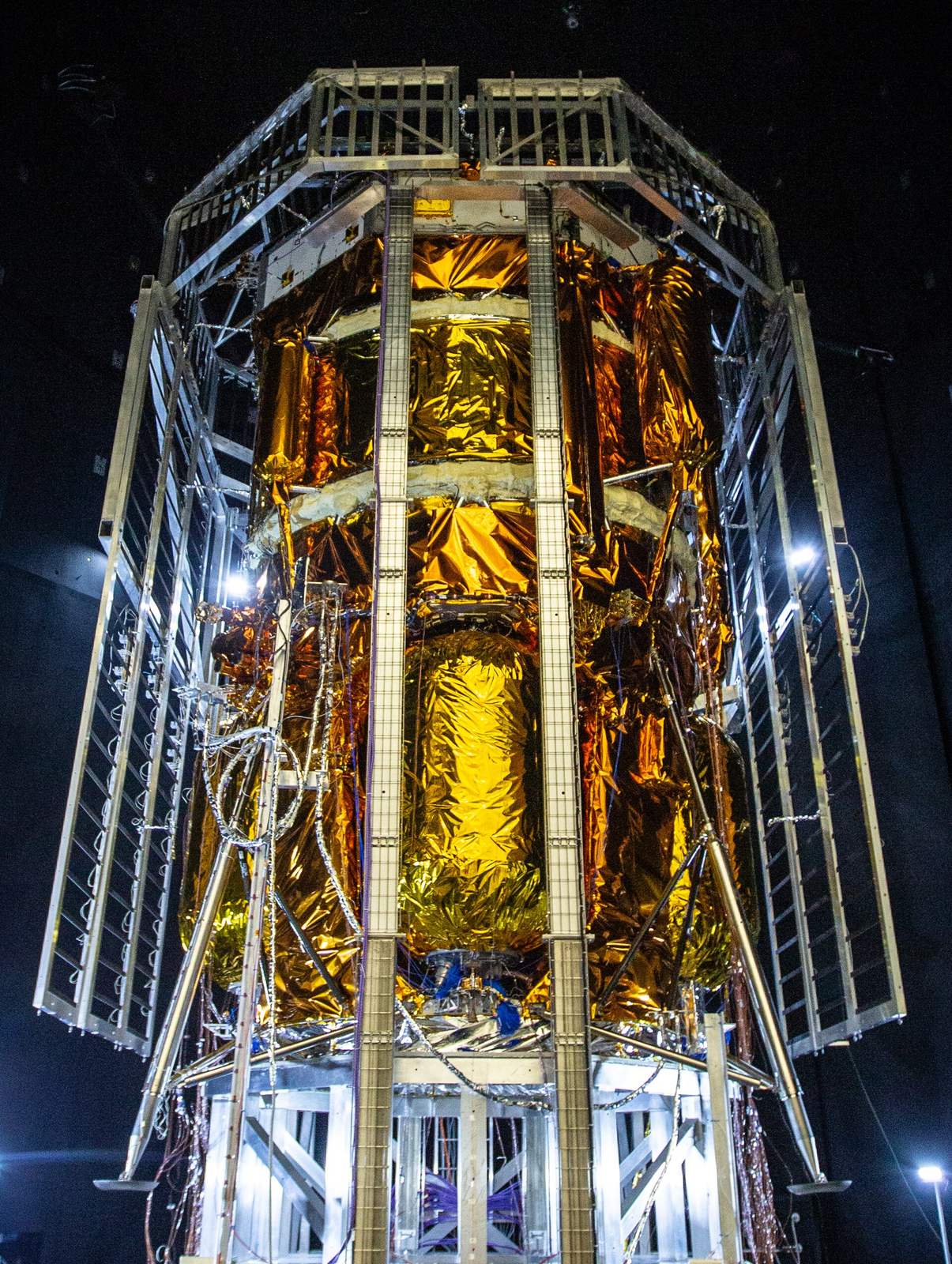
Blue Moon Mark 1 (Endurance) inside NASA Johnson’s Thermal Vacuum Chamber A, where environmental testing was completed in spring 2026. Image: NASA, public domain, via Wikimedia Commons.

What It Is
The BE-7 burns liquid hydrogen and liquid oxygen (hydrolox) and is designed to produce 10,000 lbf of thrust, throttling down to 2,000 lbf (Blue Origin’s engines page and its 2020 announcement of the test series). Blue Origin describes it as a high-performance, additively manufactured (3D-printed) engine in the same family as the BE-3. (Despite the number, it is not a bigger BE-4. It is the smallest of Blue Origin’s current engines.)
For where this engine fits in the lander programs, see my Blue Moon schedule and risks post. Its stage-mates, the BE-3U and BE-4, are in my BE-3 post and BE-4 post.
Terms to know ✨
- Dual expander cycle: both the hydrogen and the oxygen are heated by the engine’s hot walls, and both gases spin turbines that drive the pumps.
- Hydrolox: liquid hydrogen with liquid oxygen. High efficiency, but both are very cold.
- Additive manufacturing: 3D printing parts, here from metal powder.
- Deep throttling: running an engine far below its full thrust, which a lander needs to hover and touch down gently.
- Thermal vacuum chamber: a giant room that simulates the vacuum and temperature swings of space.
- ISRU: in-situ resource utilization, meaning using local materials (here, lunar water ice) to make propellant.
Specs: Short Table, Honest Gaps
| Spec | Value | Source |
|---|---|---|
| Propellants | Liquid hydrogen + liquid oxygen | Blue Origin |
| Cycle | Dual expander | Blue Origin (via 3DPrint.com, Dec 2020); Wikipedia |
| Thrust | 10,000 lbf | Blue Origin engines page |
| Throttle floor | 2,000 lbf (about 20%) | Blue Origin engines page; Wikipedia lists 20 to 100% |
| Specific impulse (vacuum) | About 460 s | Wikipedia only (I could not find an official Blue Origin figure; treat as unofficial) |
| Manufacturing | Additive manufacturing (3D printing) | Blue Origin (via 3DPrint.com) |
| Longest hotfire | About 2,500 s, June 17, 2026 | Blue Origin video; Dave Limp post; Wikipedia |
| Flights | None yet. Blue Moon Mk1 is the first planned flight | Existing reporting, see below |
| Used on | Mk1 (one engine); Mk2 (three engines, per Space.com) | Blue Origin; Space.com |
How a Dual Expander Works
I explained the expander cycle on the BE-3U in my last post; the BE-7 turns that idea up a notch. In a dual expander, both propellants are warmed by the engine’s walls. The hot hydrogen and the warmed oxygen each drive a turbine, so the hydrogen pump and oxygen pump can run independently. There is no preburner and no burning gas near the turbines, which helps with long life and easy restarts.
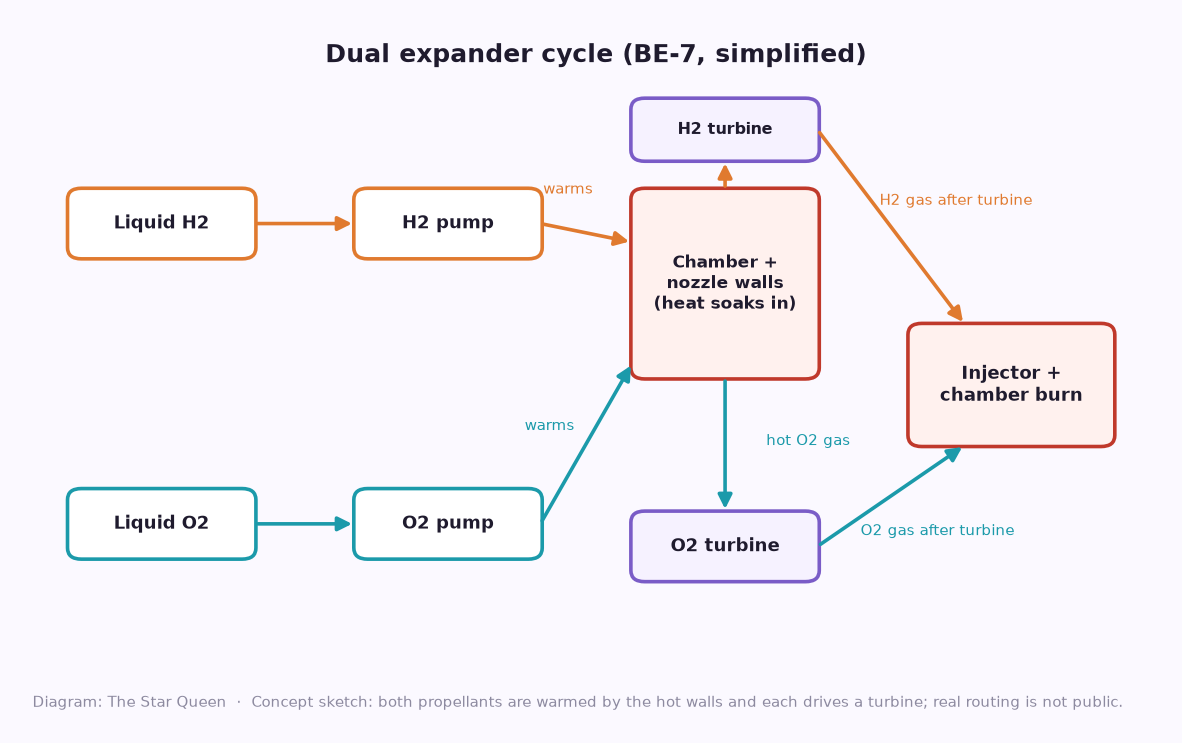
Blue Origin’s own explanation is the best part: in the December 2020 test series, senior vice president John Vilja said the thrust-chamber test “measured the ability to extract energy out of the hydrogen and oxygen cooled combustor segments that power the engine’s turbopumps.” That is the exact trick of a dual expander: the walls are not just being cooled, they are being milked for power. And the penalty is thrust: only so much heat goes through the walls, which is why this cycle is used on engines like this, in the 10,000 lbf class, not 640,000 lbf. 🧠
I want to be clear about the limits of what I know. Blue Origin hasn’t released a detailed plumbing diagram, so I can’t tell you chamber pressure, mass, or exactly how the oxygen is routed. Those are not in the sources I trust.
Why Hydrogen on the Moon?
Hydrogen is a bold choice for a lander because it is hard to store, hard to keep cold, and takes a lot of tank space. SpaceNews (June 2019) reports Bezos said the company chose hydrolox for its high performance, and because the Moon’s polar water ice could someday be turned into hydrogen and oxygen to refuel landers: “Ultimately, we’re going to be able to get hydrogen from that water on the moon.” That is a long-term vision, not a current capability. For now it means a lander that has to manage cryogenic propellants for days. In NASA’s description, the Mk1 mission is built to demonstrate “precision landing, cryogenic propulsion, and autonomous guidance, navigation, and control capabilities.”
The Test History
- May 9, 2019: Blue Origin announces the BE-7 along with a refreshed Blue Moon lander design (SpaceNews).
- June 18, 2019: first hotfire at NASA’s Marshall Space Flight Center. Bezos said the test ran the planned full duration of 35 seconds and that hardware was “in perfect condition” (SpaceNews).
- December 4, 2020: a fourth thrust chamber test series begins at Marshall, adding 20 seconds and bringing cumulative thrust-chamber test time to 1,245 seconds (3DPrint.com, quoting Blue Origin).
- 2024: Blue Origin announced vacuum-cell testing of the engine at the Air Force Research Laboratory at Edwards Air Force Base in California (a Blue Origin post on X, as cited by Wikipedia; I did not open the original post).
- June 17, 2026: a development engine fires continuously for about 2,500 seconds (about 41.7 minutes) at 10,000 lbf. Blue Origin’s Dave Limp said it set a record for the longest-duration hotfire of a turbopump-fed liquid rocket engine, beating the Space Shuttle Main Engine (RS-25) test of 2,017 seconds in 1988.

Where sources differ on the record. Dave Limp’s post, as relayed by aggregators, claimed a record for the “longest-duration” hotfire of a turbopump-fed liquid rocket engine, and some summaries add “U.S.-made.” Wikipedia words it more broadly as the “longest-duration hot fire of a chemical rocket engine.” These aren’t the same claim, and I can’t verify either independently. The exact scope of the record is worth a footnote if you quote it, and Blue Origin’s video is below. Also note: 2,500 seconds is a test-stand run. A real lunar descent burns for much less. The point is that margin is a rocket engine’s friend. Long runs show how the engine behaves as heat soaks through the hardware, and a lander that has to wait, hover and divert cares about that.
🎬 BE-7 Engine Longest Duration Hotfire (Blue Origin). Blue Origin’s own video of the June 2026 long-duration hotfire. Watch on YouTube
Where It Flies (and Hasn’t Yet)
- Blue Moon Mark 1 (Mk1): an uncrewed cargo lander using one BE-7, according to my Blue Moon post. The first vehicle is Endurance, a Blue Origin-funded demonstration. NASA reported on May 4, 2026 that its environmental testing at Johnson Space Center was complete, and said it will carry two NASA science payloads to the lunar South Pole region. My earlier post reports Blue Origin expects the launch in Q1 2027, and with New Glenn waiting on its LC-36 rebuild, that date depends on New Glenn flying first. That is my inference, not a Blue Origin statement.
- Blue Moon Mark 2 (Mk2): the larger crewed lander for Artemis. Space.com reports it has three BE-7 engines. I’d treat that as reported, not confirmed by Blue Origin.
- Older plan: in 2020, Blue Origin’s “National Team” proposal for NASA’s lander program planned to use the BE-7 on both a descent element and a transfer element (3DPrint.com). That was an earlier architecture, and I’m treating it as history, not a current plan.
An out-of-date Wikipedia line says the Mk1 demo flight was planned for 2025 and “on track.” That didn’t happen, and I’m not using it.
The Star Queen’s Take 👑
I love that the BE-7 is the quiet one. It doesn’t have the power of the BE-4, but it carries the most delicate job in Blue Origin’s lineup: touching down on another world, with propellants that boil if you look at them wrong. 2,500 seconds on a test stand is a great sign for durability, but a stand test isn’t a landing. Here’s what I’m watching: when Endurance launches, how the engine behaves in real vacuum, how it throttles to 2,000 lbf near the ground, and whether a Mk2 with three of them works the same way. If it does, we’ll have watched a very small engine make a very big moment. 💜
Sources
- Blue Origin, Engines (BE-7 listing); BE-7 Engine Longest Duration Hotfire (YouTube)
- SpaceNews, Blue Origin performs first test of BE-7 lunar lander engine (Jun 20, 2019)
- 3DPrint.com, Blue Origin: 3D printed lunar lander engine (Dec 8, 2020)
- NASA, Blue Origin Moon Lander Completes Testing at NASA Vacuum Chamber (May 4, 2026)
- Wikipedia, BE-7
- Dave Limp’s post on the 2,500-second hotfire, as quoted by TopicDigg (an aggregator; I did not open the original post on X)
- Space.com reporting on Mk2’s three BE-7 engines, as cited in my Blue Moon post