By The Star Queen · Star Queen Chronicles
My loves, thirteen is a lucky number in my house. Thirteen engines on one first stage, all lit at once, all made by one company that started out printing rocket parts in a leased building. That is Terran R, and the engine at its heart is Aeon R: a 269,000-pound-force LOX/methane engine that Relativity Space designed, printed and tested in-house. 🔥
This is the sequel to my Aeon 1 deep dive. Aeon 1 was a 23,000-lbf proof of concept. Aeon R is the one that has to work thirteen times in a row, and then fly again. I’ll cover how it works, how it was tested, the numbers Relativity has and has not released, and where reporting disagrees. For the whole rocket, see my Terran R status post.
How I label things: Official comes from Relativity or NASA, Reported comes from journalists or social posts I could not open directly, and My math is mine.
Terms to know ✨
- Gas-generator cycle: a design where a small side burner makes hot gas to spin the turbine that drives the pumps; the exhaust is dumped. Simple and forgiving, a little less efficient than staged combustion.
- Thrust chamber assembly (TCA): the injector, combustion chamber and nozzle: the part of the engine where thrust is actually made.
- Powerpack: the pumps, turbines and gas generator tested together, without the main chamber, to prove the “power” half of an engine first.
- Mission duty cycle (MDC): a test that runs an engine through the throttle levels and durations of a real flight.
- Qualification: the formal test campaign that proves an engine design meets its flight requirements across start conditions, duration, throttle and gimbal range.
- Gimbal: tilting the whole engine on a mount so the thrust line steers the rocket.
- Subcooled propellant: cryogenic propellant chilled below its normal boiling point so it is denser and more resistant to vapor bubbles.
- Acceptance testing (ATP): the check each flight engine passes before it is cleared to fly, separate from qualifying the design.
Aeon R at a Glance
| Item | Value | Label and source |
|---|---|---|
| Propellants | Liquid oxygen and liquid methane | Official, Relativity |
| Cycle | “Uniquely high-pressure” gas generator cycle driving two turbopumps | Official, Relativity (April 2023) |
| Sea-level thrust | 269,000 lbf per engine | Official, Terran R page (the April 2023 announcement said 258,000 lbf) |
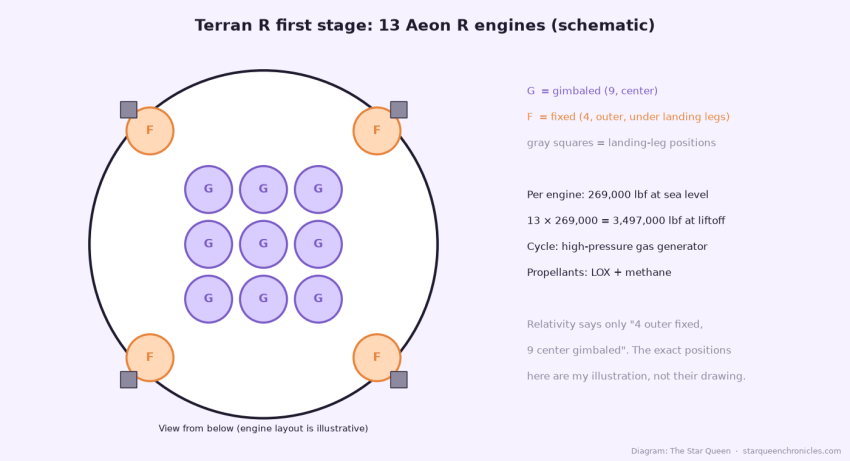
| Engines on Terran R stage 1 | 13: four fixed outer engines, nine gimbaled center engines | Official (April 2023 layout); 13 engines confirmed in the September 2026 update |
| Stage 1 liftoff thrust | 3,497,000 lbf (13 × 269,000, my math) | Official total; my math agrees |
| Gimbal test | 5.5 degrees, the most the stand allowed | Reported by NASASpaceflight, Jun 2025 |
| Qualification | Completed July 2025; “more than 60 hot fires” reported | Official (“sufficient run time”); 60+ figure is Reported from a company social post |
| Specific impulse | Not published | Not public |
| Chamber pressure, mass | Not published | Not public |
| Second-stage engine | Aeon V, 323,000 lbf vacuum (earlier called Aeon Vac, 279,000 lbf in 2023) | Official; spec drift |
Why a Gas Generator, and Why That Is a Real Choice
Plenty of modern methane engines use staged combustion, which sends all the gas through the main chamber and squeezes out more efficiency. Raptor does it, and so does Blue Origin’s BE-4. (Both are general background, not Relativity statements.) Relativity chose the gas-generator cycle again for Aeon R, and says it builds on the company’s “advanced experience developing gas generator engines.” I think the logic is easy to see: a company that had just flown its first engine wanted the next one to be a scale-up, not a leap.
There is a reuse angle too. In general engineering terms (not a Relativity claim), a gas generator can run the turbines at gentler temperatures than an oxygen-rich preburner does, and a simpler start sequence has fewer ways to go wrong. I want to be careful: Relativity has not published an efficiency number for Aeon R, so I cannot tell you how much Isp it gave up. What Relativity does say is that the engine’s cycle is a “uniquely high-pressure” gas generator design. “Uniquely” is a marketing word. My guess is that it means higher chamber pressure than a typical open-cycle engine, but that is only a guess and I have no figure for it.
The Printed Engine
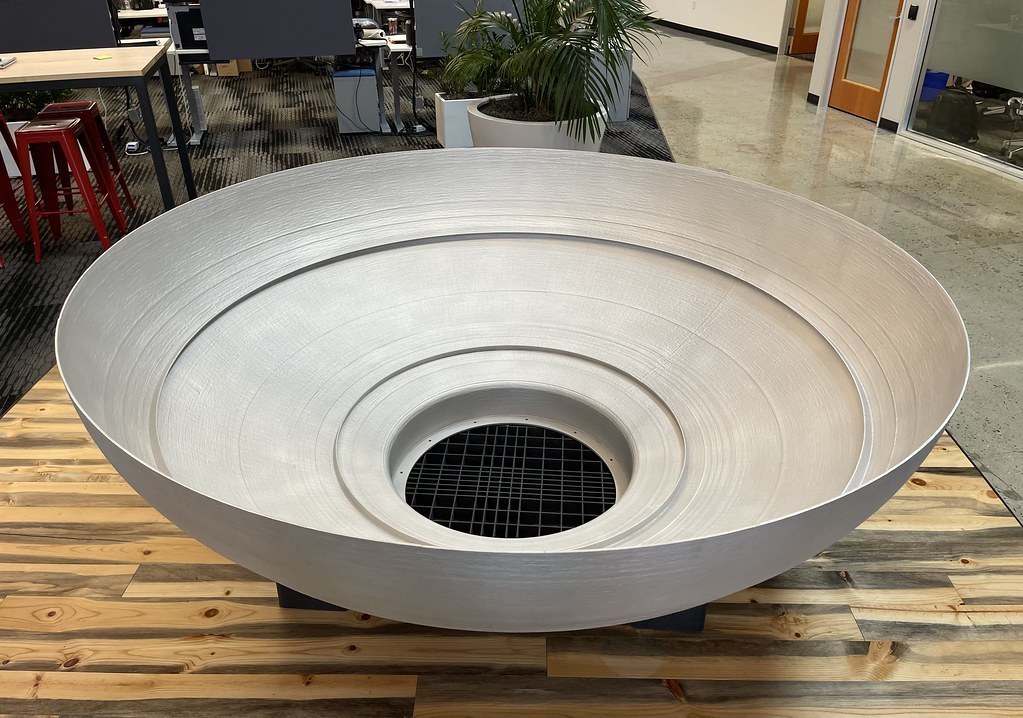
Official: Relativity says Aeon R is 3D printed, designed and manufactured in-house, and built on Aeon 1’s lessons. Its April 2023 announcement describes “nodes of simplicity,” where many engine elements are designed as a single print, and says all engine active valves are developed in-house. The company also says larger printers made the bigger engine possible.
In its Aeon R turbopump explainer, Relativity’s engineers describe a dual-shaft layout in which the oxygen and fuel pumps are driven separately, with parts printed to cut the number of pieces. The video also covers testing the pumps on liquid nitrogen before the full engine. I am deliberately not quoting the rotational speeds, because the speeds I could extract from the video’s auto-generated captions looked garbled and I could not verify them.
Relativity engineers walk through the Aeon R turbopumps. Official, from the company’s YouTube channel. If the player does not load, watch “Relatively Speaking: Aeon R Turbopumps Explained” by Relativity Space on YouTube.
From Powerpack to Qualification
Relativity’s own Aeon R Progress page lists the testing it has shown, which I turned into a timeline. The picture is a careful build-up: gas generator tests in November 2022, a thrust chamber assembly firing at 100% power in March 2023, powerpack tests in November 2023, then the first full engine hot fire on December 13, 2023, and a full mission duty cycle test on December 15, 2023.
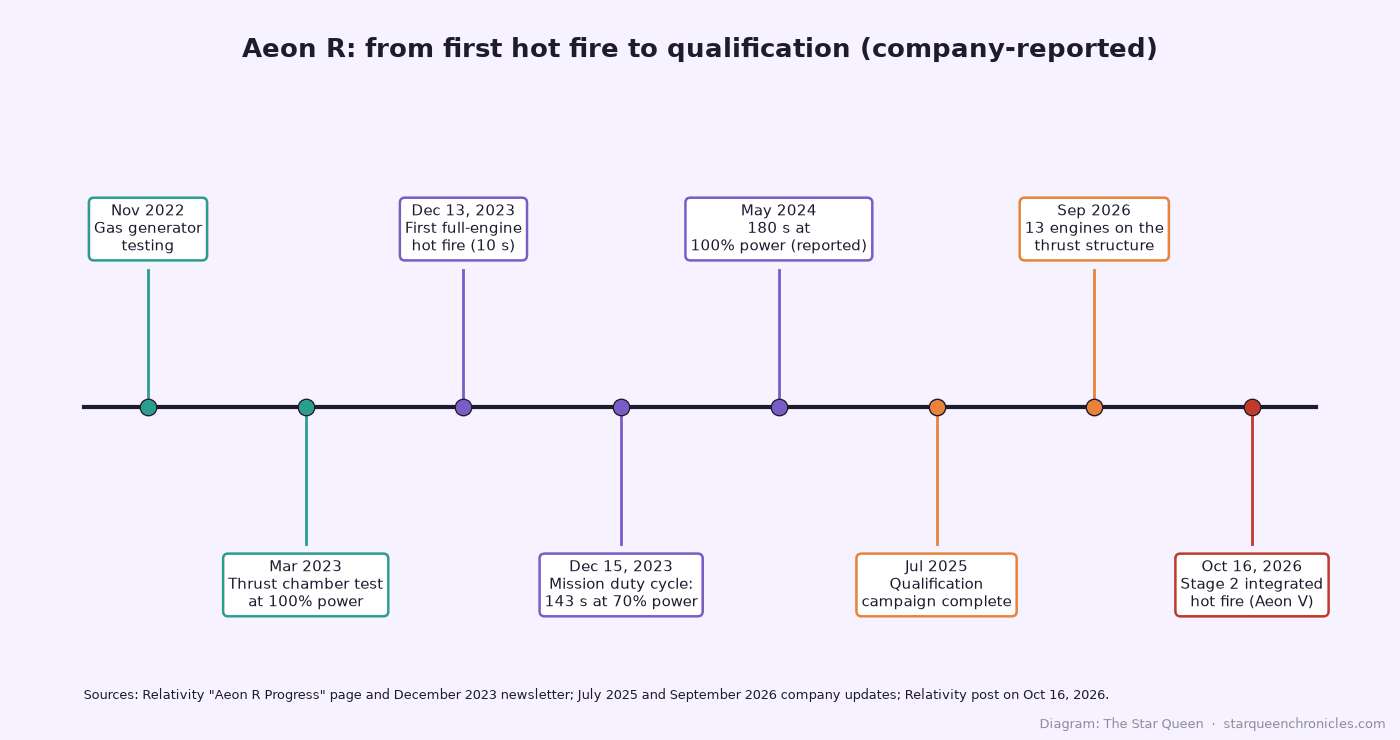
The December 2023 details (a 10-second first firing and a 143-second mission duty cycle at 70% power) come from Relativity’s newsletter and social posts that I could not re-open for this draft, so please read them as Reported. The same goes for “180 seconds at 100% power” in May 2024, which I saw on LinkedIn and Stennis posts.
More recent numbers are easier to confirm. Reported (NASASpaceFlight, June 2025): by March 2025 Aeon R had passed 2,500 seconds of accumulated run time, with a longest burn above 160 seconds. In April it demonstrated thrust vector control at 5.5 degrees of gimbal motion, the maximum range of the stand. The program then moved from development to qualification, with the main chamber and injector assembly passing acceptance testing. The first qualification engine was built in Long Beach, California, and fired more than 11 times in May, including four hot fires in under 10 working hours.
Official: Relativity’s July 2025 update says the qualification campaign finished that month, and that the engine “accumulated sufficient run time to validate expected flight performance, including start cycles, duration, inlet conditions, and throttle and gimbal profiles.” A company post that I could only see through a mirror site puts the count at more than 60 hot fires, so I show it as reported.
Relativity’s own walk-through of the qualification campaign. If the player does not load, watch “Deep Dive: Aeon R Engine Qual Campaign” by Relativity Space on YouTube.
Where Aeon R Stands in October 2026
- Official (July 2025): 92% of printed components for the 13 first-flight engines were complete and the first set of flight turbopumps assembled.
- Reported (Ars Technica, Oct 20, 2026): acceptance testing is done for all 13 first-stage Aeon R engines.
- Official (September 2026 update): all 13 engines are installed on the thrust structure and gimbal testing, which checks clearances as each engine pivots, has started. Engines for flights two and three are well into manufacturing.
- Official (September 2026 update): a stage-two Aeon V engine is installed on the A2 stand at NASA Stennis, with a first autogenous laser weld completed for the Aeon V nozzle extension. Ars reports a successful integrated stage-two hot fire on Friday, October 16, 2026.
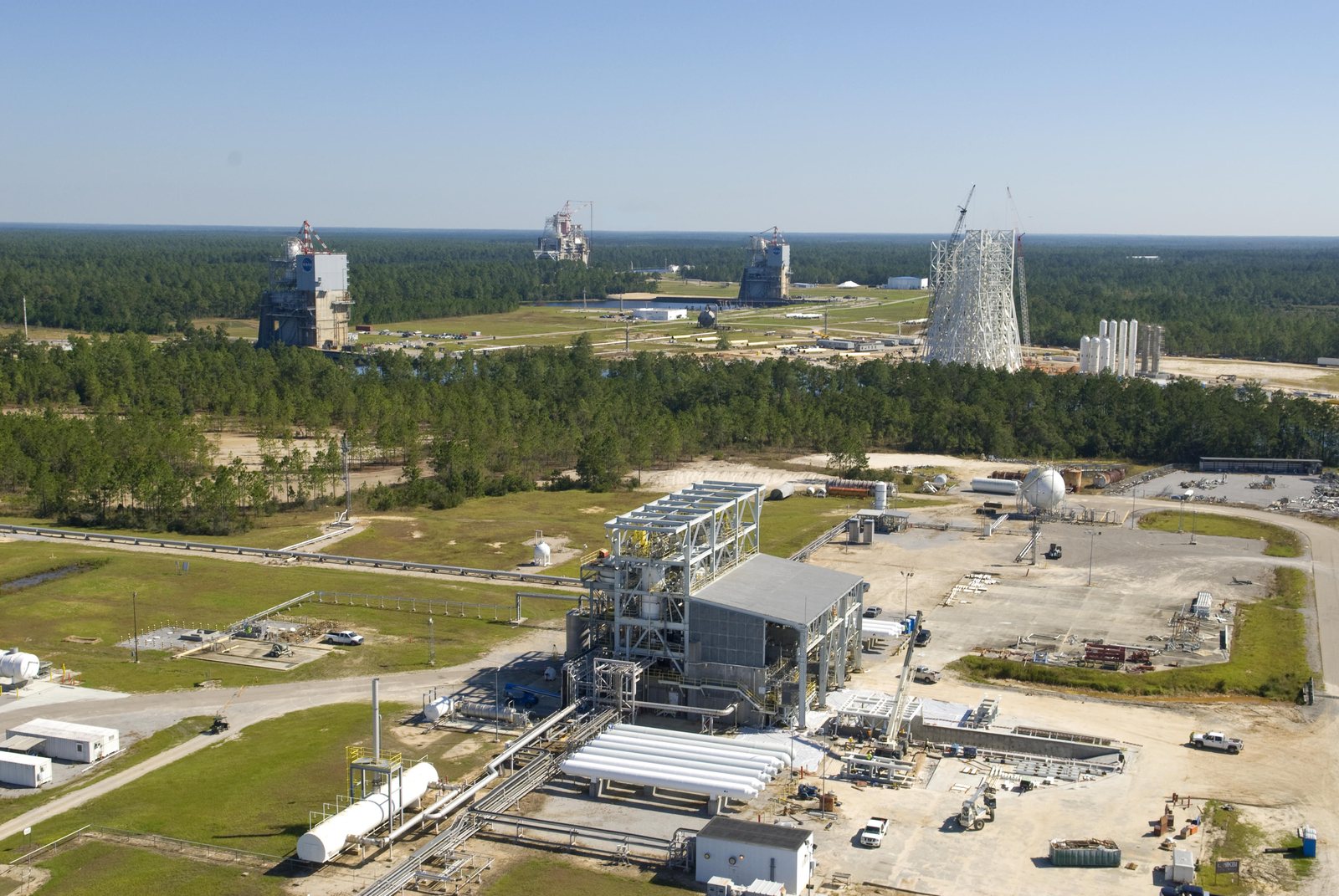
The A2 stand is a nice piece of history. Relativity says it flight-certified the second stage of Saturn V, later supported shuttle and Constellation engine testing, and sat unused for nearly a decade before Relativity began reviving it.
Aeon 1 to Aeon R in Numbers
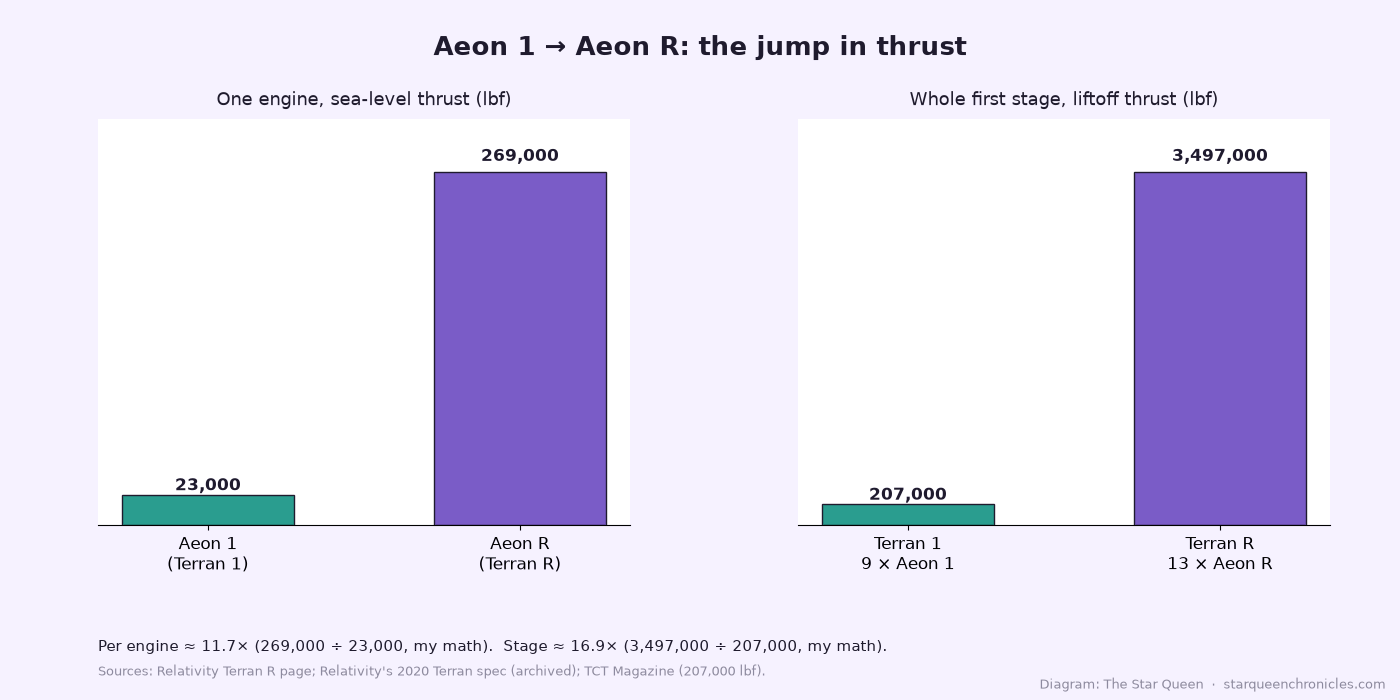
My math: 269,000 ÷ 23,000 ≈ 11.7, so one Aeon R makes almost twelve Aeon 1s’ worth of thrust. At the stage level, 3,497,000 ÷ 207,000 ≈ 16.9. That is a huge step for a company with one flight of experience, and it is why the test record above matters so much.
Where My Sources Disagree
- Thrust: 258,000 lbf (April 2023) versus 269,000 lbf (current page). I use the current page.
- Second-stage engine: “Aeon Vac, 279,000 lbf” (2023) versus “Aeon V, 323,000 lbf” (current). Relativity’s September 2026 update says Aeon V, while NASASpaceFlight’s June 2025 piece still says Aeon Vac. Same role, so I read it as a rename plus an uprating, but that is my reading.
- Vehicle size: 270 ft tall and 18 ft wide (2023) versus 284 ft and 17.7 ft (current page).
- Reuse payload: Relativity says 23,500 kg reusable. Ars says “closer to 20 metric tons.” NASASpaceFlight’s June 2025 piece suggests a reconciliation: 23,500 kg to a 200 km orbit and 20,000 kg to 400 km. I think that is the likely explanation, but it is NASASpaceFlight’s summary, not an official statement.
- First launch: Relativity says late 2026; Ars predicts September 2027. Ars calls its dates “almost certainly wrong” opinions, and I label them as such.
- Test details: the 2023 test durations and the 60+ hot-fire count are from company social posts I could not open directly.
- Not public: Isp, chamber pressure, engine mass and exact thrust-to-weight. If you see numbers for those, they are not from Relativity.
The Star Queen’s Take 👑
What I admire about Aeon R is that it is not trying to win a spec-sheet beauty contest. It is a printed, open-cycle engine whose big bet is on volume and repeatability: thirteen of them, a qualification campaign, a real test stand history and a company with money behind it again. What I do not know yet is how many flights each engine will survive, because no Aeon R has flown. That is the number I am watching, and it is also the one that will decide whether the open-cycle choice was smart. Until then, I am cheering for thirteen clean ignitions. ✨
Related Reading
- Aeon 1: The 3D-Printed Engine That Flew Relativity’s First Rocket
- Terran R Explained: October 2026 Edition
- Zenith: Stoke’s Full-Flow Engine
Sources
- Terran R — Relativity Space vehicle page (undated)
- Aeon R Progress — Relativity Space (undated)
- Relativity Space unveils Terran R — Relativity Space, Apr 12, 2023
- July 2025 Company Update — Relativity Space, Aug 11, 2025
- September 2026 Company Update — Relativity Space, Oct 12, 2026
- Relativity Space accelerates production and testing of first Terran R — NASASpaceFlight, Jun 20, 2025
- Does anyone actually want to win the medium-lift race in the United States? — Ars Technica, Oct 20, 2026
- Tech Deep Dive: Aeon R Turbopumps — Relativity Space newsletter, Feb 2024
- Relatively Speaking: Aeon R Turbopumps Explained — Relativity Space, YouTube
- Deep Dive: Aeon R Engine Qual Campaign — Relativity Space, YouTube
- Relativity Space — Wikipedia (secondary; used only for flagged items)
- File:Stennis test complexes on display (SSC-2009-02208).jpeg — NASA Stennis Space Center, 2009, via Wikimedia Commons
- Relativity Space 3D Print — Steve Jurvetson, Feb 3, 2022, CC BY 2.0, via Flickr
