By The Star Queen · Star Queen Chronicles
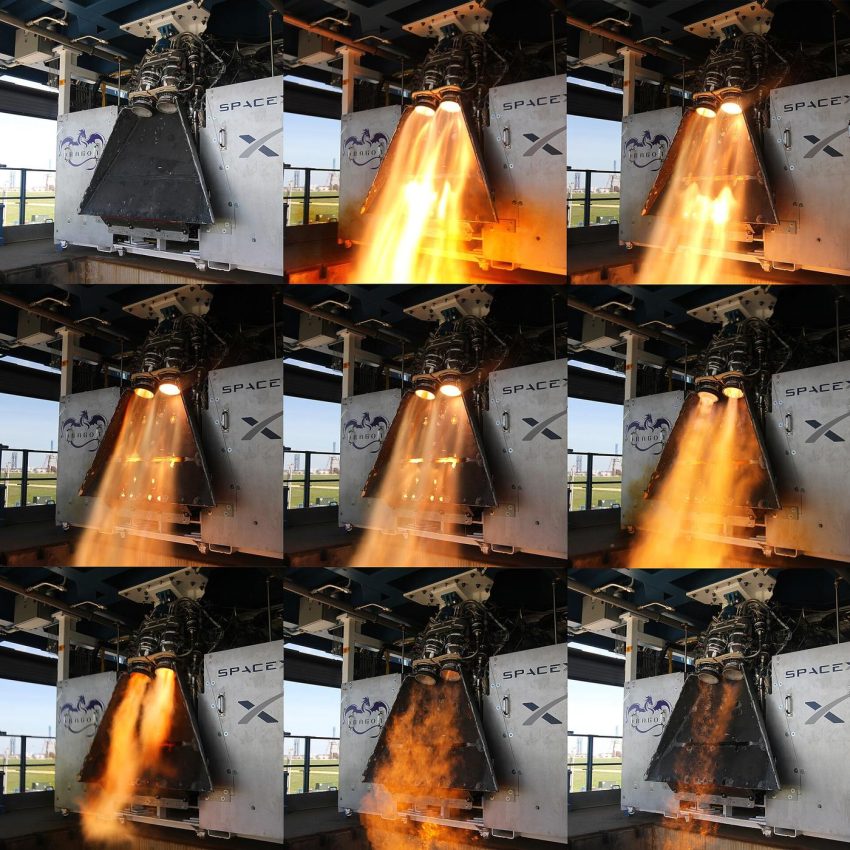
A SuperDraco pod (two engines) in a full test firing, shown as a nine-frame mosaic. Credit: SpaceX, CC0 (public domain dedication), via Wikimedia Commons
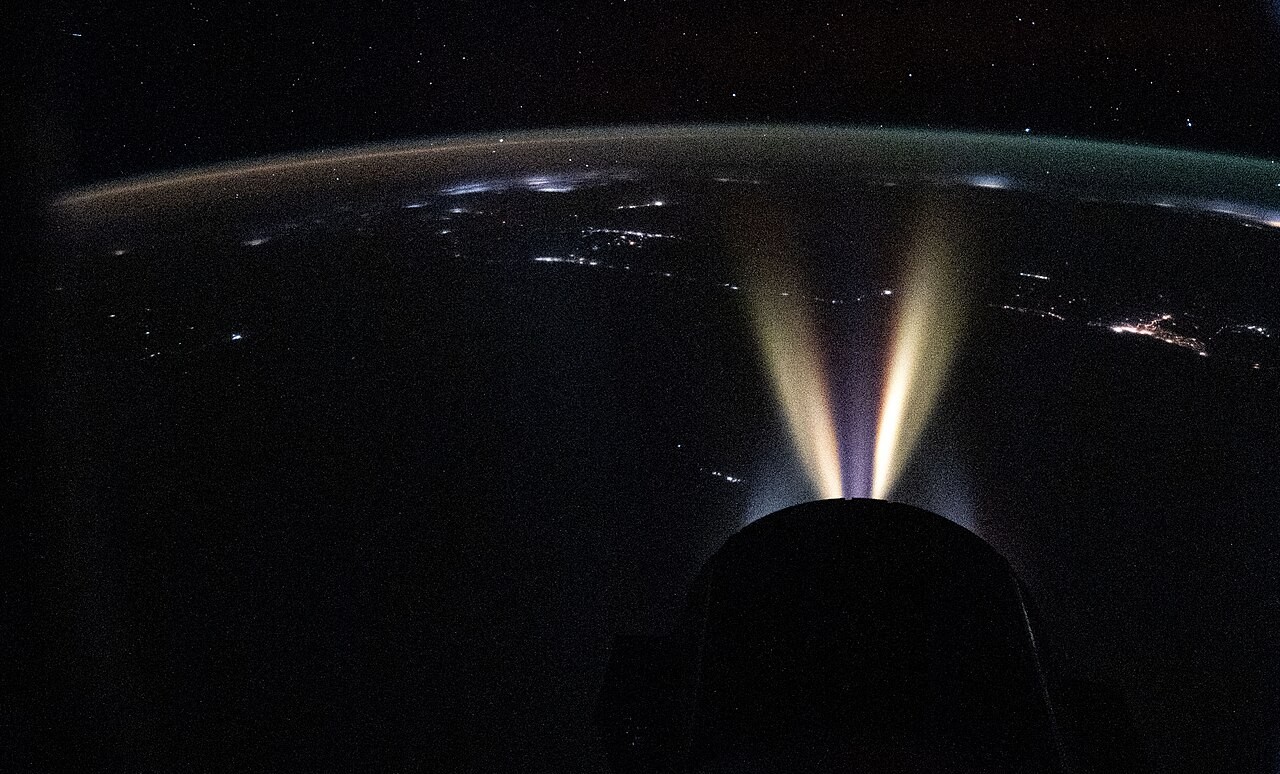
My loves, we’ve celebrated the engines that make the headlines, Raptor and Merlin. Today it’s the ones nobody puts on a poster. 🌟 Every time a Dragon meets the space station, raises its orbit, or comes home, it does it with small thrusters called Draco. And built into the side of the crew version are eight bigger siblings, SuperDraco, whose whole job is to be ready for the worst day of a mission and, so far, never be needed in flight.
As of October 26, 2026, here is what I can back up. I tag numbers as official, reported or my arithmetic, and flag where sources disagree.
The Short Version
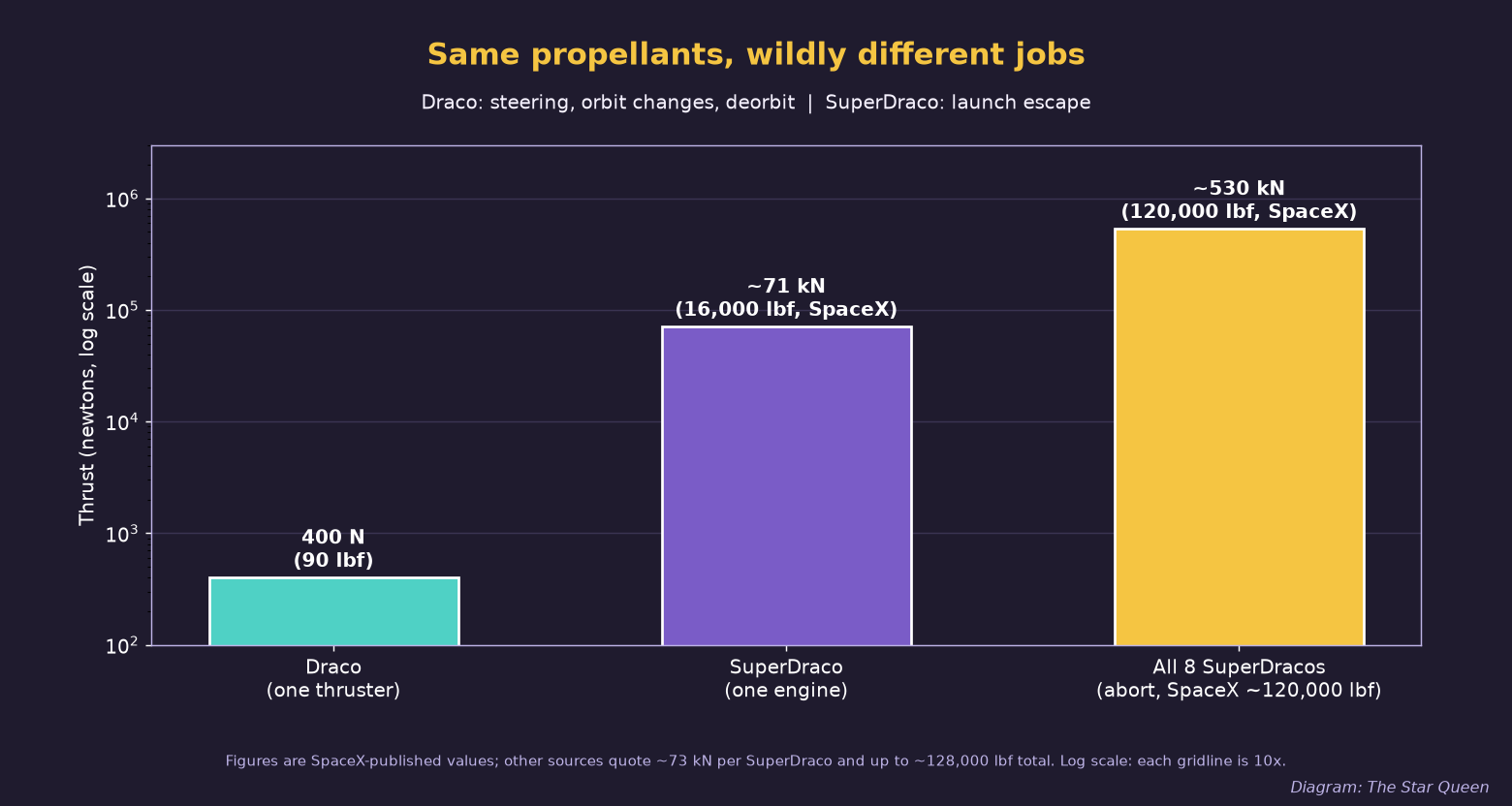
- Draco is a pressure-fed, hypergolic thruster rated at about 400 N (90 lbf). SpaceX’s Dragon page lists 16 of them on the current Dragon (the original Dragon had 18).
- SuperDraco is the escape engine: eight of them, in four pairs, built into Crew Dragon’s side walls. SpaceX quotes roughly 71 kN (16,000 lbf) each, and the FAA paperwork says about 73 kN.
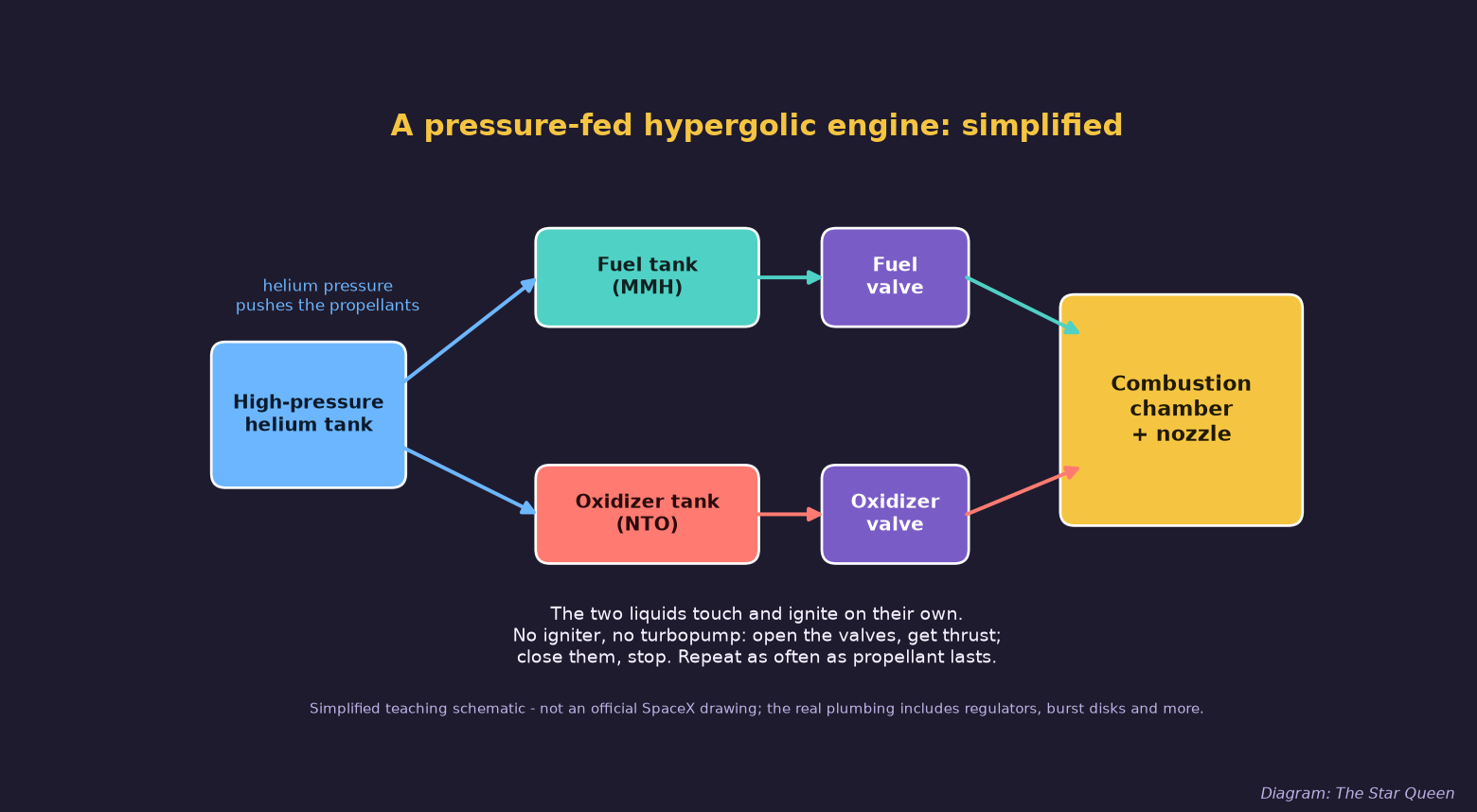
- Both burn monomethylhydrazine (MMH) and nitrogen tetroxide (NTO), which ignite on contact. No igniter, easy restarts, years of storability.
Terms to know ✨
- Hypergolic: propellants that ignite spontaneously when they touch.
- MMH (monomethylhydrazine): the fuel, a hydrazine derivative. Very toxic.
- NTO (nitrogen tetroxide, N2O4): the oxidizer. Also very toxic, and corrosive.
- Pressure-fed: tank pressure pushes propellant to the engine, with no turbopumps.
- Regenerative cooling: flowing propellant through channels in the chamber wall to carry heat away.
- DMLS: direct metal laser sintering, a 3D-printing process that fuses metal powder with a laser. Inconel is the nickel superalloy it printed.
- Launch escape system (LES): the rockets that pull a crew capsule away from a failing launch vehicle.
- Reboost: a burn to lift the space station’s orbit and counter atmospheric drag.
Why Hypergolic? 🔥
A spacecraft that sits in orbit for months can’t babysit a tank of boiling-off oxygen, and it needs to relight on demand. That’s the hypergolic bargain. When MMH and NTO touch, they burn. Wikipedia’s hypergolic article spells out the consequences: no ignition system, so the engine can fire any number of times by opening and closing valves until the propellant runs out, and instant ignition keeps unburned propellant from pooling into a hard start. Both liquids are storable at room temperature, and NTO is dense (about 1.45 g/mL versus 1.14 for liquid oxygen), so tanks stay small.
SpaceX said much the same in 2008: these are the Space Shuttle’s orbital-maneuvering propellants, and their long on-orbit life meant Dragon could stay berthed at the ISS for a year or more as an emergency “lifeboat.”
The downsides are real: hypergolics are toxic and corrosive, carry less energy per kilogram than methane or hydrogen, and a leak can turn dramatic (see 2019 below). After splashdown, recovery crews check the capsule for leaking propellant (NASASpaceflight, on Polaris Dawn).
Draco: The Steering Thruster That Does Everything
SpaceX’s December 2008 release called Draco its smallest rocket engine: up to 90 pounds (400 N) of force from MMH and NTO. In a vacuum chamber in McGregor, Texas it fired for ten continuous minutes, then after a thermal soak restarted for another minute to simulate typical use in space. Tom Mueller, then SpaceX’s VP of Propulsion, said Draco is “as important to Dragon as the large Merlin engines are to Falcon 9.”
Wikipedia notes the thrust is comparable to the Marquardt R-4D used on Apollo’s Service and Lunar Modules.
On the current Dragon, Draco’s jobs read like a flight plan:
- Attitude control: pointing the capsule precisely.
- Orbit changes: raising or lowering the orbit and phasing for rendezvous. Polaris Dawn’s crew used Draco burns to climb from a 190-by-1,200 km orbit to a 1,400 km high point in September 2024 (collectSPACE).
- Docking approaches: the fine corrections as Dragon closes on the station. Crew-13 docked about eight hours after its October 1, 2026 liftoff (NASA).
- The deorbit burn: after the trunk is jettisoned (which saves propellant), Dracos fire to bring the capsule down. On Polaris Dawn that burn lasted about seven minutes (NASASpaceflight).
- Abort cleanup: after a SuperDraco abort, Dracos turn the capsule for its parachutes.
SuperDraco: The Escape Engine
If Draco is the steering wheel, SuperDraco is the ejector seat for the whole capsule. SpaceX announced completion of its qualification testing on May 27, 2014, and described the design this way:
- Eight engines, four pairs. They’re built into the side walls of the capsule, giving what SpaceX called up to 120,000 pounds of axial thrust. Unlike a classic launch escape tower, the system isn’t jettisoned a couple of minutes after liftoff. It stays with the spacecraft, so it can protect the crew at any point in the ascent.
- Redundancy. SpaceX said an escape can still succeed with one engine out.
- Restart and deep throttle. The engines can restart multiple times and throttle deeply. Wikipedia lists a 20 to 100% throttle range, and Wikipedia, citing a NASA press release, gives about 100 milliseconds from ignition to full thrust.
- A printed engine. The chamber is made by DMLS in Inconel and is regeneratively cooled. SpaceX said printing makes engine parts “at a fraction of the cost and time” of traditional methods.
At roughly 71 kN against 0.4 kN, one SuperDraco is about 175 times a Draco (my arithmetic; Wikipedia says “over 100 times” and “about 200 times” in different places).
Spec table
| Property | Draco | SuperDraco |
|---|---|---|
| Propellants | MMH + NTO, pressure-fed | MMH + NTO, pressure-fed |
| Thrust | about 400 N (90 lbf), SpaceX | about 71 kN (16,000 lbf), SpaceX; about 73 kN (16,400 lbf) in FAA-sourced figures |
| Count on Dragon | 16 (SpaceX, current Dragon); 18 on the original Dragon | 8, in four pairs on Crew Dragon |
| Main job | Steering, orbit changes, docking approach, deorbit burn, ISS reboost | Launch and pad abort; contingency propulsive landing |
| Restart | Yes (10-minute burn plus 1-minute restart in a 2008 vacuum test) | Yes; deep throttle (Wikipedia: 20 to 100%) |
| Specific impulse | about 300 s (reported, Wikipedia) | about 235 s, from a 2,300 m/s exhaust velocity in FAA-sourced figures (my arithmetic) |
Pad Abort, 2015: Eight Engines, One Big Push
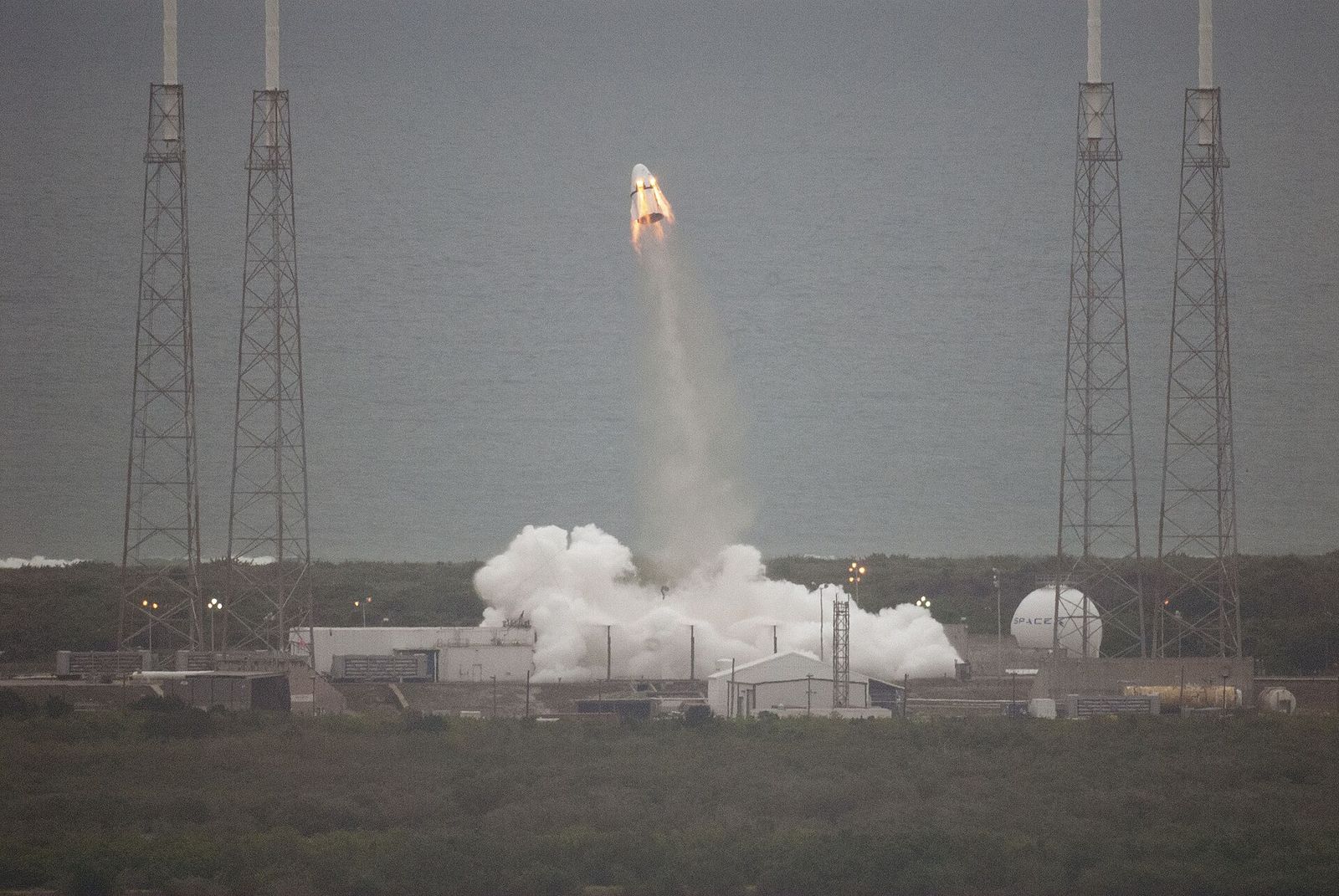
SpaceX’s first full test of the system came on May 6, 2015, from Cape Canaveral’s Space Launch Complex 40. NASA’s account: the capsule fired all eight SuperDracos at once, the engines burned for about six seconds at about 15,000 pounds of thrust each, the trunk was jettisoned at the top of the arc, and the capsule splashed down under parachutes about two minutes after ignition. Ars Technica reported it went from 0 to 100 mph in about 1.2 seconds and peaked near 345 mph.
The Landing That Wasn’t (Until It Sort Of Was)
When SpaceX unveiled Dragon V2 in May 2014, the pitch was dazzling: eight SuperDracos would let the capsule land “anywhere with the accuracy of a helicopter.” A tethered prototype hovered at McGregor in November 2015, and a “Red Dragon” Mars lander was pitched too.
Then reality arrived. SpaceX switched to parachutes as the primary landing method. According to NASASpaceflight, NASA wanted a higher loss-of-crew reliability rating and worried the heat-shield openings for landing legs could create hot spots on reentry. Red Dragon was dropped in favor of Starship.
The SuperDraco landing idea has had a quiet comeback as a backup. Before Crew-9 in September 2024, NASA said Dragon could cut away its main parachutes and fire the eight SuperDracos for a “tolerable” propulsive splashdown if the parachutes failed. It only stays enabled if the relevant sensors are healthy; on Crew-7 it was switched off over a misbehaving GPS sensor (NASASpaceflight).
The Day the Capsule Blew Up: April 20, 2019 💥
Every propulsion nerd should know this one. On April 20, 2019, during a static-fire test at Cape Canaveral’s Landing Zone 1, the Crew Dragon capsule that had flown the uncrewed Demo-1 mission was destroyed in an explosion.
SpaceX’s July 2019 findings, as reported by Spaceflight Now, traced it to a leak, not to the SuperDraco engines:
- A faulty check valve let liquid NTO oxidizer seep into the high-pressure helium lines during ground processing.
- When the system was rapidly pressurized for the test, a slug of NTO was driven into a titanium check valve.
- The valve was destroyed and ignited, and the explosion followed.
SpaceX’s vice president of build and flight reliability, Hans Koenigsmann, summed it up: “Imagine a lot of pressure driving back a slug of liquid (that) has significant force, and that basically destroyed the check valve and caused an explosion.” Titanium is a staple spacecraft metal; nobody expected that reaction.
The fix: burst disks (one-shot membranes that block the path until startup ruptures them) replaced the check valves, and Wikipedia adds that flaps now seal each SuperDraco before splashdown. On November 13, 2019, SpaceX repeated the static fire: NASA described a roughly nine-second firing of all eight SuperDracos, then two Dracos firing and all flaps closing, about 70 seconds in all. Clean run.
The In-Flight Abort Test: January 19, 2020 🚀
Escaping at high speed in thick air is harder than escaping from the pad. On January 19, 2020, a Falcon 9 lifted off from Launch Complex 39A with a Crew Dragon on top. Per Spaceflight Now, citing SpaceX:
- The abort began at about 85 seconds (NASA said about 1.5 minutes), around the time of maximum aerodynamic pressure, as the Falcon 9 shut its engines down.
- The eight SuperDracos accelerated the capsule from about 1,200 mph to more than 1,500 mph in roughly seven seconds, with a peak of about 3.3 g.
- Crew Dragon reached about Mach 2.3 and roughly 131,000 feet. After trunk jettison, two drogue chutes and four main chutes brought it to a splashdown about 26 miles (42 km) from the launch site.
- The Falcon 9 broke up in a fireball, as planned.
NASA called it the final major flight test before astronauts flew the vehicle, and SpaceX called the SuperDraco performance “flawless.”
Watch: The Escape Engines in Action 🎥
First, SpaceX’s own point-of-view video of the 2015 pad abort. It’s only about two minutes:
Can’t see the video? Watch it on YouTube: Pad Abort Test | Point of View (SpaceX)
And the full SpaceX webcast of the January 2020 in-flight abort test (about 30 minutes, so it’s the whole show):
Can’t see the video? Watch it on YouTube: Crew Dragon | Launch Escape Demonstration (SpaceX)
From Demo-2 to Today
With the abort system proven, NASA’s Demo-2 flew the first crew: Crew Dragon Endeavour launched May 30, 2020, docked May 31, and splashed down August 2, 2020 (NASA). SpaceX’s own count, as of May 21, 2026, was 78 crew members across 20 missions, and NASA’s Crew-13 launched October 1, 2026. Every flight leans on the Dracos for the whole mission, with the SuperDracos standing by during ascent.
Dragon, the Space Tug 🛰️
The Dracos have a second career now: raising the space station. Station altitude decays from drag; Russia’s Progress and Northrop Grumman’s Cygnus also reboost it (NASA).
- November 8, 2024 (CRS-31): Dragon’s own Dracos made the first ISS reboost demonstration, a burn of about 12 minutes 30 seconds that raised the orbit about 0.07 mile at apogee and 0.7 mile at perigee (NASA).
- CRS-33 (August 2025 to February 2026): this cargo Dragon carried a boost kit in its trunk: two Draco engines with an independent propellant system. It performed six reboosts (September 3, September 26, October 14, November 7 and December 29, 2025, and January 23, 2026). The last burned for 26 minutes 11 seconds and left the station in a 269-by-255-mile orbit (NASA). The capsule splashed down February 27, 2026 (Space.com).
Why it matters: another way to keep the station up. Space.com noted it’s unclear whether Russia will stay a partner for the station’s whole life, so backup options count.
The Big One: A Dragon to Deorbit the ISS
NASA picked SpaceX in 2024 to build a US Deorbit Vehicle, a modified Dragon with an enlarged trunk. Ars Technica, citing a SpaceX illustration, says it will carry 46 Dracos: 30 for the deorbit burns and 16 for attitude control. Wikipedia lists about 30,000 kg total, 16,000 kg of it propellant. NASA’s analysis (via Ars) puts the needed speed change at just 127 mph (57 m/s), which still takes about 10 tons of propellant because the station weighs roughly 450 tons. Per Ars, NASA’s plan is retirement in 2030 and a Pacific deorbit in 2031, though a February 2026 House committee amendment asked NASA to study storing the station instead. Contract values and launch dates vary by report, so I’m leaving them out.
Where Starship Fits (and Doesn’t)
Starship goes another way. Wikipedia describes cold-gas thrusters fed by leftover tank gas for attitude control in unpowered flight, and SpaceX says its orbital flights use a sea-level Raptor for circularization and deorbit burns. So hypergolic Draco is, for now, a Dragon specialty. For the other approach, see: Raptor Explained: The Full-Flow Methane Engine Behind Starship.
Where the Sources Disagree
- SuperDraco thrust: SpaceX says 16,000 lbf (about 71 kN). Wikipedia and Ars, via the FAA environmental document, say 16,400 lbf (about 73 kN). NASA’s pad-abort release said about 15,000 lbf each.
- Total abort thrust: SpaceX said “up to 120,000 pounds of axial thrust” in 2014; Ars quotes 122,600 lbf (FAA); Spaceflight Now gave 128,000 lbf and later “nearly 130,000.” I suspect “axial” means the straight-up component of the angled engines, but I haven’t seen it spelled out.
- Fuel name: SpaceX and NASA say MMH; some outlets just say “hydrazine,” since MMH is a hydrazine derivative.
The Star Queen’s Take
What I love here is the philosophy. Draco is the opposite of a showpiece: a 400-newton thruster quietly trusted to point, brake and boost a capsule, on propellants already proven on Apollo and the Space Shuttle. SuperDraco is the radical sibling: printed, throttleable, built into the spacecraft, and giving crews an escape option for the whole ascent.
And the 2019 explosion is the story I’ll keep telling. A test went wrong in an unexpected way, SpaceX and NASA found the cause (a leak, a titanium valve, a slug of oxidizer), changed the design, and proved the fix on the ground and then in the sky. That’s what “human rated” looks like. Now the same little Dracos that steer astronauts are being asked to lift the station and, one day, bring it down. Small engines, huge responsibilities. 👑
Also see: Merlin Explained: The Kerosene Workhorse Behind Falcon 9 and Falcon Heavy, the engine that gets Dragon to orbit in the first place. 🚀
Sources
- SpaceX, Dragon: https://www.spacex.com/vehicles/dragon/
- SpaceX, Draco thruster long-duration firing and restart (December 2008, archived): https://web.archive.org/web/20170412033357/http://www.spacex.com/press/2012/12/19/spacex-draco-thruster-performs-long-duration-firing-and-restart
- SpaceX, SuperDraco qualification testing (May 2014, archived): https://web.archive.org/web/20170406172423/http:/www.spacex.com/press/2014/05/27/spacex-completes-qualification-testing-superdraco-thruster
- SpaceNews/SpaceRef, SpaceX completes qualification testing of SuperDraco thruster: https://spacenews.com/spacex-completes-qualification-testing-of-superdraco-thruster/
- NASA, SpaceX demonstrates astronaut escape system (pad abort, May 2015): https://www.nasa.gov/news-release/spacex-demonstrates-astronaut-escape-system-for-crew-dragon-spacecraft/
- NASA, final major flight test of Crew Dragon (January 2020): https://www.nasa.gov/news-release/nasa-spacex-complete-final-major-flight-test-of-crew-spacecraft/
- Spaceflight Now, preliminary results from the Crew Dragon abort test: https://spaceflightnow.com/2020/01/23/spacex-releases-preliminary-results-from-crew-dragon-abort-test/
- Spaceflight Now, SpaceX points to leaky valve as culprit in the Crew Dragon test accident: https://spaceflightnow.com/2019/07/15/spacex-points-to-leaky-valve-as-culprit-in-crew-dragon-test-accident/
- Spaceflight Now, Crew Dragon thruster test after the April explosion (November 2019): https://spaceflightnow.com/2019/11/13/spacex-fires-up-crew-dragon-thrusters-in-key-test-after-april-explosion/
- NASA, Demo-2 launch: https://www.nasa.gov/news-release/nasa-astronauts-launch-from-america-in-historic-test-flight-of-spacex-crew-dragon/
- NASA, Demo-2 splashdown: https://www.nasa.gov/news-release/nasa-astronauts-safely-splash-down-after-first-commercial-crew-flight-to-space-station/
- NASA, Dragon spacecraft boosts station for first time (November 2024): https://www.nasa.gov/blogs/spacestation/2024/11/08/dragon-spacecraft-boosts-station-for-first-time/
- NASA, final CRS-33 reboost (January 23, 2026): https://www.nasa.gov/blogs/spacestation/2026/01/23/crew-studies-cardiac-research-artificial-intelligence-as-dragon-boosts-stations-orbit/
- NASA, Dragon docks bringing SpaceX Crew-13 to station (October 1, 2026): https://www.nasa.gov/blogs/spacestation/2026/10/01/dragon-docks-bringing-spacex-crew-13-to-station/
- Space.com, CRS-33 Dragon splashdown after the ISS-boosting mission: https://www.space.com/space-exploration/international-space-station/spacex-crs-33-cargo-capsule-undock-after-iss-boosting-mission
- NASASpaceflight, Dragon receives long-planned propulsive landing upgrade: https://www.nasaspaceflight.com/2024/10/dragon-propulsive-landing/
- NASASpaceflight, Polaris Dawn returns home: https://www.nasaspaceflight.com/2024/09/polaris-dawn-splashdown/
- collectSPACE, Polaris Dawn flies higher than Gemini 11: https://www.collectspace.com/news/news-091024a-polaris-dawn-altitude-record-gemini-11.html
- Ars Technica, From zero to 100mph in 1.2 seconds, the SuperDraco thruster delivers (2016): https://arstechnica.com/science/2016/04/meet-spacexs-superdraco-thruster-the-key-to-landing-a-dragon-on-mars/
- Ars Technica, lawmakers ask what it would take to “store” the ISS (February 2026): https://arstechnica.com/space/2026/02/congress-advances-bill-requiring-nasa-to-reconsider-deorbiting-space-station/
- Wikipedia, SpaceX Draco: https://en.wikipedia.org/wiki/SpaceX_Draco
- Wikipedia, SuperDraco: https://en.wikipedia.org/wiki/SuperDraco_(rocket_engine)
- Wikipedia, Dragon 2: https://en.wikipedia.org/wiki/Dragon_2
- Wikipedia, Hypergolic propellant: https://en.wikipedia.org/wiki/Hypergolic_propellant
- Wikipedia, Launch escape system: https://en.wikipedia.org/wiki/Launch_escape_system
- Wikipedia, Starship: https://en.wikipedia.org/wiki/SpaceX_Starship
- SpaceX, Starship updates: https://www.spacex.com/updates
- Images: Wikimedia Commons and NASA (credit and license in each caption). Diagrams by The Star Queen.