By The Star Queen · Star Queen Chronicles
My loves, Flight 3 is the one where Starship finally went somewhere. 🌍 On March 14, 2024, at 8:25 a.m. Central (13:25 UTC, 9:25 a.m. Eastern), the stack left Starbase, the booster and ship separated cleanly with hot staging for the second time, and Ship 28 burned all the way to its planned trajectory, becoming the first Starship to complete its full-duration ascent burn. It then did several things in space, tried to come home, and was lost during its first entry from space, nearly 50 minutes into the flight.
As of October 26, 2026, Flight 3 is the third of 14 Starship integrated flights. I mark numbers as official, reported or my arithmetic, and I flag it when sources disagree.

The Short Version
- What flew: Super Heavy Booster 10 and Ship 28, from Starbase’s Orbital Launch Pad 1 on March 14, 2024 (official).
- Booster: all 33 engines lit for a full-duration burn for the second time. Hot staging worked again. But during the boostback burn six engines shut down from a liquid-oxygen filter blockage, and at the landing burn only 2 of 13 engines relit. SpaceX lost the booster at about 462 m (1,516 ft) above the Gulf, just under seven minutes into the mission (Wikipedia lists T+7:01; SpaceX says “just under seven minutes”).
- Ship: completed its full ascent burn (SECO at T+8:35). It opened and closed its payload door, and completed a propellant-transfer demo (header tank to main tank). It skipped the planned in-space Raptor relight because of roll rates.
- Loss: the ship started its first reentry from space, then tumbled and lost telemetry at about T+49:41, near 65 km altitude. It never reached its planned Indian Ocean splashdown.
- Official result: the FAA declared a mishap, then in late May 2024 determined that no public safety issues were involved, which let SpaceX fly again before the investigation fully closed.
Terms to know ✨
- Boostback burn: the booster relights engines after separation to turn toward the Gulf of Mexico.
- Landing burn: the final engine firing that slows the booster near the water or the tower. On Flight 3 it was done over the water.
- LOX filter: a screen in the liquid-oxygen feed to the engines that catches debris. If it clogs, the engines get less oxygen and can fail.
- Roll control thrusters: small gas thrusters on the ship that control its spin while coasting in space.
- Payload door (“PEZ dispenser”): the slot in the ship’s side, meant for deploying satellites later.
- Propellant transfer demo: a test of moving propellant between tanks in microgravity, the first step toward refueling ships in orbit.
- Entry interface: the point where the ship starts feeling the atmosphere, roughly 100 km up.
- Public safety determination: an FAA finding that a mishap didn’t involve public safety, so the operator can fly again while the investigation remains open.
- Apoapsis and periapsis: the highest and lowest points of an orbit or trajectory.
Flight at a glance
| Item | Detail |
|---|---|
| Date and time | March 14, 2024, 13:25 UTC (8:25 a.m. CDT local; 9:25 a.m. EDT) |
| Launch site | Starbase, Boca Chica, Texas (Orbital Launch Pad 1) |
| Vehicles | Super Heavy Booster 10 and Ship 28, Block 1 |
| Planned trajectory | Suborbital. Booster splashdown in the Gulf. Ship to a planned splashdown in the Indian Ocean at about T+1:04:39. |
| Mission goals | Full ship ascent burn; payload door test; propellant transfer demo; in-space Raptor relight; first reentry from space; booster landing burn over water |
| Results | Booster lost at about 462 m, just under seven minutes in (Wikipedia lists T+7:01). Ship reached its planned trajectory (apoapsis about 234 km, periapsis about -54 km per Jonathan McDowell), then was lost at about T+49:41 at ~65 km on reentry. |
| Duration achieved | About 49 min 41 s (planned: about 1 h 4 min 39 s) |
| Classification | Mixed. Wikipedia counts the outcome as a success while noting the booster and ship landings failed. |
| Regulatory outcome | FAA license Mar 13, 2024. Mishap declared Mar 14. FAA public safety determination in late May 2024. |
The Road to Launch
After Flight 2, SpaceX carried out the changes listed in the FAA’s investigation closure of February 26, 2024 (17 corrective actions) and a set of upgrades: electric thrust vector control on the ship, a delay of the LOX vent until after SECO, tank farm upgrades (subcoolers and pumps), steel plates on the pad concrete, and a concrete wall replacing the HESCO barriers. A wet dress rehearsal took place on March 3, SpaceX announced the target on March 5, and the FAA issued the license on March 13, the day before launch.
Play-by-Play
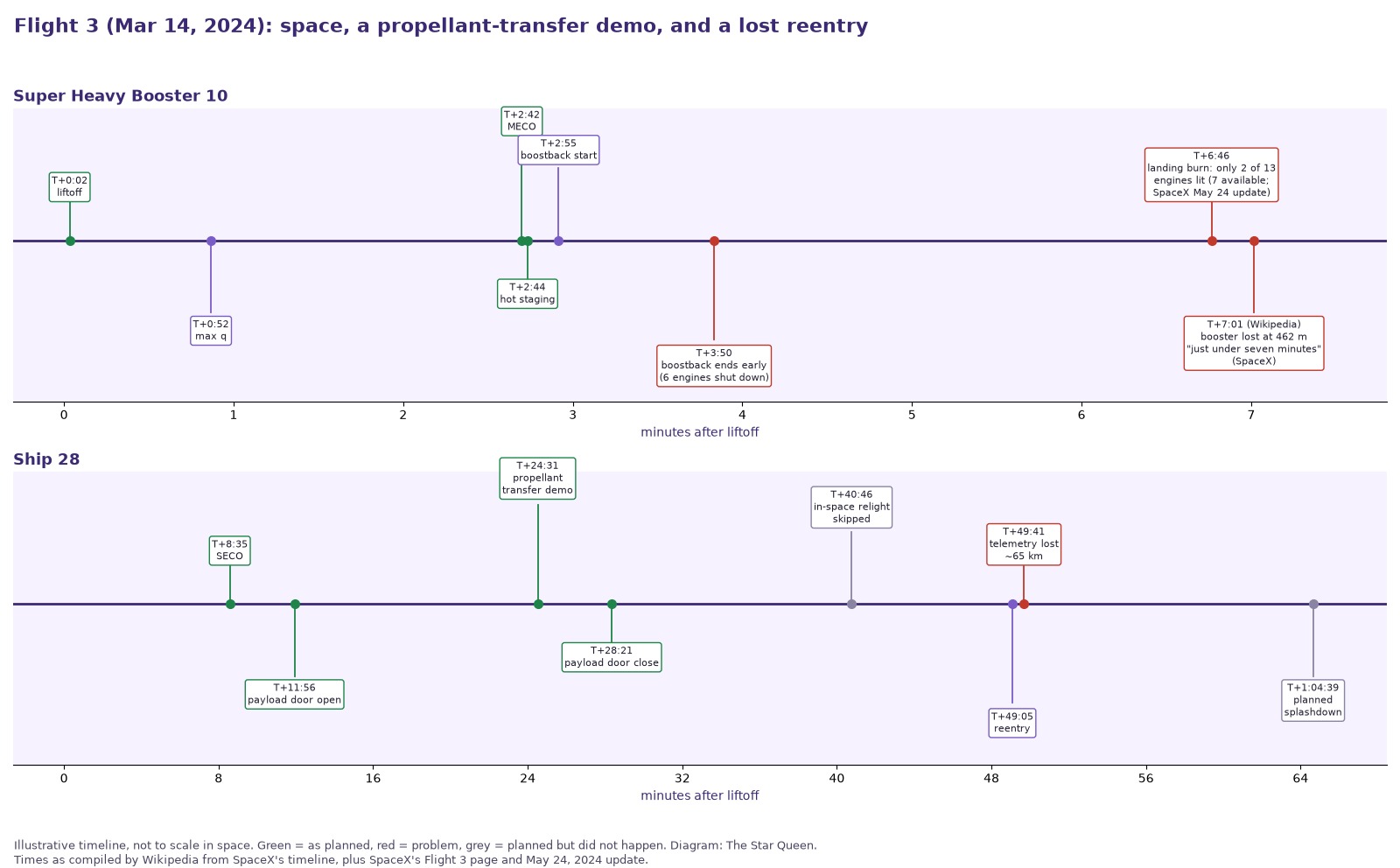
Times are from SpaceX’s flight timeline as compiled on Wikipedia, plus SpaceX’s own Flight 3 page and its May 24, 2024 update.
- T+0:02, liftoff. All 33 engines lit.
- T+0:52, max q.
- T+2:42, MECO. Most booster engines cut off.
- T+2:44, hot staging. SpaceX says the second successful hot-stage: power down all but three booster Raptors, light the ship’s six, separate.
- T+2:55, boostback begins. The booster had flipped and started to head for the Gulf.
- T+3:50, boostback ends early. Six engines began shutting down because of the LOX filter blockage.
- T+6:36, booster transonic. Later than planned because of the off-nominal trajectory.
- T+6:46, landing burn begins. Only 2 of 13 engines ignited. The vehicle prevented the six engines that had shut down from being used, leaving seven candidates, and two lit (SpaceX’s May 24 update).
- Just under seven minutes in, booster lost at about 462 m (1,516 ft) above the water. (Wikipedia lists T+7:01; SpaceX says “just under seven minutes.”)
- T+8:35, ship SECO. The ship reached its planned trajectory. (SpaceX’s Flight 3 page says “expected orbit,” but its own later report says “expected trajectory,” and SpaceX has since said that flights 1 through 13 were intentionally suborbital.)
- T+11:56, payload door opens.
- T+24:31, propellant transfer demo begins. SpaceX’s wording on its Flight 3 page was that it “initiated” the demonstration, with results to come. Its later report, published May 24, 2024, says the vehicle “successfully completed a propellant transfer demonstration.” Wikipedia’s table marks it a success too.
- T+28:21, payload door closes.
- T+40:46 (planned), in-space Raptor relight. Skipped because of roll rates.
- About T+49:05, entry interface. The ship began its first entry from space.
- T+49:41, telemetry lost at about 65 km altitude, via Starlink, which was providing live views from the ship.
- T+1:04:39 (planned), splashdown. It didn’t get there.

What Went Right
- All 33 engines, again. For the second time in a row all 33 Raptors lit and ran full duration on the way up.
- Hot staging, again. It worked on the second try, which tells us the design wasn’t a one-off.
- The ship completed its full ascent burn. That had never been done on a Starship. The six Raptors performed to the planned trajectory.
- Tests in space. The payload door opened and closed, and SpaceX completed its propellant transfer demo (header tank to main tank). Viewer analysis of the door footage raised questions, but SpaceX’s account called the payload test a success.
- First reentry data. Even though the ship was lost, the entry gave SpaceX real data from the hypersonic regime, with live views from Starlink terminals on the vehicle.
- The booster got to the landing burn. It flew a full-up boostback and attempted its first-ever landing burn.
What Went Wrong (and Why)
1. The booster: a clogged filter, again
SpaceX’s May 24, 2024 update said the likely cause of the boostback shutdown was filter blockage in the liquid-oxygen intake, which caused a loss of pressure at the oxygen turbopumps. In plain language: little bits of debris in the oxygen line clogged the screens, the pumps got starved, and engines shut down. With six engines off the table, the booster ran with low thrust, lit only two engines for the landing burn, and SpaceX said the vehicle had lower than expected thrust and was lost at about 462 m.
If this sounds familiar, it’s because Flight 2’s booster failure was also related to oxygen supply to the engines. Same family of problem, different flight.
2. The ship: roll control valves
The more interesting failure is on the ship. SpaceX said that several minutes after SECO, the valves that control the roll control thrusters clogged. The ship started to roll in an unplanned way. That did two things: it canceled the in-space Raptor relight (the planned burn at T+40:46) and it sent the ship into entry with much higher roll rates than planned. Because the ship wasn’t pointing the way it was meant to, it saw much higher heat loads on both tiled and untiled parts of the vehicle. Telemetry stopped at about 65 km, and the planned splashdown didn’t happen.

The Paperwork
On March 14, the FAA declared a mishap involving both the ship and the booster. The agency’s commercial space chief, Kelvin Coleman, said on March 18 that he didn’t expect the investigation to be a major delay. SpaceX asked the FAA on April 5 to make a public safety determination: a finding that no public safety issue was involved, which would let SpaceX fly again while the investigation stayed open.
In late May 2024 the FAA made that determination. Its statement: “After a comprehensive review, the FAA determined no public safety issues were involved in the anomaly that occurred during the SpaceX Starship (Orbital Flight Test-3) launch on March 14. The Starship vehicle may return to flight operations while the overall investigation remains open, provided all other license requirements are met.” Reports date the statement to May 28. Wikipedia’s Flight 4 page describes this as the FAA concluding its investigation, which I think is a loose way of putting it, so I follow the FAA statement and flag the difference in my notes. A new license was still needed, and it came on June 4 for Flight 4.

What Changed Next
After the flight, SpaceX said in its May 24 update that it was making these fixes:
- Better filtration on the booster’s LOX tank to stop the clogging.
- More roll control thrusters on the ship, for redundancy.
- Raptor startup reliability: hardware and software changes.
Separately, SpaceX had said in early April that if the booster’s “virtual landing” went well on Flight 4, it intended to try a tower catch on Flight 5. That plan is the subject of the Flight 4 post.
The Star Queen’s Take
Flight 3 is the first one where I felt the shift from “will it work” to “how many things can we test before it breaks.” 🧪 The ship went to space, ran a full burn, and tried several in-orbit experiments. Even the ending was informative: SpaceX’s account points to a valve problem that came before the heating problem.
What stands out to me is how small the root causes were. A clogged filter, in the oxygen feed. A clogged valve, in the thrusters. These are not glamorous failures, but rocket reliability is the sum of dozens of tiny parts. SpaceX’s answer was to add redundancy (more roll thrusters) and filters, which is exactly the right instinct.
One note on the propellant transfer demo: SpaceX first said it initiated the demo, and its later report says it was successfully completed, moving liquid oxygen from a header tank into the main tank inside the ship. SpaceX doesn’t publish a quantity, so I’m not repeating a figure here.
Watch
SpaceX’s official recap, then Everyday Astronaut’s slow-motion supercut of the flight.
If the video doesn’t load, watch it on YouTube: SpaceX: Starship’s Third Flight Test
If the video doesn’t load, watch it on YouTube: Everyday Astronaut: Starship Flight 3 supercut
Keep Reading
- Previous: Starship Flight 2 explained, hot staging’s debut.
- Next: Starship Flight 4 explained, the first controlled splashdowns.
- The engines: Raptor, the full-flow methane engine.
Sources
- SpaceX, Starship’s Third Flight Test (flight page): https://www.spacex.com/launches/starship-flight-3
- Wikipedia, Starship flight test 3 (timeline, SpaceX May 24, 2024 update, FAA steps): https://en.wikipedia.org/wiki/SpaceX_Starship_integrated_flight_test_3
- Wikipedia, Starship flight test 4 (FAA public safety determination, plans for Flight 5): https://en.wikipedia.org/wiki/SpaceX_Starship_integrated_flight_test_4
- NASASpaceflight, “As SpaceX Completes Second Starship WDR, FAA Conducts Safety Investigation Into Flight 3” (May 2024): https://www.nasaspaceflight.com/2024/05/starship-flight4-faa/
- San Antonio Express-News, “FAA: ‘No public safety issues’ in SpaceX Starship’s third flight”: https://www.expressnews.com/business/article/faa-no-public-safety-issues-spacex-starship-19486094.php
- Related posts on this site: Raptor, liquid methane
- Images: Wikimedia Commons (credit and license in each caption). Diagrams by The Star Queen.