Welcome to Star Queen’s Sky Map, my new series where we learn the night sky one constellation at a time: the stories, the star-hops, and the best Florida nights to look up. We’re starting with the king of the winter sky.
Hello, stargazers! If you only ever learn one constellation, make it Orion. Once you spot those three stars in a neat little row, you’ll never un-see them, and they’ll become your signpost for half the winter sky. I like to think of Orion as the constellation that says “welcome back” every fall, just as the cooler, clearer Space Coast nights roll in.
The Story: A Hunter Among the Stars
In Greek mythology, Orion was a giant hunter, son of the sea god Poseidon in many tellings. The stories vary (the Greeks never agreed on one version!), but a favorite says Orion boasted he could hunt down every animal on Earth. Gaia, the Earth goddess, sent a scorpion to stop him, and its sting killed him. Zeus placed both in the sky, but on opposite sides, so Orion sets in the west as Scorpius rises in the east. They never share the sky. (We’ll meet that scorpion in post five!)
Other cultures saw something very different in the same stars:
- For the Lakota, the lower part of Orion forms a great Hand: the Belt is the wrist, and Rigel and the Orion Nebula are fingertips. The story tells of a chief whose arm was torn away by the Thunder Beings as punishment for selfishness, until a young hero named Fallen Star won it back.
- Other Native American nations saw a canoe, a chief, or a bison in these same stars, and from the Southern Hemisphere, the whole Hunter appears upside down.
How to Find Orion
Look for Orion’s Belt: three evenly spaced stars in a short, straight line. From west to east they are Mintaka, Alnilam, and Alnitak. Around the Belt, four bright stars make a big rectangle:
- Betelgeuse (top left, as seen from the Northern Hemisphere): a red supergiant with a noticeably orange-red glow. It’s so big that if it replaced our Sun, its outer layers would reach past the orbit of Mars. It’s roughly 550 to 700 light-years away (astronomers are still refining that number).
- Rigel (bottom right): a brilliant blue-white supergiant, usually the brightest star in Orion.
- Bellatrix and Saiph complete the other two corners.
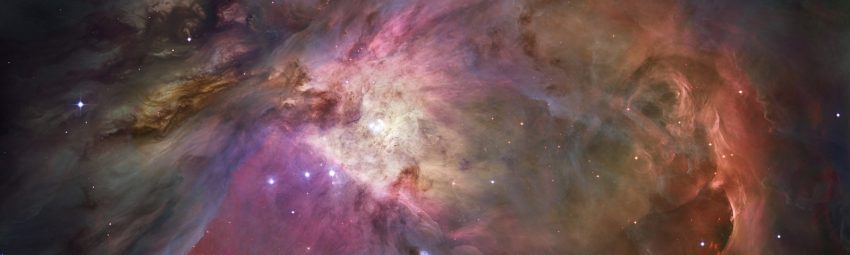
Now hang down from the Belt and you’ll see a fainter line of “stars” — Orion’s Sword. The fuzzy middle “star” isn’t a star at all. It’s the Orion Nebula (M42), a giant stellar nursery about 1,300–1,500 light-years away where new stars are being born right now. It’s visible to the naked eye from a dark site and gorgeous in binoculars. Even a small telescope will show the Trapezium, a tight cluster of young stars lighting up the nebula.
Star-Hops from the Belt
Orion is a launch pad (you know I had to) for finding other stars:
- Follow the Belt down and to the left to reach Sirius, the brightest star in the night sky, in Canis Major.
- Follow it up and to the right to the orange star Aldebaran in Taurus, and keep going to the Pleiades star cluster.
- A line from Rigel up through Betelgeuse points toward Gemini’s twin stars, Castor and Pollux.
When to See It from Florida
Orion sits right on the celestial equator, which means it’s visible from virtually everywhere on Earth. From the Space Coast at about 28° north, it climbs high in the southern sky on winter evenings — higher than it gets for folks up north.
- Early November: Orion rises in the east around 9:30 to 10 p.m. and is well placed after midnight.
- December–January: Rises in early evening and rides highest in the south around midnight in mid-December.
- February–March: Well placed in the south and southwest right after dark — prime viewing at a reasonable hour.
- Late spring: It sinks into the western twilight and disappears behind the Sun for the summer.
A good rule of thumb: stars rise about 4 minutes earlier each night, or about 2 hours earlier each month.
My Space Coast Corner
One thing I love about winter launch season is that Orion is often hanging right there on the cooler, clear nights. When I’m waiting for a night launch, I’ll often find myself tracing the Belt and Sword while the countdown ticks along. If you’re watching from a beach or causeway, face south: Orion stands tall over the water, and the low light pollution over the ocean makes M42 easier to pick out in binoculars. Pro tip from my front yard: give your eyes 15–20 minutes away from phone screens and the Sword really pops.
Quick Facts
- Brightest stars: Rigel and Betelgeuse
- Must-see object: Orion Nebula (M42)
- Best Florida evenings: December through March
- Difficulty: Easiest constellation in the sky ⭐
Next up in the series: we follow Orion’s Belt up to Taurus the Bull and the Pleiades, one of the prettiest sights in the whole sky. Clear skies!
Sources
- NASA Science, Hubble Messier Catalog: Messier 42: https://science.nasa.gov/mission/hubble/science/explore-the-night-sky/hubble-messier-catalog/messier-42/
- NASA Science, What Is Betelgeuse? Inside the Strange, Volatile Star: https://science.nasa.gov/universe/what-is-betelgeuse-inside-the-strange-volatile-star/
- EarthSky, Orion the Hunter, the most recognizable constellation: https://earthsky.org/constellations/orion-the-hunter-most-recognizable/
- EarthSky, Use Orion’s Belt to find 4 bright stars: https://earthsky.org/sky-archive/use-orions-belt-to-find-two-other-stars-2006/
- Windows to the Universe (NESTA), Lakota myth of the Hand constellation: https://www.windowstotheuniverse.org/mythology/hand_orion.html
- ICT News, Constellation Orion in Native American astronomy: https://ictnews.org/archive/be-it-hunter-canoe-chief-or-bison-constellation-orion-is-our-winter-buddy/
- IAU, The Constellations: https://www.iau.org/IAU/IAU/Astronomy-FAQs/Constellations.aspx
Banner image: The Orion Nebula (M42), Hubble mosaic. Image: NASA, ESA, M. Robberto (STScI/ESA) and the Hubble Space Telescope Orion Treasury Project Team, public domain.
