By The Star Queen · Star Queen Chronicles · Basic Rocket Science, Part 2 of 5
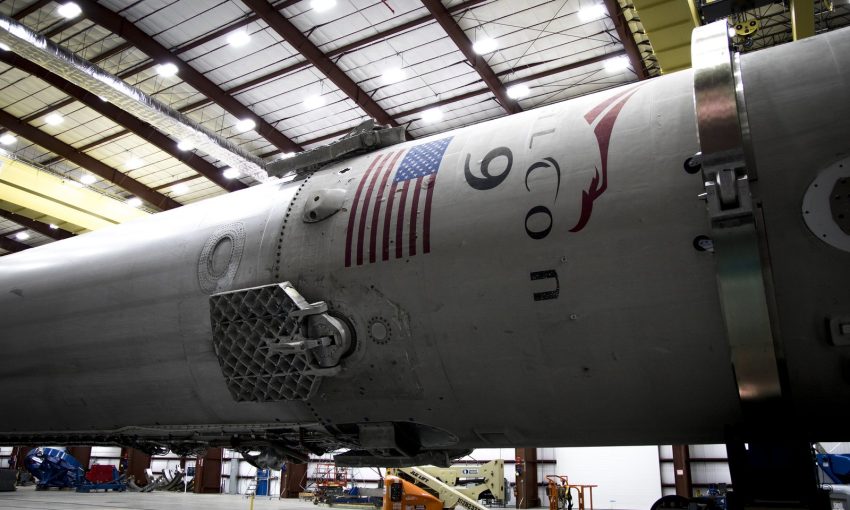
Header photo: A Falcon 9 first stage in its hangar. Most of that long body is propellant tank (December 2015). Credit: SpaceX (CC0)
Here’s a fun thing to notice at your next launch: that enormous rocket is mostly propellant. The satellite or capsule on top is a tiny fraction of the whole stack. 😮 In Part 1 we learned how a rocket pushes. Now let’s find out why it needs so much to push with.
Delta-v: Your Speed Budget
Rocket people talk about delta-v (written Δv), which just means “change in velocity.” Think of it as a speed budget, like a gas budget for a road trip, except it’s measured in how much faster you can make your vehicle go.
Reaching low Earth orbit takes a budget of roughly 9 to 10 km/s once you add up everything. About 7.8 km/s of that is the orbital speed itself (more on that in Part 3, coming Saturday, Nov. 14). The rest pays for fighting gravity and air drag on the way up. My January primer used about 9.4 km/s, and you’ll see numbers in that neighborhood, because the exact figure depends on the rocket and the orbit.
The Equation (In Words)
Around the turn of the 20th century, Russian schoolteacher and rocket pioneer Konstantin Tsiolkovsky worked out how much speed a rocket can gain. In symbols it’s:
Δv = exhaust speed × ln(starting mass ÷ ending mass)
In words: your speed budget depends on how fast your exhaust leaves and on how much of your starting weight you burn away. That “ln” is a natural logarithm, and it brings bad news: the returns diminish quickly. Each extra bit of speed requires a much bigger jump in propellant, not a proportional one.
Engineers often describe exhaust speed with specific impulse (Isp), measured in seconds. Higher Isp means a more efficient engine. NASA Glenn’s pages walk through the full derivation if you want to see the math.
Why Rockets Are Mostly Fuel
NASA Glenn works through an example: a rocket engine with a specific impulse of about 350 seconds, trying to reach a 200-mile-high orbit, which takes about 17,000 mph (roughly 25,000 feet per second). The equation says the mass ratio is about 10. In NASA’s words, that means about 90 percent of the rocket’s weight at launch is propellant, and the payload is only about 1 percent.
NASA’s Jet Propulsion Laboratory calls this the “tyranny of the rocket equation”: what goes up takes fuel, and if fuel is going up, it takes fuel to lift the fuel. JPL says even the most efficient rocket is still about 85 percent fuel by mass. Their car comparison is great: if your car had to obey the rocket equation, the whole car plus everything in it could weigh only about 13 to 16 pounds. 🚗
See the Pattern for Yourself
Here’s a little list I worked out from the equation. It shows the share of a rocket’s starting mass that must be propellant, depending on how many “exhaust speeds” of Δv you need. (This is my own arithmetic for illustration, with no tank weight or losses included.)
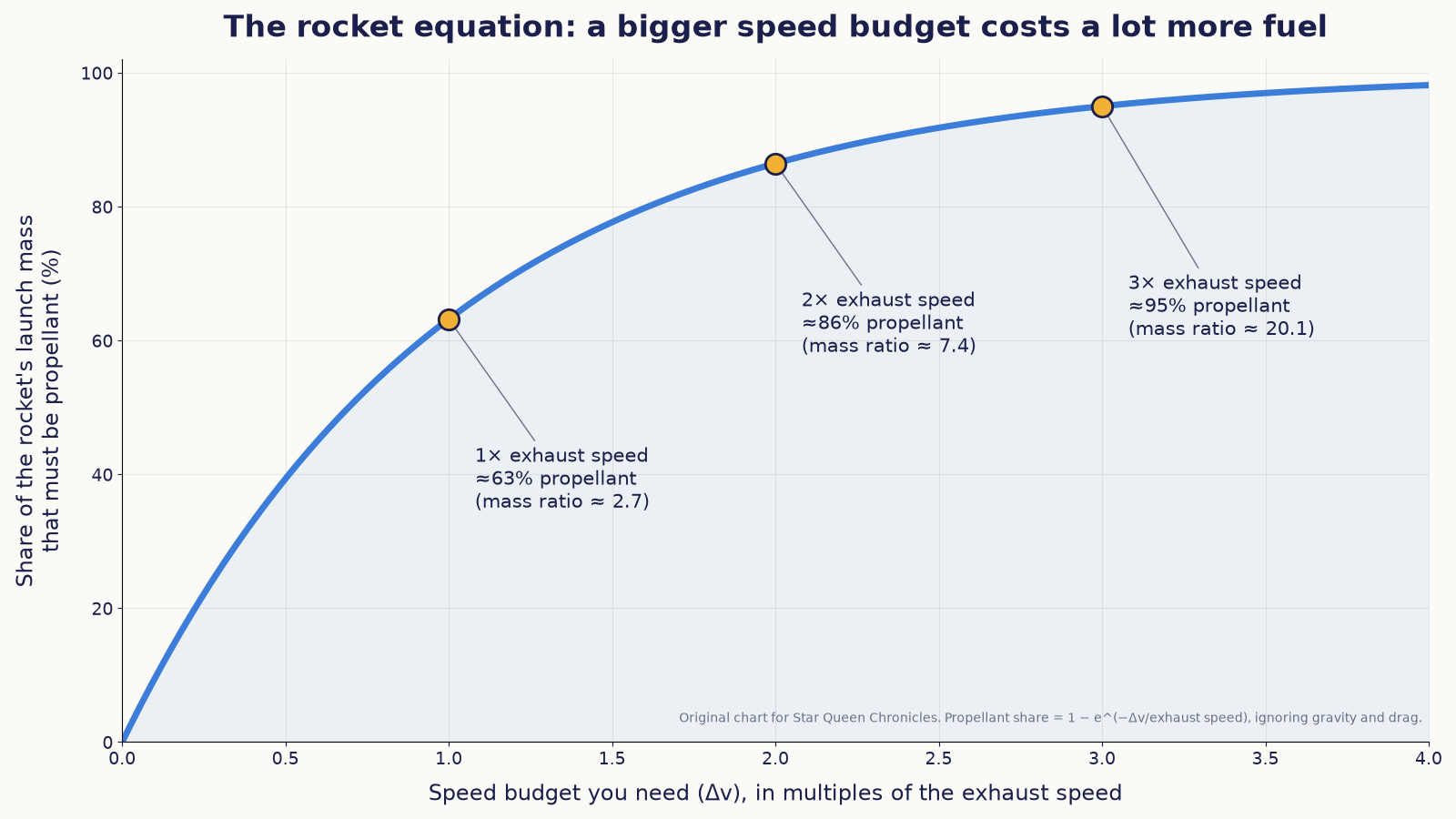
- Need Δv equal to 1× the exhaust speed: mass ratio about 2.7, so about 63% of the rocket is propellant.
- Need 2×: mass ratio about 7.4, so about 86% propellant.
- Need 3×: mass ratio about 20, so about 95% propellant.
Going from 1 to 3 didn’t triple the propellant. It took a rocket from “a bit over half fuel” to “almost nothing but fuel.”
Staging: Dropping the Dead Weight
If an empty tank is just dead weight, why carry it? That’s the idea behind staging. When one stage runs out, it’s let go, and the next stage only has to accelerate the lighter remainder.
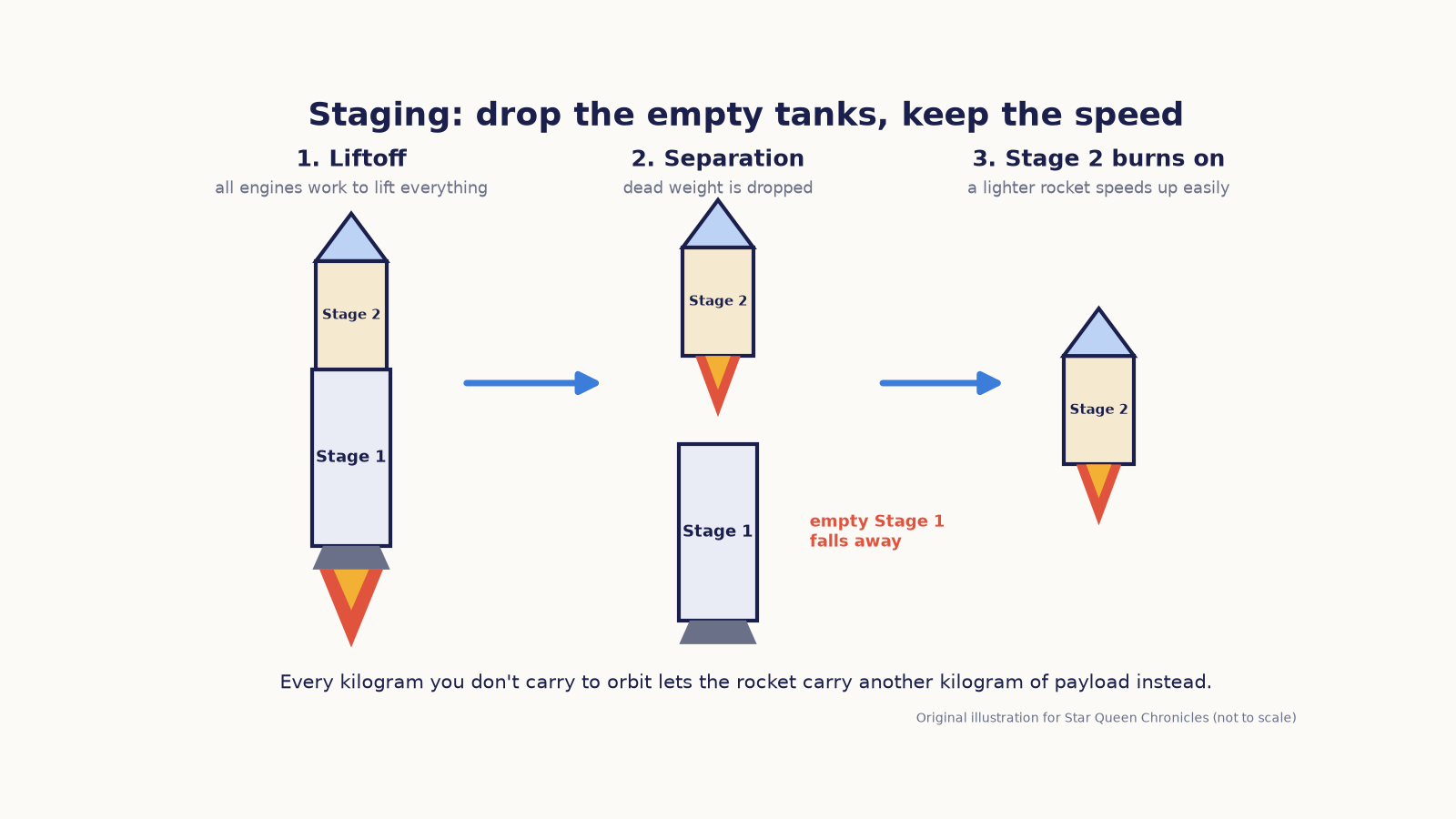
Think of climbing a mountain with a series of backpacks. When one runs out of food, you drop it and keep going with less weight. Or think of a relay race: each runner gives their all, then someone fresh takes over.
Falcon 9 is a two-stage rocket. The first stage, with nine Merlin engines, does the heavy lifting off the pad. The second stage, powered by a single Merlin Vacuum engine, burns for up to about 397 seconds to reach orbit, according to SpaceX. Even the payload fairing is jettisoned about three minutes into flight. Starship works similarly, with Super Heavy as the first stage and Starship as the upper stage, though SpaceX designs both halves to be reused.
Why Refueling in Orbit Is a Big Deal
The equation never goes away. Once a spacecraft is in orbit, getting to the Moon or Mars costs a whole new budget of delta-v. SpaceX’s plan is to launch tanker Starships that refill the main ship in low Earth orbit, which lets one ship carry far more than it could from the ground. That’s also the core of NASA’s current plan for the Starship lunar lander, which I covered in my Moon post. The rocket equation is why “gas stations in orbit” matter so much. ⛽🌙
Try It Yourself 🧮
Grab a calculator and try the equation backward:
- Pick an exhaust speed: Isp × 9.8. For 350 seconds, that’s about 3,430 m/s.
- Pick a budget: 9,400 m/s.
- Divide: 9,400 ÷ 3,430 ≈ 2.74.
- Raise e (about 2.718) to that power: you get a mass ratio of about 15.5.
- Propellant share: 1 − (1 ÷ 15.5) ≈ 94%.
A single stage with zero margin would be 94% propellant. That’s my simplified illustration, but it shows why real rockets use stages and better engines.
The Star Queen’s Takeaway 👑
Rockets aren’t big because engineers love big things. They’re big because the equation forces them to carry fuel to carry fuel. Staging lets them shed weight as they go, and in Part 4, coming Saturday, Nov. 21, we’ll see how better propellants help. But first, Part 3, coming Saturday, Nov. 14: why orbit is about speed, not height. 🚀
Previous: Part 1: How a Rocket Actually Works · Next: Part 3, “Getting to Orbit: It’s Sideways Speed, Not Height,” coming Saturday, Nov. 14.
Keep reading: For more on Starship’s refueling plans, see my Starship post.
Sources
- NASA Glenn Research Center, Ideal Rocket Equation: https://www1.grc.nasa.gov/beginners-guide-to-aeronautics/ideal-rocket-equation/
- NASA Glenn Research Center, Specific Impulse: https://www1.grc.nasa.gov/beginners-guide-to-aeronautics/specific-impulse/
- NASA Glenn Research Center, Mass Ratios: https://www1.grc.nasa.gov/beginners-guide-to-aeronautics/mass-ratios/
- NASA/JPL, Basics of Space Flight, Chapter 14, “Perspective: Launch Mass”: https://science.nasa.gov/learn/basics-of-space-flight/chapter14-1
- ESA Bulletin, “Towards Reusable Launchers” (ideal LEO requirement of roughly 9 km/s): https://www.esa.int/esapub/bulletin/bullet87/pfeffe87.htm
- SpaceX, Falcon 9: https://www.spacex.com/vehicles/falcon-9/
- SpaceX, Starship: https://www.spacex.com/vehicles/starship/
- Star Queen Chronicles, "Basic Rocket Science" primer (Jan. 4, 2026): https://starqueenchronicles.com/basic-rocket-science-how-rockets-defy-gravity-and-reach-the-stars/