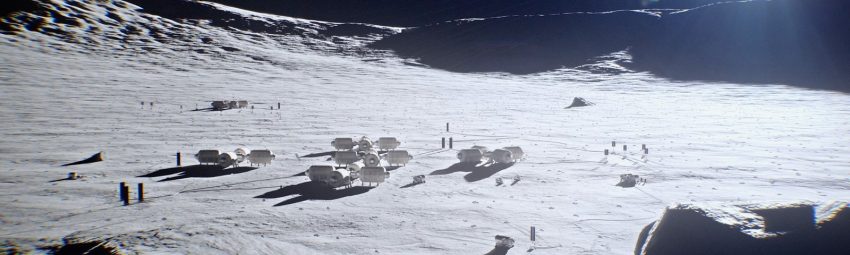
Some weekends on the Space Coast are about launches. This one was about contracts, and honestly, these might shape the next decade of Moon missions more than any single liftoff. On Saturday, November 7, NASA used the MAX POWER aerospace expo at Kennedy Space Center to roll out a big batch of Moon Base awards. Let’s break it down. ✨
I watched the announcement online, and things are definitely getting interesting in spaceworld!
CLPS 2: Eight Companies, Up to $10 Billion
NASA’s Commercial Lunar Payload Services program, CLPS for short, is how the agency buys rides to the lunar surface instead of building every lander itself. The next phase, CLPS 2, is a 10-year contract with a combined maximum value of $10 billion. Eight companies are now eligible to compete for delivery missions:
- Blue Origin
- Firefly Aerospace
- Intuitive Machines
- ispace-U.S.
- Lockheed Martin Space
- Northrop Grumman Space Systems
- SpaceX
- Voyager Technologies
Being selected doesn’t mean a company has a mission yet. It means it can bid on individual delivery task orders as NASA needs them. NASA also raised the value of the original CLPS contract from $2.6 billion to $4.2 billion to cover early Moon Base work. That contract runs through November 2028, with deliveries allowed to finish through November 2033.
PROMISE: A Nuclear-Powered Rover Built From Mars Rover Spares
This is the part that made me grin. 🤩 PROMISE stands for Polar Rover for Observation, Mapping, and In-Situ Exploration. It’s a six-wheeled rover headed for the Moon’s South Pole, and it’s nuclear powered, so it can keep working through the long lunar night and inside permanently shadowed craters where ice is thought to hide. Solar panels simply can’t do that job.
NASA’s Jet Propulsion Laboratory will manage the mission and build the rover from spare flight parts and engineering test models left over from Curiosity and Perseverance. (If you read my Mars rovers rundown, you know what a legendary family that is.) Reusing proven hardware is meant to cut cost and shorten the schedule.
PROMISE will carry a drill that reaches about 3 feet (1 meter) below the surface to study ice and other resources, plus spectrometers, temperature and radiation sensors, cameras, and a new radiation-tolerant computer called High Performance Spaceflight Computing. NASA is targeting a late 2028 launch and an 18-month mission. Keep in mind that’s a target, not a locked date.
Blue Origin won a $94 million base contract, with an option worth up to $140 million more based on performance, to deliver PROMISE using its Mark 1 lander. That expands a May 2026 task order for Blue to deliver two lunar terrain vehicles.
The Freight Trucks of Cislunar Space
NASA also awarded six task orders, worth about $1.3 billion combined, to Arrow Science and Technology, Blue Origin, and Impulse Space under its VADR launch services contract. These missions will test orbital transfer vehicles, which NASA compares to long-distance freight trucks hauling cargo between Earth and the Moon. Planned payloads include CAPSTONE 02 and NASA’s MoonFall scouting drones. Some flights will use New Glenn, Relativity’s Terran R, and Falcon 9, with in-space vehicles from Blue Origin, Firefly, Impulse, and Quantum Space.
And for my fellow SpaceX fans: NASA picked SpaceX to launch communications satellites to cislunar space aboard a Starship in 2028, a test for the network that will keep astronauts and the Moon Base connected. 🚀
Power on the Surface
Finally, NASA plans to buy parts for a Mini-Communications and Solar Tower (miniCAST), with awards to Honeybee Robotics (a Blue Origin company) for energy storage, Redwire for power generation, and Yank Technologies for wireless power transfer. A separate solicitation for fully integrated power systems is expected in early 2027.
Why It Matters
Put together, this is NASA building the Moon Base supply chain piece by piece: landers, freight haulers, communications, power, and a rover to scout the ground first. As Administrator Jared Isaacman put it, when astronauts return, “they will arrive with the first elements of the Moon Base already waiting for them on the surface.” I’ll be watching every one of these launches, and you know I’ll be watching until those landers touch down. 💫
Sources
- NASA, “NASA Awards Moon Base Transportation, Technology, Science Projects,” November 7, 2026
- Scientific American, “NASA reveals new lunar rover, PROMISE, to launch to moon in 2028”
- GovConWire, “NASA Taps 8 Firms for $10B CLPS 2 Lunar Delivery Contract”
- NASA Moon Base program page
Featured image: NASA artist’s concept of Moon Base. Image credit: NASA.