By The Star Queen · Friday, November 6, 2026 · Star Queen Chronicles
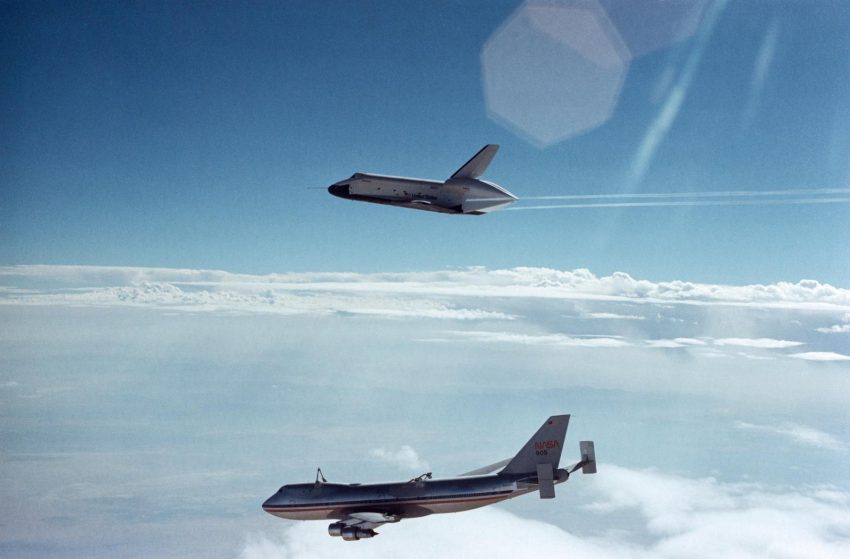
Featured image: NASA. Enterprise above the NASA 747 carrier aircraft after separation during the first free flight, Aug. 12, 1977 (NASA image S77-27945).
Part 2 of 15 · Series hub · Previous: My Space Shuttle Story: 135 Missions, 5 Orbiters, 30 Years (Start Here) 🚀
My loves, the first space shuttle never went to space. 🛩️ She never even tried. And the program still couldn’t have happened without her.
A name that almost wasn’t
NASA unveiled its first orbiter, OV-101, to the public on September 17, 1976, at Rockwell’s facility in Palmdale, California. That was Constitution Day in America’s bicentennial year, and the plan was to name her Constitution. Then the fans got involved. NASA says nearly 100,000 fans of Star Trek wrote to the White House asking for the shuttle to be named after the fictional starship Enterprise. In a memo, President Gerald Ford told NASA he was “partial to the name.” So Enterprise it was. NASA marked the 50th anniversary of that rollout just this September.
Why build a shuttle that can’t reach orbit?
Because the scariest part of a shuttle flight is the end. When an orbiter comes home it has no engine power to climb back up and try again. It has to glide down and land on a runway, and nobody wanted to try that for the first time on a real mission. So Enterprise was built for the Approach and Landing Tests, or ALT, to learn how the orbiter flew and handled in the air.
Terms to know ✨
- Orbiter: the winged spacecraft part of the shuttle.
- ALT: Approach and Landing Tests, the 1977 flights to check how the orbiter flew and landed.
- Shuttle Carrier Aircraft: a modified Boeing 747 that carries an orbiter on its back.
- Captive flight: the orbiter stays attached to the 747 the whole time.
- Free flight: the orbiter separates from the 747 and flies and lands on its own.
Thirteen tests in three steps
NASA’s 1977 year-in-review describes a 10-month series of low-altitude flights that began at what was then NASA’s Dryden Flight Research Center at Edwards, California. After taxi tests with Enterprise bolted on top of the 747, the first flight of the pair took place on February 18, 1977. All together it added up to 13 tests:
| Phase | Flights | What happened |
|---|---|---|
| Captive inert | 5 | Enterprise rode the 747 unpowered and unmanned, to prove the combination could fly. |
| Captive active | 3 | Enterprise was powered up and crewed by two teams of NASA astronauts: Fred W. Haise with C. Gordon Fullerton, and Joe H. Engle with Richard H. Truly. |
| Free flights | 5 | Enterprise separated from the 747 and glided to a landing. |
The five free flights
The mated flights finished on July 26, 1977, and the first free flight followed on schedule on August 12. Haise and Fullerton were at the controls. Explosive bolts released the 75-ton Enterprise from the 747 at 24,000 feet. She glided to a landing on the dry lake bed at Edwards in 5 minutes and 22 seconds.
Two more free flights followed with a smooth tailcone fitted, to reduce drag. For the fourth, on October 12, the tailcone came off and three simulated engines went on in its place, which was the configuration that was closer to how an orbiter would return from space. Engle and Truly flew that one for 2 minutes and 34 seconds to what NASA called a near-perfect lake bed landing.
The fifth and final free flight was on October 26, 1977. The goal this time was a landing on a hard runway, not the huge open lake bed. Haise and Fullerton did it in under two minutes, and Enterprise touched down safely on the Edwards runway. That is the shot that proved the shuttle could land like an airplane.
The 747 kept working
The modified 747 had a second career. The Shuttle Carrier Aircraft flew orbiters home on its back: NASA’s Kennedy Space Center fact sheet counts 55 ferry flights to the Shuttle Landing Facility at KSC. I think that is one of my favorite things about the program. Every time a shuttle landed in California, a jumbo jet had to carry it back across the country to the Cape.
What happened to Enterprise
She never flew in space. NASA’s own caption says the orbiter “was not designed to fly in space,” but that she did the essential atmospheric test flights that paved the way for the shuttle program’s first spaceflights in 1981. NASA says she is now on display at the Intrepid Museum in New York City.
If you want to know what a shuttle stack looks like and why it’s built the way it is, my Basic Rocket Science post covers the basics. The full roadmap for this series lives on the series hub.
The next step after Enterprise’s tests was the real thing: a crew of two, a launch from Pad 39A, and a very long wait to see if it would work.
— The Star Queen 👑
Coming next: Columbia’s First Ride: April 12, 1981 🌅
Sources
- NASA: NASA Unveils Enterprise, the First Space Shuttle (Sept. 17, 2026)
- NASA Technical Reports Server: NASA 1977 year in review (Approach and Landing Tests)
- NASA: Space Shuttle
- NASA Kennedy Space Center: Space Shuttle Era Facts (April 2012)
- NASA Image and Video Library: S77-27945