By The Star Queen
My loves, today’s engine is really a family story. 🧬 The BE-3 started as the engine that lifted New Shepard past the edge of space, and a cousin of it now sits on the second stage of New Glenn. Same name, same propellants, very different jobs and, importantly, different engine cycles. Everything here is as of October 26, 2026, with official versus unofficial numbers labeled.
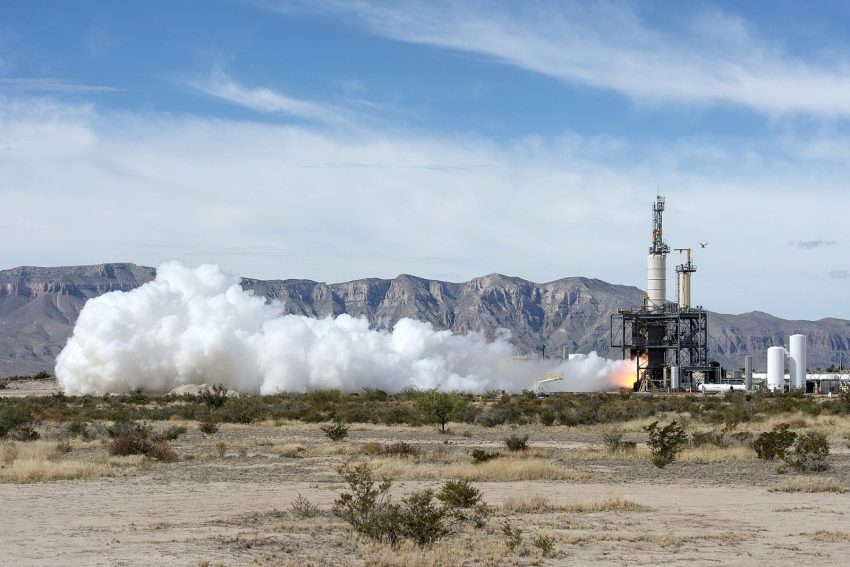
A Blue Origin BE-3 test firing at the company’s West Texas test site, November 2013. Image: NASA/Lauren Harnett, public domain, via Wikimedia Commons.

Meet the Twins
- BE-3PM (“PM” for propulsion module): the sea-level engine on New Shepard, Blue Origin’s suborbital rocket. It first flew on April 29, 2015 and carried people for the first time on July 20, 2021 (Wikipedia).
- BE-3U (“U” for upper stage): a vacuum-optimized cousin used in pairs on the second stage of New Glenn. New Glenn has flown with two (the “7×2”), and the planned 9×4 would use four. See my 7×2 vs 9×4 explainer.
For the engine that powers New Glenn’s first stage, see my BE-4 deep dive.
Terms to know ✨
- Hydrolox: liquid hydrogen fuel burned with liquid oxygen. High efficiency, but hydrogen is very cold and very bulky.
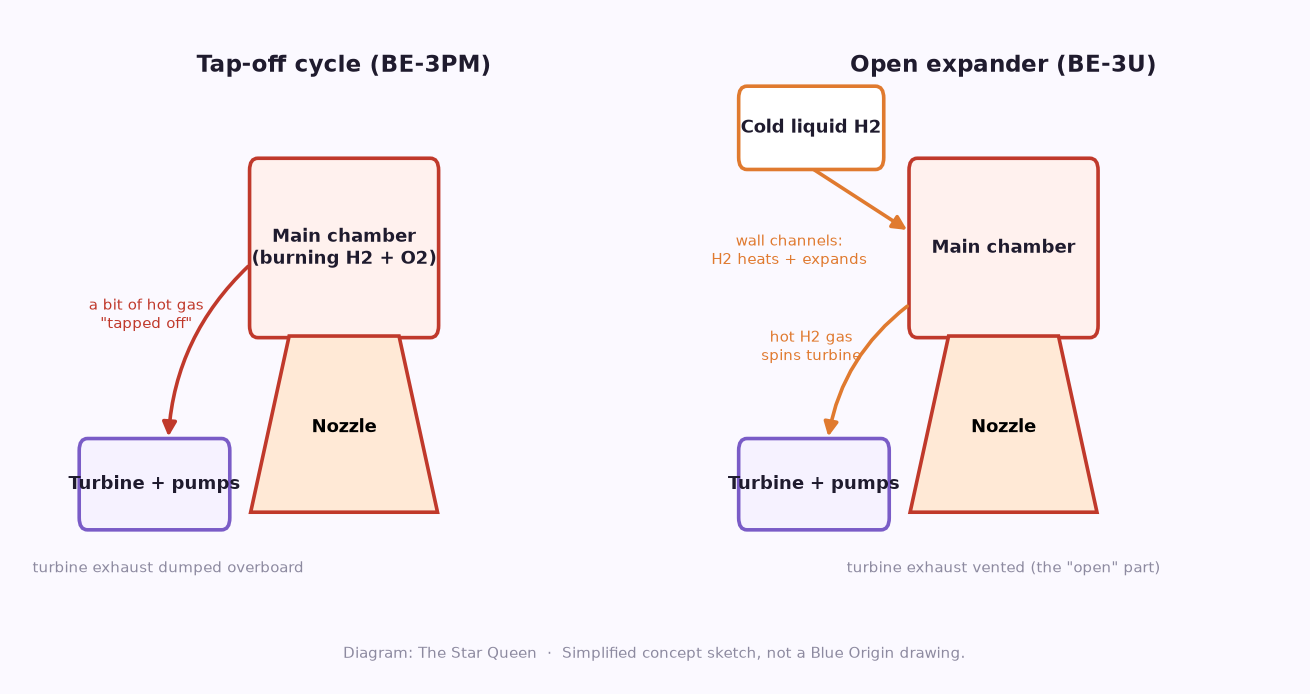
- Tap-off cycle: a small amount of hot gas is “tapped” from the main combustion chamber to spin the turbopump.
- Expander cycle: heat soaked up by the engine’s walls turns the cold hydrogen into gas, and that gas spins the turbine.
- Bleed (open) expander: an expander where part of the gas that drives the turbine is dumped overboard instead of being burned.
- Vacuum-optimized: an engine with a very large nozzle that works best where there is no air pressure pushing back.
- Throttle: running an engine below full thrust.
- Specific impulse (Isp): how much push you get per unit of propellant per second. Higher is more efficient.
Specs: Two Engines, Two Sets of Caveats
| Spec | Value | Source |
|---|---|---|
| Propellants (both) | Liquid hydrogen + liquid oxygen | Blue Origin |
| BE-3PM cycle | Tap-off | Wikipedia; Blue Origin |
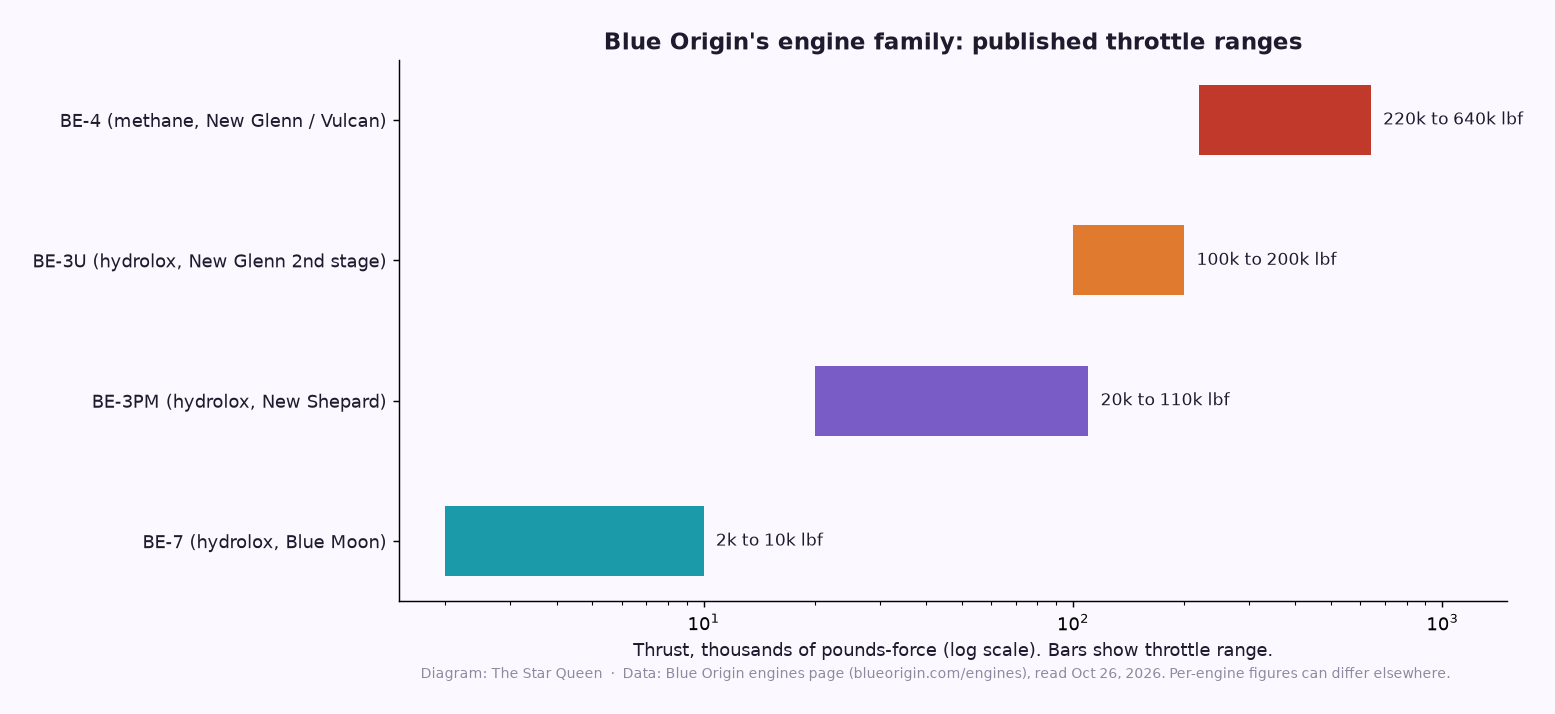
| BE-3PM thrust | 110,000 lbf at full power, throttling to 20,000 lbf | Blue Origin engines page; Wikipedia |
| BE-3PM role | New Shepard (flights paused since Jan 30, 2026; Wikipedia lists the engine as “dormant”) | Blue Origin; Wikipedia |
| BE-3U cycle | Expander bleed (open expander) | Wikipedia |
| BE-3U thrust (current listing) | 200,000 lbf (about 890 kN), throttling to 100,000 lbf | Blue Origin engines page |
| BE-3U thrust (earlier figures) | 150,000 (2015 projection), 160,000 (2019), about 172,000 to 173,000 (2024), 175,000 (Apr 2025 static fire) | Wikipedia, citing Blue Origin statements |
| BE-3U thrust (demonstrated, Nov 2025) | 211,658 lbf on the test stand | Blue Origin news, Nov 20, 2025 (Wikipedia lists 211,500 lbf) |
| BE-3U specific impulse | About 445 s (vacuum) | Wikipedia, citing a Bezos statement (unofficial) |
| New Glenn upper stage total | 2 engines: about 320,000 lbf before, 400,000 lbf now | Blue Origin (via my New Glenn post) |
Why the BE-3U thrust number keeps changing: Blue Origin has been repeatedly raising what it says the engine can do. That is why articles from 2019, 2024 and 2025 give 160,000, about 173,000, 175,000 and 211,658 lbf. I use Blue Origin’s own current page, 200,000 lbf, as the headline and treat the 211,658 lbf Blue Origin reported on November 20, 2025 as a one-off test-stand demonstration (Wikipedia gives a slightly different 211,500). The same announcement says the pair’s total thrust is rising from 320,000 to 400,000 lbf over the next few missions. For scale, one BE-3U at 200,000 lbf is roughly eight times the thrust of an RL10C-1-1 (23,825 lbf, per Wikipedia), my arithmetic. For that engine’s story, see my RL10 deep dive.
Cycle One: Tap-Off (BE-3PM)
Every pumped engine needs power to drive the pumps that push propellant into a chamber at high pressure. The BE-3PM gets that power by tapping a small amount of burning gas straight from the main combustion chamber (Wikipedia). That gas spins a turbine that drives the pumps. Everyday Astronaut’s cycle guide groups the tap-off cycle with the open cycles: the gas that went through the turbine is not burned in the main chamber, so you give up a little efficiency. The upside is a fairly simple design with no separate preburner.
The BE-3PM has to do something unusual for a hydrolox engine: throttle a long way down so New Shepard’s booster can land on its tail. Blue Origin’s page lists a range from 110,000 down to 20,000 lbf. Wikipedia’s older figures were 110,000 and a 25,000 lbf floor in December 2013, improved to 20,000 in April 2015 when the engine’s specifications were finalized.
Cycle Two: Expander Bleed (BE-3U)
An upper-stage engine lives in a vacuum, so it wears a huge nozzle, and a large nozzle has a lot of surface area for heat to soak into. The BE-3U uses that. Cold liquid hydrogen flows through channels in the chamber and nozzle walls, gets hot, and expands into a high-pressure gas that spins the turbine. That is an expander cycle. The BE-3U is described as a bleed expander, so some of the turbine gas does not go into the main chamber (Wikipedia calls it “expander bleed”). Its big advantage is gentle temperatures: nothing in the turbine path is burning at thousands of degrees, which is friendly to a reusable or long-lived engine. The limit, which I’ll explain in my RL10 post, is that thrust is limited by how much heat the walls can collect.
I’ll be careful here: Blue Origin has published less about the BE-3U’s internal plumbing than about its headline numbers, so the details of how much gas is bled and where it goes are not something I can tell you.
Test History: Building Confidence
The BE-3 was announced in January 2013 and fired in 2013 at Blue Origin’s West Texas site, near Van Horn. By December 2013 Blue Origin said the engine had run more than 160 starts and 9,100 seconds. Wikipedia reports that by April 2015 the engine had logged over 450 firings and more than 500 minutes of test time. In late 2013 it ran a full simulated suborbital burn, with coast phases and relights, a single test sequence that NASA publicized. Development of the upper-stage BE-3U started after that: by August 2018 there were test engines with more than 700 seconds of test time, according to Wikipedia. In 2016 the Air Force partly funded an extendable nozzle for it.

🎬 Blue Origin Debuts BE-3 Hydrogen Engine (Blue Origin). Blue Origin’s own video introducing the BE-3 hydrogen engine. Watch on YouTube
The Day It Went Wrong: NS-23
On September 12, 2022, New Shepard’s NS-23 flight suffered a mishap. Blue Origin’s findings, published March 24, 2023, say the direct cause was a structural fatigue failure of the BE-3PM engine nozzle during powered flight, caused by operating temperatures higher than the nozzle material’s expected values. The company said design changes to the boundary layer cooling system raised nozzle heating and created hot streaks. The capsule’s escape system worked as designed, and the capsule and its payloads landed safely, while the booster was lost. Blue Origin said it made corrective changes to the combustion chamber, operating parameters and nozzle. The FAA closed its investigation on September 27, 2023 and required 21 corrective actions, including redesigned engine and nozzle components. It is a textbook example of how a small design tweak can push a nozzle past its limits.
Where Each Engine Stands Today
BE-3PM. On January 30, 2026, Blue Origin announced it would pause New Shepard flights for no less than two years to focus on human lunar capability, including New Glenn and Blue Moon (Blue Origin; Reuters; Space.com). Reports say New Shepard had completed 38 flights and carried 98 people to space. That leaves the BE-3PM without a flight job for now, and Wikipedia lists its status as dormant. I covered what’s next for the program in my Beyond New Glenn post.
BE-3U. It has flown on every New Glenn mission so far, and it had a rough outing on NG-3 on April 19, 2026, when the upper stage underperformed and AST SpaceMobile’s BlueBird 7 satellite ended up in too low an orbit (Ars Technica, NASASpaceflight). The FAA said the direct cause was a cryogenic leak that froze a hydraulic line and caused a thrust anomaly in the second-stage burn. Note the wording: that was reported as a problem around the engine system, not an engine design flaw. Blue Origin listed corrective actions. I covered that flight in my 7×2 vs 9×4 post.
🎬 Rocket engine cycles: How do you power a rocket engine? (Everyday Astronaut). A friendly, thorough explainer of tap-off, expander and staged-combustion cycles and the trade-offs between them. Watch on YouTube
Production
The Huntsville factory opened in February 2020 to make BE-4 and BE-3U engines. SpaceNews reported the factory was designed for up to 42 engines per year across both types. I couldn’t find a published BE-3U-only production number.
The Star Queen’s Take 👑
I find the BE-3 family beautiful because it shows two different answers to one problem. The BE-3PM taps hot gas for a simple, deep-throttling engine that can land a booster, and the BE-3U uses wall heat to run an expander that suits a vacuum stage. The name is the same, the physics is not. 💜 The pattern in the thrust numbers (160,000 to 200,000 lbf and beyond) is Blue Origin finding margin as it tests, which is encouraging, but I’d like to see those uprates flying in an unbroken string of successful second-stage burns. With New Shepard paused, the BE-3U carries the family’s future, and New Glenn’s return to flight will tell us a lot.
Sources
- Blue Origin, Engines; New Glenn Update (Nov 20, 2025); NS-23 findings (Mar 24, 2023); New Shepard to pause flights (Jan 30, 2026)
- Wikipedia, BE-3
- Everyday Astronaut, Rocket engine cycles
- FAA, FAA closes Blue Origin mishap investigation
- Reuters, Blue Origin pauses New Shepard (Jan 30, 2026); Space.com, Blue Origin pausing space tourism flights
- SpaceNews, Blue Origin opens Huntsville engine factory
- Wikipedia, RL10 (for the RL10C-1-1 thrust comparison)
- Videos: Blue Origin and Everyday Astronaut on YouTube