By The Star Queen · Star Queen Chronicles
My loves, here is my favorite way to describe a rocket engine: it is a controlled explosion with very good plumbing. Now imagine that plumbing was grown in a printer, one laser-melted layer at a time. That is Aeon 1, the engine that lifted Relativity Space’s Terran 1 off the pad in Florida on March 22, 2023 (March 23 in UTC; more on that below). 🔥
In this deep dive I’ll open the engine up: how it works, why its copper matters, what its vacuum-optimized cousin Aeon Vac was supposed to do, and what really happened in the last seconds of that flight. Relativity has since moved on to the bigger Aeon R (my Aeon R deep dive is the sequel), but Aeon 1 is where the company learned most of what it knows.
How I label things: Official comes from Relativity or NASA, Reported comes from journalists or third parties, and My math is mine. Where sources disagree, I say so.
Terms to know ✨
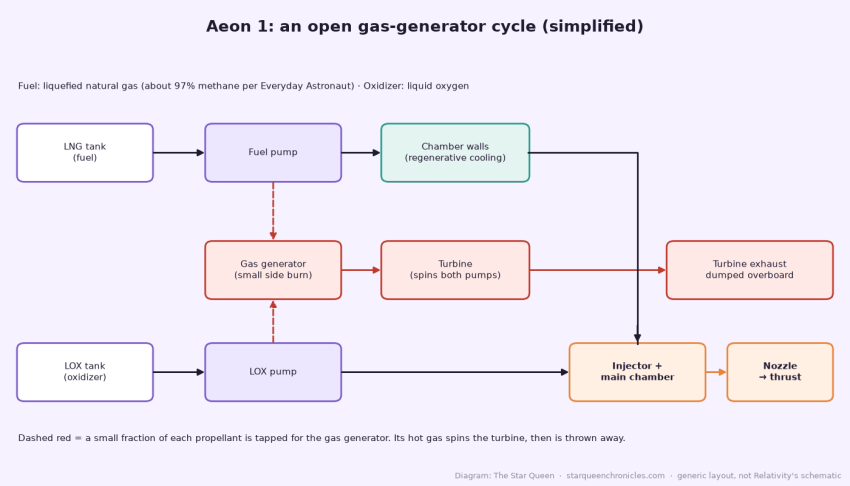
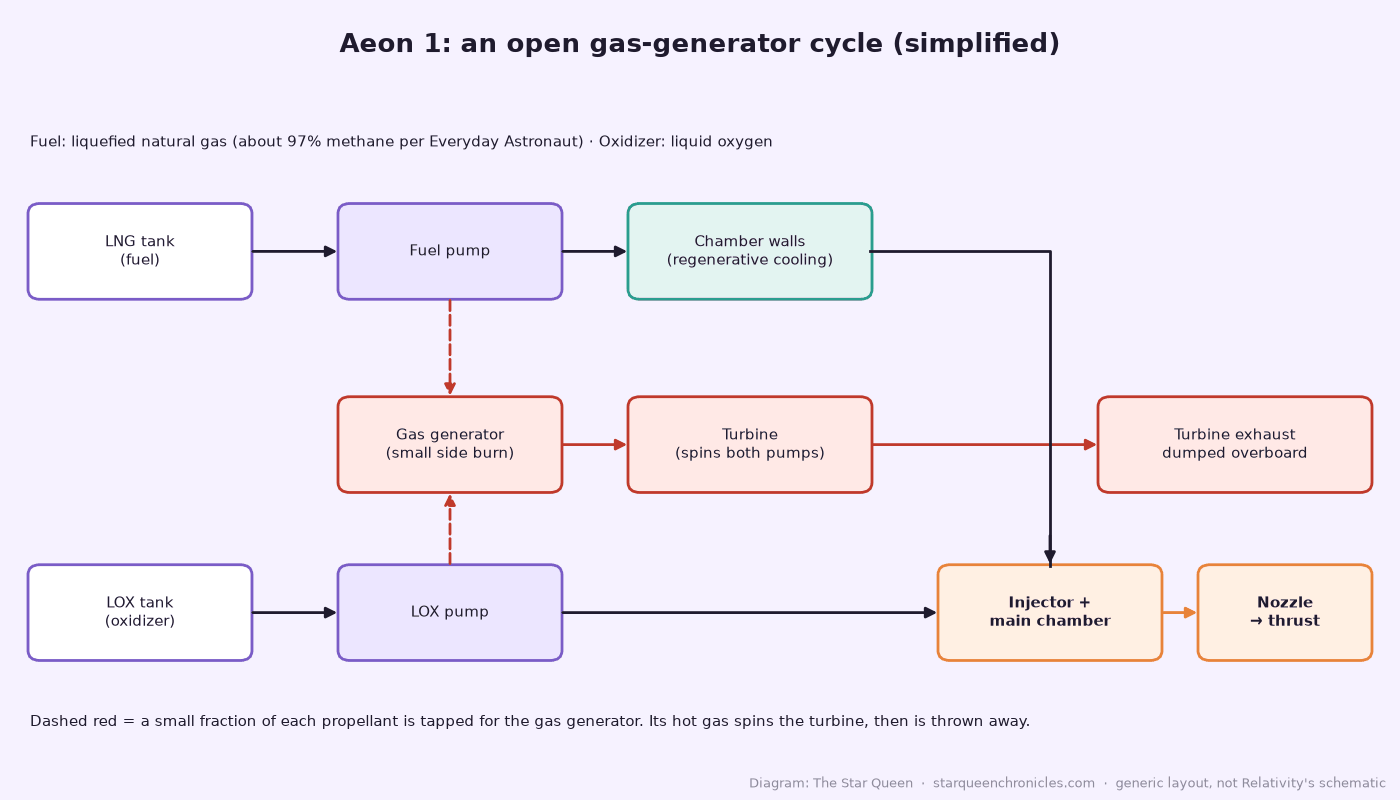
- Gas-generator cycle: an engine design that burns a small slice of the propellant in a side chamber; the hot gas spins the turbine that drives the pumps and is then exhausted overboard.
- Turbopump: a pump driven by a turbine. It raises propellant pressure high enough to push it into the combustion chamber.
- Regenerative cooling: sending cold propellant through channels in the chamber wall before it is burned, so the fuel cools the engine as it goes.
- GRCop-42: NASA Glenn’s copper-chromium-niobium alloy for combustion chambers. The name reflects roughly 4 parts chromium and 2 parts niobium in copper.
- Specific impulse (Isp): how many seconds one pound of propellant can produce one pound of thrust. Higher means a more efficient engine.
- Cavitation: vapor bubbles forming in a liquid inside a pump. A pump built for liquid does very little when it ingests gas.
- Laser powder bed fusion: the metal 3D printing method where a laser melts thin layers of powder, thousands of times, into a finished part.
- LNG: liquefied natural gas, mostly methane. Relativity says “liquid natural gas”; most news coverage says “methane.”
Aeon 1 at a Glance
Here are the headline numbers, with where each one comes from. Most of the engine specs come from Relativity’s own 2020 Terran 1 page (an archived copy), because Relativity has not republished them since retiring the rocket.
| Item | Value | Label and source |
|---|---|---|
| Maker | Relativity Space (Long Beach, California) | Official |
| Propellants | Liquid oxygen and liquefied natural gas | Official, 2020 spec page |
| Cycle | Gas generator, gas-gas torch ignition, autogenous pressurization | Official, 2020 spec page |
| Aeon 1 thrust | About 23,000 lbf at sea level (≈100 kN); 25,400 lbf in vacuum | Vacuum: official, 2020 page. Sea level: my math, 207,000 ÷ 9 = 23,000; Everyday Astronaut lists 100 kN (22,480 lbf) |
| Aeon 1 Isp | More than 310 s | Official, 2020 page (conditions not stated) |
| Aeon Vac | Restart-capable vacuum engine; more than 360 s Isp | Official, 2020 page |
| Aeon Vac vacuum thrust | 29,800 lbf (2020 page) or about 28,300 lbf (Wikipedia and Everyday Astronaut) | Sources conflict |
| On Terran 1 | 9 Aeon 1 on stage 1, one Aeon Vac on stage 2 | Official |
| Liftoff thrust | 207,000 lbf (9 × 23,000 = 207,000, my math checks out) | Official findings, via TCT Magazine |
| Printed share of the rocket | 85% by mass (some sources say 90%) | Official / Reported, conflict noted below |
| Flights | One (Terran 1, “Good Luck, Have Fun,” March 2023) | Official; Relativity then shifted to Terran R |
How a Gas-Generator Engine Works
Every liquid engine has the same problem: the propellants sit in tanks at low pressure, and the chamber needs them at very high pressure. Something has to do that pumping, and that something needs power. The gas-generator cycle is the simplest answer. Tap off a little fuel and liquid oxygen, burn them in a small side chamber, and send the hot gas through a turbine. The turbine spins the pumps. Then the exhaust gas from that turbine is dumped overboard, or fed into the nozzle at low efficiency.
That last part is the catch. You are spending propellant to make shaft power and then throwing it away, so an open-cycle engine gives up some efficiency compared with a staged-combustion engine, where all the gas ends up in the main chamber. (That is the trade I walk through in my Zenith deep dive.) In return you get fewer ways to go wrong: lower pressures, lower turbine temperatures, and a start sequence that is much more forgiving. For a young company building its first engine, that is a smart trade, and it is the same cycle that powers SpaceX’s Merlin. (That Merlin comparison is general engineering background, not something Relativity said.)
Official: Relativity lists Aeon 1 as a gas-generator engine with a gas-gas torch igniter, which lights the main chamber with a small flame of gaseous propellants instead of a one-shot chemical cartridge. Aeon 1 is also regeneratively cooled, per Relativity’s own findings as reported by TCT Magazine. Everyday Astronaut’s launch article adds two turbopump assemblies, one for LNG and one for LOX (Reported; I did not find it on a Relativity page).
Printed Copper That Survives Fire
A rocket chamber asks metal to survive a flame hotter than the metal’s own melting point. The trick is that cold propellant flowing through the wall carries the heat away, so the wall has to conduct heat extremely well. Copper is the classic choice, but pure copper is soft and weakens as it heats.
That is where NASA’s GRCop family comes in. Official (NASA): the Glenn Research Copper alloys are copper, chromium and niobium, designed for high strength, high thermal conductivity and creep resistance, and NASA says they tolerate temperatures up to 40% higher than traditional copper alloys. NASA also says Terran 1 flew nine additively manufactured engines made of the newest version, GRCop-42, which saw temperatures approaching 6,000 °F, and that NASA provided technical expertise to Relativity under a reimbursable Space Act Agreement. NASA names laser powder bed fusion as one of the processes suited to these alloys, because it can print the fine cooling channels and nozzles.
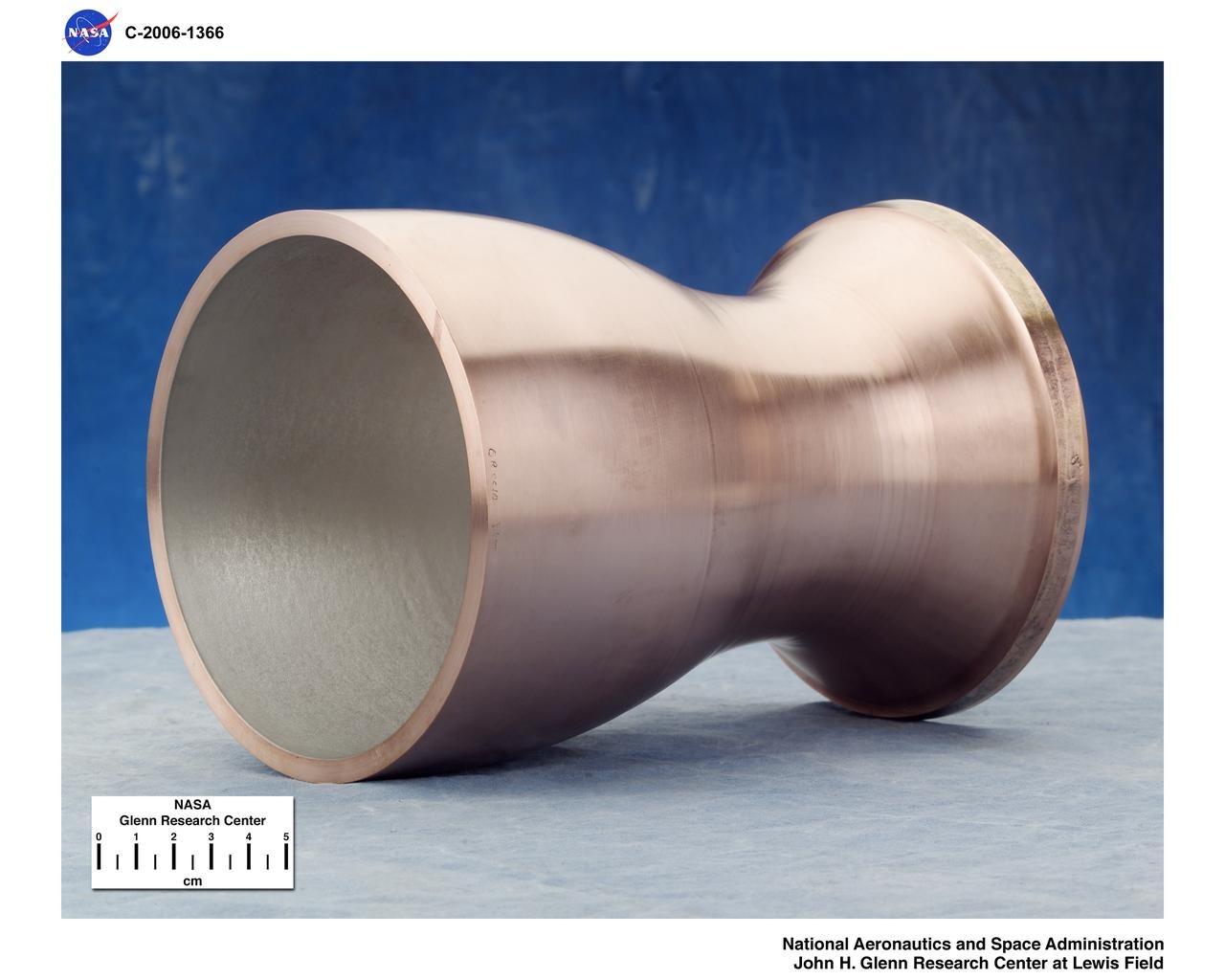
Two caveats from me. First, NASA says nine engines flew with GRCop-42 and Relativity counts ten Aeon engines on the rocket (nine Aeon 1 plus the Aeon Vac). I could not find a statement about the Aeon Vac’s chamber material, so I am not claiming one. Second, NASA’s article calls Terran 1 “made entirely from 3D-printed parts,” while Relativity’s own findings say 85% printed by mass. NASA’s wording reads like shorthand to me, and I use Relativity’s figure.
Relativity’s 2020 page claims printing cut part count by 100× across the structure and engines. I treat that as a company marketing number, not an audited count.
Aeon Vac: The Vacuum Cousin
The second stage did not use Aeon 1. It used Aeon Vac, an engine tuned for the near-zero pressure of space. In a vacuum, a longer nozzle (a bigger expansion ratio) lets the exhaust keep expanding and pushes harder on the engine, which is why Relativity lists a higher Isp for Aeon Vac, above 360 s versus above 310 s for Aeon 1. Aeon Vac was also the restart-capable engine, which matters if you want to place a payload carefully. Everyday Astronaut reports a 165:1 expansion ratio (Reported).
There is little public detail beyond that, which is why I folded Aeon Vac into this post. What matters most is how its first start in space went.
The Test Stand Years
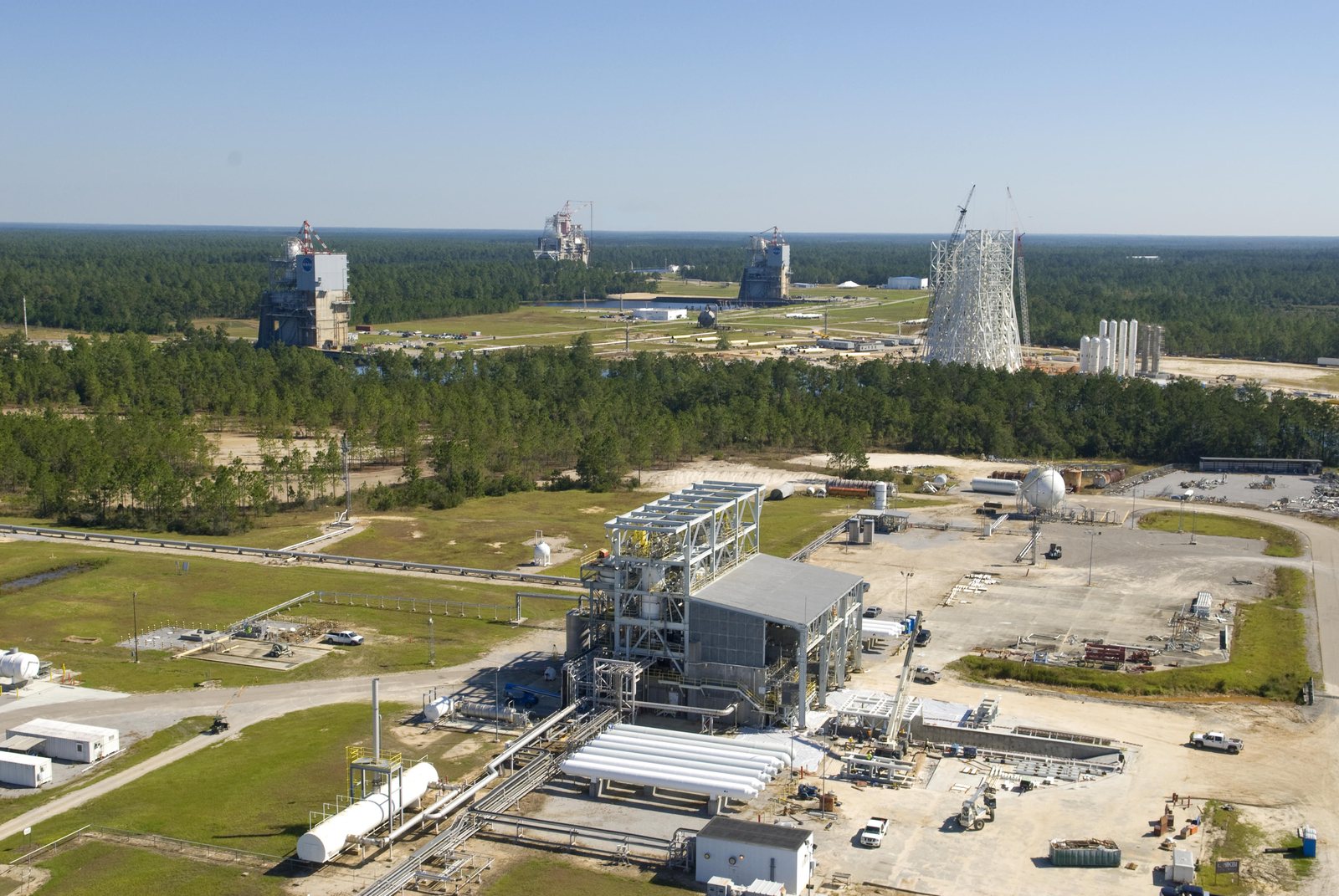
Aeon 1 was developed at NASA’s Stennis Space Center in Mississippi, in the same complex of test stands that fired Apollo and shuttle hardware. Official: Relativity’s 2020 page says it ran development tests at Stennis’s E3 facility starting in 2016, with over 200 hot fires across 14 engine iterations, and over 300 test fires for Aeon overall.
Reported: a TEST Spaceflight video of an Aeon 1 firing says the engine ran a full 187 seconds at full power in a 2020 test; I found it in coverage of a full-duration test and could not confirm the date from Relativity itself. It matters because Terran 1’s first-stage burn was about 163 seconds (see below), so a 187-second firing covers a full mission burn.
An Aeon 1 test fire, posted by the TEST Spaceflight channel (third-party, not Relativity). If the player does not load, watch “Aeon 1 rocket engine test fire by Relativity Space” by TEST Spaceflight on YouTube.
Flight 1: What Worked and What Did Not
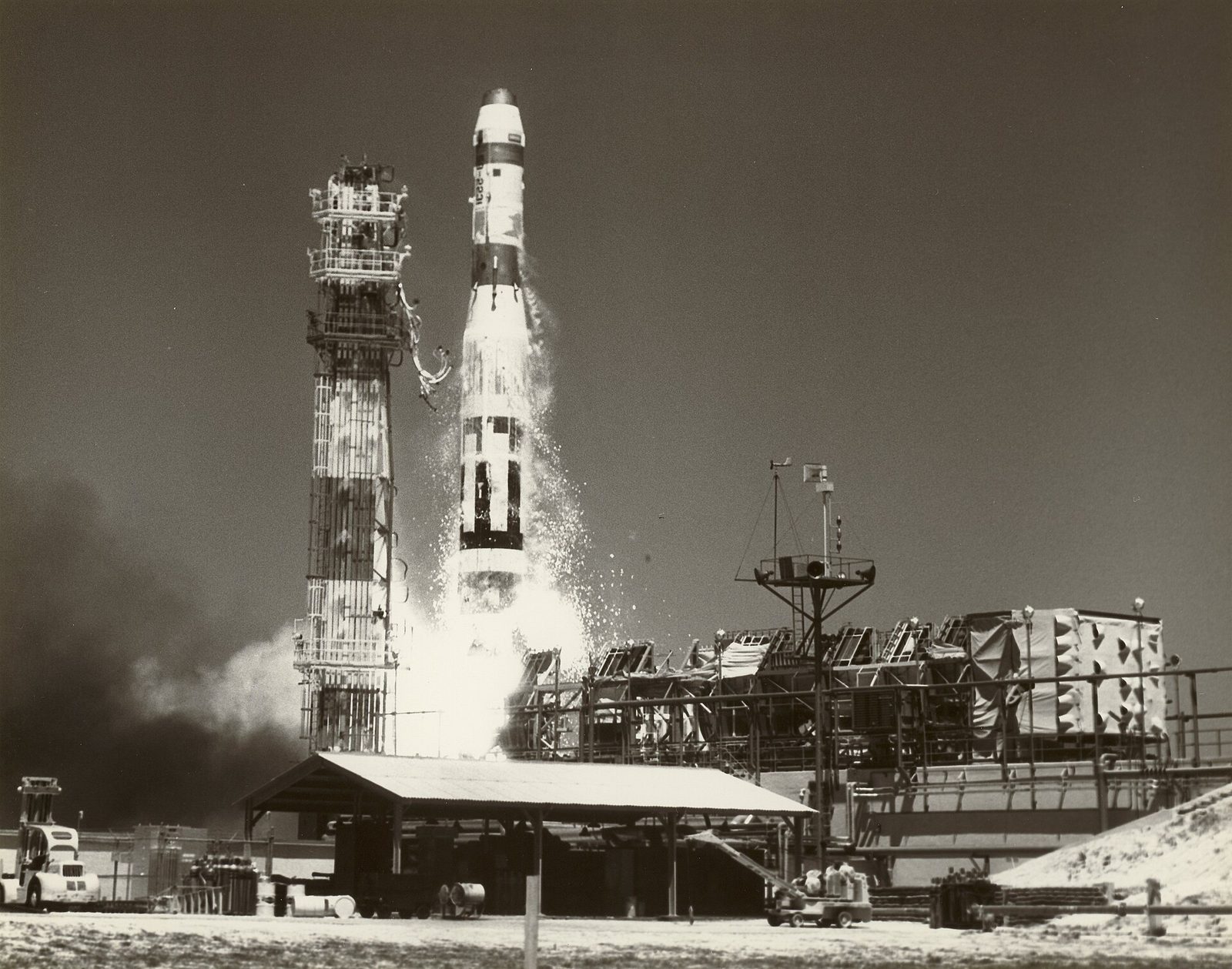
Terran 1’s only launch came from Launch Complex 16 at Cape Canaveral, a pad with its own history (it first served Titan missiles in the early 1960s). The date depends on who you ask: Ars Technica reports March 22, 2023, and the Cape Canaveral Space Force Museum says March 23. Everyday Astronaut’s pre-launch table lists the window as 22:00 EDT on March 22, which is 02:00 UTC on March 23, so I read these as the same moment in two time zones.
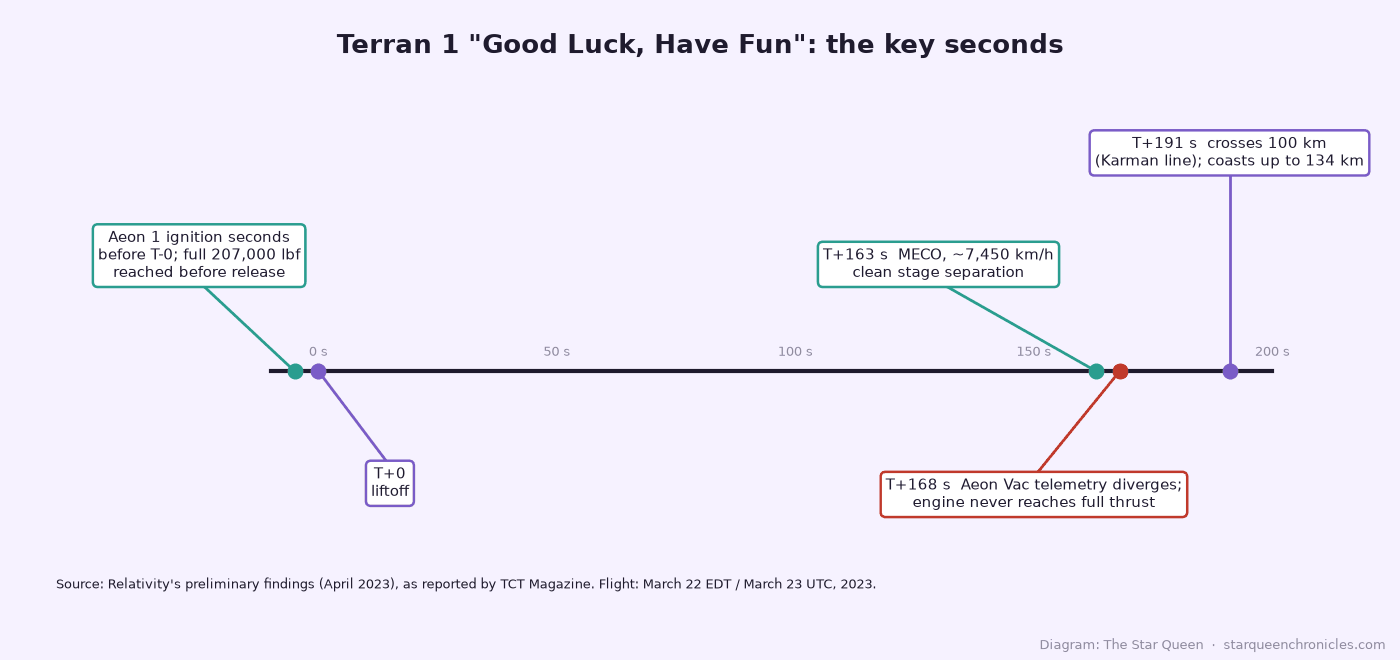
Official findings (Relativity’s April 2023 summary, as reported by TCT Magazine):
- The nine Aeon 1 engines ignited several seconds before T-0 and reached their full 207,000 lbf of combined thrust before release.
- The vehicle passed Max-Q, the moment of peak aerodynamic stress, with the printed structure performing as expected.
- Stage 1 main engine cutoff came at T+163 seconds at about 7,450 km/h, and the stages separated cleanly.
- About T+168 seconds, Aeon Vac’s telemetry diverged from expectations and the engine never reached full thrust.
- Even so, the stage kept control with engine gimballing and its reaction control system, crossed the 100 km Kármán line at T+191 seconds, and coasted up to 134 km.
Why Aeon Vac Stumbled
Here is the engineering story, because it is a good one. Relativity’s preliminary root-cause findings (as reported by TCT) say three things happened in sequence. First, valves opened slower than expected, which changed the pressures and the timing of propellant reaching the chamber and the gas generator. Second, when the turbines were spun up, the fuel pump built pressure as expected but the oxygen pump did not, and the pump data was consistent with a vapor bubble at the pump inlet. Third, with bad pressure and timing, the gas generator never lit, so the engine never reached full power.
Months later, CEO Tim Ellis told Payload that the cause was ingestion of a gas bubble by the turbopump, producing cavitation and a failed startup sequence, and said the learnings carry over to Terran R. Notice what that means: it was not the printing process that failed. It was a start-up problem for a cryogenic pump in a vacuum, the sort of fault that can bite any engine, and one that is nearly impossible to fully reproduce on the ground. As Ellis put it, “you really do have to fly to get the data.” Wikipedia says the second stage “failed to ignite,” which is a bit off: the engine started, but never reached full power.
What Aeon 1 Left Behind
After the flight, Relativity said it was done with Terran 1 and would focus on Terran R, so Aeon 1 has one flight to its name. Its legacy is the playbook: a printed, regeneratively cooled, gas-generator LOX/natural-gas engine, designed so that printing could cut the number of parts. Relativity’s April 2023 Terran R announcement says Aeon R builds on Aeon 1 and migrates many of the same architecture choices. If you want to see what that turned into, jump to my Aeon R post or the story of the company’s pivot in From a 3D-Printed Terran 1 to Terran R.
Relativity’s own archive video about the Terran 1 launch effort, from the company’s YouTube channel. If the player does not load, watch “From the Archive: Terran 1 Launching The World’s First 3D Printed Rocket (Pt. 3)” by Relativity Space on YouTube.
Where My Sources Disagree
- Aeon Vac thrust: 29,800 lbf (Relativity’s 2020 page) versus about 28,300 lbf (Wikipedia, Everyday Astronaut). I do not know which is the as-flown number.
- Printed share: 85% by mass in Relativity’s findings (via TCT), about 90% in other coverage, and “entirely” in NASA’s article.
- Fuel name: Relativity says liquid natural gas; most coverage says methane. Everyday Astronaut puts the mix at about 97% methane.
- Launch date: March 22 (Ars, Eastern time) versus March 23 (Cape museum, UTC). Same night; the time zones differ.
- Material by engine: NASA says nine GRCop-42 engines; the rocket carried ten Aeon engines in total.
- Test numbers: the 187-second burn is third-party reporting and “over 300 test fires” is a 2020 company claim, so I label both as reported.
The Star Queen’s Take 👑
Aeon 1 is the kind of engine I love: modest on paper, big on consequences. 23,000 lbf is tiny next to the engines of today’s big rockets, but it proved a printed copper chamber could fly, and it taught Relativity a hard lesson about starting a pump in the cold dark. The thing I most want you to take away is that the failure was a plumbing-and-timing problem, not a printing problem, which is exactly the kind of lesson that gets baked into the next engine. Next up: what that next engine looks like. ✨
Related Reading
- Aeon R: The 269,000-lbf Engine Behind Terran R
- From a 3D-Printed Terran 1 to Terran R
- Zenith: Stoke’s Full-Flow Engine
Sources
- Terran 1 (archived Relativity page, Nov 2020) — Relativity Space via Internet Archive; engine specs
- Relativity Space shares key findings from Terran 1 launch; shifts focus to Terran R development — TCT Magazine, Apr 12, 2023
- Relativity Space unveils Terran R — Relativity Space, Apr 12, 2023
- 3D Printed Rocket Launched Using Innovative NASA Alloy — NASA, May 2, 2023
- Tim Ellis on The Way Forward After Terran 1’s First Flight — Payload, Nov 7, 2023
- Relativity’s 3D-printed engine has completed a mission duty cycle test-firing — Ars Technica, Nov 2020
- Relativity Space is moving on from the Terran 1 rocket to something much bigger — Ars Technica, Apr 12, 2023
- Good Luck, Have Fun | Terran 1 — Everyday Astronaut, Mar 5, 2023
- Launch Complex 16 — Cape Canaveral Space Force Museum
- Relativity Space — Wikipedia (secondary; used only for flagged items)
- Aeon 1 rocket engine test fire by Relativity Space — TEST Spaceflight, YouTube
- From the Archive: Terran 1 Launching The World’s First 3D Printed Rocket (Pt. 3) — Relativity Space, YouTube
- File:Stennis test complexes on display (SSC-2009-02208).jpeg — NASA Stennis Space Center, Oct 20, 2009, via Wikimedia Commons
- GRC-2006-C-01366 (GRCop-84 thrust chamber) — NASA Glenn Research Center, NASA Image and Video Library
- Launch Complex 16 (Titan I C-1 RVX-3 test) — U.S. Air Force, Mar 8, 1960, via Wikimedia Commons

