By The Star Queen · Star Queen Chronicles
My loves, here is a design question that sounds like a riddle. How do you bring the top half of a rocket back from orbit without covering its bottom in fragile tiles? Stoke Space’s answer: make the bottom of the rocket the engine, and cool it with the fuel. 🌌
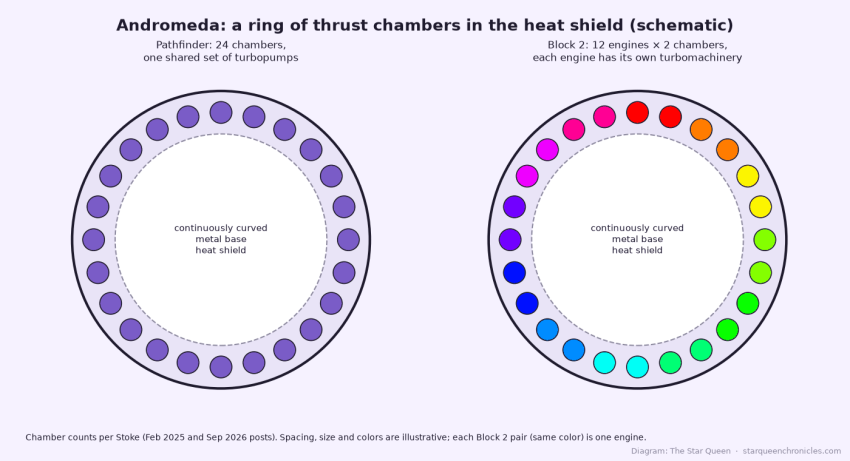
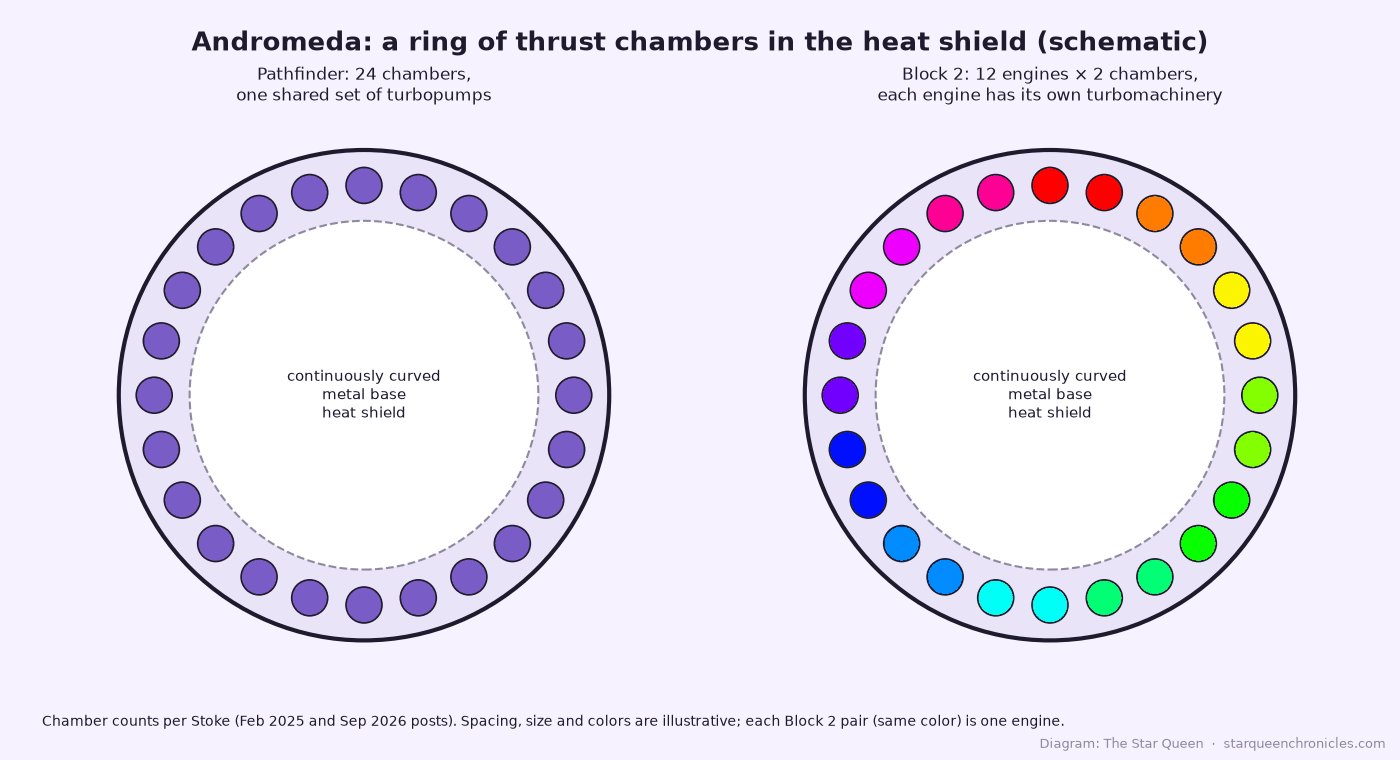
That is Andromeda, the upper-stage engine of Stoke’s Nova rocket. It is a ring of 24 small hydrogen thrust chambers built into a metal heat shield, and the same liquid hydrogen that burns in the chambers also flows through the shield to carry heat away during reentry. In this deep dive I’ll explain how that works, how the design has changed on the way to Nova Pathfinder and Nova Block 2, and why I would not call it an aerospike. Companion reading: Zenith, the booster engine, and my Nova Pathfinder post.
How I label things: Official is from Stoke, Reported is from journalists or third parties, and My math is mine.
Terms to know ✨
- Thrust chamber: one small combustion chamber and nozzle. Andromeda has many of them instead of one big bell.
- Regenerative cooling: sending cold propellant through channels in a wall that needs cooling before burning it. Stoke applies this to the heat shield, not just the chambers.
- Base heat shield (BHS): Stoke’s name for the metallic, actively cooled shield at the base of the upper stage that doubles as part of the engine.
- Expander cycle: an engine cycle where heat picked up by the hydrogen (in the cooled walls) expands it to spin the turbines. No separate burner is needed.
- Differential throttle thrust vector control (DT-TVC): steering by throttling different thrust chambers by different amounts, instead of tilting an engine on gimbals.
- Hot staging: lighting the upper stage’s engine while it is still attached to the first stage.
- Isp: specific impulse, seconds of thrust per pound of propellant per second. Higher is more efficient.
- Aerospike: an engine type with a central spike that the exhaust expands against. It is not how Stoke describes Andromeda, as I explain below.
Andromeda at a Glance
| Item | Value | Label and source |
|---|---|---|
| Propellants | Liquid hydrogen and liquid oxygen | Official, Stoke |
| Nova Pathfinder: layout | 24 thrust chambers around an actively cooled base heat shield, shared turbopumps | Official, Stoke (Sep 2026) |
| Nova Pathfinder: thrust and Isp | 25,000+ lbf and 400+ s | Official, Stoke’s Nova page |
| Nova Pathfinder: cycle | “Expander cycle” (an earlier 2023 description called it an expander bleed cycle) | Official; wording differs |
| Nova Block 2: layout | 12 independent engines, each with two chambers and its own turbomachinery (still 24 chambers) | Official, Stoke (Sep 2026) |
| Nova Block 2: Isp | More than 440 s by closing the hydrogen expander cycle | Official, Stoke |
| Nova Block 2: thrust | Stage 2 thrust scaled by “over a factor of five”; over 125,000 lbf if applied to 25,000 (my rough math) | Official factor; my math |
| Steering | Differential throttling; no gimbal | Official, Stoke |
| Nozzle modes | One vacuum mode, one sea-level mode for the landing burn | Official, Feb 2025 |
| Chamber material and printing | Printed chambers reported; material not stated by Stoke in sources I read | Reported (NASASpaceFlight, EA) |
The Big Idea: Don’t Armor the Engine, Be the Engine
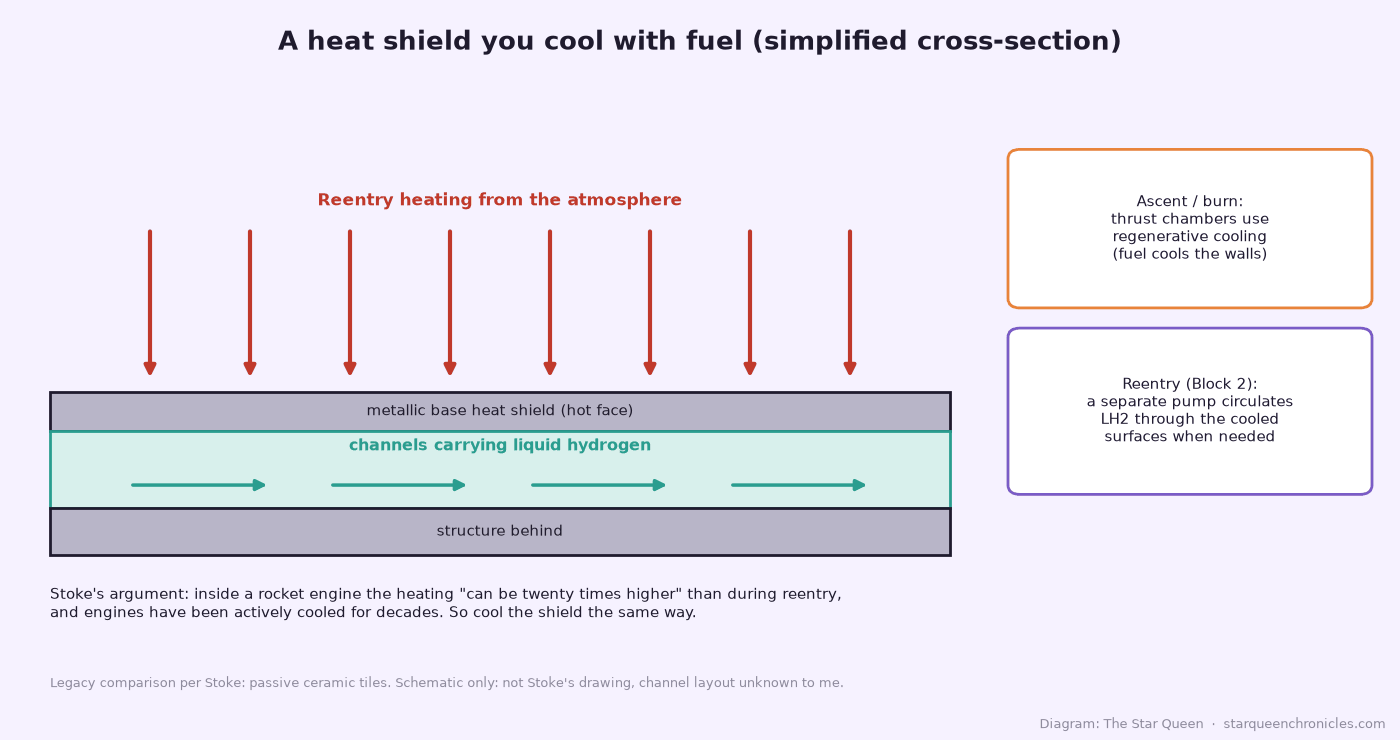
A reusable upper stage has to survive entering the atmosphere at orbital speed. The usual answer is a passive heat shield, like ceramic tiles. Stoke’s argument, from its September 2026 “Scaling Nova” post, is that tiles create many individual failure points that must be inspected and refurbished between flights, whereas the industry has for decades protected the inside of rocket engines by actively cooling a metal surface. Stoke says the heating inside a rocket engine can be 20 times higher than the heating of reentry. So it extends the same trick to the reentry shield.
Official: on Nova, thrust chambers are distributed around, and integrated into, an actively cooled metallic base heat shield. Liquid hydrogen, already on board as fuel, flows through the shield to absorb heat during reentry. The upper stage comes back base-first, which also keeps the sidewalls shaded from the worst heating. In February 2025 Stoke said that regenerative cooling lets the shield handle reentry and “be ready for the next flight without refurbishment.”
Everyday Astronaut’s 2023 explainer describes the logic as a self-regulating loop in its early design: reentry heat warms the hydrogen, which makes the expander-cycle pumps spin faster, which pumps more coolant. That is Reported and describes the early design, so I treat it as an intuition, not a spec.
Why So Many Little Chambers?
A ring of small chambers does several jobs at once, and Stoke has spelled out most of them:
- It fits the heat shield. With the nozzles embedded around the outer edge of a continuously curved base, there is no big bell to protect or to throw away.
- It steers without gimbals. Stoke says Andromeda uses precise differential throttling, first demonstrated on its Hopper test vehicle in 2023, to control the vehicle with independently throttled chambers. Everyday Astronaut’s early explanation adds that gimbaling needed ceramic seals that seemed unreliable over many cycles.
- It makes hot staging easy. Stoke says that while attached to Stage 1, Andromeda’s thrusters sit outboard of Stage 1’s outer diameter. That lets the upper stage light before separating without a heavy one-use interstage shield or separation pushers, and Stoke says that cuts gravity losses.
- It is serviceable. The February 2025 post says the engine can be serviced or even replaced within hours or minutes.
Everyday Astronaut also reports that Stoke’s early engine used pintle injectors to allow deep throttling and a consistent mixture ratio, and that engine shutdown has to be simultaneous around the ring so no side keeps pushing and twists the stage. That is the 2023 design, so I am not promising that it is the same today.
How the Design Has Changed
The chamber count is a nice story, and the Stoke posts let me trace it. Reported (EA, Feb 2023): the early test engine had 15 chambers, with a long-term plan for 30. Official (Feb 13, 2025): Andromeda 1 had proved the concept on the Hopper flight, and Andromeda 2 reduced the number of thrusters from 30 to 24 while making each one bigger, simplifying flow circuits, saving weight and improving injector performance. The vacuum and sea-level nozzle modes arrived with Andromeda 2, and so did a continuously curved base that Stoke says lets it test chamber ignition in vacuum conditions on the ground.
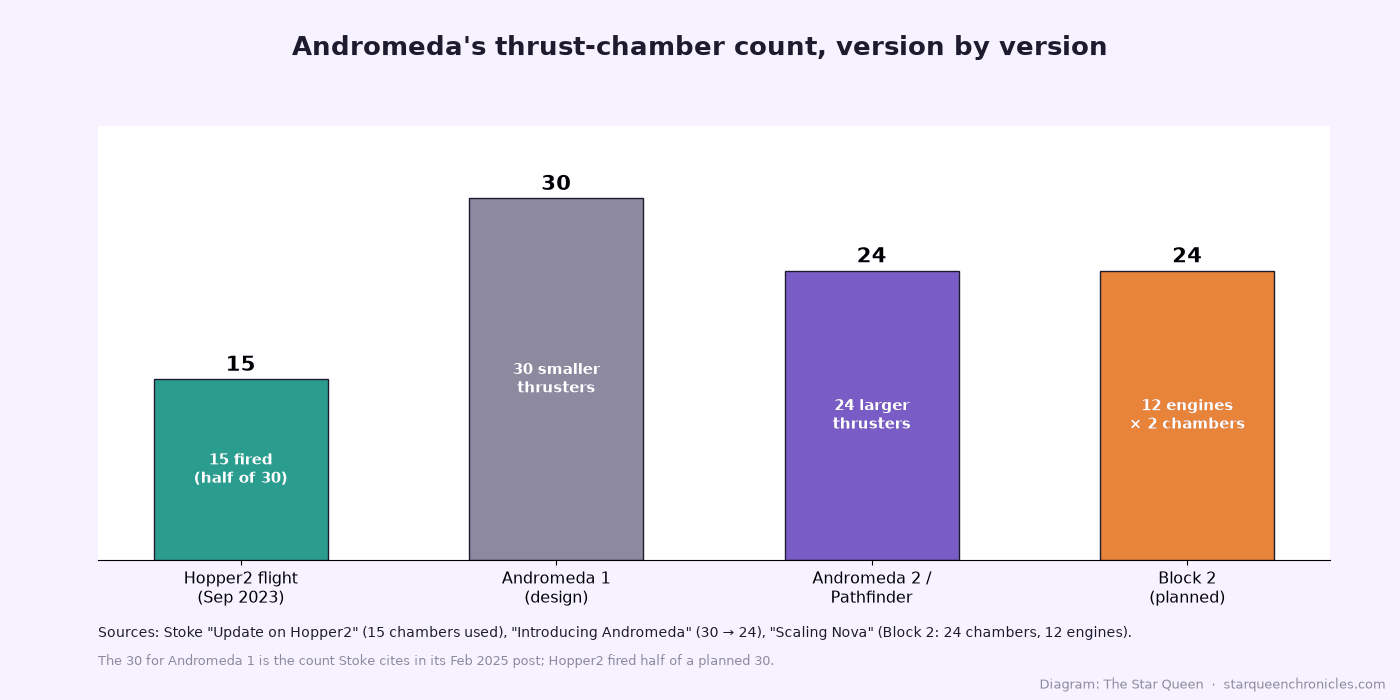
Official (Sep 2026): Block 2’s Andromeda keeps 24 hydrogen chambers around the shield but changes the guts. Instead of one common set of turbopumps feeding everything through the shield, Block 2 uses 12 independent engines, each with two thrust chambers and its own turbomachinery. Stoke’s stated reasons: it lets thrust scale by more than a factor of five without scaling the turbomachinery, and if one engine fails, the vehicle can shut it down and continue on the rest, which Stoke notes is unusual for an upper stage. It also eases start and shutdown transients, and a separate reentry pump circulates hydrogen through the cooled surfaces, so propulsion and cooling can each be designed for their own conditions.
Stoke says the distributed layout also lets it close the hydrogen expander cycle, raising Isp above 440 s, and that Nova can deliver more than 4 metric tons to geosynchronous transfer orbit. My reading: Pathfinder’s Isp of 400+ s fits with an open expander (EA’s 2023 phrase was “expander bleed cycle”), and the Block 2 step to 440+ s is the payoff for closing it. Stoke does not say this in so many words, so it is an inference.
One naming wrinkle: NASASpaceFlight calls the Pathfinder engine “Andromeda 2” and says it is capable of unlimited in-space restarts, while Stoke’s newest post says “Andromeda Block 2” for the Block 2 version. They are different engines, so be careful with the numbers.
A tour of Stoke’s Kent factory and test site, recorded in 2022. Third-party, and an early view of the design, so the details have moved on (including the chamber count). If the player does not load, watch “How Stoke Space’s Unique Rocket Works // Exclusive Tour & Interview” by Everyday Astronaut on YouTube.
About That “Aerospike” Label
You will see Andromeda called an aerospike. Everyday Astronaut’s 2023 article says Stoke’s choice of an engine that “makes use of the aerospike effect” was driven by burying the engine in the heat shield. I could not find Stoke using that word in its own posts, which describe a ring of thrust chambers in an actively cooled heat shield. A classic aerospike has a central spike for the exhaust to expand against. Commenters under that article argued the heat shield plays the spike’s role, pointing to a Stoke patent; I have not read the patent, so I cannot judge. Either way, the word is an outside characterization, not Stoke’s, and I keep it out of the specs.
Where Andromeda Flies
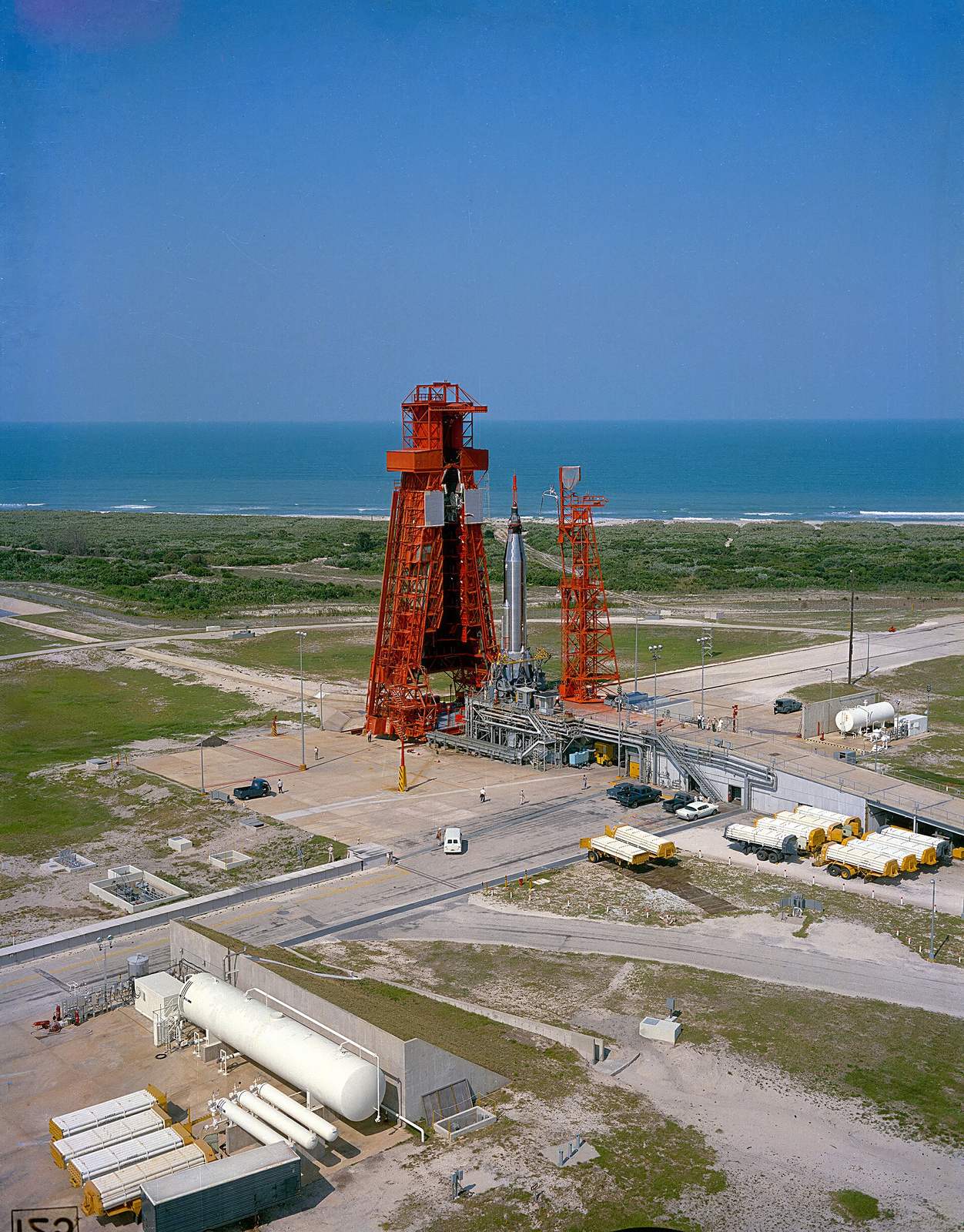
Nova launches from Space Launch Complex 14 at Cape Canaveral. The pad dates to the early 1960s, when it launched Friendship 7. For the status of Nova Pathfinder (first flight targeted for early 2027) and what is built, see my Pathfinder post; for the bigger vehicle, see Nova Block 2.
Where My Sources Disagree
- Cycle: “expander” (Nova page) versus “closed expander” (Block 2 post), plus EA’s “expander bleed cycle” for the early design. Different versions, not necessarily a contradiction.
- Naming: “Andromeda 2” (Stoke’s February 2025 post, NASASpaceFlight) versus plain “Andromeda” (Nova page) and “Andromeda Block 2” (September 2026).
- Pathfinder payload and size: 2,500 kg (Stoke’s page) versus 3,000 kg (NASASpaceFlight and Ars); diameter 4.2 m (NASASpaceFlight, 2026) versus about 4 m (Everyday Astronaut, 2023).
- Chamber counts: 15, 30, 24: these describe different versions in different years. I trace them rather than pick one.
- Printing and material: the chambers are described as printed by outside reports; I did not find Stoke naming the material.
- Not public: the heat shield’s alloy, coolant mass flow, the Block 2 thrust figure, and any reentry flight data. No Andromeda has flown to orbit, and the shield has not returned from orbital speed.
The Star Queen’s Take 👑
Andromeda is the part of Nova I would pay to see in a lab. It is a bold bet that actively cooling a metal shield with fuel you were already carrying is simpler than tiles, and the design keeps evolving: more engines, each with its own pumps, so one failure does not end the mission. I like that Stoke explains its reasoning in public, including what changed and why. What I do not know yet is whether the shield survives real orbital reentry, repeatedly, and that is the question the flight data will answer. Until then, I will enjoy the ring of fire in the diagrams. ✨
Related Reading
Sources
- Introducing Andromeda, our rapidly reusable high-performance upper-stage rocket engine — Stoke Space, Feb 13, 2025
- Scaling Nova — Stoke Space, Sep 8, 2026
- Nova Pathfinder — Stoke Space product page (undated)
- Nova Block 2 — Stoke Space product page (undated)
- Update on Hopper2: The Hopper Has Landed — Stoke Space, Sep 18, 2023
- Stoke Space completes Nova Stage 1 structural verification — NASASpaceFlight, Jun 10, 2026
- Full Reusability By Stoke Space — Everyday Astronaut, Feb 4, 2023
- How Stoke Space’s Unique Rocket Works // Exclusive Tour & Interview — Everyday Astronaut, YouTube
- Does anyone actually want to win the medium-lift race in the United States? — Ars Technica, Oct 20, 2026
- Aerial View of Launch Complex 14 (GPN-2000-000609) — NASA, May 7, 1963, via Wikimedia Commons
