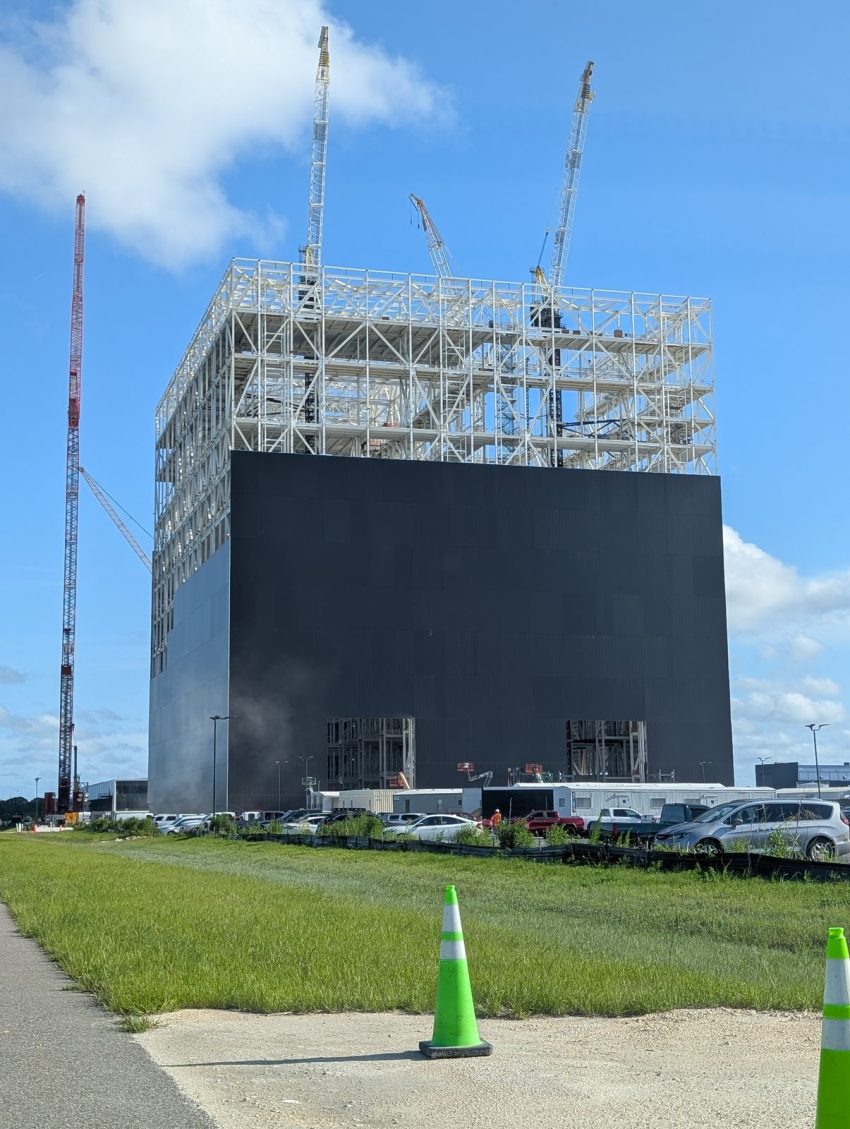
Hello, stargazers! 🚀 Welcome to my Gigabay Progress Report for May. This month I got two drive-by chances at the SpaceX Gigabay at Kennedy Space Center: May 8 and May 20. My last report was based on photos from April 2, 11 and 27, so these sets come 11 and 23 days after my last April photos (Apr 27). What impressed me most? The black wall keeps climbing. On the north side it now covers about two-thirds of what I can see of the building, by eye, where in April it was a bit under half. 🖤🏗️
A reminder: I took every one of these as I drove by. I didn’t stop, so my angles change from photo to photo. I’m always grateful for the chances I get. I’ll show you what I can actually see, say “appears” when I’m not sure, and add the proper construction words so we can all learn together. 🌟
How I take these
The road I drive runs north and south, and the Gigabay sits on its west side. That means it’s on my left when I drive north and on my right when I drive south, and I’m always looking west at it. Some shots go through the windshield and some out the side window, so my sets never line up perfectly. I’ll use “left end” and “right end” of the building as I see it in each photo. This month: my May 8 photos were taken in the late afternoon (about 4:40 to 4:41 PM by my phone’s clock) and my May 20 photos a little later (about 5:43 PM). The sky was clear blue on May 8 (a bit hazy in the look-up shot) and blue with big white clouds on May 20. Every photo this month shows the north side, the side with the two garage-door-style openings. I didn’t get a view of the south side, where the huge bay doors will be.
Where we left off in April
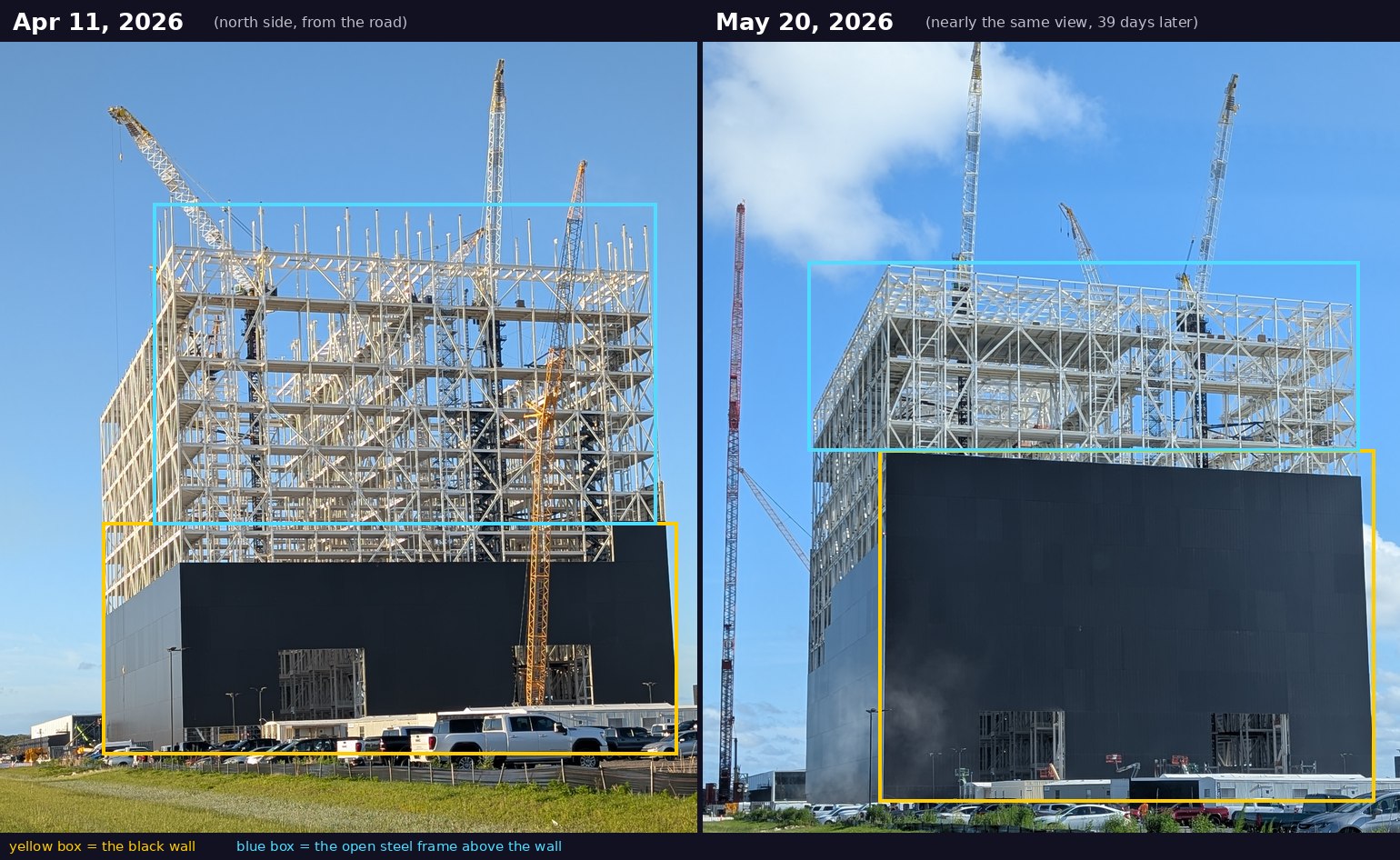
In my April report the big news was that the black wall had started to climb. (My March, February and January reports show how it got there.) The last time I got a clear, wide look at the north side was Apr 11, so that’s the day I’m comparing against:
- Wall. On the north side, a black wall over the bottom of the frame, a bit under half of the building’s visible height by eye, with a block at the right end that stood a bit taller than the rest.
- Openings. Two garage-door-style openings at the base, with white steel visible inside.
- Steel above. Several levels of open white steel above the wall, with a whole row of white posts sticking up along the top edge.
- Cranes. Several cranes, with an orange one standing in front of the right-hand opening. (I know nothing about cranes, only that there are some in the pics.)
- South end. Tall black panels with wide gaps between them (Apr 27). I didn’t get that end this month.
For an outside check: NASASpaceflight (NSF) reported on Apr 23 that the siding was going up with progress every day, and Florida Today wrote on May 9 that the black siding is easy to see from across the Indian River in Titusville and that completion is expected by August 2026. That fits my photos. SpaceX says the finished building will stand 380 feet tall.
May 8 snapshot
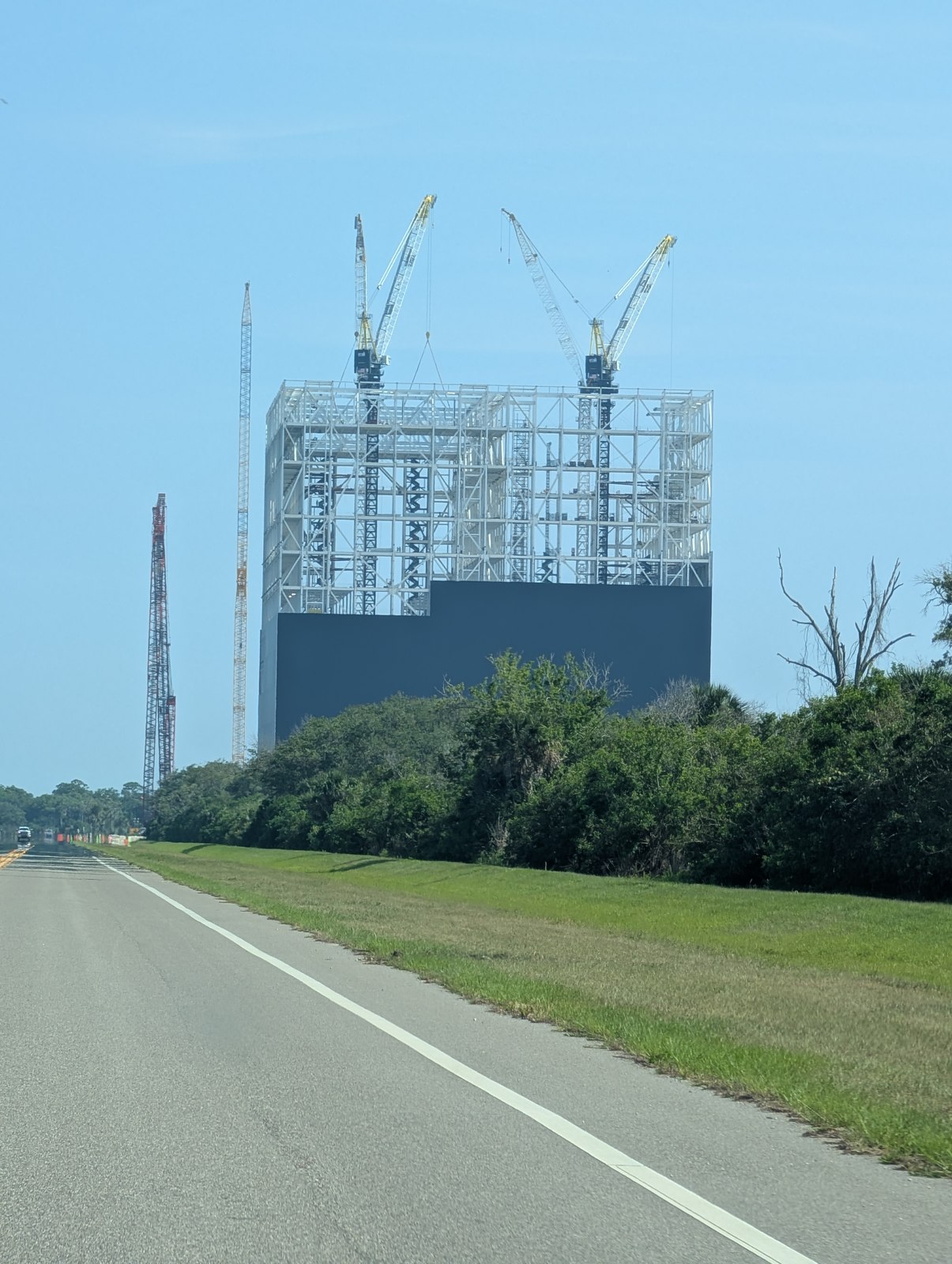
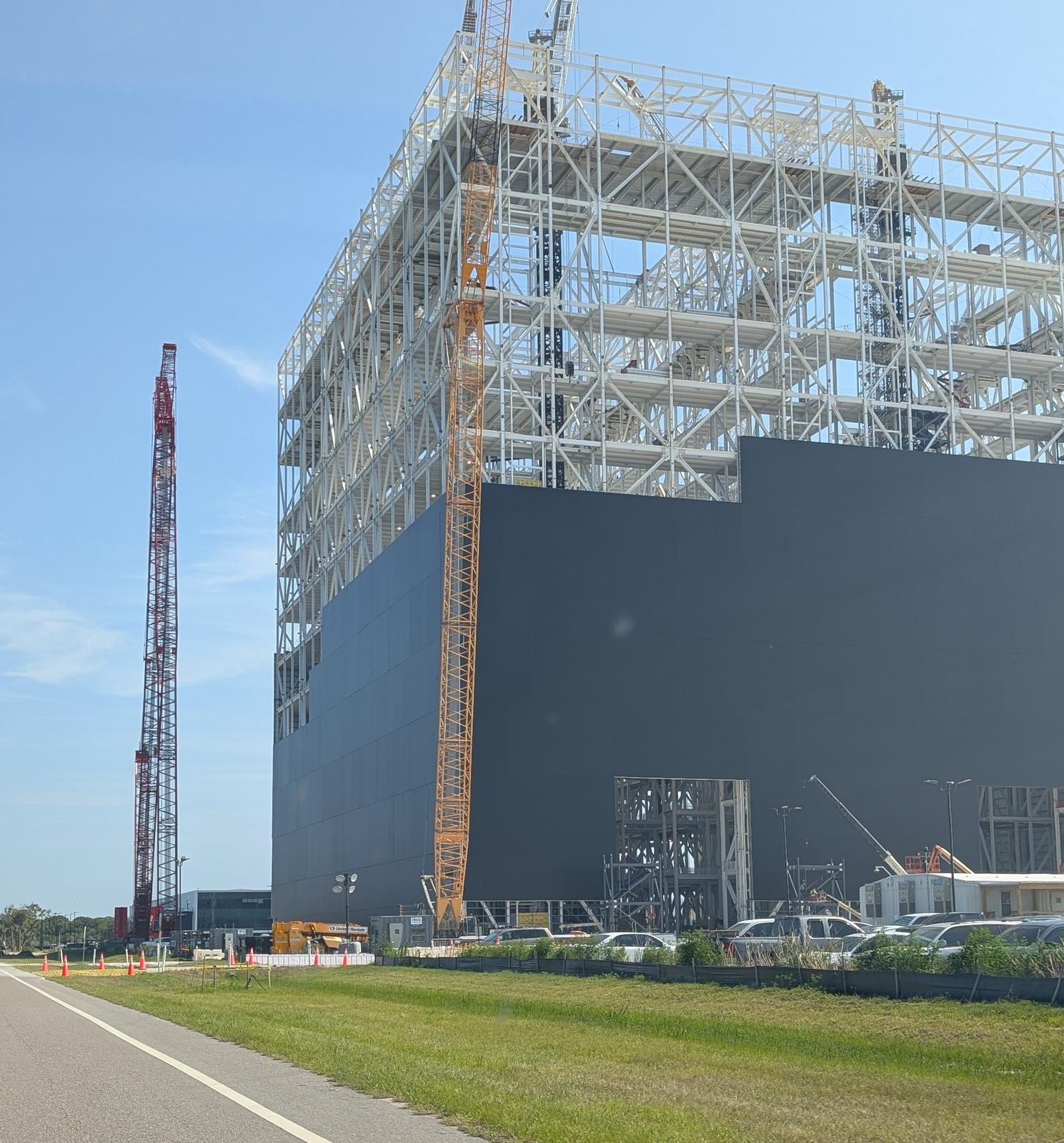
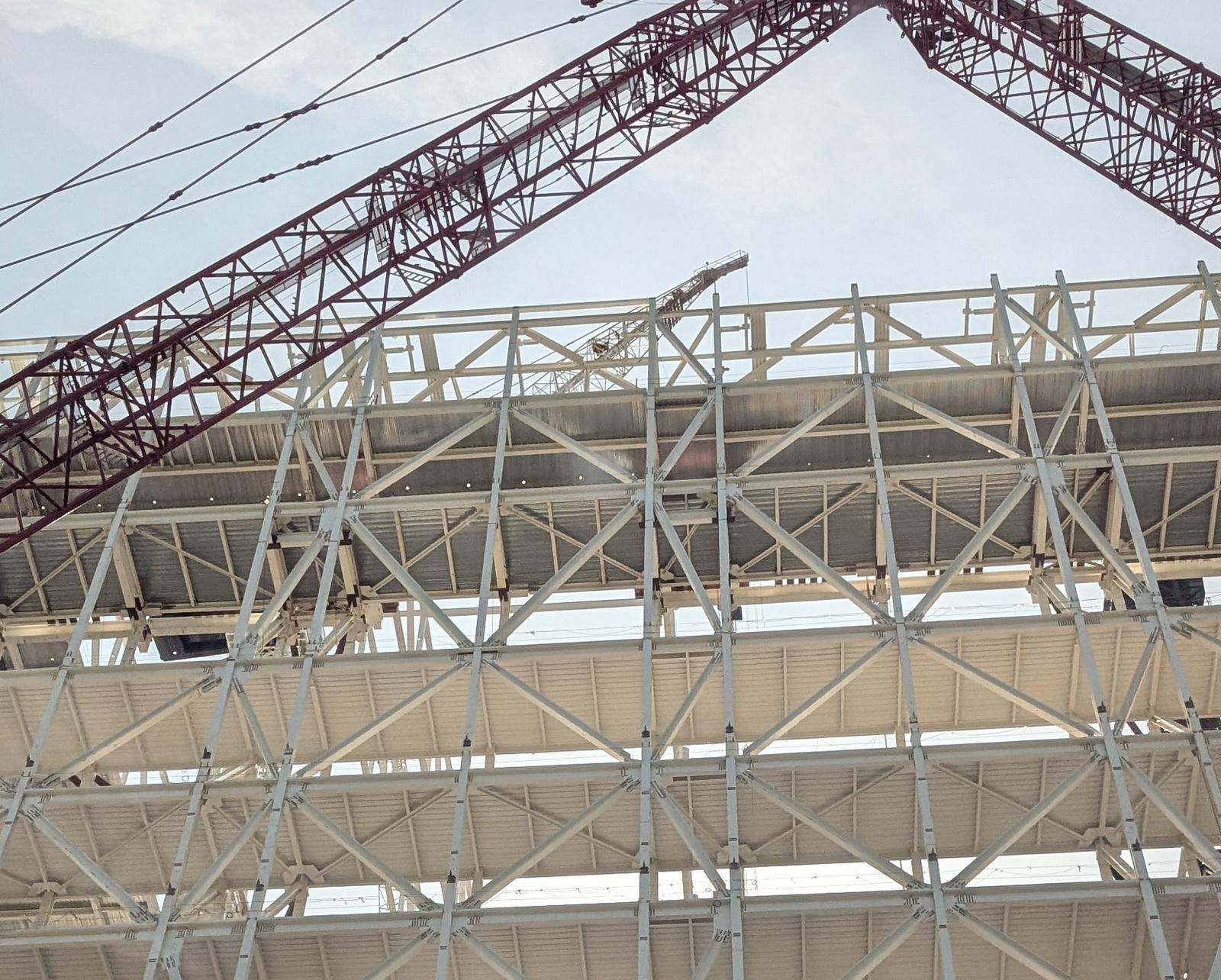
Three photos from the late afternoon of May 8 (4:40 and 4:41 PM by my phone’s clock), 11 days after my last April photos. The first is a long look up the road, the second is close to the wall, and the third is looking straight up into the steel.
May 20 snapshot
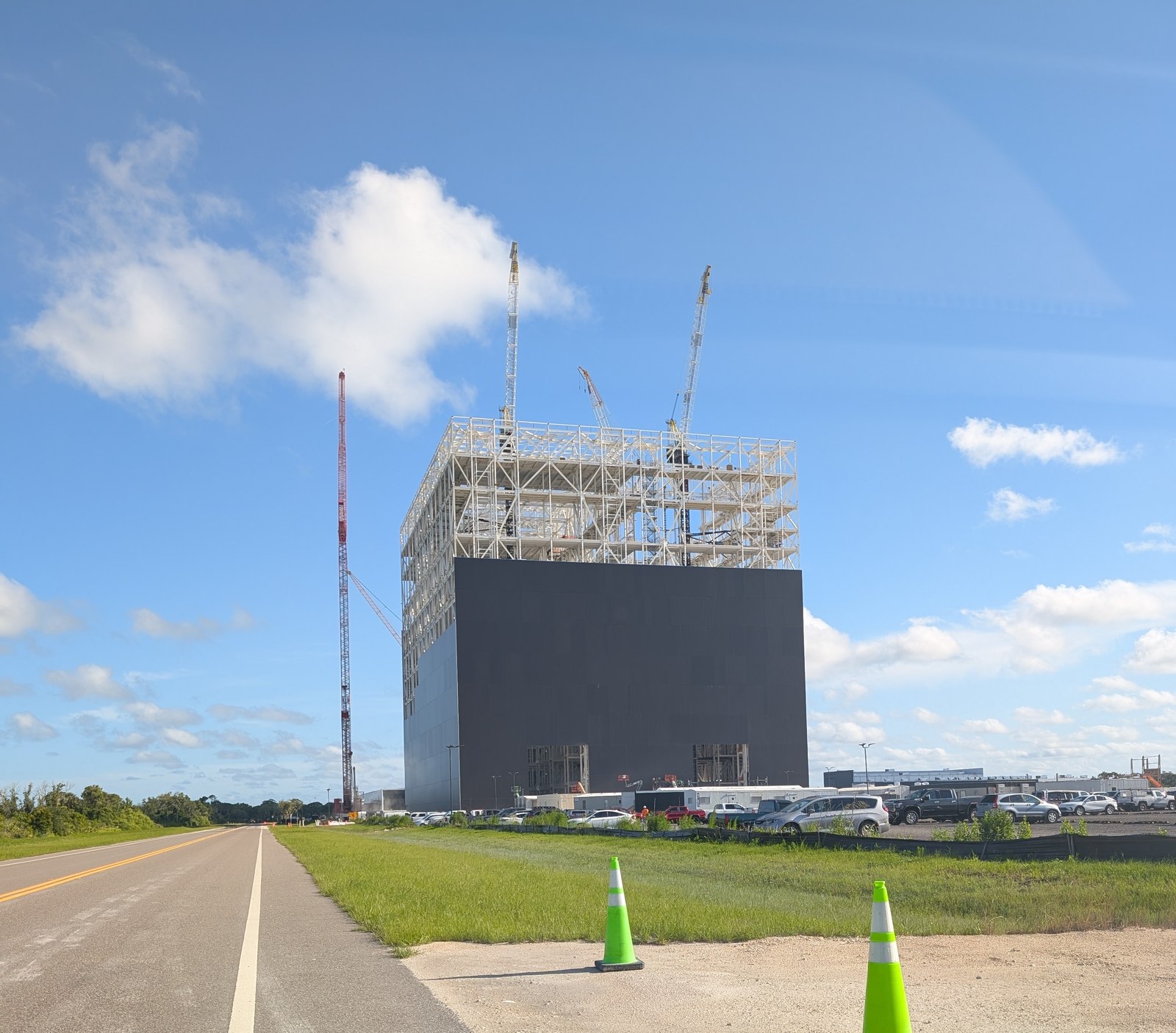
Two photos from May 20 (both at about 5:43 PM by my phone’s clock), 23 days after my last April photos and 12 days after May 8, under a blue sky with big white clouds. Both show the north side, and the wall is much bigger than it was on May 8.
Header photo: May 20 – the north side up close, the second of the day (5:43 PM). This is the photo at the top of the post. Look for: the black wall, now a big flat block covering most of the face under the open steel; the two garage-door-style openings at the base with white steel inside; the lighter gray wall at the left end; the yellow ones and other cranes behind the frame; a tall red crane at the left; white trailers and parked vehicles along the base; and two bright green cones, one cut off at the right edge. I don’t see door panels in the openings.
What changed since April
- The wall keeps climbing. This is the biggest change. On Apr 11 the black wall on the north side was a bit under half of the building’s visible height, by eye. By May 20 it looks like about two-thirds (the comparison above, and the May 20 photos). It goes on in horizontal rows called courses, from the bottom up, and I can’t tell you how many rows were added between my visits, because my angles don’t match exactly.
- The top of the wall has evened out. On May 8 the top edge of the wall had a step, with the right part standing higher than the left (May 8 wide and close photos), like in April. By May 20 the top edge looks level all the way across the face.
- Less open steel above the wall. Because the wall is taller, the band of bare steel above it is much shorter than in April, though I still see several levels of white steel, with gray metal deck and diagonal braces (May 8 look-up photo and May 20 photos). The row of white posts that stuck up along the top edge in April is not sticking up on May 20. The top edge looks flat, with long horizontal steel. NSF said on Apr 23 that the main steel truss had reached its maximum height, and I can’t tell from the road whether the steel has topped out or what is on the roof.
- The two openings are still there. The two garage-door-style openings at the base look much as they did in April, with white steel visible inside (May 8 close photo, May 20 photos). I don’t see door panels in them. I can’t see inside, so I can’t say whether doors are in.
- The lighter gray end wall. The wall at the left end is still a lighter gray than the black one. Its top edge stops lower than the black wall, and open steel shows above it (May 8 close photo, May 20 photos).
- Wind and the wall. The bigger the wall gets, the more wind it catches. Engineers call that wind load. The frame and its diagonal braces have to carry that push down to the foundation, so I’m not surprised to see so much bracing in the look-up photo.
- Cranes. I know nothing about cranes, only that there are some in the pics. I see several in most of my shots, a handful at a time, and some hide behind others, so treat that as a rough count. I can’t tell you what kinds they are or what they’re doing. If it helps you find your way around the photos, the yellow ones stand on top of the frame, there’s a tall red one at the left in most of them, and an orange one stands at the left corner of the wall on May 8 (the close photo). The orange one that stood in front of the right-hand opening on Apr 11 isn’t in my May 20 photos, but my angle is different, so I can’t say where it went.
- Ground work. I see white trailers and parked trucks along the base, orange cones along the road on May 8, and on May 20 two green cones, a big parking area full of vehicles at the right and a gravel patch by the road. Some of this was there in April, so I can’t say what’s new, and I can’t see the far side or the inside.
Terms to know ✨
- Siding course: one horizontal row of wall panels. Siding goes on one row at a time, usually from the bottom up, so the wall grows taller after each visit.
- Wind load: the sideways push wind puts on a building. A wall acts a bit like a sail, so the more wall goes on, the more the frame and its diagonal braces have to hold the building steady and carry that push down to the foundation.
- Chord and web: the two long edges of a truss are called chords, and the diagonal pieces zig-zagging between them are the web. Together they make the triangle pattern that you see in the steel.
- Building envelope: everything that wraps the building, which means the walls, roof and doors. When the envelope is closed enough to keep the rain out, builders call it “dried in,” and the inside work can speed up. The Gigabay isn’t dried in yet as far as I can tell.
- Job trailer: a trailer that crews use as an office or a break room. I think the white trailers along the base are job trailers, but I’m not certain.
What impressed me most
That wall. In April I was excited that the black wall had started to climb, and in 39 days the north face turned into a huge flat block of black with the steel poking out above it. And the look-up shot on May 8 reminded me how much steel is holding it all up. Even with so much still to do, SpaceX wastes no time. 🚀
What I’m watching next
- More wall. Siding keeps going up row by row from the bottom. I’ll watch whether the lighter gray wall at the left end climbs to match the black one, and how much open steel is left above it.
- The top of the building. I can’t see the roof from the road, but I’ll watch for anything new along the top edge. Closing in the walls and the roof is what builders call the building envelope. SpaceX says the finished Gigabay will stand 380 feet tall.
- The garage-door-style openings. I’ll keep looking for any change at them, such as door panels or door frames.
- The south side’s large bay doors. These are where the ship will enter. I didn’t get that end this month, so I’ll try to catch it next time and see what changed since the tall panels and wide gaps I showed in April.
- Overhead cranes inside. SpaceX says the Gigabay will have huge overhead cranes of up to 400 US tons, running on rails high inside. NSF says brackets for the crane rails are at about the 315-foot level. I can’t see them from the road, but I’ll keep looking.
- The cranes outside. I still know nothing about them, but I’ll keep noting how many are in the pics.
I’ll keep snapping photos every few weeks as I drive by. Look out for the next report!
Sources
- SpaceX, “Future of Building Starship” (Mar 3, 2025): 380 ft building, 24 work cells, overhead cranes up to 400 US tons. spacex.com/updates
- NASASpaceflight, Apr 23, 2026 (primary steel truss at maximum height, siding progress every day, crane-rail tabs at about 315 ft): article
- Florida Today, May 9, 2026 (black siding visible from Titusville, completion expected by August 2026): article
All photos by The Star Queen, taken from the road at Kennedy Space Center. Photos are not official and are not affiliated with SpaceX or NASA.
Thank you for stargazing with me. Until next time, keep looking up (and sideways, at the cranes). ✨