By The Star Queen
My loves, here is one of the strangest partnerships in spaceflight history. 🌍 For more than two decades, one of America’s most reliable rockets flew on a Russian-designed, Russian-built engine. It survived the end of the Cold War, the annexation of Crimea and a full-scale war, and, per Wikipedia, its only blemish was a single non-critical failure in 2016. As of October 26, 2026, Atlas V has flown its last non-Starliner mission, and six rockets are left. Let’s open up the RD-180.
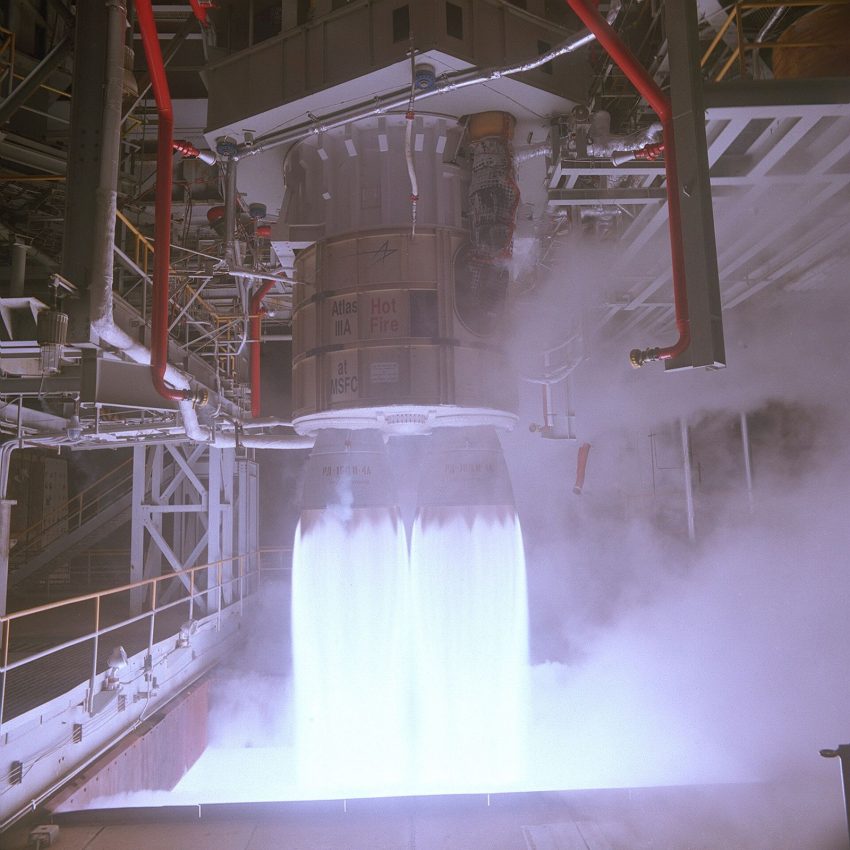
An RD-180 hot-fire test at NASA’s Marshall Space Flight Center on November 4, 1998, years before the engine’s first launch. Image: NASA/MSFC (image ID MSFC-9808476), public domain, via Wikimedia Commons.

The Short Version
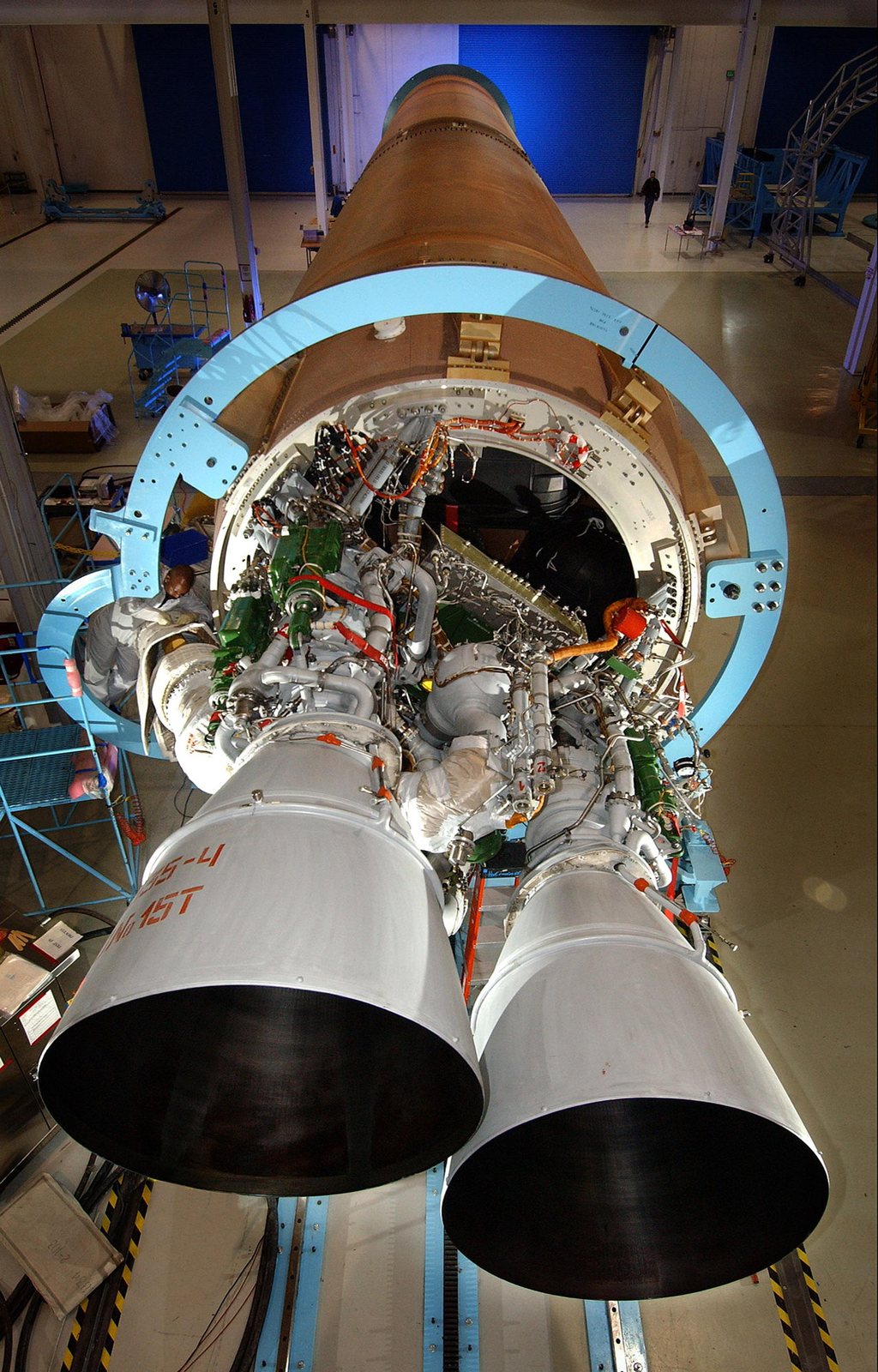
- What it is: a kerosene (RP-1) and liquid oxygen engine with two combustion chambers and two nozzles fed by a single turbopump, using oxygen-rich staged combustion (Wikipedia).
- Who built it: NPO Energomash in Russia, derived from the RD-170 that powered the Soviet Energia rocket’s strap-on boosters.
- Where it flew: Atlas III (six flights) and Atlas V (110 flights through July 2, 2026) and nothing else (Wikipedia; Ars Technica).
- What replaced it: Blue Origin’s BE-4 on ULA’s Vulcan, covered in my Vulcan Centaur explainer.
Terms to know ✨
- Staged combustion: a design where some propellant burns first in a preburner to spin a turbine, and then all that gas goes into the main chamber, so nothing is wasted.
- Oxygen-rich: the preburner burns all of the oxygen with only a little fuel, so the turbine gas is mostly hot oxygen.
- RP-1: a highly refined kerosene used as rocket fuel.
- Energomash: NPO Energomash, the Russian company that builds the RD-180.
- Atlas III and Atlas V: two generations of ULA and Lockheed Martin Atlas rockets. Both used the RD-180.
- Throttling: running an engine at less than full thrust. The RD-180 can run from 47 to 100%.
- Starliner: Boeing’s crew capsule, which still needs the last Atlas Vs to fly.
The Numbers
| Spec | Value | Source |
|---|---|---|
| Propellants | RP-1 (kerosene) + liquid oxygen | Wikipedia; ULA |
| Cycle | Oxygen-rich staged combustion, 2 chambers, 2 nozzles, 1 turbopump unit | Wikipedia |
| Thrust, sea level | 3,830 kN (about 861,000 lbf, my conversion). ULA says “more than 860,000 pounds” at liftoff | Wikipedia; ULA |
| Thrust, vacuum | 4,150 kN (about 933,000 lbf, my conversion) | Wikipedia |
| Specific impulse | 311 s at sea level; 338 s in vacuum | Wikipedia |
| Chamber pressure | 26.7 MPa (about 3,870 psi, my conversion) | Wikipedia |
| Throttle range | 47 to 100% | Wikipedia |
| Mixture ratio | 2.72 (oxygen to fuel, by mass) | Wikipedia |
| Dry mass | About 5,480 kg (about 12,080 lb, my conversion) | Wikipedia |
| Size | About 3.56 m long, 3.15 m wide | Wikipedia |
| Burn time | About 270 s | Wikipedia |
| Price (2014, to ULA) | $23.4 million each | Wikipedia (an old figure; I haven’t found a current price) |
Compare that chamber pressure with the BE-4. Wikipedia lists the BE-4’s at about 140 bar, which is 14 MPa, roughly half of the RD-180’s 26.7 MPa. I flagged that BE-4 figure as unofficial in my BE-4 post, so treat the comparison as approximate. But it fits Blue Origin’s description of the BE-4 as a “medium-performing version of a high-performance architecture,” while the RD-180 is a Russian design that runs at very high pressure. One more rough comparison, from my own arithmetic: the RD-180 packs about 861,000 lbf into about 12,080 lb of engine, while the BE-4’s roughly 550,000 to 640,000 lbf comes with an unofficial dry mass of about 11,900 lb. So the Russian engine is the more compact, higher-strung design, and the BE-4 is the larger, gentler one. 🌟
How It Works: Oxygen-Rich Staged Combustion
The RD-180 is one of the best-known examples of oxygen-rich staged combustion. As I explained in my BE-4 post, in this cycle the preburner burns the oxygen with a small amount of fuel, and the hot, oxygen-heavy gas drives the turbine and then flows into the main chambers, where it meets the rest of the kerosene. This gives a lot of power for the weight. Wikipedia notes that the arrangement is unlike “typical fuel-rich US designs.”
The price is that the hot, high-pressure gaseous oxygen can corrode or ignite bare metal. According to Wikipedia, the RD-180 solves this with an inert enamel coating on all metal surfaces in contact with the hot oxygen. If you want a refresher on the cycle diagram, see the staged combustion diagram in my BE-4 post. Two other design notes:
- Two chambers, one turbopump. The RD-180 shares one turbopump unit between its two chambers, like its four-chambered parent, the RD-170 (Wikipedia).
- Steering by gimbal. Four hydraulic actuators move the nozzles (Wikipedia).

Why Did an American Rocket Use a Russian Engine?
It comes from the early 1990s. According to Wikipedia, General Dynamics Space Systems (later bought by Lockheed Martin) acquired rights to use the engine for the Evolved Expendable Launch Vehicle program and the Atlas line. The engine was sold through a joint venture between NPO Energomash and Pratt & Whitney called RD Amross. A plan existed for Pratt & Whitney to build the engine in the United States, but all production stayed in Russia.
The roots go further back. The RD-170 was a four-chamber engine for the Soviet Energia launch vehicle, whose strap-on boosters helped launch the Buran orbiter. Engineers made the RD-180 by scaling it to two chambers, with half-size turbomachinery (Wikipedia). After a successful test and government agreements, engines were imported for Lockheed Martin’s Atlas III, which flew from 2000 to 2005, and then Atlas V from 2002. The RD-180’s first launch was May 24, 2000.
And it worked. Wikipedia says the engine flew on all six Atlas III flights and 110 Atlas V flights, with a single non-critical failure in March 2016. Ars Technica calls the Atlas V’s career “near-flawless” (as quoted in my Atlas V final chapter post).
🎬 Rocket engine cycles: How do you power a rocket engine? (Everyday Astronaut). A friendly explainer of engine cycles, including the staged-combustion family the RD-180 belongs to. I did not find an official RD-180 video that I could verify, so this general explainer is the one I’m embedding. Watch on YouTube
When Politics Met Plumbing
Russia’s military intervention in Ukraine in March 2014 changed the picture. Wikipedia reports that on May 13, 2014, Russian Deputy Prime Minister Dmitry Rogozin announced that Russia would ban the United States from using Russian-made rocket engines for military launches. That caused a US scramble for alternatives:
- June 2014: Aerojet Rocketdyne proposed an all-new US kerosene engine called the AR1.
- September 2014: ULA announced a partnership with Blue Origin to develop the BE-4 (Wikipedia). At the time ULA expected the new rocket to fly no earlier than 2019. In reality, Vulcan’s first flight was in January 2024.
- 2014 to 2015: the Air Force looked at replacement options, and ULA studied building the RD-180 in the US under license, but that never happened. A Pentagon estimate said US production would take about $1 billion and five years.
- December 2015: ULA ordered more RD-180s after Congress lifted the ban, according to Wikipedia (the claim has a “citation needed” flag, so I’m treating it as less solid).
Then came February 24, 2022, Russia’s full-scale invasion of Ukraine. On March 2, 2022, Russia announced an end to all sales and support of the RD-180 to the United States (Wikipedia). The reason this didn’t ground Atlas V is that ULA had already bought enough engines. As Wikipedia quotes ULA CEO Tory Bruno in August 2021: “We took early delivery, if you will, with the RD-180, so I can end that relationship and not be dependent upon [Russia] because that’s what Congress asked us to do.”
Counting the Engines: How Many Are Left?
Here’s the best accounting I can make from public reporting:
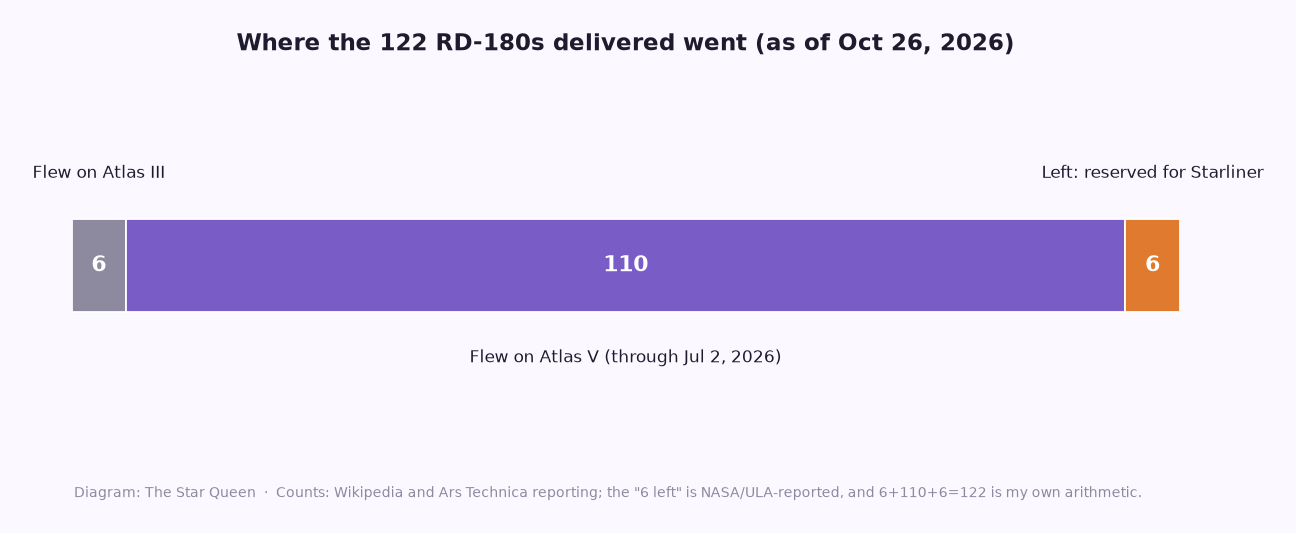
- 122 RD-180s were delivered by Energomash over more than 20 years, according to Wikipedia (as of April 14, 2021).
- 6 flew on Atlas III (Wikipedia).
- 110 have flown on Atlas V through July 2, 2026 (Wikipedia and Ars Technica; July 2 was the 110th flight).
- 6 Atlas Vs remain, all reserved for Boeing’s Starliner (Ars Technica, July 7, 2026).
That gives 6 + 110 + 6 = 122, which is my own arithmetic. It matches nicely, but I can’t be sure every engine ever delivered was counted that way. Some engines may have been used for ground testing, for example, so treat this as a consistency check, not an official inventory.
A conflict to flag: Wikipedia’s RD-180 article still says “as of June 2024, 16 launches remain.” That is out of date. Since then Atlas V has flown many more launches, and Ars Technica says six are left. I’m using the newer count.
Atlas V’s Last Chapter
The last non-Starliner Atlas V flew on July 2, 2026, carrying 29 Amazon Leo satellites into orbit. It was the 110th Atlas V and the last one to fly with a payload fairing. What’s left is Starliner. NASA said on September 28, 2026, that it plans to exercise options for fifth and sixth Starliner flights, and an uncrewed Starliner-1 “has the potential to fly in December of this year or January 2027” (via my Atlas V post). Ars Technica calls the final Atlas V flight “still several years off.” So the RD-180 will go out slowly, one Starliner flight at a time.

The Star Queen’s Take 👑
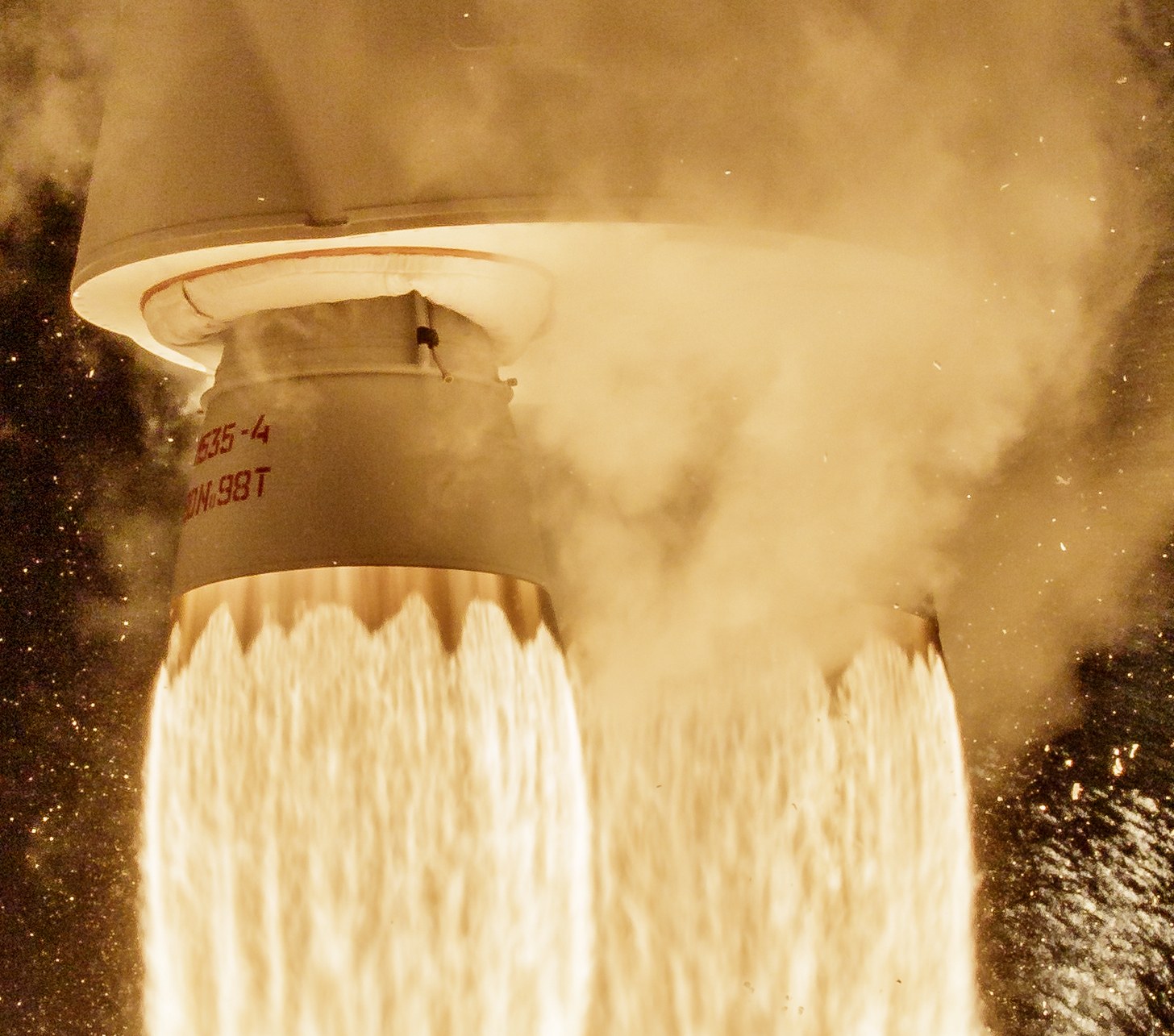
I admire the RD-180 because it is a piece of engineering that outlived the politics around it. It also shows why Blue Origin’s BE-4 matters: the United States didn’t just want a good engine, it wanted one it could keep making. 💜 The BE-4 is a different design, and it has had its own delays and a 2026 valve problem (see my BE-4 post), but it is American. If you want a final thought: the RD-180 had a nearly perfect record, and that is what the BE-4 now has to match. I’d be sad to see the last Atlas V fly, and happy that it will take people to space when it does. 🌌
Sources
- Wikipedia, RD-180
- ULA, Atlas V
- Ars Technica, After a stellar career, ULA’s Atlas V rocket’s last act is waiting on Starliner (Jul 7, 2026)
- NASA, Starliner update (Sep 28, 2026)
- NASA/MSFC image archive (via Wikimedia Commons): RD-180 test firing
- Everyday Astronaut, Rocket engine cycles
- Video: Everyday Astronaut on YouTube