By The Star Queen
My loves, imagine an engine that was first test-fired in 1959, flew its first successful mission in 1963, helped send Voyager 1 and 2 on their way, and is still being built in a brand-new 3D-printed version today. 🤩 That’s the RL10, the hydrogen engine that sits at the top of ULA’s Vulcan and Atlas V rockets, one of the most trusted engines in spaceflight. Everything below is as of October 26, 2026.
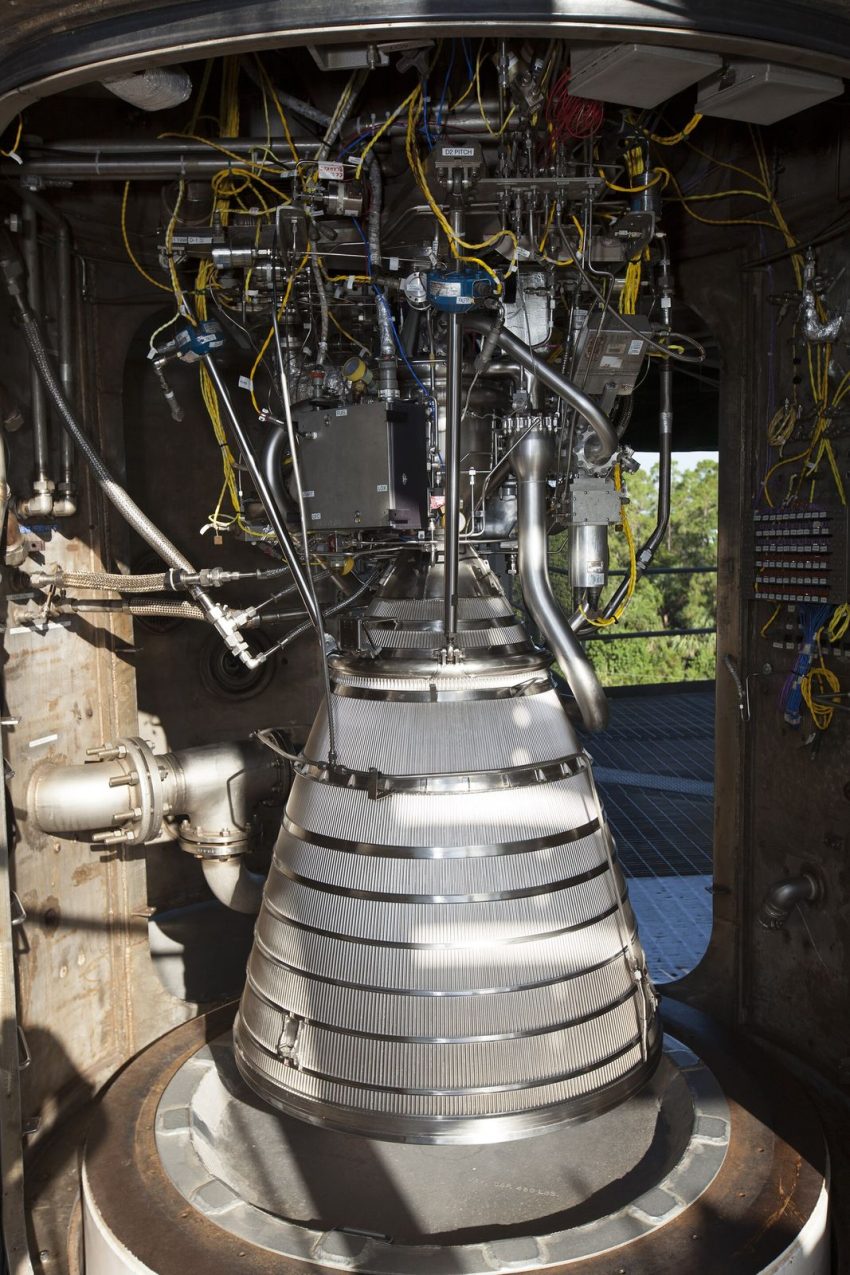
An RL10 engine standing in a vacuum chamber at Aerojet Rocketdyne’s West Palm Beach test stand in August 2016, being prepared for a Starliner crew flight test. Image: NASA, public domain, via Wikimedia Commons.

The Short Version
- What it is: a liquid hydrogen and liquid oxygen engine using a closed expander cycle.
- Where it flies: two RL10s power Vulcan’s Centaur V upper stage. A single one powered the Interim Cryogenic Propulsion Stage (ICPS) on the first two SLS missions, per the maker’s datasheet.
- Who makes it: the RL10 began at Pratt & Whitney. It later passed to Aerojet Rocketdyne, then to L3Harris when it bought Aerojet Rocketdyne in 2023. On August 4, 2026, AE Industrial Partners completed a purchase of L3Harris’s space propulsion unit, which relaunched as an independent company named Rocketdyne, with AE Industrial holding 60% and L3Harris keeping 40% (SpaceNews; L3Harris). So the RL10 maker’s name has come full circle.
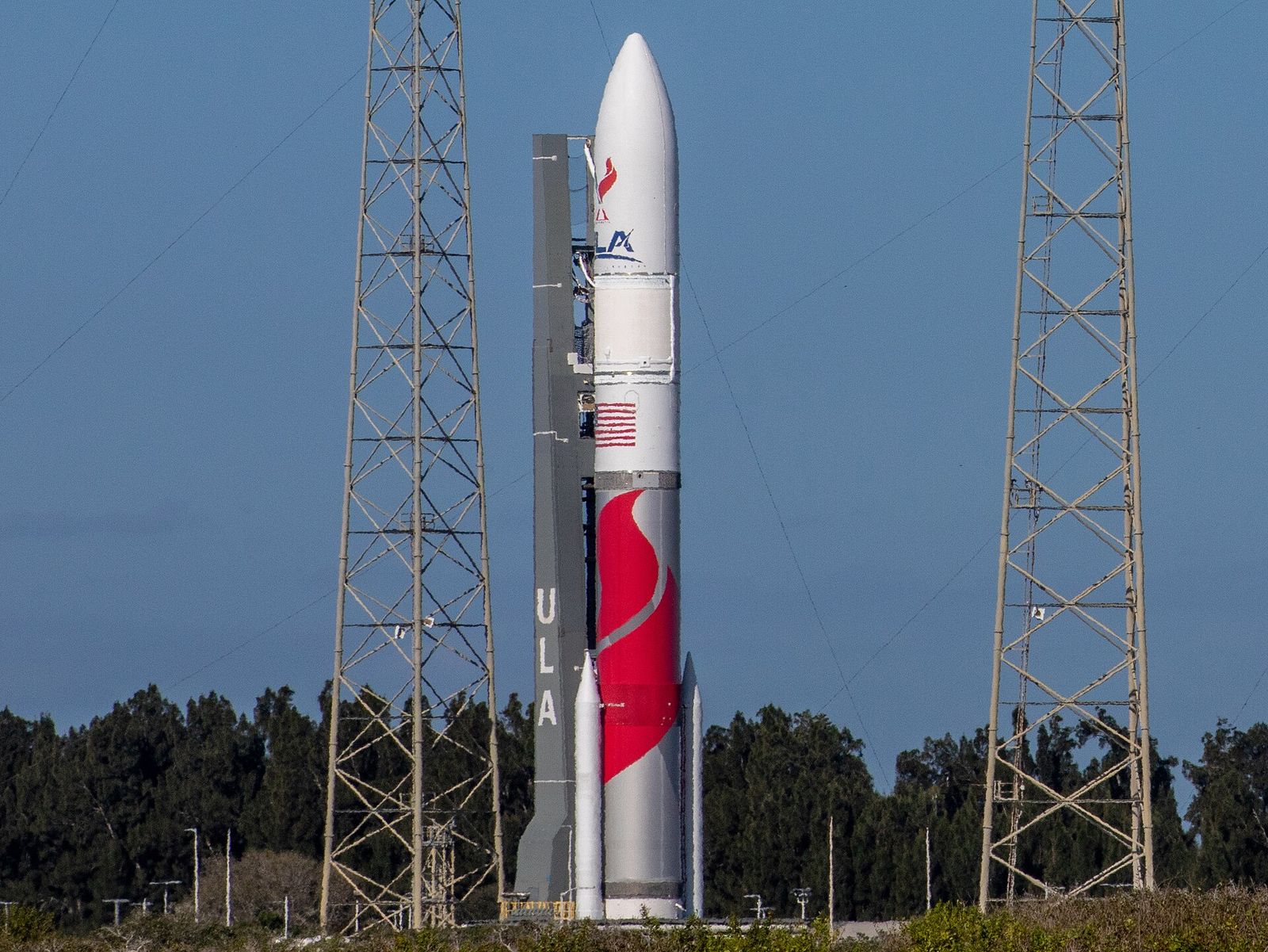
- How it ties to my other posts: Centaur V’s role is in my Vulcan Centaur explainer; the rocket that stood on the pad above it needed BE-4s and GEM 63XL boosters.
Terms to know ✨
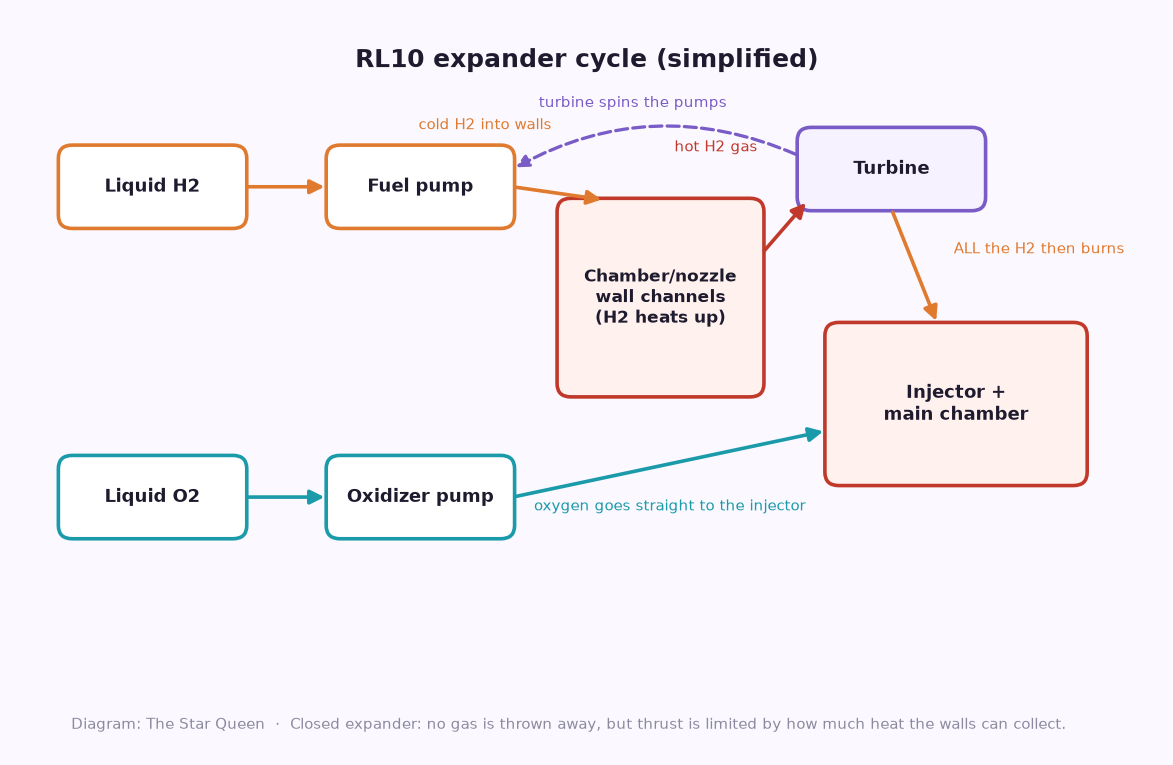
- Closed expander cycle: liquid hydrogen picks up heat from the chamber and nozzle walls, turns to gas, spins the turbine, and then ALL of it goes on to burn in the chamber. Nothing is thrown away.
- Open (bleed) expander: like a closed expander, but some of the turbine gas is dumped overboard. The BE-3U is described that way.
- Upper stage: the last stage of a rocket, which starts working after the booster has done its job and must often restart in space.
- Specific impulse (Isp): how much push you get per unit of propellant per second. Higher is more efficient.
- Hydrolox: liquid hydrogen fuel plus liquid oxygen. High efficiency, but cold and bulky.
- Additive manufacturing: 3D printing, in this case metal parts for the engine.
- Expansion ratio: how much wider the nozzle exit is than the throat. A big ratio suits a vacuum.
The Numbers (Two Versions, Plus a Vintage One)
| Spec | Value | Source |
|---|---|---|
| RL10C-1-1 thrust (vacuum) | 23,825 lbf (about 106 kN) | Wikipedia’s version table |
| RL10C-1-1 specific impulse | 453.8 s | Wikipedia’s version table |
| RL10C-1-1 dry mass | About 415 lb (about 188 kg) | Wikipedia’s version table |
| RL10C-1-1 nozzle expansion ratio | 155:1 | Wikipedia’s version table |
| RL10E-1 thrust | About 107.3 kN (about 24,100 lbf, my conversion) | Wikipedia’s version table |
| RL10E-1 specific impulse | 460.9 s | Wikipedia’s version table |
| RL10E-1 dry mass | 231 kg | Wikipedia’s version table |
| Two engines on a Vulcan upper stage | Combined thrust of about 48,000 lbf | L3Harris, Nov 2024 |
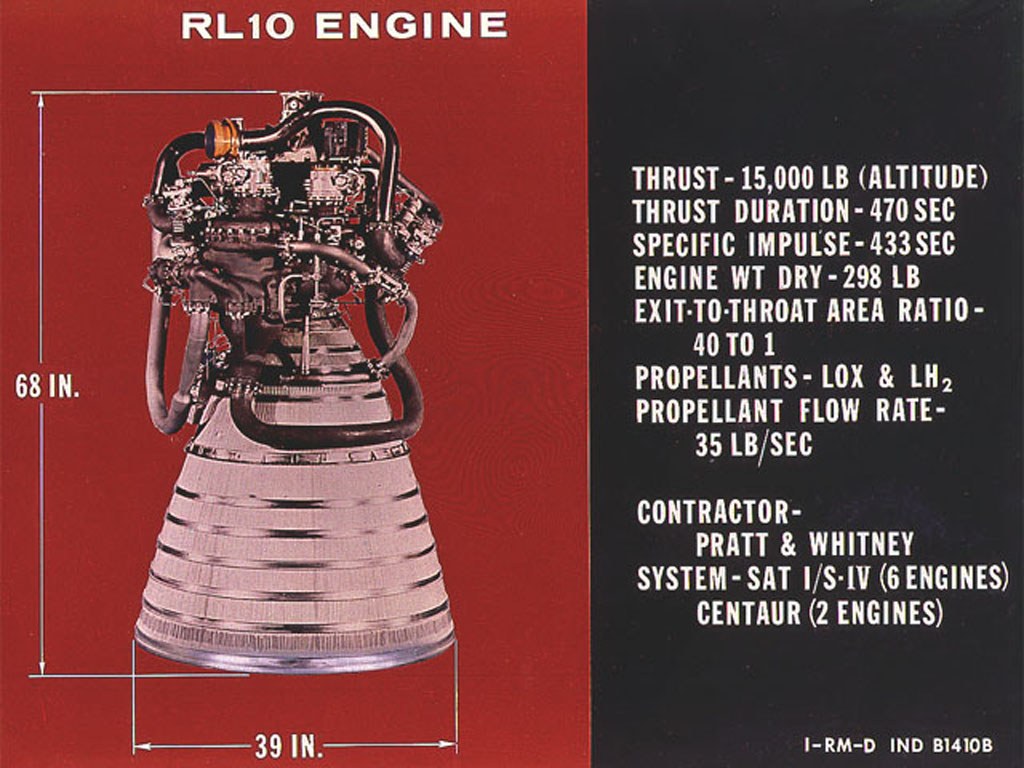
| Early RL10A-1 (1960s chart) | 15,000 lb at altitude, 433 s Isp, 298 lb dry mass, 40:1 area ratio | NASA/MSFC chart (see below) |
| Cycle | Closed expander, LH2/LOX | L3Harris; Wikipedia |
A conflict about the earliest RL10: NASA’s old specification chart (pictured below) says 433 s of specific impulse for the early RL10. Wikipedia’s version table lists 425 s for the RL10A-1 and 444 s for the RL10A-3C. These were different early versions, and old figures from the 1960s were often rounded, so I’ll just say it was in the low-to-mid 400s. The point is the same: the first RL10 was already efficient.

How a Closed Expander Works
This is one of my favorite rocket tricks, because it looks like cheating. 🎩 Liquid hydrogen is extremely cold, about minus 253 °C. The nozzle and chamber walls of a rocket engine are extremely hot. So the engine runs the hydrogen through channels inside those walls. The hydrogen cools the walls (so they don’t melt) and the walls heat the hydrogen, turning it into a high-pressure gas. That gas spins a turbine that drives the fuel and oxygen pumps. Then the same hydrogen flows on into the injector and burns. That’s the “closed” part: nothing is dumped overboard.
Why is this such a good fit for an upper stage?
- Efficiency. With all the hydrogen burned and a big nozzle, the RL10C-1-1 reaches 453.8 s of specific impulse in vacuum (Wikipedia).
- Simplicity and gentleness. There is no preburner full of burning gas, and the turbine sees only warm hydrogen gas, not hot combustion products. That’s a gift for reliability and for restarting in space, which is the key skill of a Centaur.
- Predictability. The engine’s own power supply scales with how much heat the walls collect.
The catch is a ceiling on size. As a general rule of thumb from engine-cycle explainers like Everyday Astronaut’s cycle guide, the heat a wall can collect depends on its surface area, while thrust grows faster as an engine gets bigger. That’s why expanders live in the tens-of-thousands-of-pounds class, as the RL10 does, rather than the hundreds of thousands of the BE-4. For the very different open-expander and tap-off cycles on Blue Origin’s hydrogen engines, see my BE-3 post.
🎬 The Most Efficient Rocket Engine – The RL10 Expander Cycle Engine (Scott Manley). A popular explainer of the RL10 and how its expander cycle works. Watch on YouTube
A Quick History
- 1950s: Wikipedia says the engine began as a throttleable engine for the USAF Lunex lunar lander concept, with development involving Marshall Space Flight Center and Pratt & Whitney.
- 1959: first ground test, at Pratt & Whitney’s Florida facility in West Palm Beach (Wikipedia; Rocketdyne datasheet).
- November 27, 1963: the first successful flight, with two RL10A-3 engines powering the Centaur upper stage on an Atlas launch (Wikipedia).
- 1964: the Saturn I’s S-IV stage flew with six RL10s (Rocketdyne datasheet).
- 1993: a vehicle called DC-X, the “Delta Clipper” test rocket, flew with four RL10A-5 engines (datasheet).
- 2002: first Atlas V flight, with two RL10A-4-2 engines on Centaur (datasheet).
- 2009 and 2020: the 400th and then 500th RL10 flights (datasheet).
- 2010: the engine family demonstrated deep throttling from 104% down to 5.9% of rated power, a 17.6-to-1 range. That was a test of a development version called CECE, and Wikipedia calls it a record for an expander cycle engine of this type.
- 2014: first flight of the RL10C-1 (datasheet).
- 2021: first use of an RL10 with 3D-printed components. Wikipedia says the RL10C-1-1 had a printed nickel superalloy main injector. Its first flight, on an Atlas V (the SBIRS GEO-5 mission), noted some unexpected vibration, and later use was paused until understood. It flew again successfully on SBIRS GEO-6.
ULA says on its Vulcan page that the RL10 family has more than 500 successful flights and more than 800 firings in space (via my Vulcan explainer). That matches the maker’s 500th-flight milestone in 2020.
Variants: A Cheat Sheet
The RL10 is a family, not a single engine. A few names you will see:
- RL10A-4-2: the pair on the Atlas V’s dual-engine Centaur, used for Starliner launches (Wikipedia: 22,300 lbf, 451 s).
- RL10C-1 and RL10C-1-1: single-engine Atlas V Centaur and Vulcan’s Centaur V. The “-1-1” is the version with a printed injector.
- RL10B-2: the extendable-nozzle version for Delta IV’s upper stage, with a carbon-carbon extendable nozzle, 24,750 lbf and 465.5 s (Wikipedia). The ICPS on SLS uses a related RL10 version.
- RL10E-1: the newest, with a 3D-printed copper thrust chamber.
- Cancelled relatives: the RL10C-3 for SLS’s cancelled Exploration Upper Stage and the RL10C-5-1 for Northrop Grumman’s cancelled OmegA rocket.
The Printed Engine: RL10E-1
This is the modern chapter. Aerojet Rocketdyne began developing the printed copper chamber in 2015 (Wikipedia). According to the company, the printing process cut chamber fabrication time from about 20 months to 4 to 6 months, enabling up to one engine per week instead of about one per month (Wikipedia, citing the company). The thrust chamber uses 98% fewer parts than a traditional RL10 (L3Harris, Nov 2024). The first production RL10E-1 was delivered to ULA on November 21, 2024, as the first of 116 engines under a contract, and was expected to fly on Vulcan the following year. L3Harris says the engine retains the performance and reliability customers expect.
Honest gap: I could not confirm which engine version has flown on Vulcan’s most recent launches, or whether the RL10E-1 has flown at all. Wikipedia lists the engine as delivered but not yet flown, and I can’t verify more. So I’m treating the E-1’s flight debut as unconfirmed as of today.

Where It Flies Next
- Vulcan Centaur: two RL10s per Centaur V. That’s what rides on every Vulcan, and Vulcan is waiting on its solid-booster fix (see my booster status post).
- Atlas V: one RL10C-1 or a pair of RL10A-4-2 in Centaur III. After the last Amazon launch, only Starliner rockets remain, per my Atlas V final chapter post.
- SLS: the Rocketdyne datasheet says NASA selected the Centaur V upper stage, with two RL10s, for SLS beginning with Artemis IV.
🎬 Expander Cycle Rocket Engines – Using Waste Heat To Drive Your Rocket (Scott Manley). A second Scott Manley explainer, this time on expander cycle engines in general. Watch on YouTube
Why It’s So Reliable
My own list, backed by what’s above:
- It is simple by rocket standards. An expander has few failure points compared with a staged combustion engine.
- It has lots of flights. More than 500 flights (maker and ULA).
- Its failures have been studied. For example, a brazing flaw in an RL10B-2 chamber was the cause of the May 4, 1999 Delta III failure carrying the Orion-3 satellite (Wikipedia). So it hasn’t been perfect, but problems have been traced and fixed.
- It’s evolving without a redesign. The core idea stayed, while materials and manufacturing changed.
The Star Queen’s Take 👑
I love an engine that has outlasted so many rockets. The RL10 is the opposite of flashy: it is a small, patient, hydrogen-burning workhorse that quietly puts expensive things in the right orbit. 💜 What I’m watching: whether the RL10E-1 starts flying on Vulcan once Vulcan returns, whether the new Rocketdyne ownership changes anything about delivery speed, and whether the 3D-printing production rates ever get published as actual flown engines instead of capacity. And I’m watching Artemis, where a Centaur V with two of these engines is in line to join SLS.
Sources
- Rocketdyne, RL10 Propulsion System datasheet (07/2026)
- L3Harris, L3Harris Delivers New Generation of RL10 Rocket Engines (Nov 21, 2024)
- SpaceNews, Rocketdyne reemerges as standalone space company (Aug 4, 2026); L3Harris, L3Harris Completes Sale of Majority Stake in Commercial Space Propulsion, Power and Electronics Businesses
- Wikipedia, RL10
- Everyday Astronaut, Rocket engine cycles
- ULA, Vulcan Centaur (via my Vulcan explainer)
- Videos: Scott Manley on YouTube, The RL10 Expander Cycle Engine and Expander Cycle Rocket Engines