By The Star Queen · Star Queen Chronicles
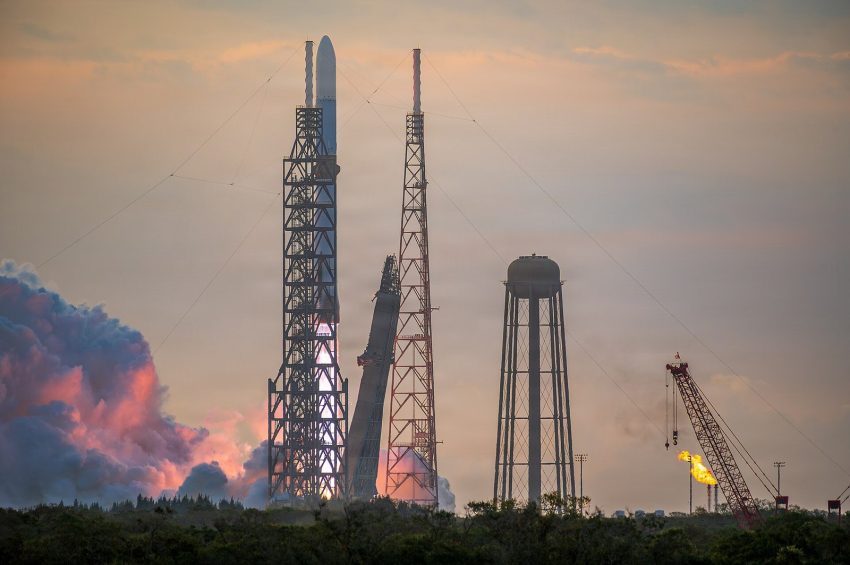
My loves, NG-3 is the flight that shows how rocketry can hand you a gold medal and a heartbreak in the same ten minutes. 🥇💔 On the morning of April 19, 2026, a New Glenn booster that had already flown once came back and landed on the ship Jacklyn again. That’s a huge step toward making this rocket affordable. Then, about an hour later, Blue Origin said the satellite it was carrying had been left in an “off-nominal orbit.”
I’m writing this on October 26, 2026, so I know how the investigation ended. I’ll point out where sources differ, and where I’m reading between the lines.
The Short Version
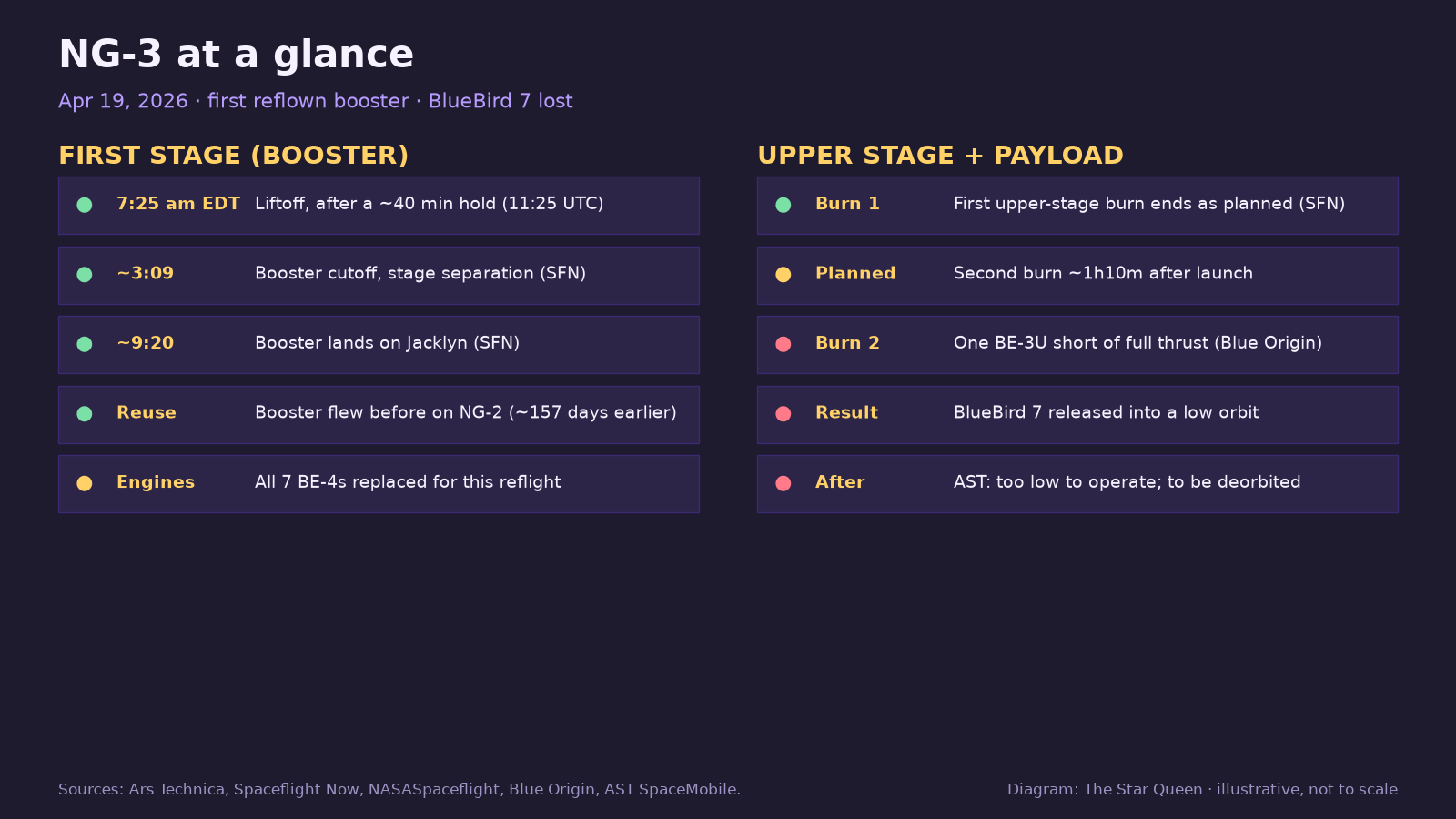
- When: Sunday, April 19, 2026, liftoff at 7:25 am EDT (11:25 UTC), after a hold of about 40 minutes. Blue Origin’s launch window was 6:45 to 8:45 am EDT.
- Payload: AST SpaceMobile’s BlueBird 7, a roughly 6-ton direct-to-phone satellite with a 2,400-square-foot antenna array.
- Booster: “Never Tell Me The Odds” flew for the second time, about 157 days after NG-2, and landed on Jacklyn. That was the first reflight of a New Glenn booster.
- Problem: The upper stage’s second burn fell short, and the satellite ended up in an orbit too low to operate.
- FAA: Required a mishap investigation on April 20 and closed it on May 22, 2026, with nine corrective actions.
- Satellite: AST said it will be deorbited and that insurance should cover the cost.
Terms to know ✨
- Reflight: flying the same booster again. NG-3 was the first for New Glenn.
- GS2: “Glenn Stage 2,” New Glenn’s upper stage, with two BE-3U engines.
- Off-nominal: Blue Origin’s way of saying “not what was planned.”
- Perigee and apogee: the lowest and highest points of an orbit. A low perigee means the orbit keeps dipping into the upper atmosphere.
- Cryogenic: extremely cold. Liquid hydrogen and liquid oxygen, which the upper stage burns, are cryogenic.
- Thrust anomaly: an engine producing a different thrust than planned.
- Direct cause: the term the FAA used for NG-3, the specific event that led to the mishap.
- Corrective action: a fix the FAA requires and then verifies before the next flight.
NG-3 at a glance
| Item | Details |
|---|---|
| Date and time | April 19, 2026, 7:25 am EDT (11:25 UTC) |
| Launch site | LC-36, Cape Canaveral Space Force Station |
| Payload | AST SpaceMobile BlueBird 7 (a Block 2 satellite) |
| Booster | “Never Tell Me The Odds” (GS1-SN002), second flight; landed on Jacklyn |
| Booster engines | All seven BE-4s replaced; one nozzle carried a thermal-protection test (Dave Limp) |
| Planned orbit | About 285 miles (460 km) at 49 degrees inclination (Ars Technica) |
| Result | Satellite released into a lower-than-planned orbit; booster landed |
What Went Right: The First Reflown Booster
Spaceflight Now reported the first stage shut down and separated about three minutes and nine seconds after liftoff, then flew itself to an on-target touchdown at about 9 minutes 20 seconds. Ars Technica described a “smoky but on-target touchdown.” NASASpaceflight added that the booster vented from its aft section after touchdown, which hadn’t been seen on NG-2, likely to purge leftover propellant, and noted the 157-day turnaround. For comparison, it said SpaceX’s first reused Falcon 9 booster took 356 days between its landing and second flight.
Limp said the team chose to replace all seven BE-4s and to test a thermal protection system on one nozzle, and that the NG-2 engines will fly again on future flights. For the engine itself, my BE-4 deep dive has the details.
What Went Wrong: The Second Burn
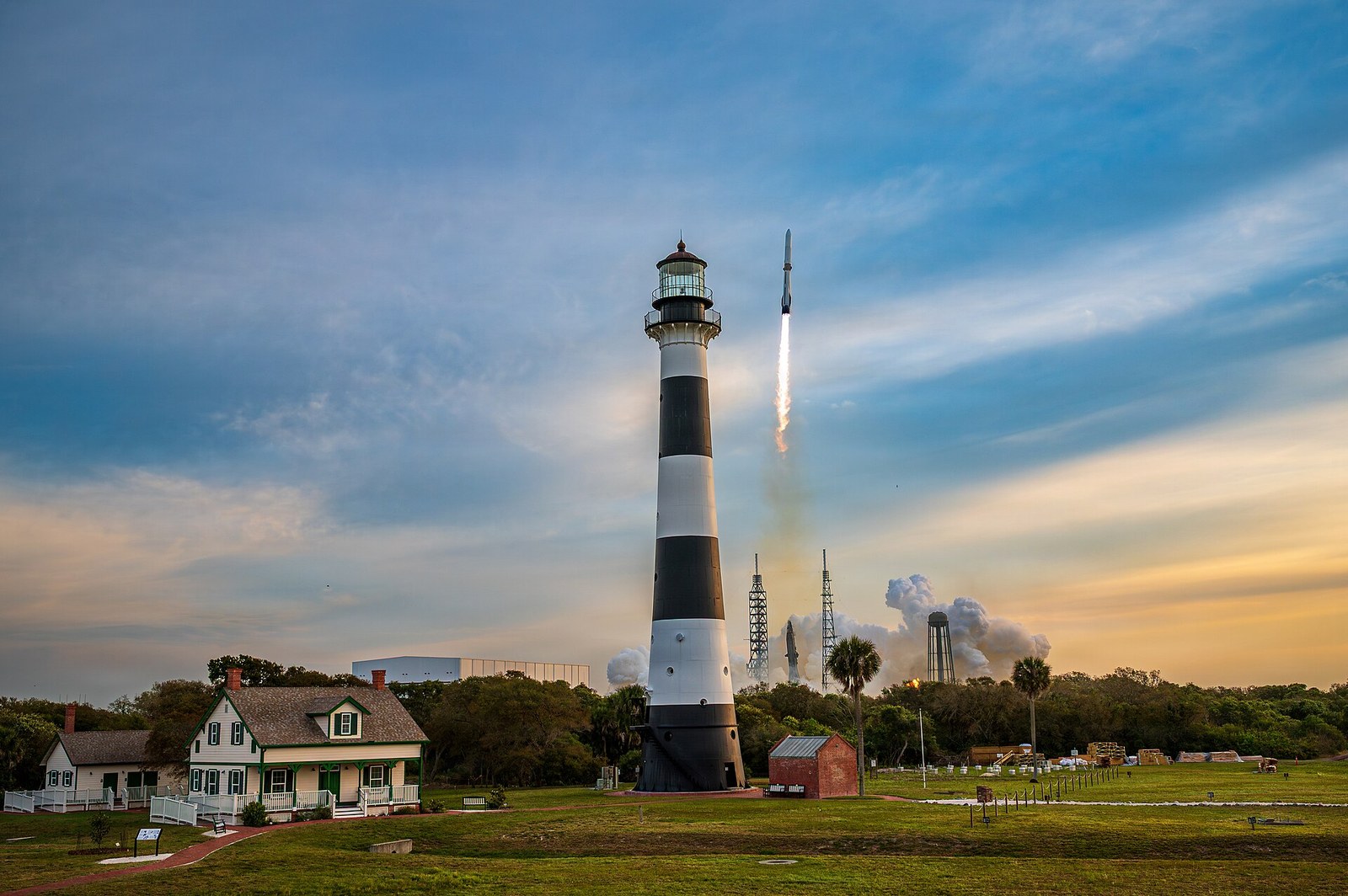
The upper stage is built to burn twice. The first burn gets it into a first trajectory, then it coasts and burns again to circularize at the right altitude. Spaceflight Now reported that the stage shut down as planned about two and a half minutes after the booster landing. A second burn was expected about 1 hour 10 minutes after launch, but there were no updates from Blue Origin for a while, and about an hour later the company said the satellite hadn’t been released into the intended orbit.
Blue Origin’s first statement: “We have confirmed payload separation… AST SpaceMobile has confirmed the satellite has powered on. The payload was placed into an off-nominal orbit.” AST later said the orbit was “too low to sustain operations” with the satellite’s onboard thrusters, so it “will be de-orbited.”
On April 20, SatNews reported, Dave Limp gave an early assessment: “Early data suggest that on our second GS2 burn, one of the BE-3U engines didn’t produce sufficient thrust to reach our target orbit.” He added that the team was pleased with the booster recovery but “clearly didn’t deliver the mission our customer wanted.” (I’m quoting SatNews and haven’t seen Limp’s original post. Other outlets give a matching paraphrase.)
The numbers don’t line up
| Source | What it says about the orbit |
|---|---|
| Ars Technica (planned) | About 285 miles (460 km) circular, 49 degrees |
| Ars Technica (preliminary tracking) | Lowest point about 95 miles (154 km) |
| NASASpaceflight (Space Force tracking via Jonathan McDowell) | 154 by 494 km at 36.1 degrees at the first cutoff |
| Blue Origin / AST | “Off-nominal” and “too low to sustain operations” |
The differences are partly because the sources describe different moments, and NASASpaceflight’s inclination is far from the planned one, which I can’t explain. Please treat the exact figures as preliminary tracking data, not the official result.
The Engineering, In Plain Language
What does a frozen hydraulic line have to do with an engine?
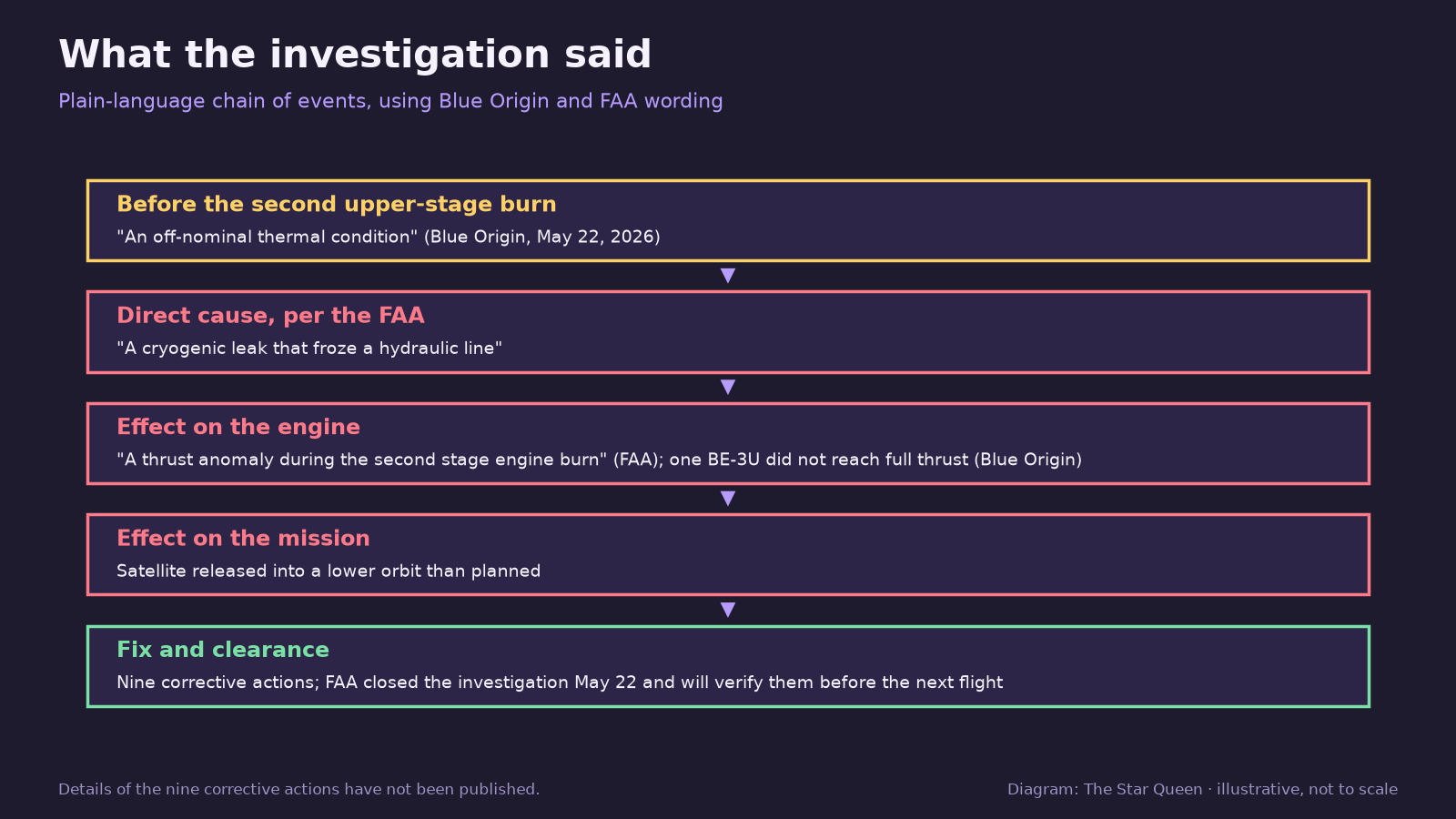
The FAA’s wording is that “a cryogenic leak froze a hydraulic line and led to a thrust anomaly during the second stage engine burn.” In a rocket, hydraulic fluid is commonly used to move parts such as valves or actuators, but neither the FAA nor Blue Origin said what this line did, and I won’t guess. A leak of a very cold liquid near a line full of fluid can chill it until it freezes, and a frozen line can’t do its job. The FAA also didn’t say which propellant leaked.
Why would one engine mean a low orbit?
The second burn is what raises the low point of the orbit. With two BE-3U engines and one producing less thrust than planned, the stage would gain less speed in the time it burned, leaving it short. That’s my simple explanation of Blue Origin’s statement, not a published analysis.
Is it related to NG-1’s ice problem?
During NG-1’s countdown, a scrub was blamed on ice in a purge line on a power unit for hydraulic systems. Both stories involve cold and hydraulics, but they’re different systems and different stages, and no source links them. I’m mentioning it as a theme and not a finding.
What the FAA Said
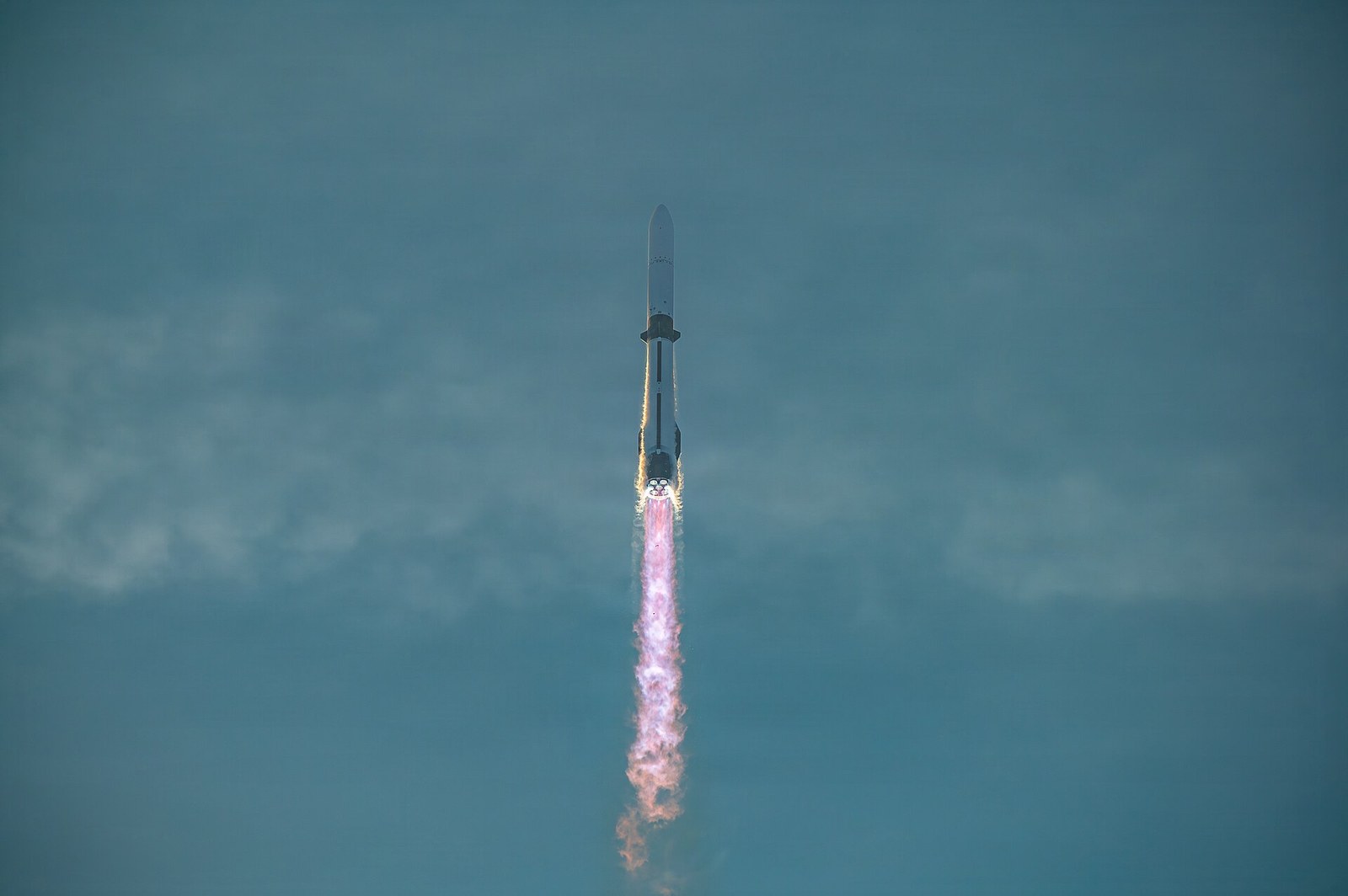
On April 20, the FAA said New Glenn 3 “experienced a mishap during the second-stage flight sequence following a successful launch” and was requiring a Blue Origin-led investigation under FAA oversight. On May 22 it closed the investigation, saying the final report “identified the direct cause of the mishap as a cryogenic leak that froze a hydraulic line and led to a thrust anomaly during the second stage engine burn.” Blue Origin identified nine corrective actions. The FAA said it “will verify” they were implemented before the next New Glenn mission, and that New Glenn “is authorized to return to flight provided all other licensing requirements are met.” The nine actions haven’t been published.
Blue Origin said on May 22: “The FAA has approved our NG-3 report, and corrective measures have been implemented. Prior to our second GS2 burn, we experienced an off-nominal thermal condition, and, as a result, one of the BE-3U engines didn’t achieve full thrust to reach our target orbit.” One difference to notice: Blue Origin says the measures were implemented, while the FAA said it would verify them.
Then and Now
What changed from NG-2: The booster came back a second time, now with new engines, but the upper stage had a new problem. What came next: Just six days after the FAA closed the investigation, a New Glenn was lost in an explosion during a static-fire test at LC-36, which is a different event, not a launch. I cover it in the LC-36 explosion and rebuild post. As of October 26, 2026, I have not found a fourth New Glenn launch. For what is planned next, see Beyond New Glenn.
The Star Queen’s Take 👑
I want to hold two thoughts at once. First, reflying a booster in 157 days is a great accomplishment, and I don’t want the satellite’s loss to erase it. Second, a rocket company’s reputation depends on delivering the payload, and AST lost a satellite it built. Ars Technica noted that AST was thankful only one BlueBird was aboard, and AST’s 8-K filing said the cost is expected to be recovered under insurance.
What I like about the FAA’s wording is how plainly it reads: a cryogenic leak froze a line. That’s a mechanical, understandable failure. I’d still like to know which line it was and what nine fixes came out of it. Those details aren’t public yet.
Watch
Blue Origin’s replay, plus Spaceflight Now’s live coverage and NASASpaceflight’s launch stream.
If the video doesn’t load, watch it here: Blue Origin on YouTube.
Link fallback: NASASpaceflight on YouTube.
Keep Reading
Previous: New Glenn NG-2 Explained. Also: New Glenn NG-1 Explained, New Glenn 7×2 vs 9×4 and Blue Moon landers.
Sources
- Blue Origin, NG-3 mission update: https://www.blueorigin.com/news/new-glenn-ng-3-mission
- FAA statements (Apr 20 and May 22, 2026): https://www.faa.gov/newsroom/statements/general-statements
- Spaceflight Now, “Blue Origin launches third New Glenn rocket, but payload ends up in wrong orbit”: https://spaceflightnow.com/2026/04/20/blue-origin-launches-third-new-glenn-rocket-but-payload-ends-up-in-wrong-orbit/
- Ars Technica, “Blue Origin’s rocket reuse achievement marred by upper stage failure”: https://arstechnica.com/space/2026/04/errant-upper-stage-spoils-blue-origins-success-in-reusing-new-glenn-booster/
- NASASpaceflight, “AST SpaceMobile’s BlueBird 7 declared lost following New Glenn launch”: https://www.nasaspaceflight.com/2026/04/ast-bluebird-7-lost-new-glenn-launch/
- SatNews, “Blue Origin CEO Attributes BlueBird 7 Satellite Loss to Second-Stage Thrust Anomaly”: https://satnews.com/2026/04/23/blue-origin-ceo-attributes-bluebird-7-satellite-loss-to-second-stage-thrust-anomaly/
- TechCrunch, “Blue Origin cleared to fly New Glenn mega-rocket after April mishap”: https://techcrunch.com/2026/05/22/blue-origin-cleared-to-fly-new-glenn-mega-rocket-after-april-mishap/
- The Register, “Bezos rocket fell short after cryogenic leak cut engine thrust”: https://www.theregister.com/science/2026/05/26/bezos-rocket-fell-short-after-cryogenic-leak-cut-engine-thrust/5246481
- AST SpaceMobile Form 8-K, April 20, 2026: https://www.sec.gov/Archives/edgar/data/1780312/000149315226018012/form8-k.htm
- Images (Wikimedia Commons, U.S. Space Force photos by Gwendolyn Kurzen, public domain; the featured image is the first): https://commons.wikimedia.org/wiki/File:New_Glenn_-BlueBird_7_Launch(9628275).jpg, https://commons.wikimedia.org/wiki/File:New_Glenn_-BlueBird_7_Launch(9628283).jpg, https://commons.wikimedia.org/wiki/File:New_Glenn_-BlueBird_7_Launch(9628278).jpg