By The Star Queen · Star Queen Chronicles
A note on pictures: no freely reusable photo of the GLHF launch exists, and I only use images I’m allowed to reuse. So you’ll see my own diagrams plus public-domain and credited context photos, each labeled as such.
My loves, this is the kind of launch where the headline says “failure” and the details say “wait, that mostly went really well.” 🥹 On March 22, 2023, Relativity Space launched Terran 1, a rocket built largely by 3D printers, on a mission nicknamed GLHF, for “Good Luck, Have Fun.” It reached space. It did not reach orbit. Here’s what happened, what we know, and where sources disagree.
I’m writing on October 26, 2026, so I’ll point to how the story continued, but I won’t retell the company saga here. My other posts are under “Keep Reading.”
The Short Version
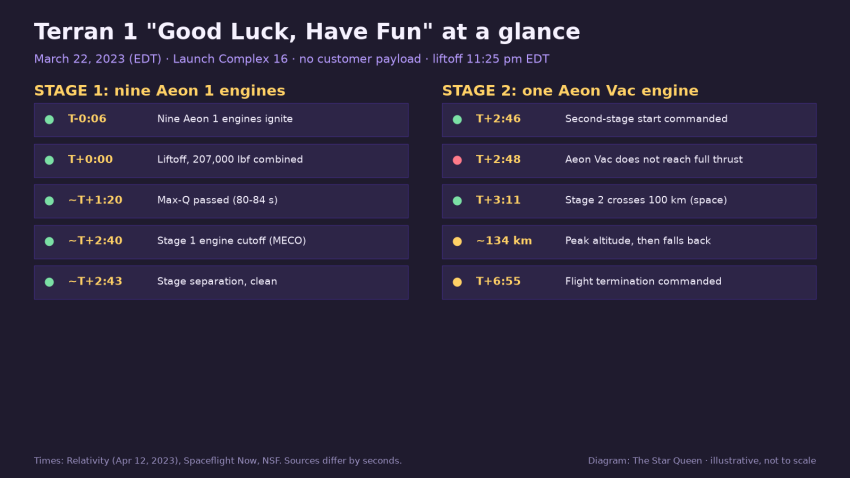
- When and where: Wednesday, March 22, 2023, liftoff at 11:25 pm EDT (03:25 UTC on March 23), from Launch Complex 16 at Cape Canaveral Space Force Station, Florida. It was the third attempt, after scrubs on March 8 and March 11.
- What worked: Liftoff, max-Q (the point of greatest aerodynamic stress), first-stage burn and stage separation.
- What didn’t: The second-stage Aeon Vac engine did not reach full thrust, so the stage never built orbital speed. It climbed to about 134 km, above the 100 km Kármán line, and fell back into the Atlantic.
- Payload: No customer satellite. A small 3D-printed metal ring rode in the nosecone as a token payload.
- What came next: On April 12, 2023, Relativity shared preliminary findings and said it would move on to a much larger rocket, Terran R. Terran 1 never flew again.
Terms to know ✨
- 3D printing (additive manufacturing): building a part layer by layer instead of cutting it from a block.
- Max-Q: the moment the rocket feels the highest aerodynamic pressure on its way up. Relativity called it “the highest stress state on our printed structures.”
- MECO: main engine cutoff, when the first stage shuts down.
- Stage separation: the used first stage is released so the second stage can fly on alone.
- Aeon 1: Relativity’s first-stage engine, burning liquid oxygen and methane. See my Aeon 1 explainer.
- Aeon Vac: the second-stage version, tuned for vacuum and able to restart.
- Autogenous pressurization: using a bit of the rocket’s own propellant, turned into gas, to pressurize its tanks instead of carrying a separate gas such as helium.
- Kármán line: the 100 km altitude commonly used as the edge of space.
Flight at a Glance
| Item | Details |
|---|---|
| Mission | “GLHF” (“Good Luck, Have Fun”), the first and only Terran 1 flight |
| Liftoff | March 22, 2023, 11:25 pm EDT (03:25 UTC, March 23) |
| Site | Launch Complex 16, Cape Canaveral Space Force Station |
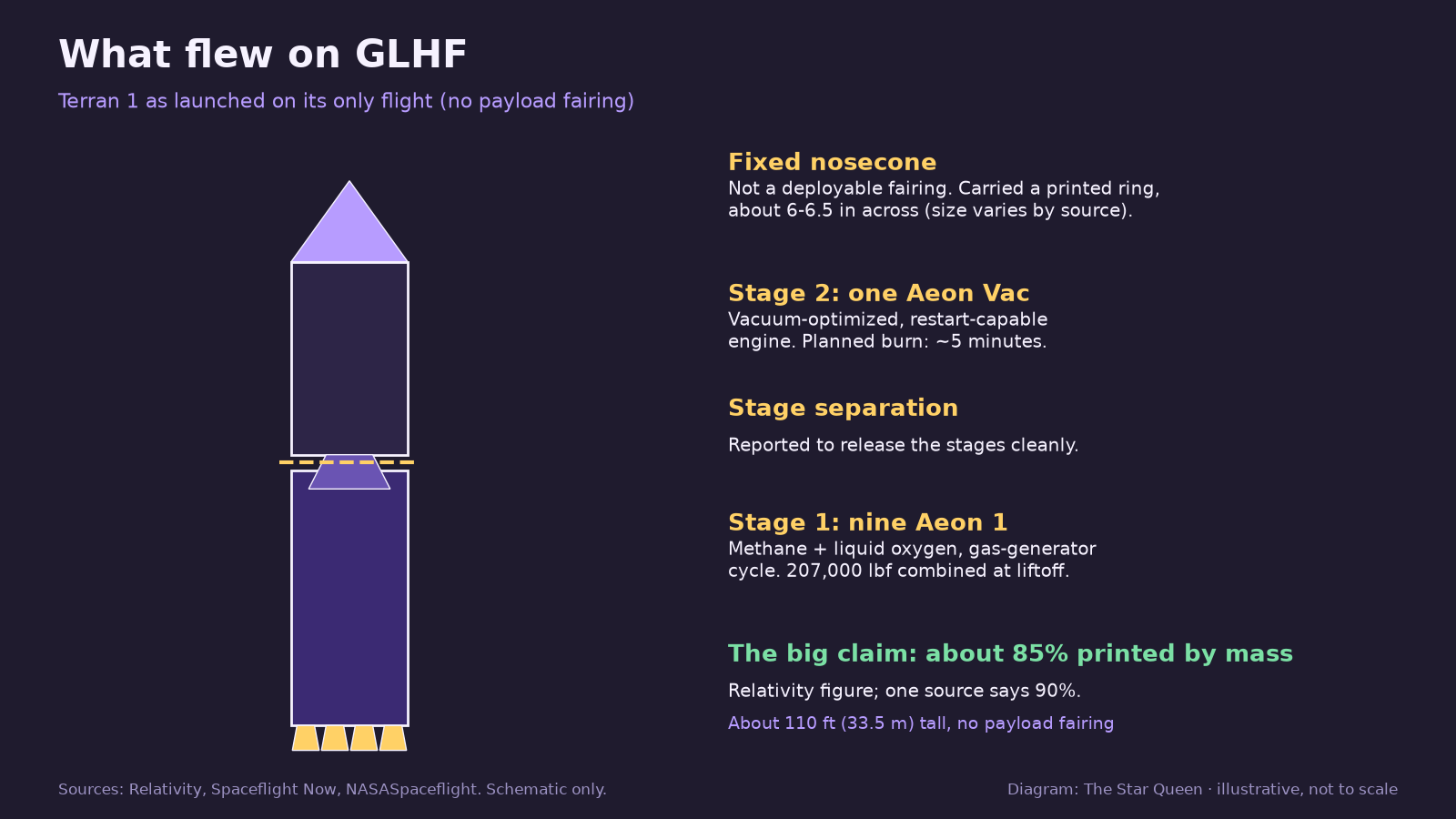
| Vehicle | Two stages, about 110 ft (33.5 m) tall without a payload fairing; nine Aeon 1 engines (207,000 lbf combined) on stage 1, one Aeon Vac on stage 2 |
| Payload | No customer payload; a printed metal ring in the nosecone |
| Result | Reached space (about 134 km); stage 2 engine failed to reach full thrust; no orbit |
A Rocket Built by Printers
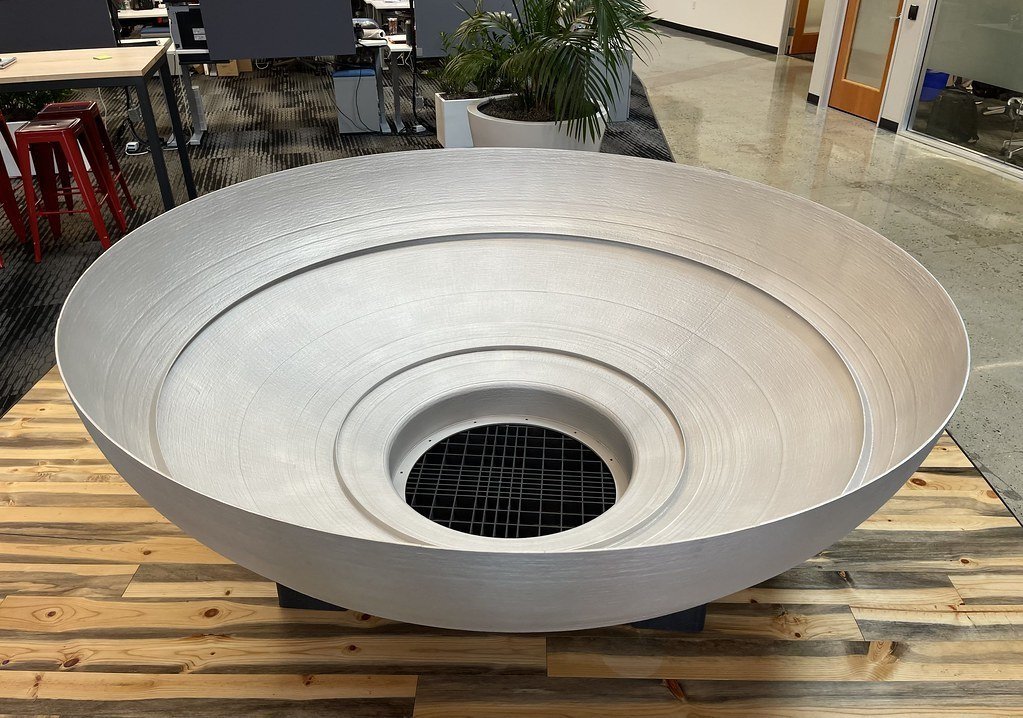
Relativity’s pitch: a rocket has too many parts, so print the big ones. Its metal printers, called Stargate, built tanks and structures from an aluminum alloy, and the company said about 85% of Terran 1’s mass was 3D printed. (One source says 90%, so treat 85% as Relativity’s figure.) Fewer parts means fewer joints to leak and fewer things to assemble.
Stage 1 used nine Aeon 1 engines on liquid oxygen and methane, using a gas-generator cycle. They are also 3D-printed in large part (my Aeon 1 post has the details). Stage 2 had one Aeon Vac. Relativity’s design used autogenous pressurization on its tanks. Relativity’s own pages sometimes say “liquid natural gas” while news outlets say “methane”; natural gas is mostly methane, so that’s labeling. For why methane is popular, see my liquid methane explainer.
Three Tries in 15 Days
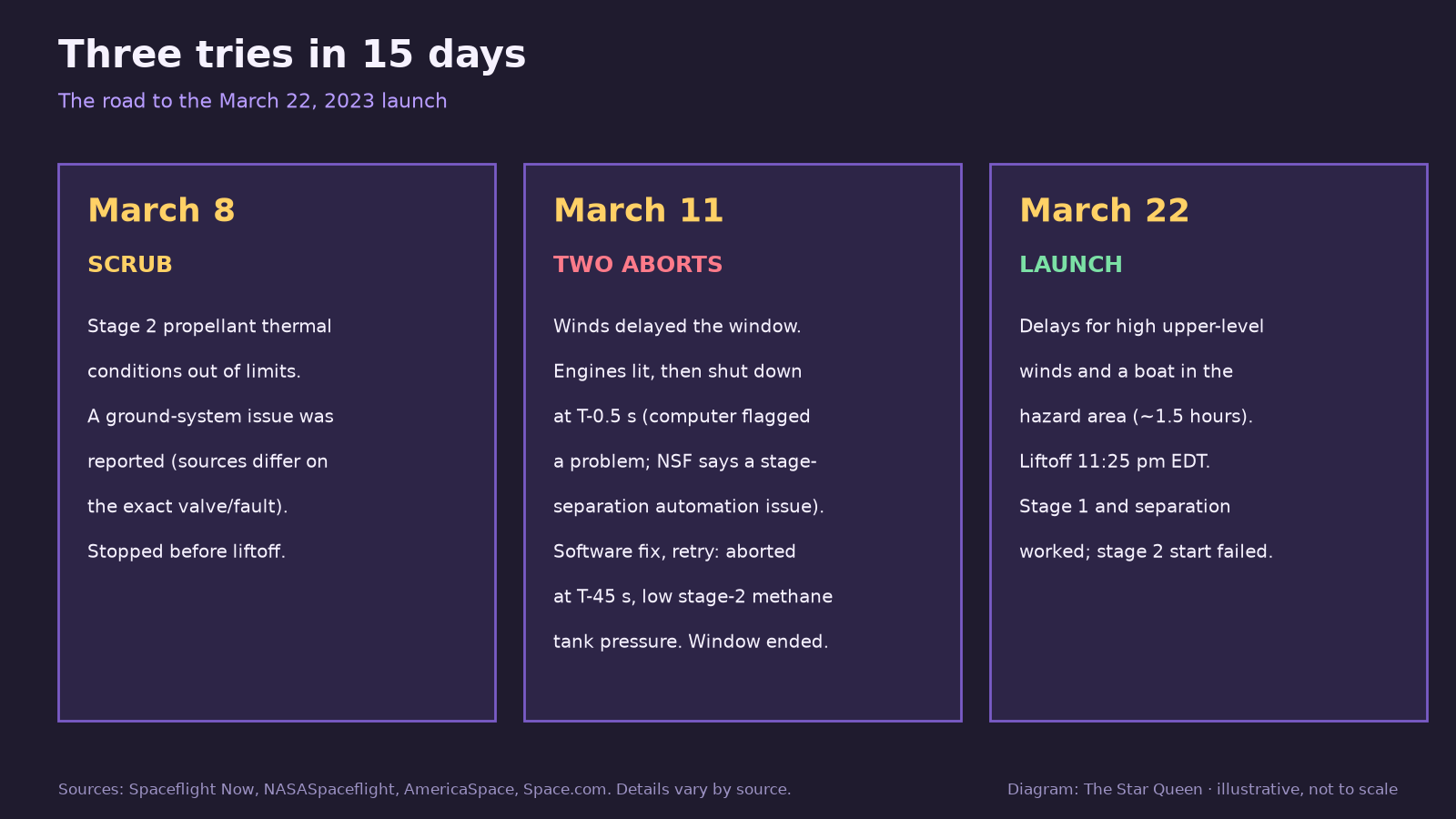
- March 8: scrubbed. Spaceflight Now cited liquid-oxygen temperature and a ground-system issue; Relativity (via AmericaSpace) cited stage-2 propellant thermal conditions. Close, not identical.
- March 11: engines lit and shut down at T-0.5 s. NASASpaceflight said stage-separation automation caused it; Spaceflight Now said a computer-detected problem was fixed by a software uplink. A retry aborted around T-45 s over slightly low pressure in the stage-2 methane tank, and the window closed.
- March 22: high upper-level winds and a boat in the hazard area cost roughly an hour and a half, then it flew.
The Flight, Minute by Minute
| Event | Planned (pre-launch plan) | Reported |
|---|---|---|
| Engine ignition | T-6 s | T-6 s |
| Liftoff | T+0 | 11:25 pm EDT |
| Max-Q | about T+1:20 | T+80 s (Spaceflight Now); T+84 s (Relativity) |
| First-stage cutoff (MECO) | about T+2:40 | about T+2:40 to T+2:43 (Relativity says T+163 s) |
| Stage separation | about T+2:45 | reported clean; about T+2:43 |
| Second-stage ignition | about T+2:51 | commanded T+166 s; engine did not reach full thrust (T+168 s per Relativity) |
| Crosses the Kármán line | n/a | T+191 s |
| Peak altitude | planned orbit | about 134 km |
| Flight ended | about T+7:43 (planned engine cutoff) | termination commanded about T+415 s (6:55) |
Honest notes: Relativity’s “T+163 s” is called MECO in some reports and separation in others, so I show a range. Ars put the second-stage ignition attempt near 2:48, close to Relativity’s T+166 to T+168. Planned times come from pre-launch timelines, so they were only a plan. And Space.com’s wrap-up article gave a wrong liftoff time (8:25 pm EST) that contradicts its own livestream page, so I use 11:25 pm EDT, which three other outlets agree on.
What Went Wrong (Preliminary)
Relativity said an investigation was underway. On April 12, 2023, it shared preliminary findings. I’m reading them through coverage that quotes them (TCT Magazine, the Long Beach Business Journal, Space.com):
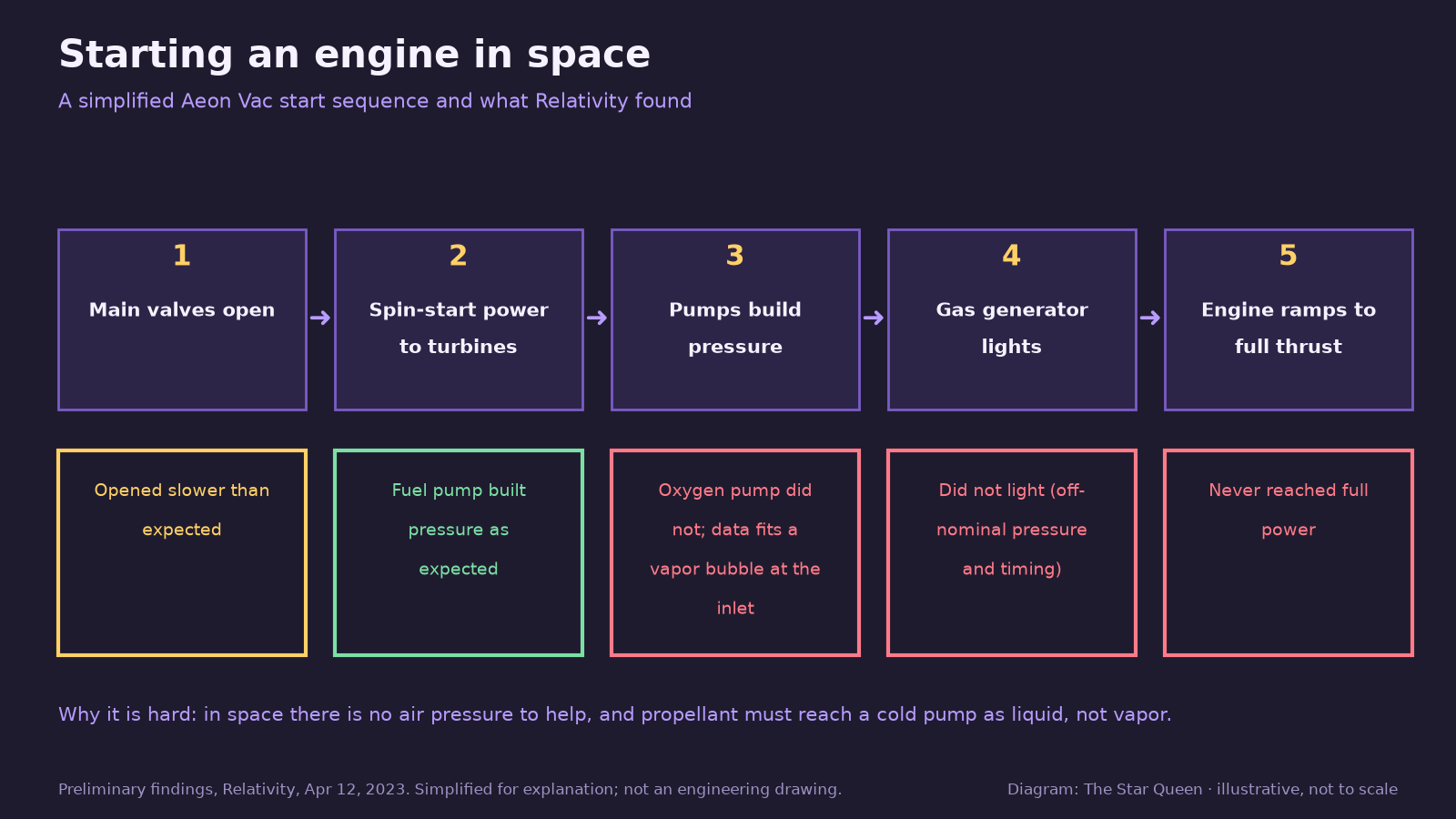
- The main engine valves opened more slowly than expected, which changed system pressures and when propellant arrived at the thrust chamber and the gas generator.
- When spin-start power was applied to the turbines, the fuel pump built pressure as expected, but the oxygen pump did not. The data was “consistent with a vapour bubble being present at the pump inlet.”
- Because of off-nominal pressure and timing, the gas generator did not light and the engine never reached full power.
- Even without full power, the vehicle kept steering with engine gimbaling and its reaction control system.
CEO Tim Ellis later described it, on a Payload podcast, as a gas bubble ingested by the turbopumps (which are meant to pump liquid, not gas), causing cavitation and a failed start. I haven’t found a final public report beyond those preliminary findings.
Why Starting an Engine in Space Is So Hard
An engine this size doesn’t just “turn on.” It follows a precise recipe: open valves, spin up turbines, deliver both propellants at the right pressure and moment, light a small gas generator that drives the pumps, then ramp up.
In general rocketry (not a Relativity finding), after stage separation the upper stage is coasting, and propellant can slosh, warm up or form vapor. A pump wants a solid stream of cold liquid. If a bubble gets in, the pump can’t build pressure, which is cavitation, and the start recipe has little slack. On the ground you can test again. In flight, you get one go.
None of that tells us exactly why the bubble formed. Relativity’s April 2023 findings describe what the data showed, not a full chain of cause.
Was It a Success or a Failure?
Both. The goal was orbit, and it didn’t get there. But Relativity pointed to a real milestone: surviving max-Q on a mostly printed structure. Ars Technica argued it was “proper to characterize” the launch as a success in that sense, since Terran 1 got further on debut than several recent small-launcher debuts. That structural data was expected to help decide how much of the next rocket to print.
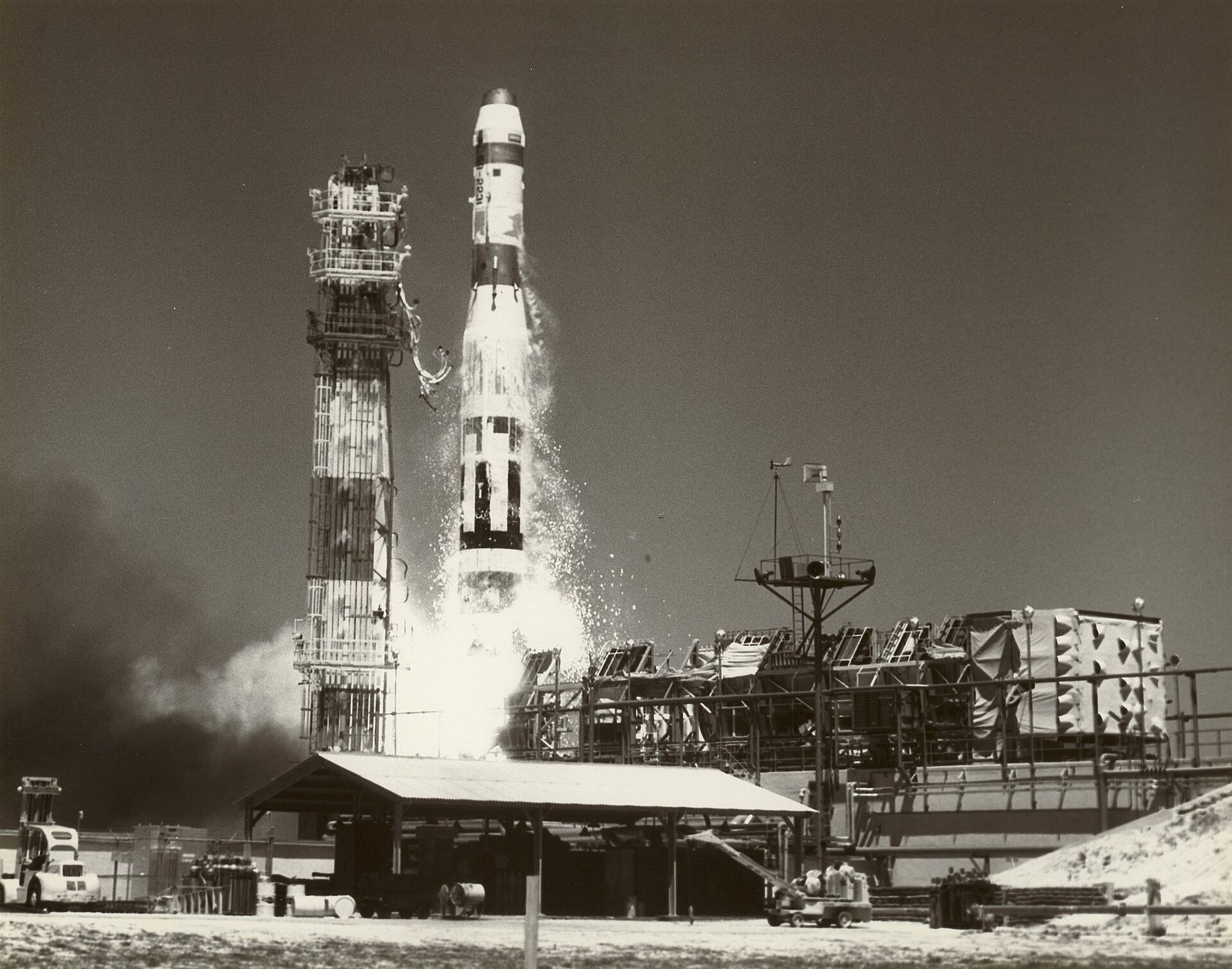

LC-16 launched Titan I missiles in the early 1960s. (The Commons description of this test says its second stage did not fire, an odd echo, but that’s one caption.)
The Payload, and What I Couldn’t Verify
There was no customer satellite. Sources agree on a small 3D-printed metal ring in the nosecone as a token payload, one of Relativity’s early test prints. Its size varies by source (roughly 6 to 6.5 inches across, 1.4 to 1.5 kg), so I won’t pick one. I could not verify any named payload beyond that ring.
What Did the FAA Say?
The FAA issued Relativity a launch license (VOL 23-127, dated February 21, 2023) for Terran 1 launches from LC-16. One report (Long Beach Business Journal) said the investigation had FAA oversight. I could not find an FAA statement or mishap determination specific to this flight, so I won’t say what the FAA decided. For how mishap investigations work in general, see the FAA’s mishap page.
After GLHF: Terran 1 Retires
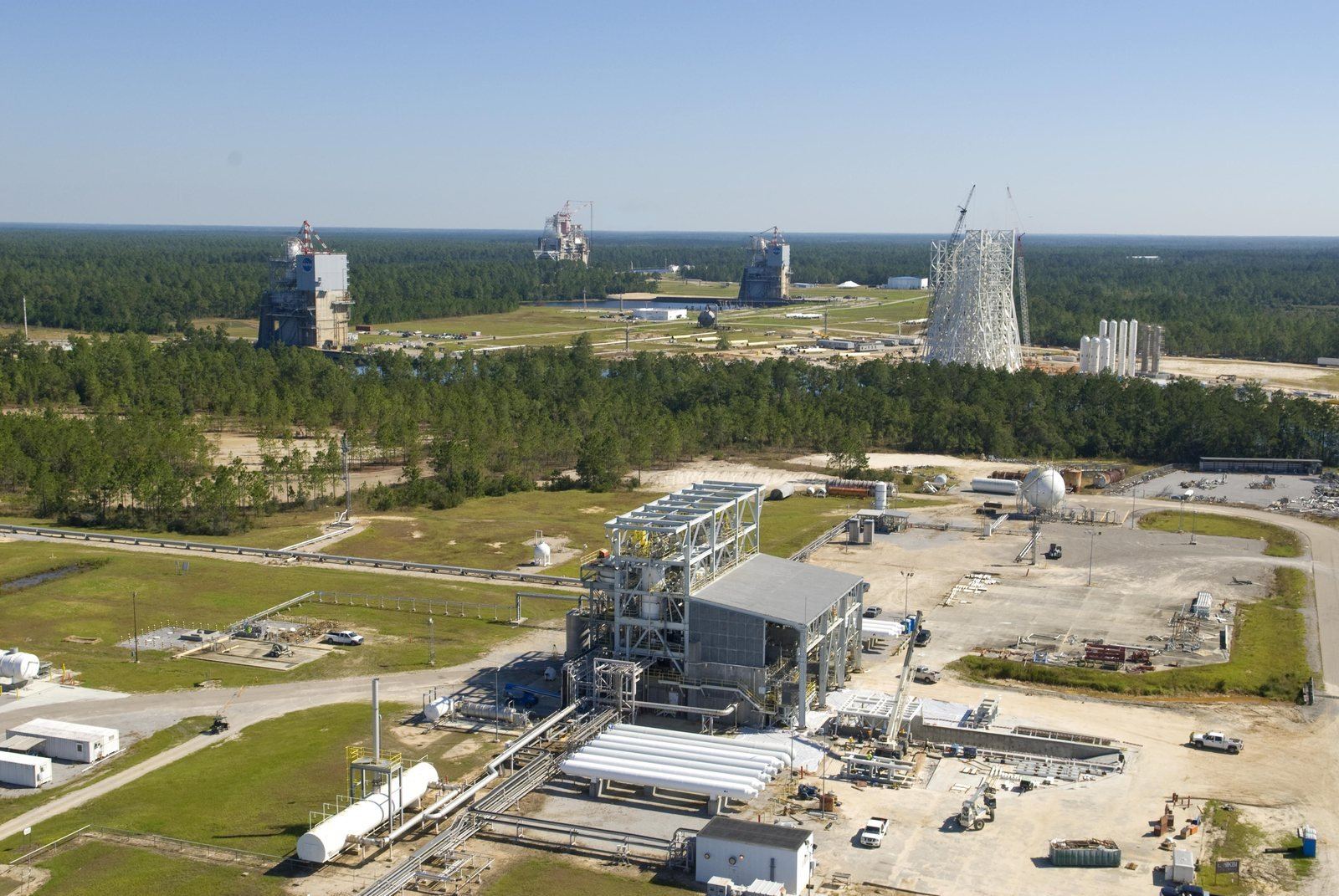
Less than a month later, on April 12, 2023, Relativity announced it was moving on from Terran 1 and putting its effort into Terran R, a far larger rocket. GLHF became the only Terran 1 flight. Relativity does its engine and stage testing at NASA’s Stennis Space Center in Mississippi.

For the pivot, read my Terran 1 to Terran R story. For where Terran R stands as of this month, see my October 2026 Terran R status post, and for the new engine see Aeon R. I’m not re-explaining all that here.
The Star Queen’s Take 👑
Two thoughts. First, the printed structure and first stage did their jobs on a first flight, which is no small thing. Second, the failure wasn’t about printing; it was an upper-stage start, which is hard for every rocket program. I admire that Relativity shared specifics within three weeks, and I’d still love a fuller final report. 💜
A gentle caution: the T+163 s wording, the March 11 cause and the printed percentage vary by source, and I’d rather show you the disagreement than pretend certainty.
Watch
Relativity’s official webcast replay, and NASASpaceflight’s launch coverage.
If the video doesn’t load, watch it here: Relativity Space on YouTube.
Link fallback: NASASpaceflight on YouTube.
Keep Reading
- From a 3D-Printed Terran 1 to Terran R: How Relativity Reinvented Itself
- Relativity’s Terran R: October 2026 status
- Aeon 1, Relativity’s 3D-printed engine
- Aeon R, the Terran R engine
- The reusable rocket race, October 2026
- Basic rocket science: how rockets defy gravity
Sources
- Spaceflight Now, “Relativity’s Terran 1 rocket launches, fails to reach orbit” (Mar 22, 2023): https://spaceflightnow.com/2023/03/22/relativity-space-terran-1-glhf-2/
- NASASpaceflight, “Relativity’s Terran 1 launches on maiden flight”: https://www.nasaspaceflight.com/2023/03/maiden-terran-1/
- Ars Technica, “Relativity Space has a successful failure with the debut of Terran 1” (Mar 2023): https://arstechnica.com/science/2023/03/relativity-space-has-a-successful-failure-with-the-debut-of-terran-1/
- Ars Technica, “Relativity Space is moving on from the Terran 1 rocket to something much bigger” (Apr 12, 2023): https://arstechnica.com/science/2023/04/relativity-space-is-moving-on-from-the-terran-1-rocket-to-something-much-bigger/
- Space.com, “Relativity Space’s Terran 1 test launch fails to reach orbit”: https://www.space.com/relativity-space-terran-1-test-launch-failure
- Space.com, launch livestream preview: https://www.space.com/relativity-space-debut-launch-livestream-march-2023
- Space.com, “Relativity Space shelves Terran 1 rocket, focuses on bigger, reusable Terran R”: https://www.space.com/relativity-space-shelves-terran-1-rocket
- TCT Magazine, “Relativity key findings from Terran 1 launch, shifts focus to Terran R” (Apr 2023; quotes Relativity’s findings): https://www.tctmagazine.com/relativity-key-findings-terran-1-launch-shifts-focus-terran-r/
- Long Beach Business Journal, “Fuel pressure, timing led to Stage 2 failure”: https://lbbusinessjournal.com/aerospace/fuel-pressure-timing-led-to-stage-2-failure-during-historic-mission-relativity-announces/
- AmericaSpace, “On third try, Relativity launches Terran 1”: https://www.americaspace.com/2023/03/23/on-third-try-relativity-launches-terran-1-fails-to-achieve-orbit/
- Payload, “Tim Ellis on the way forward after Terran 1’s first flight”: https://payloadspace.com/tim-ellis-on-the-way-forward-after-terran-1s-first-flight/
- Everyday Astronaut, Terran 1 GLHF preview (planned timeline): https://everydayastronaut.com/good-luck-have-fun-terran-1/
- Relativity Space, Terran 1 and Terran R pages: https://www.relativityspace.com/terran-1 and https://www.relativityspace.com/press-release/2023/4/12/terran-r
- FAA, launch license VOL 23-127: https://www.faa.gov/about/office_org/headquarters_offices/ast/licenses_permits/media/Relativity_VOL_23-127_2023-02-21.pdf
- FAA, mishap process: https://www.faa.gov/space/compliance_enforcement_mishap
- Wikipedia, “Terran 1” (used only as a lead): https://en.wikipedia.org/wiki/Terran_1
- Images: Wikimedia Commons (public domain) and Flickr (CC BY 2.0), credited in captions; diagrams by The Star Queen.