By The Star Queen · Star Queen Chronicles
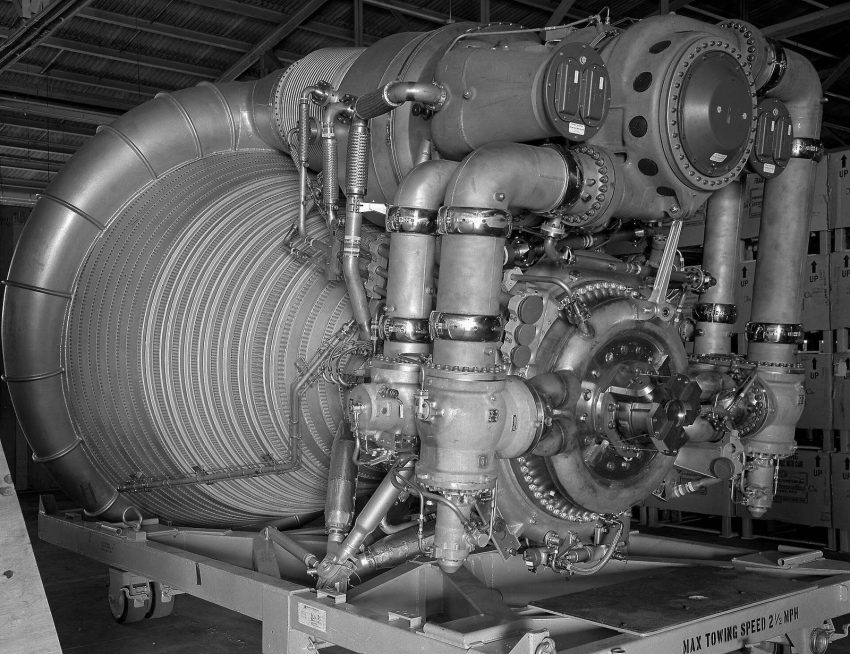
An F-1, the kerosene-and-oxygen giant that powered the first stage of Saturn V. Image: NASA (public domain, via Wikimedia Commons; listed as 1963)
My loves, here is a fun fact to drop at dinner: the fuel that lifted humans to the Moon is a cousin of the stuff in a lantern. 🌙 It is RP-1, rocket-grade kerosene, and it still lights the first stage of Falcon 9, Atlas V, Soyuz and Electron. But “cousin” is doing a lot of work in that sentence, because ordinary kerosene would wreck a modern rocket engine from the inside. Let’s open the tank and find out why.
This is part one of my rocket-fuels series. I label every number (official, reported, unofficial or my arithmetic) and flag conflicts. Everything is as of October 26, 2026.
The Short Version
- RP-1 (Rocket Propellant-1) is a tightly specified, highly refined kerosene. Burned with liquid oxygen (LOX), the pairing is called kerolox.
- It is dense, liquid at room temperature, cheap to buy by the kilogram, and easy to handle. Its weakness is efficiency (lower Isp than methane or hydrogen) and coking: it can bake into tar inside engine cooling channels.
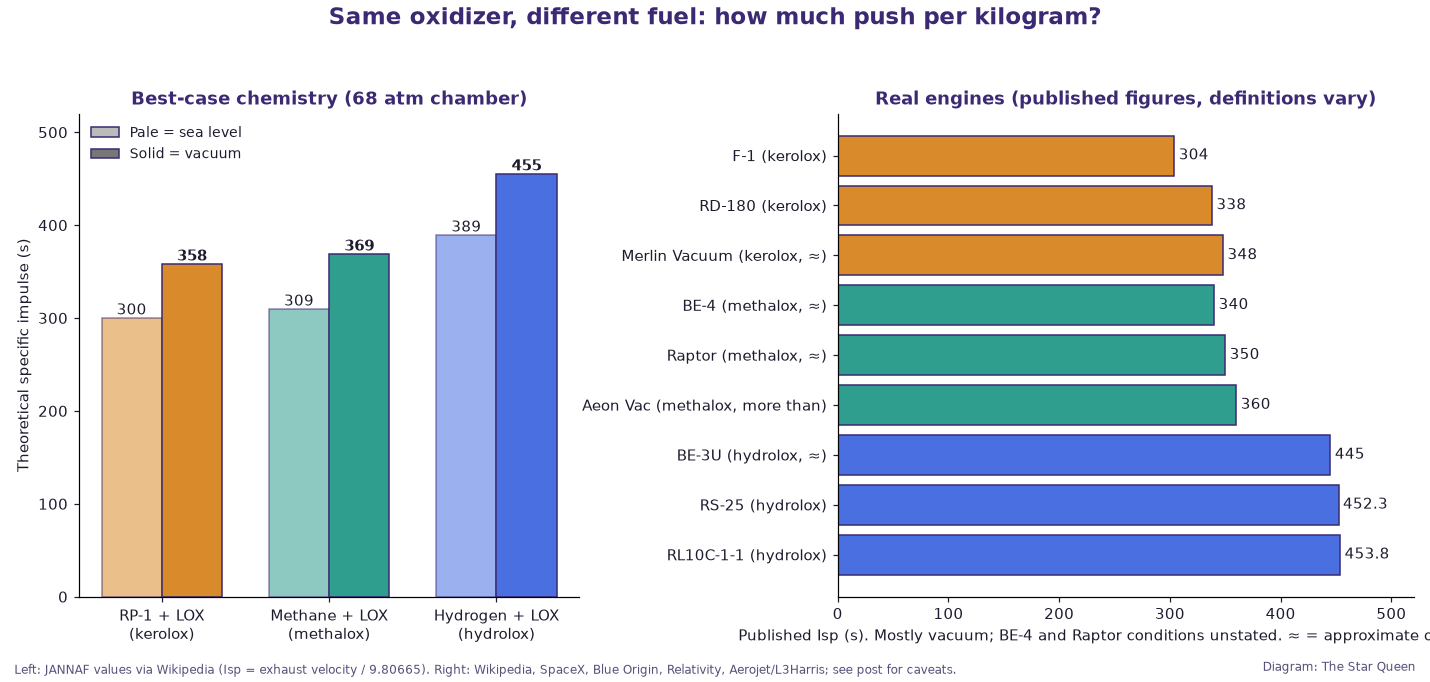
- Real kerolox engines span roughly 270 to 360 s of specific impulse (Wikipedia’s range). The F-1 made 304 s in vacuum; the RD-180 makes 338 s.
- A quick myth-bust: Relativity’s Aeon engines are not kerosene engines. They burn liquefied natural gas (methane). See my methane post.
Terms to know ✨
- RP-1: Rocket Propellant-1, kerosene made to a strict military specification (MIL-R-25576, now MIL-PRF-25576). Russian cousins are RG-1 and T-1.
- Kerolox: kerosene plus liquid oxygen as the two propellants.
- LOX: liquid oxygen, which boils at −183.0 °C. It is the oxidizer.
- Isp (specific impulse): seconds of thrust you get per unit of propellant weight flow. Higher means more efficient.
- Mixture ratio: mass of oxidizer divided by mass of fuel flowing into the engine.
- Coking: fuel breaking down on hot metal and leaving carbon or tar deposits.
- Regenerative cooling: running the fuel through channels in the chamber wall so it carries heat away before it burns.
- Gas generator (GG): a small side burner whose hot gas spins the turbopump, then is dumped overboard.
- Staged combustion: a cycle where turbine exhaust goes into the main chamber, so nothing is wasted.
- Subcooling: chilling a liquid below its normal temperature so it packs in denser.
- Density impulse: Isp times bulk density. It tells you how much “push” fits in a tank of a given size.
What Is RP-1, Chemically?
Kerosene is a mix of hydrocarbons, molecules made of carbon and hydrogen atoms. For RP-1 the typical molecule has about 12 carbon atoms, so a stand-in like dodecane (C₁₂H₂₆) is a good back-of-the-envelope model. Braeunig’s propellant tables use n-dodecane for kerosene, for exactly that reason.
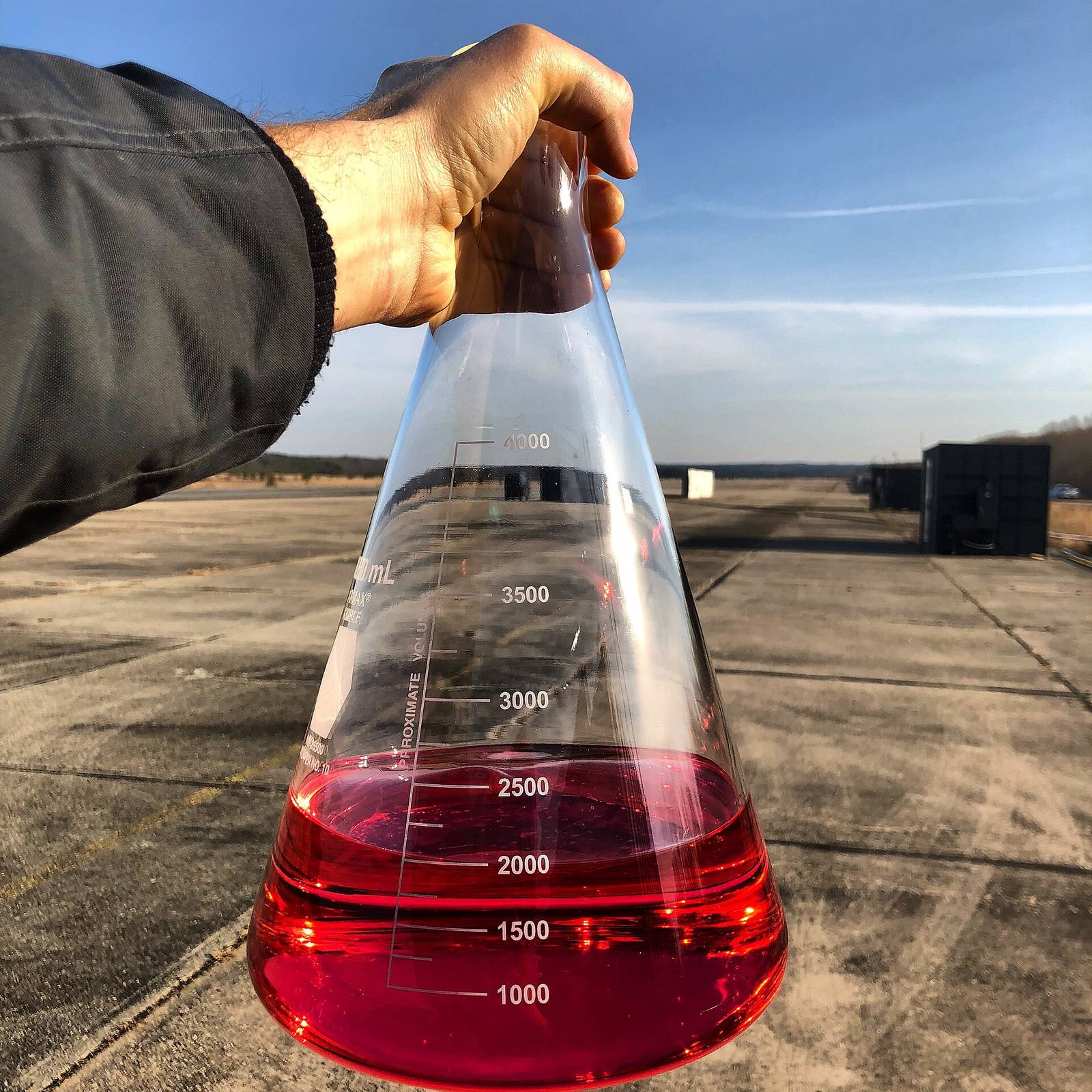
Burn it completely and you get carbon dioxide and water:
C₁₂H₂₆ + 18.5 O₂ → 12 CO₂ + 13 H₂O
That reaction needs about 3.5 kg of oxygen per kg of fuel (my arithmetic from the molar masses). Real engines run much leaner on oxygen. The JANNAF-style optimum is about 2.6 at sea level and 2.8 in vacuum, and the F-1 ran at 2.27 (Wikipedia). Why burn rich? Because oxygen atoms are heavy. Running with less oxygen leaves lighter exhaust molecules such as carbon monoxide and hydrogen, which fly out faster for the same heat. It also lowers temperatures, which helps the metal survive. Essentially every rocket does this.
So what makes RP-1 different from jet fuel?
RP-1 looks like Jet A or JP-8 but is made to stricter limits (Wikipedia):
- Tighter density and volatility ranges.
- Much lower sulfur, because sulfur attacks hot metal and promotes polymerization (gummy buildup).
- Fewer olefins and aromatics, the molecules that polymerize easily when hot or stored a long time.
- A selection of cyclic and highly branched molecules, which resist thermal breakdown better than straight chains.
All that refining is why it costs more than regular kerosene. Wikipedia notes it is typically made from a small number of high-quality crude sources, or synthesized, and that the small launch market keeps the price up. RP-2, with even lower sulfur, exists, but most customers are happy with RP-1, so it never caught on.
Why Bother? The Coking Problem
Early rockets burned alcohol, like the V-2. Alcohol has a high heat of vaporization and usually contains water, which kept engines cool. Hydrocarbons promised better performance, but they had a nasty surprise. As chamber pressures went up and engines got lighter, the fuel used as coolant got hotter. Raw kerosene dissociates and polymerizes: gas bubbles cause cavitation, and heavy waxy deposits block narrow cooling passages. Less coolant means hotter walls, which means more breakdown, which means even less coolant. That is thermal runaway, and it ends with a ruptured wall (Wikipedia, RP-1). In the mid-1950s, rocket designers asked chemists for a heat-resistant hydrocarbon. RP-1 was the answer.
How bad is coking, in numbers? NASA-sponsored heated-tube experiments in the early 1980s found substantial RP-1 deposits at wall temperatures of about 600 to 800 K, peaking near 700 K, at pressures of 136 to 340 atm. Nickel-plated tubes cut deposition. In the same study natural gas had the lowest deposition rate and propane the highest (NTRS 19840004157). That last result is one reason engineers eventually got interested in methane. I’ll get to that.
There is one upside of soot. Below a chamber pressure of about 1,000 psi (7 MPa), kerosene can leave a sooty layer on the chamber liner that insulates the wall and can reduce heat flow by roughly a factor of two (Wikipedia). Most modern kerolox engines run above that pressure, so it is not a big effect today.
Making, Storing and Handling It
It’s easy. RP-1 is a liquid at room temperature with a high flash point, so it is less of a fire hazard than gasoline (Wikipedia). It needs no insulation, no boil-off management and simple tanks. The tradeoff is that it needs a separate pressurant (typically helium or nitrogen) to push fuel out of the tank as it drains, which adds mass and cost, whereas cryogenic propellants can generate their own pressurizing gas by heating a bit of themselves (Wikipedia).
The LOX half is the real handling job. LOX boils at −183.0 °C, so it needs insulation, venting and careful cleaning, because oxygen makes contaminating oil or grease dangerous.
Subcooling. The Soviets discovered that chilling kerosene before loading made it denser. SpaceX revived the idea: every Falcon 9 since Full Thrust uses RP-1 chilled to −7 °C, for a 2.5 to 4% density increase (Wikipedia). More propellant in the same tanks is more delta-v. It works because kerosene is a liquid across such a wide temperature range (it boils at 177 to 274 °C), so there is lots of room to chill it without freezing it.
The Key Numbers
| Property | RP-1 + LOX | Source and label |
|---|---|---|
| RP-1 density | 0.81 to 0.82 g/mL (Russian RG-1/T-1: 0.82 to 0.85) | Wikipedia; Braeunig |
| LOX density | 1.14 g/mL | Braeunig |
| Bulk density (fuel and oxidizer together) | 1.03 g/mL | JANNAF, via Wikipedia |
| RP-1 boiling range | 177 to 274 °C | Braeunig |
| LOX boiling point | −183.0 °C | Braeunig |
| Best theoretical mixture ratio (O/F) | 2.58 sea level; 2.77 vacuum | JANNAF, via Wikipedia |
| Theoretical Isp (68 atm chamber) | about 300 s sea level; about 358 s vacuum | JANNAF, via Wikipedia (computed from exhaust velocity) |
| Chamber flame temperature | about 3,400 °C | JANNAF, via Wikipedia |
| Density impulse | 294 kg·s/L (sea level); about 369 (vacuum) | Braeunig; vacuum value is my arithmetic (358 × 1.03) |
| Real engine Isp range | 270 to 360 s | Wikipedia |
Two honesty notes. Braeunig’s sea-level Isp for kerosene is 289 s versus JANNAF’s 300 s, because they assume different things (Braeunig used n-dodecane), so compare within a source, not across. And “flame temperature” is a chamber figure; the walls survive it only because of cooling.
What does it cost?
Propellant prices are all over the place, and every source defines them differently. Here is what I found:
| Source | RP-1 | LOX |
|---|---|---|
| Marspedia, “Cost of transportation” (2016) | about $0.40/kg | about $0.16/kg |
| Spaceinsider (US defense moving-average prices) | about $2.3/kg | about $0.27/kg |
For a 100-tonne load at the vacuum mixture ratio (26.5 t RP-1 and 73.5 t LOX, my arithmetic), those prices give roughly $22,000 to $81,000 total. In other words, the propellant is a rounding error compared with the rocket. That is the whole reason you can afford to burn it. These are not launch-provider quotes; companies rarely publish what they pay.
The Engines, and Their Cycles
Kerolox engines come in two main flavors:
- Gas generator: simple and robust. The F-1 and Merlin work this way. A little fuel-rich exhaust is dumped overboard after spinning the turbine, so some propellant is spent without contributing full thrust. That is the efficiency cost, and the exhaust of that side burner is sooty.
- Oxygen-rich staged combustion: the Russian specialty. The RD-170 and RD-180 route all the oxygen through a preburner and then into the main chamber. That recovers the efficiency, but hot, oxygen-rich gas attacks metal, so these engines use special materials and coatings (the RD-180 uses enamel on oxygen-contact surfaces per Wikipedia). It took decades to master.
Everyday Astronaut has a great cycles primer if you want the plumbing from scratch (link in Sources).
F-1: the monster
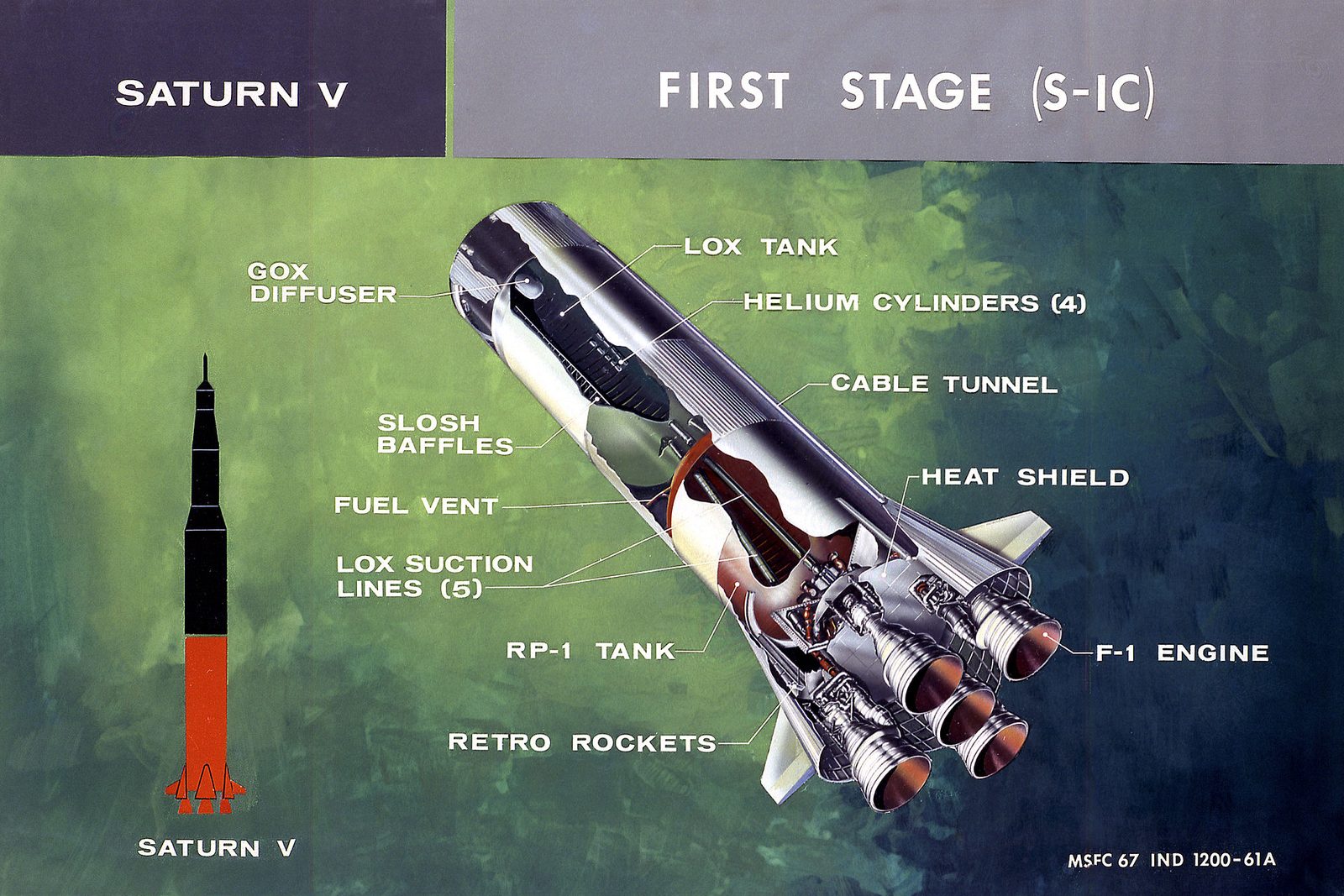
Five F-1 engines pushed the Saturn V’s first stage. Each one made about 1.5 million lbf, ran at a chamber pressure of about 70 bar, and had a mixture ratio of 2.27. At full flow, one F-1 consumed 1,738 lb/s of RP-1 and 3,945 lb/s of LOX (Wikipedia). That is about 2.6 tonnes of propellant every second per engine, or about 13 tonnes per second for all five (my arithmetic). Its Isp was 263 to 265 s at sea level and 304 s in vacuum.
RD-180 and RD-170
The RD-180 is a two-chamber oxygen-rich staged combustion engine that flies on Atlas V: 3,830 kN at sea level and 4,150 kN in vacuum, with 311 s and 338 s of Isp, and it can throttle from about 47% to 100%. The RD-170 is its four-chamber big brother: 7,250 and 7,900 kN, 309 and 337 s (Wikipedia). My full RD-180 deep dive has the story of its last six rockets.
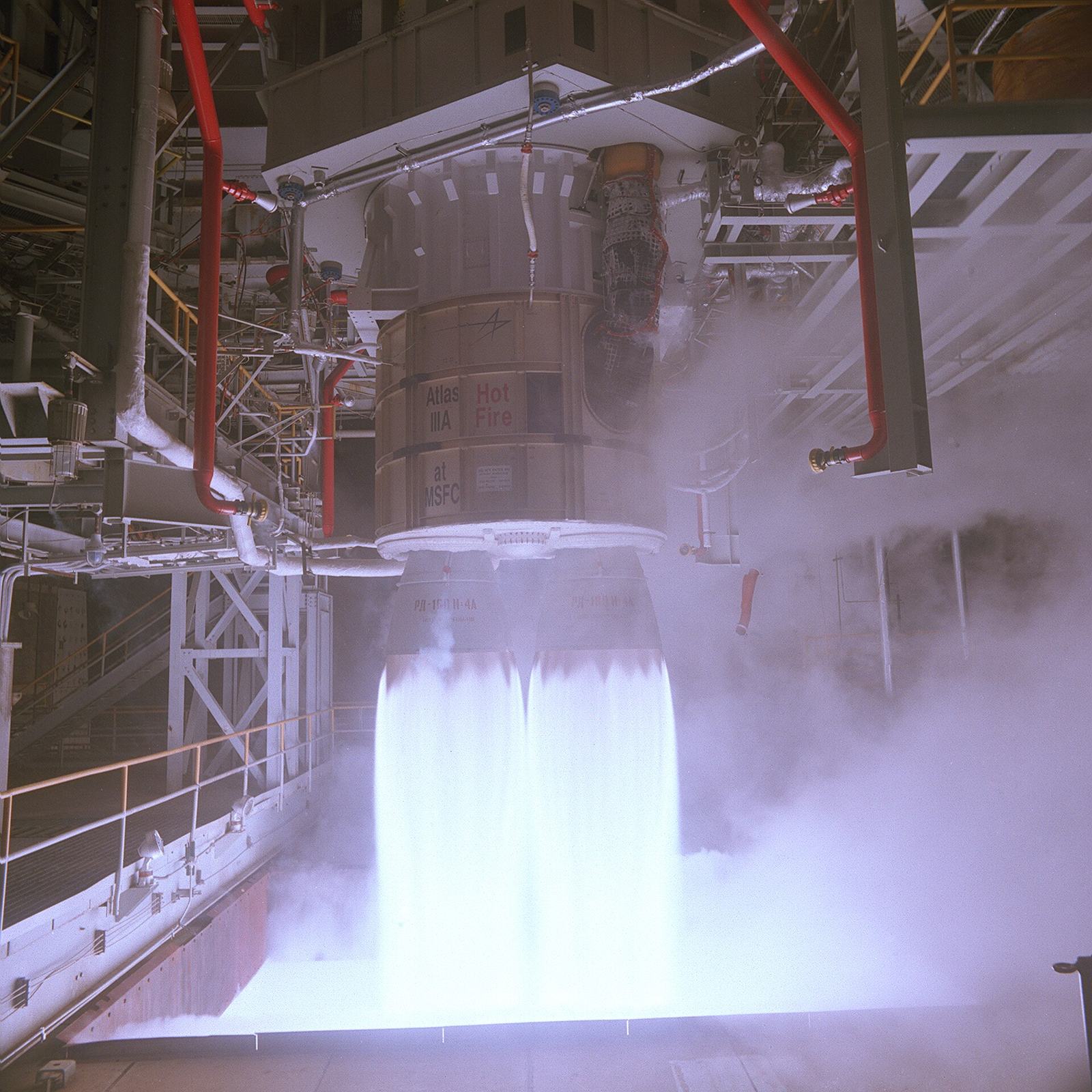
Merlin
SpaceX’s Merlin is a gas-generator kerolox engine, 845 kN at sea level and 981 kN in vacuum (Wikipedia). SpaceX has shown kerolox can be reused, but Wikipedia notes kerosene systems generally need more teardowns and overhauls, because even cold-flow tests can leave residues.
Which engines use it, and which do not
Here is the full roster of engines I track, with the kerolox ones starred ⭐. The other fuels get their own posts.
| Engine | Flies on | Propellants | Cycle | Headline numbers |
|---|---|---|---|---|
| Raptor | SpaceX Starship and Super Heavy | Methane + LOX | Full-flow staged combustion | Raptor 3: 250 tf sea level / 275 tf vacuum (SpaceX). Isp about 350 s, conditions unstated (SpaceX, Aug 2024) |
| Merlin 1D ⭐ | SpaceX Falcon 9 and Falcon Heavy | RP-1 + LOX | Gas generator | 845 kN sea level / 981 kN vacuum (Wikipedia). Merlin Vacuum about 348 s (Wikipedia, unofficial) |
| BE-4 | ULA Vulcan, Blue Origin New Glenn | Methane + LOX | Oxygen-rich staged combustion | 550,000 lbf class, uprated toward 640,000 lbf (625,000 lbf demonstrated). Isp about 340 s (Bezos, unofficial) |
| BE-3PM | Blue Origin New Shepard | Hydrogen + LOX | Tap-off | 110,000 lbf, throttles down to 20,000 lbf |
| BE-3U | Blue Origin New Glenn upper stage | Hydrogen + LOX | Expander bleed | 200,000 lbf listed (211,658 lbf demonstrated, Nov 2025). Isp about 445 s (Bezos, unofficial) |
| BE-7 | Blue Origin Blue Moon lander | Hydrogen + LOX | Dual expander | 10,000 lbf, throttles down to 2,000 lbf |
| RL10 | Centaur upper stage (Atlas V, Vulcan) | Hydrogen + LOX | Closed expander | RL10C-1-1: 23,825 lbf, 453.8 s |
| RD-180 ⭐ | ULA Atlas V first stage | RP-1 + LOX | Oxygen-rich staged combustion | 3,830 kN sea level / 4,150 kN vacuum; 311 s / 338 s |
| Aeon 1 | Relativity Terran 1 (retired) | LNG (methane) + LOX | Gas generator | About 23,000 lbf sea level (my arithmetic); more than 310 s (Relativity) |
| Aeon R | Relativity Terran R | Methane + LOX | “Uniquely high-pressure” gas generator | 269,000 lbf sea level; Isp not published |
| Zenith | Stoke Space Nova booster | LNG (methane) + LOX | Full-flow staged combustion | More than 100,000 lbf; 345 s (Stoke, conditions unstated) |
| Andromeda | Stoke Space Nova upper stage | Hydrogen + LOX | “Expander cycle” (Stoke wording) | Pathfinder: 25,000+ lbf and 400+ s (Stoke) |
| Draco and SuperDraco | SpaceX Dragon | MMH + NTO (hypergolic) | Pressure-fed | Draco about 400 N; SuperDraco about 71 kN |
| F-1 (context) ⭐ | Saturn V first stage (S-IC) | RP-1 + LOX | Gas generator | 1.5 Mlbf; 263-265 s sea level / 304 s vacuum |
| RD-170 (context) ⭐ | Energia boosters, Zenit | RP-1 + LOX | Oxygen-rich staged combustion | 7,250 kN sea level / 7,900 kN vacuum; 309 s / 337 s |
| RS-25 (context) | Space Shuttle, SLS core stage | Hydrogen + LOX | Fuel-rich staged combustion | 418,000 lbf sea level / 512,300 lbf vacuum; 366 s / 452.3 s |
| Vulcain (context) | Ariane 5 and Ariane 6 core stage | Hydrogen + LOX | Gas generator | Vulcain 2.1 cut nozzle part count by 90% and cost by 40% (Wikipedia) |
| Vinci (context) | Ariane 6 upper stage | Hydrogen + LOX | Expander | 180 kN |
| LE-9 (context) | Japan H3 first stage | Hydrogen + LOX | Expander bleed | 1,471 kN (Wikipedia) |
| TQ-12 (context) | LandSpace Zhuque-2 | Methane + LOX | Gas generator | Designed for 670 kN at sea level; Zhuque-2 reached orbit in July 2023 (Wikipedia) |
A note about Aeon: if you see Relativity’s Aeon 1 or Aeon R in a “kerosene engine” list, that’s wrong. Relativity’s Aeon 1 burns liquefied natural gas and LOX, and Aeon R burns methane and LOX. Draco and SuperDraco use a hypergolic pair, not kerolox. I explain that in my Draco post and the hypergolics post.
Safety and Ground Handling
Kerolox is the friendly one. RP-1 is not cryogenic, not especially volatile, and far less toxic than hydrazine (Wikipedia). The real hazards:
- LOX contact. Anything that burns will burn much faster in pure oxygen. Hardware that touches LOX must be cleaned to a strict standard.
- Fires. Wikipedia notes that hydrogen fires are less damaging than kerosene fires, because hydrogen rises quickly. A big kerolox failure means a fireball and heavy, sooty smoke.
- Residues. After shutdown the engine is still hot while the fuel flow has stopped, which can leave tar and carbon (Wikipedia). That residue matters more for engines you want to reuse.
- Environment. Burning any hydrocarbon makes CO₂, carbon monoxide and soot; hydrogen makes mainly water (Wikipedia).
A Short History
- 1920s to 1940s. Goddard flew gasoline rockets; alcohol fueled large early rockets (Wikipedia).
- Mid-1950s. Coking forced a rethink, and RP-1 was specified. Atlas and Titan I were designed around it. Rocketdyne experimented with a better molecule, diethyl cyclohexane, but it was not finished in time (Wikipedia).
- 1960s. RP-1 becomes the first-stage fuel of Saturn I, IB and V. The Saturn V first stage with five F-1s lifted Apollo, including Apollo 11 on July 16, 1969.
- Soviet and Russian line. RG-1 and T-1, plus the experimental syntin for upper stages, an energetic fuel used briefly (Wikipedia).
- 2010s onward. SpaceX subcools RP-1 for Falcon 9; Electron and Antares also burn it, and India is developing an RP-1 engine called SE-2000 (Wikipedia). New heavy designs have mostly moved to methane.
Pros and Cons
Pros
- ✅ Dense. Small, light tanks with no insulation, and the best density impulse of the three big fuels (294 kg·s/L versus 235 for methane and 124 for hydrogen, Braeunig).
- ✅ Storable at room temperature. Easy to load and hold on the pad.
- ✅ Cheap, well understood, and low toxicity compared with hydrazine.
Cons
- ⚠️ Lower Isp. Roughly 270 to 360 s versus 370 to 465 s for hydrogen engines (Wikipedia).
- ⚠️ Coking. Needs special engineering to avoid cooling channel clogging.
- ⚠️ Needs a separate pressurant system, which adds mass.
- ⚠️ Limited suppliers of true rocket-grade kerosene (Wikipedia).
Watch: Kerolox in Motion 🎥
Scott Manley explains what rocket fuel really is, and why the options behave so differently:
Can’t see the video? Watch it on YouTube: WTF is Rocket Fuel Anyway? (Scott Manley)
And here is a deep look at how the F-1 is started, from the same channel:
Can’t see the video? Watch it on YouTube: How To Start The Massive F-1 Rocket Engine – Explaining 'Ignition Sequence Start' (Scott Manley)
The Star Queen’s Take
Kerolox is the fuel that got us to the Moon, and I will always love it for that. 🌙 It is the “boring” choice in the best sense: dense, forgiving at the pad, and cheap enough that nobody worries about the fuel bill. What it asks in return is clever plumbing to keep the engine from coking itself to death, and it settles for modest efficiency.
My scorecard: kerolox is not dead, but it is no longer the default for new big boosters. Methane trades a bit of density for cleaner burning; hydrogen wins in space. And if someone tells you Relativity burns kerosene, you know what to say. 😄
Also see: Beyond the Big Five: Hybrids, Green Monopropellants and the Propellant Cheat Sheet, Liquid Methane Rocket Fuel Explained, Liquid Hydrogen Rocket Fuel Explained, Hypergolic Propellants Explained, and Solid Rocket Propellant Explained. 🚀
Sources
- Wikipedia, RP-1 (history, formulation, density, subcooling, comparison with other fuels): https://en.wikipedia.org/wiki/RP-1
- Wikipedia, Liquid-propellant rocket (JANNAF performance table): https://en.wikipedia.org/wiki/Liquid-propellant_rocket
- Braeunig, Rocket Propellants (densities, boiling points, density impulse): http://www.braeunig.us/space/propel.htm
- NASA NTRS, Deposit formation and heat transfer in hydrocarbon rocket fuels (19840004157): https://ntrs.nasa.gov/citations/19840004157
- NASA NTRS, Deposit formation in hydrocarbon rocket fuels (19810021741): https://ntrs.nasa.gov/citations/19810021741
- NASA NTRS, Uncertainty analysis on heat transfer correlations for RP-1 fuel in copper tubing (20040076962): https://ntrs.nasa.gov/citations/20040076962
- Wikipedia, Rocketdyne F-1: https://en.wikipedia.org/wiki/Rocketdyne_F-1
- Wikipedia, RD-180 and RD-170: https://en.wikipedia.org/wiki/RD-180 and https://en.wikipedia.org/wiki/RD-170
- Everyday Astronaut, Rocket engine cycles: https://everydayastronaut.com/rocket-engine-cycles/
- Wikipedia, Merlin (rocket engine family): en.wikipedia.org/wiki/Merlin_(rocket_engine_family)
- Marspedia, Cost of transportation: https://marspedia.org/Cost_of_transportation
- Spaceinsider, How much does rocket fuel cost: https://spaceinsider.tech/2023/06/13/how-much-does-rocket-fuel-cost/
- Relativity Space, Aeon R and Terran R (methane/LOX): https://www.relativityspace.com/terran-r
- Relativity Space, Terran 1 (archived, LNG/LOX Aeon 1): https://web.archive.org/web/20201122215131/https://www.relativityspace.com/terran
- Scott Manley on YouTube (videos embedded above)
- Images: NASA via Wikimedia Commons (F-1, S-IC cutaway, RD-180); RP-1 flask photo by Maxhaot, CC BY-SA 4.0