By The Star Queen · Star Queen Chronicles
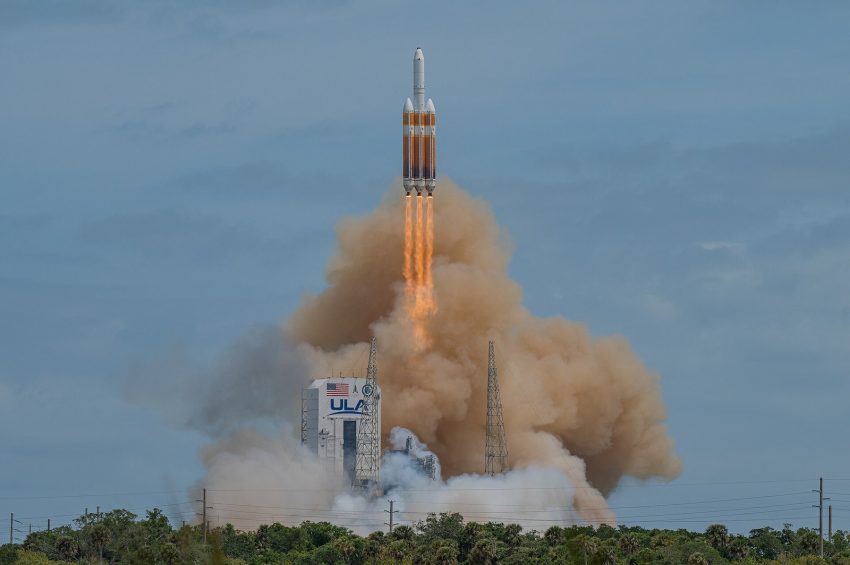
The final launch of a Delta IV Heavy, April 9, 2024. Its three RS-68A engines burned liquid hydrogen and liquid oxygen. Image: U.S. Space Force photo by Senior Airman Dakota Raub (public domain, via Wikimedia Commons)
My loves, meet the diva of rocket fuels. 💎 Liquid hydrogen is the lightest, coldest and most efficient of the common propellants, and it is also the one that leaks through the tiniest gap, burns with a flame you cannot see, and takes up three times the tank volume of kerosene. Engineers have been wrestling with it since the 1950s. They keep coming back to it, because nothing else gives you so much push for each kilogram of propellant.
Everything here is as of October 26, 2026. I label numbers as official, reported, unofficial, or my arithmetic, and I flag conflicts. This is part three of my fuels series, after RP-1 kerosene and liquid methane.
The Short Version
- Hydrolox is liquid hydrogen (LH₂) plus liquid oxygen (LOX). The only exhaust product is water.
- Theoretical vacuum Isp is about 455 s, versus 369 s for methane and 358 s for kerosene. Real engines reach about 445 to 460 s.
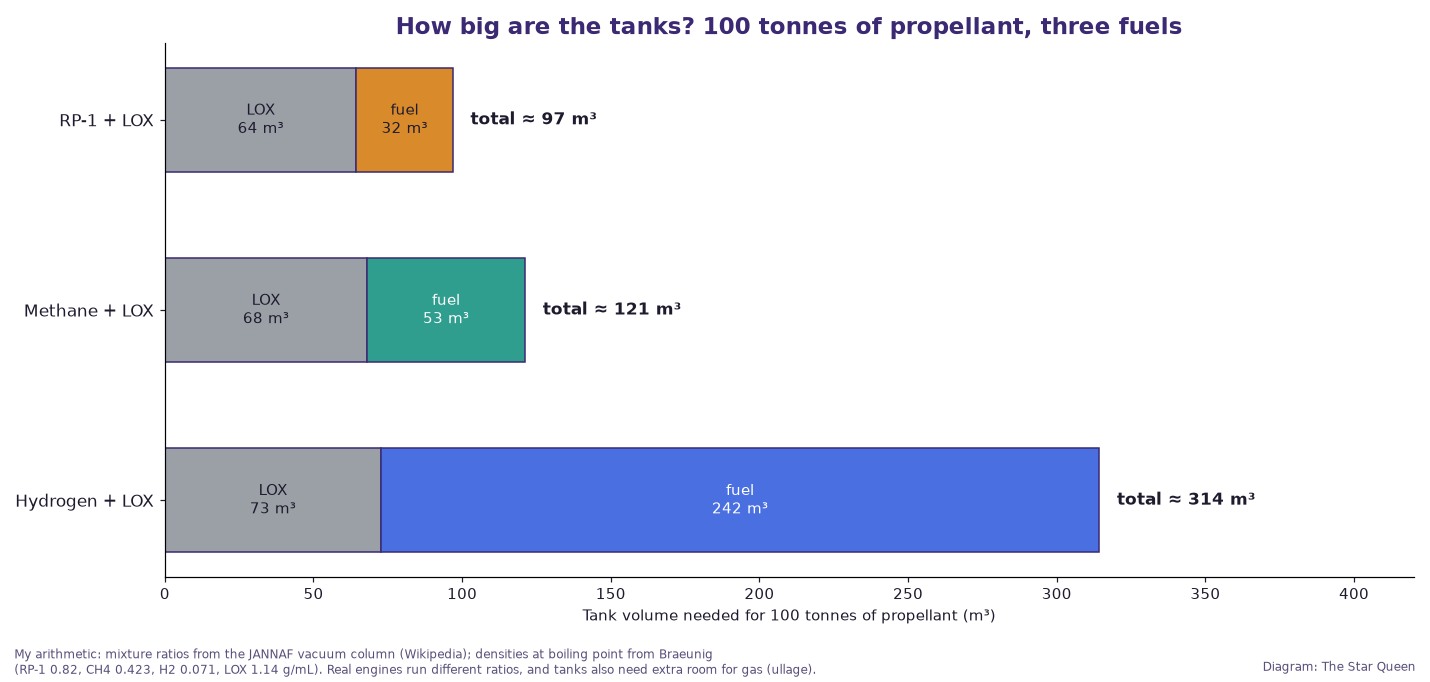
- The price: LH₂ boils at −252.9 °C and has a density of only 0.071 g/mL. For the same propellant mass, tanks are about three times bigger than kerosene tanks (my arithmetic).
- It boils off, leaks, embrittles some metals, and burns with a nearly invisible flame.
- It is the champion of upper stages, where efficiency matters most and thrust matters least.
Terms to know ✨
- Hydrolox: liquid hydrogen and liquid oxygen as the two propellants.
- LH₂ / GH₂: liquid hydrogen / gaseous hydrogen.
- Cryogenic: stored at extremely low temperatures. LH₂ is about as cold as liquids get, just 20 K above absolute zero.
- Boil-off: propellant lost as it warms up and turns to gas.
- Ortho- and parahydrogen: two forms of the H₂ molecule that differ in how the nuclei spin. Room-temperature hydrogen is 75% ortho; converting to para releases heat.
- Hydrogen embrittlement: hydrogen entering a metal and making it crack or lose strength.
- Expander cycle: an engine cycle where heat from the chamber walls boils the fuel, and that expanding gas spins the turbines. No burner is needed.
- Staged combustion: a cycle that burns turbine exhaust in the main chamber, with no overboard dumping.
- Isp (specific impulse): seconds of thrust per unit of propellant weight flow.
- Upper stage: the stage that does the final push to orbit or beyond.
- LFL / UFL: lower and upper flammability limits, the fuel-to-air percentages between which a mix can burn.
Chemistry: Why It Wins on Efficiency
The reaction is as simple as chemistry gets:
2 H₂ + O₂ → 2 H₂O
Burned perfectly, that needs 8 kg of oxygen per kg of hydrogen (my arithmetic: 32 g O₂ per 4 g H₂). But engines run very fuel-rich. JANNAF’s optimum is only about 4.1 at sea level and 4.8 in vacuum (Wikipedia). That means roughly 40 to 50% of the hydrogen leaves the nozzle unburned (my arithmetic, comparing 4.1 to 4.8 with the perfect-burn ratio of 8). Why? Because the lighter the exhaust molecules, the faster they leave. Wikipedia puts it this way: practical H₂/O₂ engines run fuel-rich so the exhaust contains some unburned hydrogen, which reduces chamber erosion and also lowers the exhaust molecular weight, which can increase specific impulse despite the incomplete combustion.
Notice the temperature too. JANNAF’s chamber temperature for hydrolox is about 2,740 to 2,980 °C, cooler than methane (about 3,260 to 3,290 °C) or kerosene (about 3,400 °C). Hydrolox wins on molecular weight, not on heat.
Making, Storing and Handling It
Making. Industrial hydrogen is liquefied by compression and cooling (Wikipedia). It must be cooled to 20.28 K (−252.87 °C) at atmospheric pressure. The theoretical minimum energy is 3.3 kWh/kg (3.9 including conversion to parahydrogen), but existing plants use 10 to 13 kWh/kg, compared with hydrogen’s own heating value of about 33 kWh/kg (Wikipedia). By my arithmetic that is roughly 30 to 40% of the energy you ultimately get back, spent on just chilling it.
The ortho/para trick. Normal room-temperature hydrogen is 75% orthohydrogen. At cryogenic temperatures it slowly converts to the more stable para form, and that releases enough heat to boil some of the liquid away. So plants convert it on purpose during liquefaction, using a catalyst, so the stored liquid stays calm (Wikipedia).
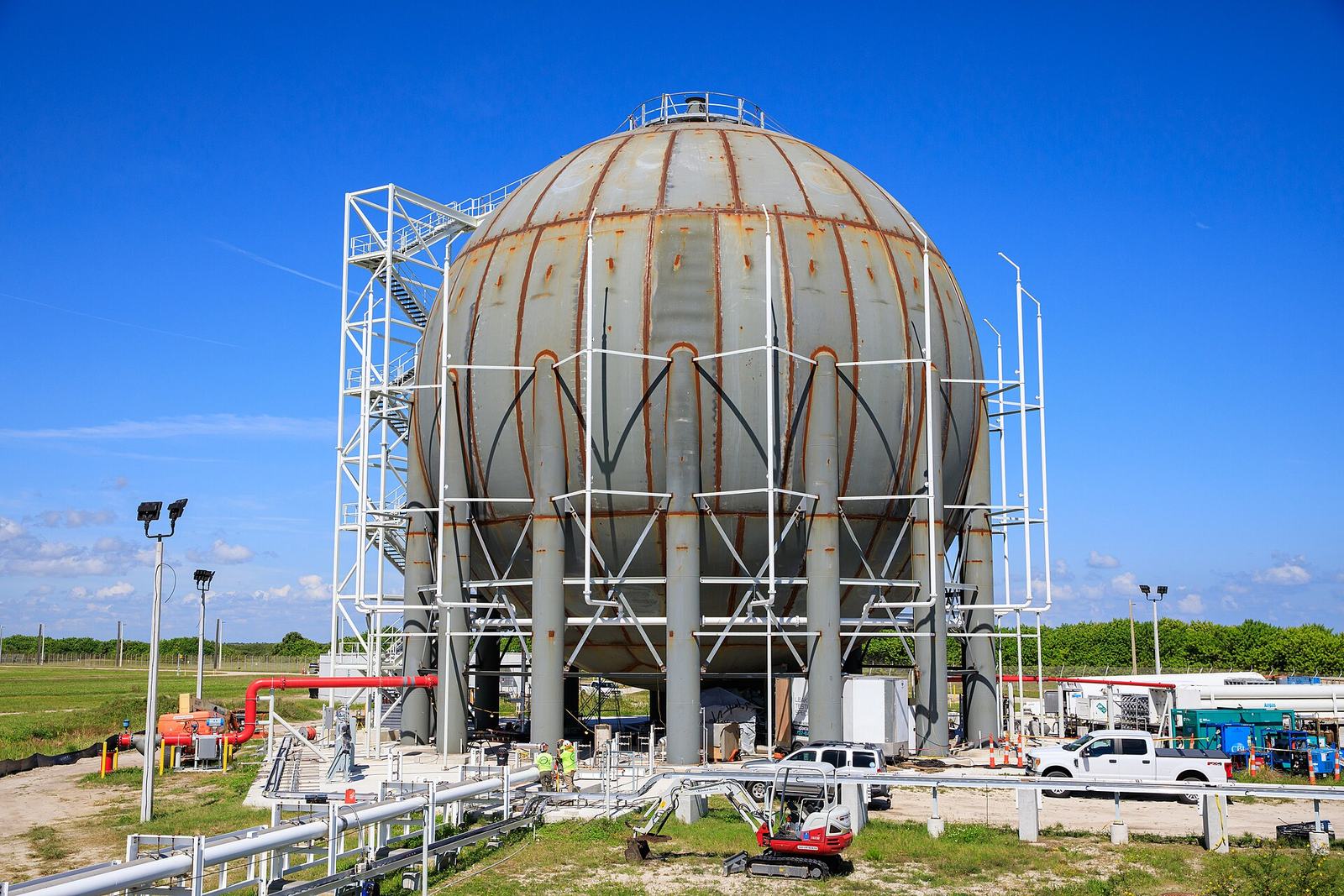
Storing. Even in well-insulated vessels, LH₂ gradually leaks away, typically at about 1% per day (Wikipedia). Big sphere tanks like the one below hold the supply at launch pads; Wikipedia says NASA and the U.S. Air Force operate tanks up to 3.8 million liters (1 million gallons).
Insulating. Hydrogen is colder than oxygen’s boiling point, so insulation that leaks can let air condense on the outside, enriching it with oxygen and creating a fire hazard (Wikipedia). Rockets carry thick insulation, and tank walls often do double duty as structure (my general observation).
The temperature ladder
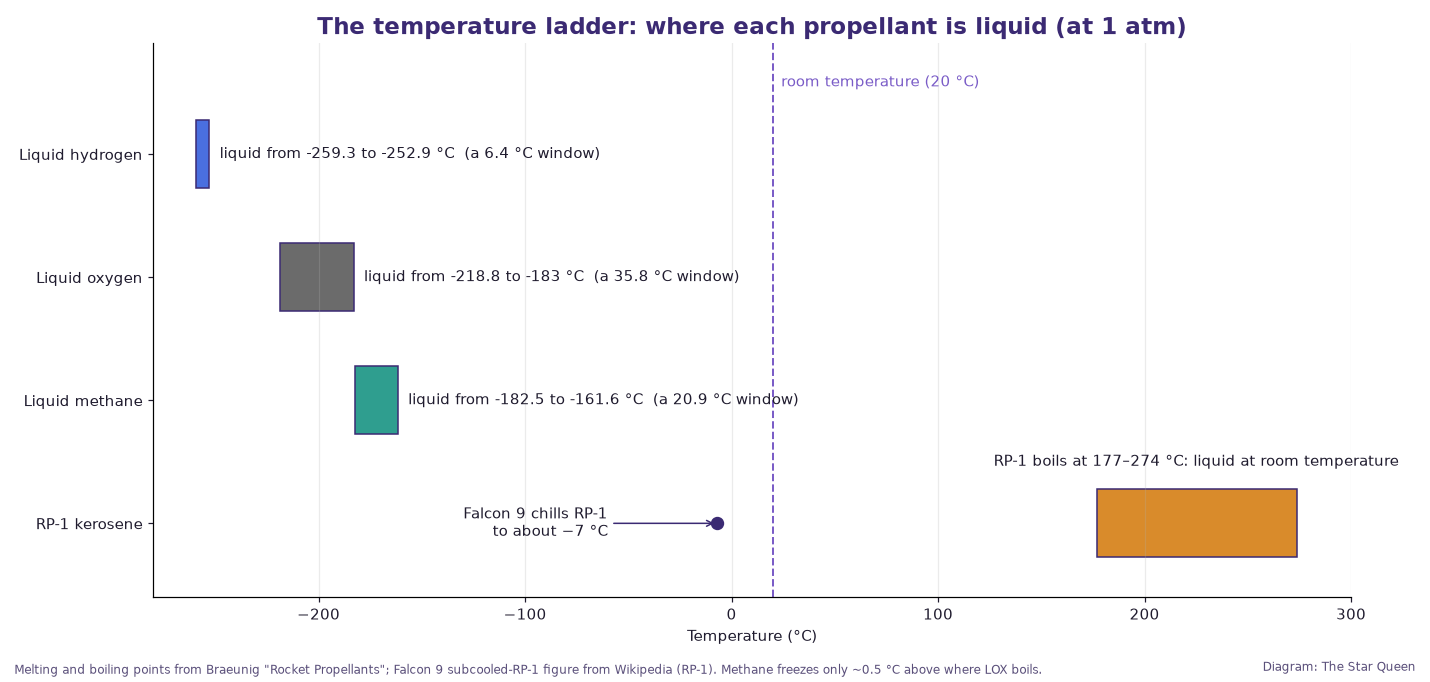
Here is how hydrogen compares with its partners. Hydrogen’s liquid range is tiny: it melts at −259.3 °C and boils at −252.9 °C, a window of only about 6 °C (Braeunig).
The Key Numbers
| Property | Hydrogen + LOX | Source and label |
|---|---|---|
| LH₂ density | 0.071 g/mL (70.85 kg/m³ at 20 K) | Braeunig; Wikipedia |
| LH₂ boiling / melting point | −252.9 °C (20.28 K) / −259.3 °C | Braeunig; Wikipedia |
| Bulk density (fuel and LOX together) | 0.29 to 0.32 g/mL | JANNAF, via Wikipedia |
| Best theoretical mixture ratio (O/F) | 4.13 sea level; 4.83 vacuum | JANNAF, via Wikipedia |
| Theoretical Isp (68 atm chamber) | about 389 s sea level; about 455 s vacuum | JANNAF, via Wikipedia |
| Chamber flame temperature | about 2,740 °C sea level; about 2,980 °C vacuum | JANNAF, via Wikipedia |
| Density impulse | 124 kg·s/L (sea level, at mixture ratio 5); about 146 (vacuum) | Braeunig; vacuum value is my arithmetic (455 × 0.32) |
| Real engine Isp range | 370 to 465 s | Wikipedia |
| Flammability in air | 4.1 to 74.8% | NASA safety standard |
| Minimum ignition energy | about 0.017 mJ | NASA safety standard |
Compare that density impulse with kerosene’s 294: hydrogen’s is less than half. That is the tradeoff in a single number.
What does it cost?
Propellant prices vary a lot by source and definition:
| Source | LH₂ | LOX |
|---|---|---|
| Marspedia, “Cost of transportation” (2016) | about $3/kg | about $0.16/kg |
| Spaceinsider (US defense moving-average prices) | about $6.1/kg (up to $30.5) | about $0.27/kg |
| NASA liquid hydrogen contracts (my arithmetic from ceiling values) | about $8.7/kg (2025 contract) to about $22/kg (2022 contract) | not applicable |
For the NASA numbers, I divided each contract’s maximum value by its maximum quantity: the 2022 Kennedy contract was up to 7.5 million pounds for about $75 million, and the 2025 contract about 36.5 million pounds for about $144.4 million. Those are ceilings, not unit prices. For 100 tonnes of hydrogen-oxygen propellant at vacuum mixture ratio (17.2 t hydrogen and 82.8 t LOX, my arithmetic), the sources give about $65,000 to $127,000 using the commodity prices, or about $170,000 to $400,000 with the NASA contract numbers. Hydrogen is clearly the priciest of the three, though still small next to the rocket.
Why Hydrogen Goes on Upper Stages
The rocket equation explains it. Δv = Isp × g₀ × ln(m₀/m_f). For the same mass ratio of 5, 360 s of Isp gives about 5,680 m/s, and 450 s gives about 7,100 m/s (my arithmetic). That is an extra 1,400 m/s for free. On an upper stage, every kilogram of stage mass subtracts from payload one-for-one, and the stage flies where drag is gone and a long, gentle burn is fine. A bulky tank is easier to live with there than on a first stage that must punch through the atmosphere and lift everything above it.
Wikipedia describes the usual solution: use kerosene on the first stage where thrust matters most, and hydrogen on upper stages where Isp matters more, as on the Saturn V and Atlas V. Methane is pushing into the first-stage role, but upper stages are where hydrogen still shines.
The Engines and Their Cycles
Hydrogen is a great coolant and a light, easily expanded gas, which makes some cycles possible that other fuels cannot easily use:
- RL10 (Aerojet Rocketdyne/L3Harris): the first LH₂ engine built in the United States; closed expander cycle; first ground test 1959, first successful flight November 27, 1963 on an Atlas/Centaur (Wikipedia). RL10C-1-1: 23,825 lbf and 453.8 s. See my RL10 post.
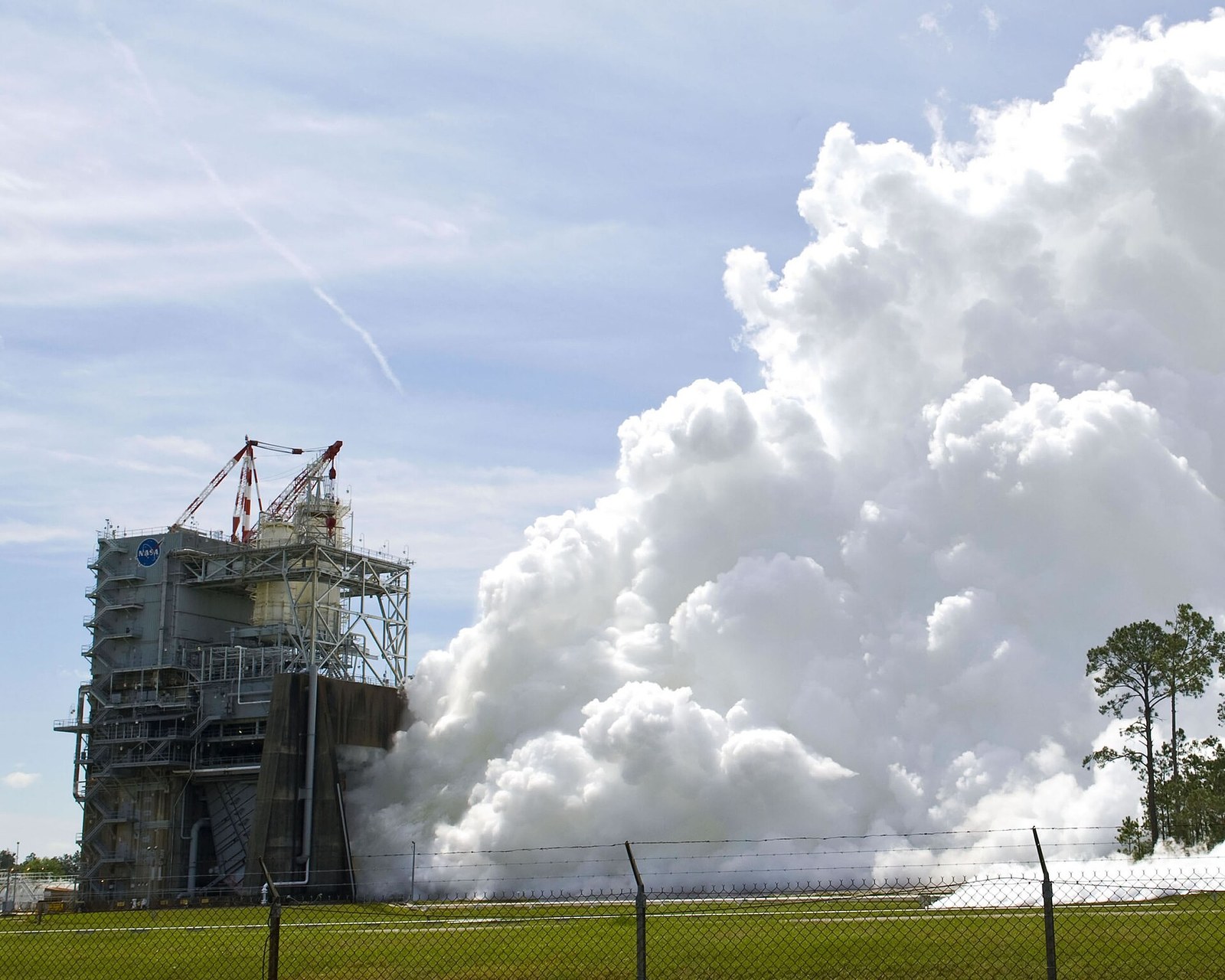
- RS-25: the Space Shuttle main engine, with fuel-rich staged combustion. 366 s at sea level and 452.3 s in vacuum; 418,000 lbf at sea level and 512,300 lbf in vacuum (Wikipedia).
- BE-3PM and BE-3U (Blue Origin): a tap-off cycle for New Shepard and an expander bleed for New Glenn’s upper stage. See my BE-3 post. Blue reports a BE-3U test demonstrating 211,658 lbf, and New Glenn’s two BE-3Us are planned to reach 400,000 lbf in total (Blue Origin, November 20, 2025).
- BE-7: a dual-expander engine for the Blue Moon lander. See my BE-7 post.
- Andromeda (Stoke Space): LH₂/LOX, built into a heat shield; Pathfinder 25,000+ lbf and 400+ s, with an “expander cycle.” See my Andromeda post.
- Vulcain (Europe): a gas-generator hydrolox engine for the first stage of Ariane 5 and Ariane 6. The Vulcain 2.1 version cut nozzle part count by 90%, cost by 40% and production time by 30% (Wikipedia).
- RS-68 / RS-68A: the gas-generator engine for Delta IV, 411.9 s vacuum for the RS-68A (Wikipedia). Its first flight was November 20, 2002, and its last was April 9, 2024.
- LE-9 (Japan): expander bleed, 1,471 kN. Wikipedia’s LE-9 page notes it is physically difficult for an expander bleed engine to generate large thrust, which makes 1,471 kN a milestone.
- J-2: Saturn V’s hydrogen engine, 421 s vacuum (Wikipedia).
Which engines use it?
Here is my full roster; hydrolox engines are starred ⭐:
| Engine | Flies on | Propellants | Cycle | Headline numbers |
|---|---|---|---|---|
| Raptor | SpaceX Starship and Super Heavy | Methane + LOX | Full-flow staged combustion | Raptor 3: 250 tf sea level / 275 tf vacuum (SpaceX). Isp about 350 s, conditions unstated (SpaceX, Aug 2024) |
| Merlin 1D | SpaceX Falcon 9 and Falcon Heavy | RP-1 + LOX | Gas generator | 845 kN sea level / 981 kN vacuum (Wikipedia). Merlin Vacuum about 348 s (Wikipedia, unofficial) |
| BE-4 | ULA Vulcan, Blue Origin New Glenn | Methane + LOX | Oxygen-rich staged combustion | 550,000 lbf class, uprated toward 640,000 lbf (625,000 lbf demonstrated). Isp about 340 s (Bezos, unofficial) |
| BE-3PM ⭐ | Blue Origin New Shepard | Hydrogen + LOX | Tap-off | 110,000 lbf, throttles down to 20,000 lbf |
| BE-3U ⭐ | Blue Origin New Glenn upper stage | Hydrogen + LOX | Expander bleed | 200,000 lbf listed (211,658 lbf demonstrated, Nov 2025). Isp about 445 s (Bezos, unofficial) |
| BE-7 ⭐ | Blue Origin Blue Moon lander | Hydrogen + LOX | Dual expander | 10,000 lbf, throttles down to 2,000 lbf |
| RL10 ⭐ | Centaur upper stage (Atlas V, Vulcan) | Hydrogen + LOX | Closed expander | RL10C-1-1: 23,825 lbf, 453.8 s |
| RD-180 | ULA Atlas V first stage | RP-1 + LOX | Oxygen-rich staged combustion | 3,830 kN sea level / 4,150 kN vacuum; 311 s / 338 s |
| Aeon 1 | Relativity Terran 1 (retired) | LNG (methane) + LOX | Gas generator | About 23,000 lbf sea level (my arithmetic); more than 310 s (Relativity) |
| Aeon R | Relativity Terran R | Methane + LOX | “Uniquely high-pressure” gas generator | 269,000 lbf sea level; Isp not published |
| Zenith | Stoke Space Nova booster | LNG (methane) + LOX | Full-flow staged combustion | More than 100,000 lbf; 345 s (Stoke, conditions unstated) |
| Andromeda ⭐ | Stoke Space Nova upper stage | Hydrogen + LOX | “Expander cycle” (Stoke wording) | Pathfinder: 25,000+ lbf and 400+ s (Stoke) |
| Draco and SuperDraco | SpaceX Dragon | MMH + NTO (hypergolic) | Pressure-fed | Draco about 400 N; SuperDraco about 71 kN |
| F-1 (context) | Saturn V first stage (S-IC) | RP-1 + LOX | Gas generator | 1.5 Mlbf; 263-265 s sea level / 304 s vacuum |
| RD-170 (context) | Energia boosters, Zenit | RP-1 + LOX | Oxygen-rich staged combustion | 7,250 kN sea level / 7,900 kN vacuum; 309 s / 337 s |
| RS-25 (context) ⭐ | Space Shuttle, SLS core stage | Hydrogen + LOX | Fuel-rich staged combustion | 418,000 lbf sea level / 512,300 lbf vacuum; 366 s / 452.3 s |
| Vulcain (context) ⭐ | Ariane 5 and Ariane 6 core stage | Hydrogen + LOX | Gas generator | Vulcain 2.1 cut nozzle part count by 90% and cost by 40% (Wikipedia) |
| Vinci (context) ⭐ | Ariane 6 upper stage | Hydrogen + LOX | Expander | 180 kN |
| LE-9 (context) ⭐ | Japan H3 first stage | Hydrogen + LOX | Expander bleed | 1,471 kN (Wikipedia) |
| TQ-12 (context) | LandSpace Zhuque-2 | Methane + LOX | Gas generator | Designed for 670 kN at sea level; Zhuque-2 reached orbit in July 2023 (Wikipedia) |
Note that Draco and SuperDraco burn a hypergolic pair, not hydrogen; see my Draco post and my hypergolics post. Relativity’s Aeon engines and Raptor, BE-4 and Zenith burn methane; Merlin and RD-180 burn kerosene.
Safety, Leaks and Embrittlement
- Cold burns and asphyxiation. LH₂ is a cold-burn hazard. Hydrogen itself is not toxic, but it can displace oxygen (Wikipedia).
- Invisible flame. NASA’s safety standard says hydrogen flames are nearly invisible and not visible in daylight, so special imaging is needed to find a fire.
- Wide flammability, tiny ignition energy. From 4.1 to 74.8% in air, and a spark of about 0.017 mJ can ignite it (NASA safety standard).
- Heavier than air, briefly. Hydrogen gas that has just boiled off from liquid is so cold it is heavier than air and can form flammable layers near the ground (Wikipedia).
- Air condensing. Cold surfaces can liquefy or solidify the air around them, enriching it in oxygen (Wikipedia).
- Embrittlement. Hydrogen can degrade the mechanical properties of metals; the NASA standard lists several forms, and effects are most pronounced in particular temperature ranges and in high-strength alloys such as some steels and titanium and nickel alloys. Material choice is a design discipline all by itself.
- Leaks. Hydrogen is the smallest molecule and slips through tiny gaps. NASA’s own Artemis I countdown showed it: on September 3, 2022, the launch attempt was scrubbed after a liquid hydrogen leak at the tail-service-mast umbilical quick-disconnect (NASA mission blog). Ars Technica wrote that NASA had rediscovered the perils of liquid hydrogen “years after Shuttle.”
- Upside. Hydrogen fires are less damaging than kerosene fires, since the fire rises quickly (Wikipedia).
A Short History
- 1898. James Dewar liquefies hydrogen using regenerative cooling and his invention, the vacuum flask (Wikipedia).
- 1959 to 1963. The RL10 is first tested on the ground (1959) and flies successfully on Centaur on November 27, 1963.
- Saturn era. The J-2 puts hydrogen in the upper stages of Saturn IB and Saturn V.
- Space Shuttle. RS-25 main engines, burning hydrogen and oxygen from the big orange external tank.
- 2002 to 2024. Delta IV flies on RS-68 and RS-68A engines; Delta IV Heavy’s final launch is NROL-70 on April 9, 2024.
- Today. RL10 on Vulcan’s Centaur V; RS-25 on SLS; BE-3U on New Glenn; Vulcain and Vinci on Ariane 6; LE-9 on Japan’s H3; Andromeda and BE-7 in development.
Pros and Cons
Pros
- ✅ Best Isp of the common chemical propellants: about 445 to 460 s for the best real engines.
- ✅ Clean exhaust. Mainly water, with no soot or coking.
- ✅ Superb coolant, which enables expander cycles that need no burner.
- ✅ Fires rise away from the ground faster than kerosene fires (Wikipedia).
- ✅ Ideal for upper stages.
Cons
- ⚠️ Very low density. Big tanks, big insulation, big dry mass: about 314 m³ of tank per 100 t of propellant versus about 97 for kerosene (my arithmetic).
- ⚠️ Extremely cold. Boil-off, venting and slow-leak problems, about 1% a day at best in storage.
- ⚠️ Leaks and embrittlement. Needs careful materials and sealing.
- ⚠️ Invisible flame and huge flammability range.
- ⚠️ Expensive and energy-hungry to make (10 to 13 kWh/kg to liquefy in existing plants).
- ⚠️ Tricky to start (Everyday Astronaut) and hard to hold in space for long without active cooling or boil-off losses.
Watch: Hydrogen Engines in Motion 🎥
Scott Manley explains why the RL10 expander cycle is so efficient:
Can’t see the video? Watch it on YouTube: The Most Efficient Rocket Engine – The RL10 Expander Cycle Engine (Scott Manley)
And Everyday Astronaut on why starting a rocket engine is so hard (his companion article says hydrogen engines are hard to start):
Can’t see the video? Watch it on YouTube: Why Starting A Rocket Engine Is So Hard! (Everyday Astronaut)
The Star Queen’s Take
Liquid hydrogen is the fuel that rewards patience. 🧊 It demands cold plumbing, careful metals, expensive tanks and a lot of humility on launch day, as Artemis I reminded us. But the pay-off is real: the best Isp you can get from a chemical rocket, and a flame that is literally just water.
My scorecard: hydrogen is not going away from upper stages, and it won’t take over first stages either. Methane took the booster crown because it is easier and denser; kerosene hangs on through heritage. And then there is Stoke’s Andromeda, which turns hydrogen’s cooling talent into a heat shield. I can’t wait to see how that one flies. 🌟
Also see: Beyond the Big Five: Hybrids, Green Monopropellants and the Propellant Cheat Sheet, RP-1 Explained, Liquid Methane Explained, Hypergolic Propellants Explained and Solid Rocket Propellant Explained. 🚀
Sources
- Wikipedia, Liquid hydrogen: https://en.wikipedia.org/wiki/Liquid_hydrogen
- Wikipedia, Hydrogen embrittlement: https://en.wikipedia.org/wiki/Hydrogen_embrittlement
- Wikipedia, Liquid-propellant rocket (JANNAF performance table): https://en.wikipedia.org/wiki/Liquid-propellant_rocket
- Wikipedia, RP-1 (comparison of kerosene and hydrogen stages): https://en.wikipedia.org/wiki/RP-1
- Braeunig, Rocket Propellants: http://www.braeunig.us/space/propel.htm
- NASA, Safety Standard for Hydrogen and Hydrogen Systems (NSS 1740.16, NTRS 19970033338): https://ntrs.nasa.gov/api/citations/19970033338/downloads/19970033338.pdf (also https://www.energy.gov/sites/default/files/2014/03/f11/871916.pdf)
- NASA Artemis blog, Sept 3, 2022 (LH2 leak): https://www.nasa.gov/blogs/missions/2022/09/03/nasa-to-stand-down-on-artemis-i-launch-attempts-in-early-september-reviewing-options/
- Ars Technica, “Years after Shuttle, NASA rediscovers the perils of liquid hydrogen”: https://arstechnica.com/science/2022/09/years-after-shuttle-nasa-rediscovers-the-perils-of-liquid-hydrogen/
- Blue Origin, Upgraded Engines and Subcooled Components Drive Enhanced Performance (Nov 20, 2025): https://www.blueorigin.com/news/new-glenn-upgraded-engines-subcooled-components-drive-enhanced-performance
- Wikipedia engine pages: https://en.wikipedia.org/wiki/RL10, https://en.wikipedia.org/wiki/RS-25, https://en.wikipedia.org/wiki/RS-68, J-2 and https://en.wikipedia.org/wiki/LE-9
- NASA, Human Exploration of Mars Design Reference Architecture 5.0 (cryogenic fluid management): https://www.nasa.gov/wp-content/uploads/2015/09/373665main_nasa-sp-2009-566.pdf
- Stoke Space, Andromeda: https://www.stokespace.com/news/introducing-andromeda
- NASA, NASA awards contract for liquid hydrogen: https://www.nasa.gov/news-release/nasa-awards-contract-for-liquid-hydrogen/
- NASA, NASA awards liquid hydrogen supply contracts: https://www.nasa.gov/news-release/nasa-awards-liquid-hydrogen-supply-contracts/
- Marspedia, Cost of transportation: https://marspedia.org/Cost_of_transportation
- Spaceinsider, How much does rocket fuel cost: https://spaceinsider.tech/2023/06/13/how-much-does-rocket-fuel-cost/
- Everyday Astronaut, How to start a rocket engine: https://everydayastronaut.com/how-to-start-a-rocket-engine/
- Images: Delta IV Heavy launch, U.S. Space Force (public domain); SSME test, NASA Stennis (public domain); LH2 sphere, NASA/Glenn Benson (public domain); diagrams by The Star Queen