By The Star Queen · Star Queen Chronicles
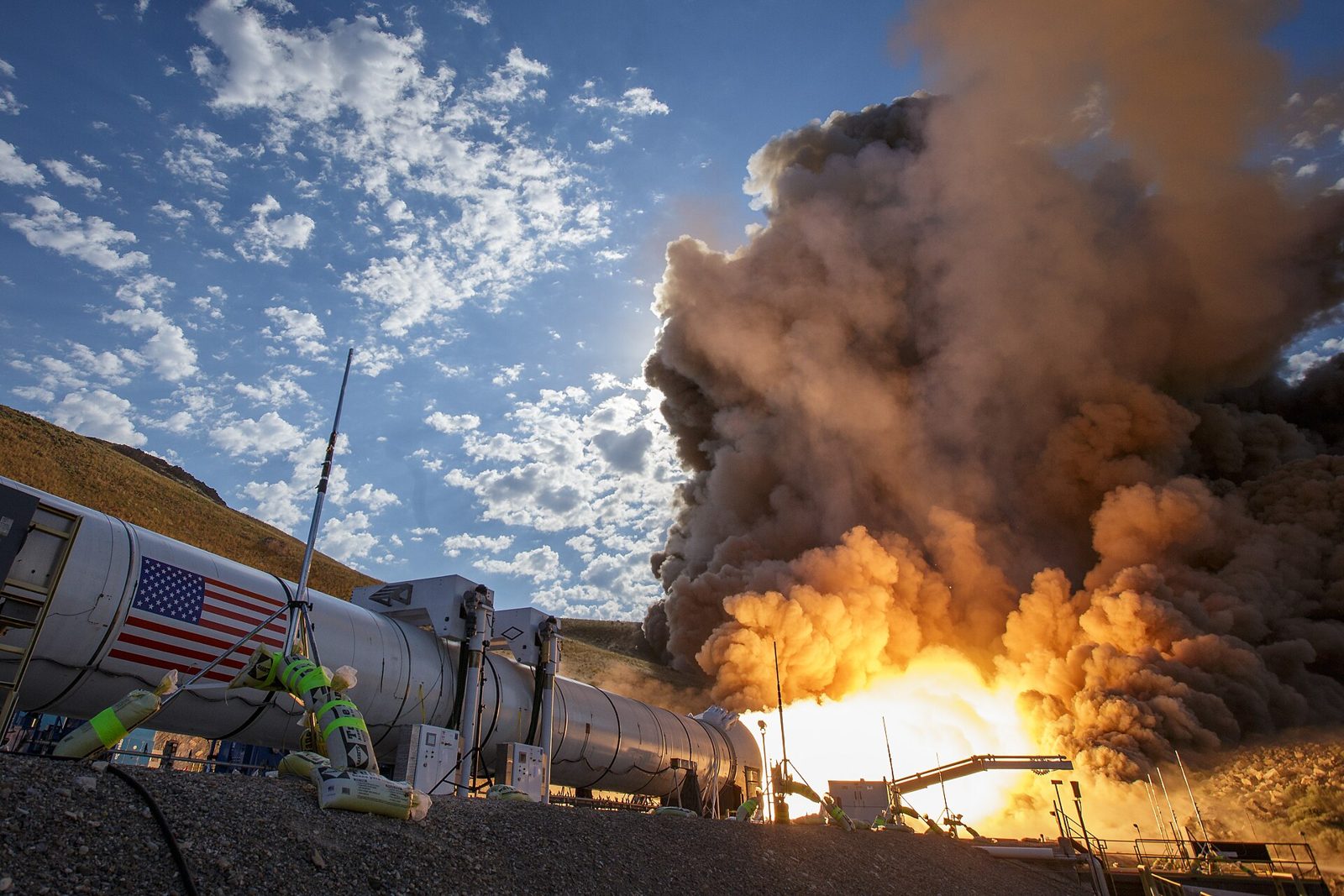

My loves, a solid rocket motor is a steel or composite tube packed with something that looks and feels a lot like a hard pencil eraser, and when you light it, it does not stop until it’s done. 🧨 No valves, no pumps, no throttle. Just a very controlled fire. That simplicity is why solids have launched missiles, shuttles, satellites and Moon rockets, and why the lessons we learned the hard way with them still shape how we design everything else.
This is my deep dive on the propellant itself. I mark claims as official, reported or my arithmetic, and I tell you when the sources disagree. Status as of October 26, 2026.
The Short Version
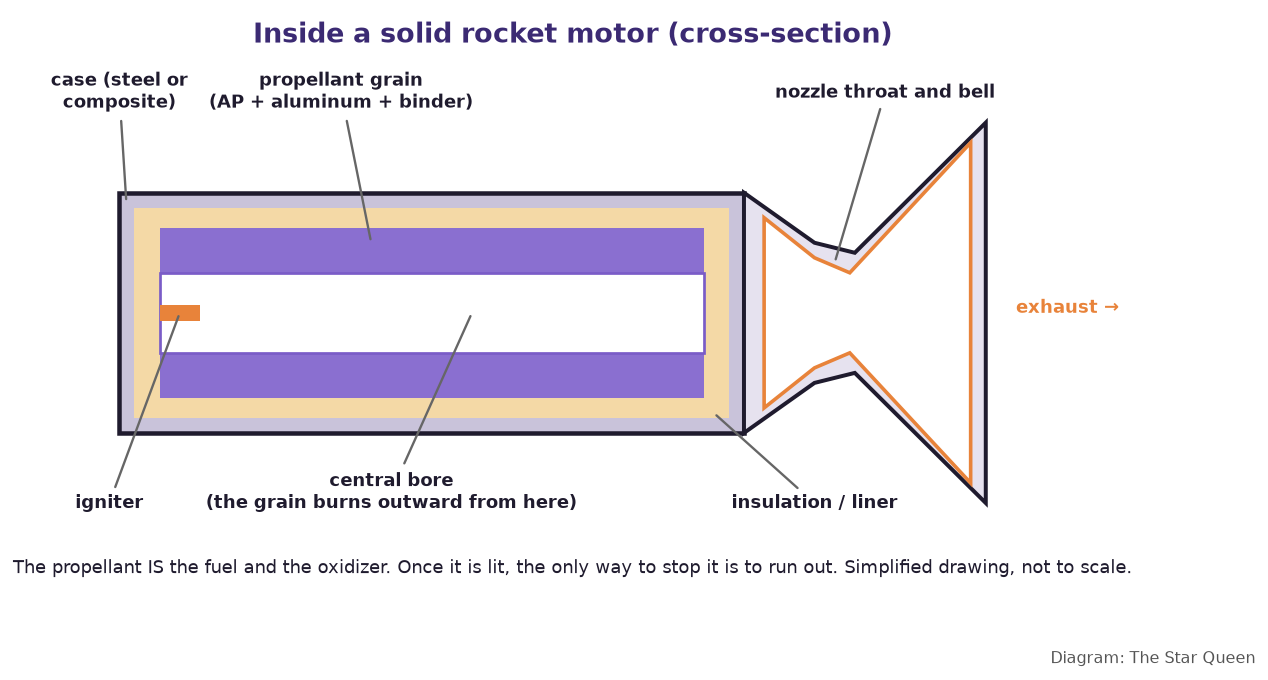
- Modern solids use APCP: ammonium perchlorate (oxidizer) + a rubbery binder (fuel) + aluminum powder (fuel) + small amounts of burn-rate catalyst.
- Fuel and oxidizer are premixed and cast in the case. That’s why solids are simple, dense and storable, and also why they can’t be throttled or shut off the way a valve-fed engine can.
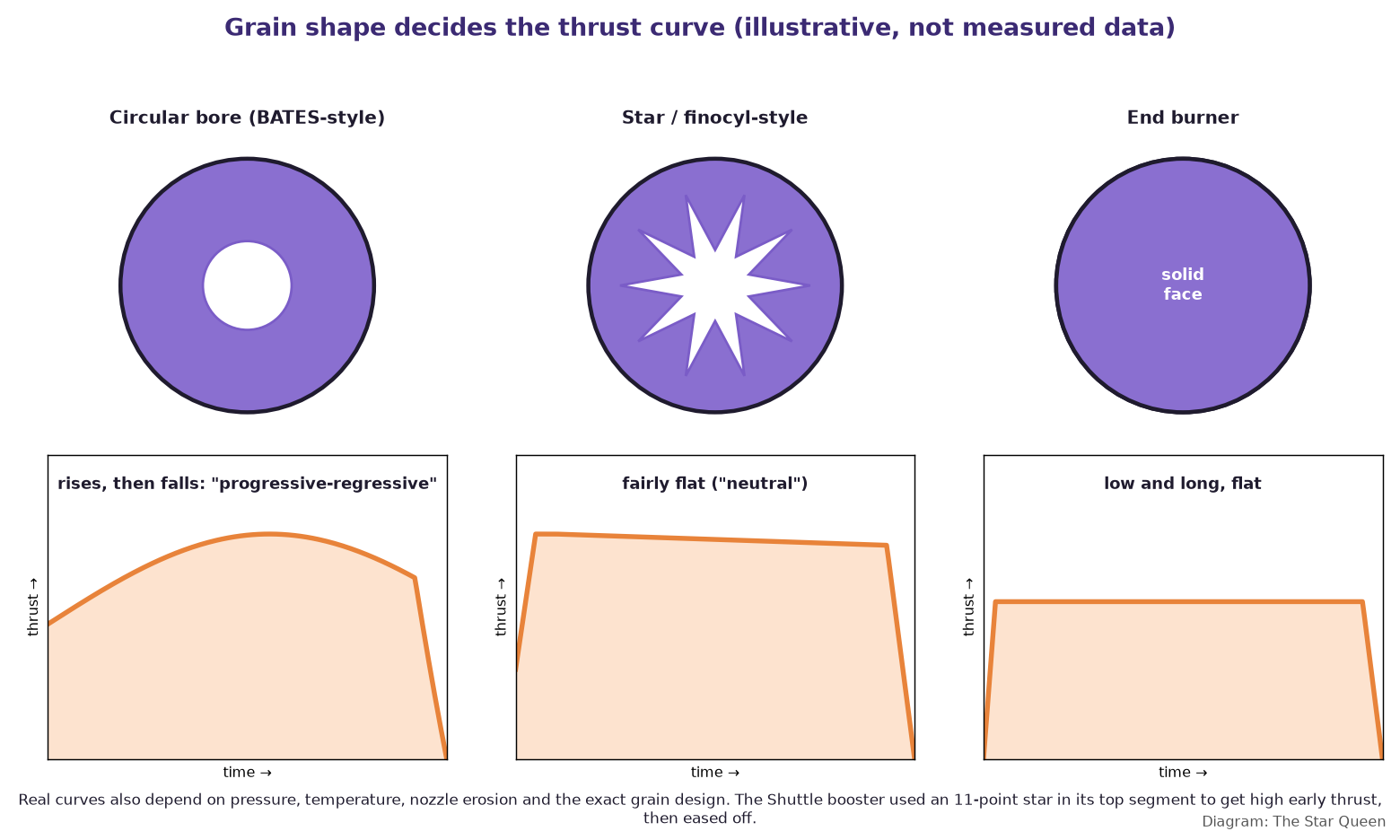
- The grain shape (the hole carved in the middle) sets the thrust curve.
- Shuttle and SLS boosters use a PBAN binder; GEM 63/63XL and Atlas V’s AJ-60A use HTPB. They’re different, and I’ll explain.
- Hybrids (solid fuel + liquid or gas oxidizer) can throttle and shut down, at a performance and engineering cost.
Terms to know ✨
- APCP: ammonium perchlorate composite propellant, the standard modern solid.
- Binder: the rubbery polymer that glues the powder together and burns as fuel. HTPB and PBAN are the two big ones here.
- Grain: the cast block of propellant, including the shape of its central hole (the port or bore).
- Burn rate: how fast the propellant surface recedes, usually in mm/s or in/s.
- Chamber pressure (Pc): the pressure inside the motor, which also drives the burn rate.
- Neutral, progressive, regressive: thrust that stays flat, rises or falls over the burn.
- Hybrid: a solid fuel grain with a liquid or gas oxidizer.
- Isp: specific impulse in seconds. Higher is more efficient.
What’s Actually in the Rubber 🧪
Wikipedia describes APCP as a “composite propellant, meaning that it has both fuel and oxidizer combined into a homogeneous mixture.” The recipe:
- Ammonium perchlorate (AP): the oxidizer, in crystals of a few dozen to a few hundred microns.
- Binder: a polymer such as HTPB or PBAN. Cured, it makes the grain “fairly elastic (rubbery),” which helps it survive shipping and handling without cracking.
- Aluminum powder: raises the burn temperature and boosts Isp. “High-performance configurations” run roughly 70/15/15 AP/binder/Al by mass, per Wikipedia.
- Catalysts: small amounts of iron oxide and similar additives that tune the burn rate.
The Space Shuttle’s boosters used, in Wikipedia’s words, “ammonium perchlorate (oxidizer, 69.6% by weight), aluminium (fuel, 16%), iron oxide (a catalyst, 0.4%), PBAN… (12.04%)” plus about 2% epoxy curing agent. Another Wikipedia page gives 69.8% and 0.2% for the AP and iron oxide. Both sum to 100%, so I’ll just say “about 70% AP, 16% aluminum, 12% PBAN, a bit of epoxy and a trace of iron oxide.”
PBAN or HTPB? The distinction you’ll hear mangled
People often say “the Shuttle boosters burned HTPB.” Not quite. Space Shuttle and SLS boosters use PBAN (polybutadiene acrylonitrile). Northrop’s GEM family (including GEM 63 and 63XL on Vulcan) and Atlas V’s AJ-60A use HTPB (hydroxyl-terminated polybutadiene), per Wikipedia. Both are rubbery polybutadiene binders and both end up in the same AP/aluminum family, but they cure and process differently. Wikipedia’s Castor page even notes that a GEM-derived replacement would swap the Shuttle’s “D6AC steel case and PBAN binder” for “carbon composite cases and HTPB binder.”
The Burn: Pressure Writes the Thrust 🔥
A solid burns from the exposed surface of the grain. Three equations tell most of the story, and I’ll keep the math friendly:
- Burn rate depends on pressure: r = a · Pc^n. The exponent n is typically around 0.3 to 0.5 for composite propellants (Stanford AA284a lecture notes).
- Gas production depends on area: mass flow = density × burning area × burn rate. More surface, more gas.
- Pressure comes from gas production vs. the nozzle throat. The result is a self-regulating loop: more pressure means a faster burn, which means more gas, which means more pressure, until the nozzle vents the excess.
That loop is stable only when n is below 1. Push it too high and tiny pressure bumps can run away, which is the textbook reason burn-rate exponents are kept low. (That’s standard rocketry theory, not a claim about any specific motor.)
Real-world Isp numbers are all over the place, depending on who you ask. Wikipedia says APCP typically delivers 180 to 260 s; the Stanford notes give a higher range around 260 to 300 s; and Braeunig’s theoretical AP/Al/HTPB figure at 68 atm is 277 s. The Shuttle SRB is listed at 242 s at sea level and 268 s in vacuum (Braeunig). These differ because of formulation, nozzle and pressure, and because “theoretical” isn’t “delivered.” I’d quote about 240 to 270 s for big boosters.
Grain Geometry: Drawing the Thrust Curve with a Hole 🕳️
Because the surface burns inward from the bore, the shape of that bore is the thrust curve. Wikipedia’s list of common grain shapes:
| Grain | What the shape does | Thrust curve |
|---|---|---|
| End burner | Burns from one end like a cigar | Steady, long burn (thermal difficulties, shifting center of gravity) |
| Circular bore (BATES) | Cylindrical hole | Progressive-regressive (rises then falls) |
| Moon burner | Off-center round hole | Progressive-regressive, long burn |
| C-slot | Wedge cut out of the side | Regressive (decreasing) |
| Finocyl | 5- or 6-legged star-like hole | Very level, slightly quicker burn |
The Shuttle’s boosters used a clever version. Per NASA’s description, the forward segment had an 11-point star bore and the aft segments had double-truncated-cone perforations. That gave a very high thrust at ignition that tapered by about a third around 50 seconds, when the stack passed max-Q, the peak of aerodynamic stress.
Can’t Throttle, Can’t Shut Down 🚫
Wikipedia says it bluntly: “Once ignited, a simple solid rocket motor cannot be shut off, as it contains all the ingredients necessary for combustion within the chamber in which they are burned.” More advanced designs can be throttled or extinguished by changing the nozzle geometry or using vent ports, and some “pulsed” motors burn in segments. For big boosters, the practical answer is the grain you designed.
That’s both a feature and a bug. For a booster, “light it and forget it” is wonderful: no turbopumps, no valves, the thrust is just there. For anything that needs control (landing, abort, hovering), you’d rather use a liquid, which is why Dragon’s escape engines are hypergolic liquids (see my hypergolic propellants post) and why hybrids exist.
Steering a solid means moving the nozzle, using jet vanes (V-2) or liquid-injection thrust vectoring. The Shuttle gimbaled its SRB nozzles, with each booster’s two hydraulic units powered by hydrazine auxiliary power units (22 lb of hydrazine each) per Wikipedia. Yes, the biggest solids in the world steered with a little hydrazine.
Shuttle SRBs: The Reusable Giants 🚀
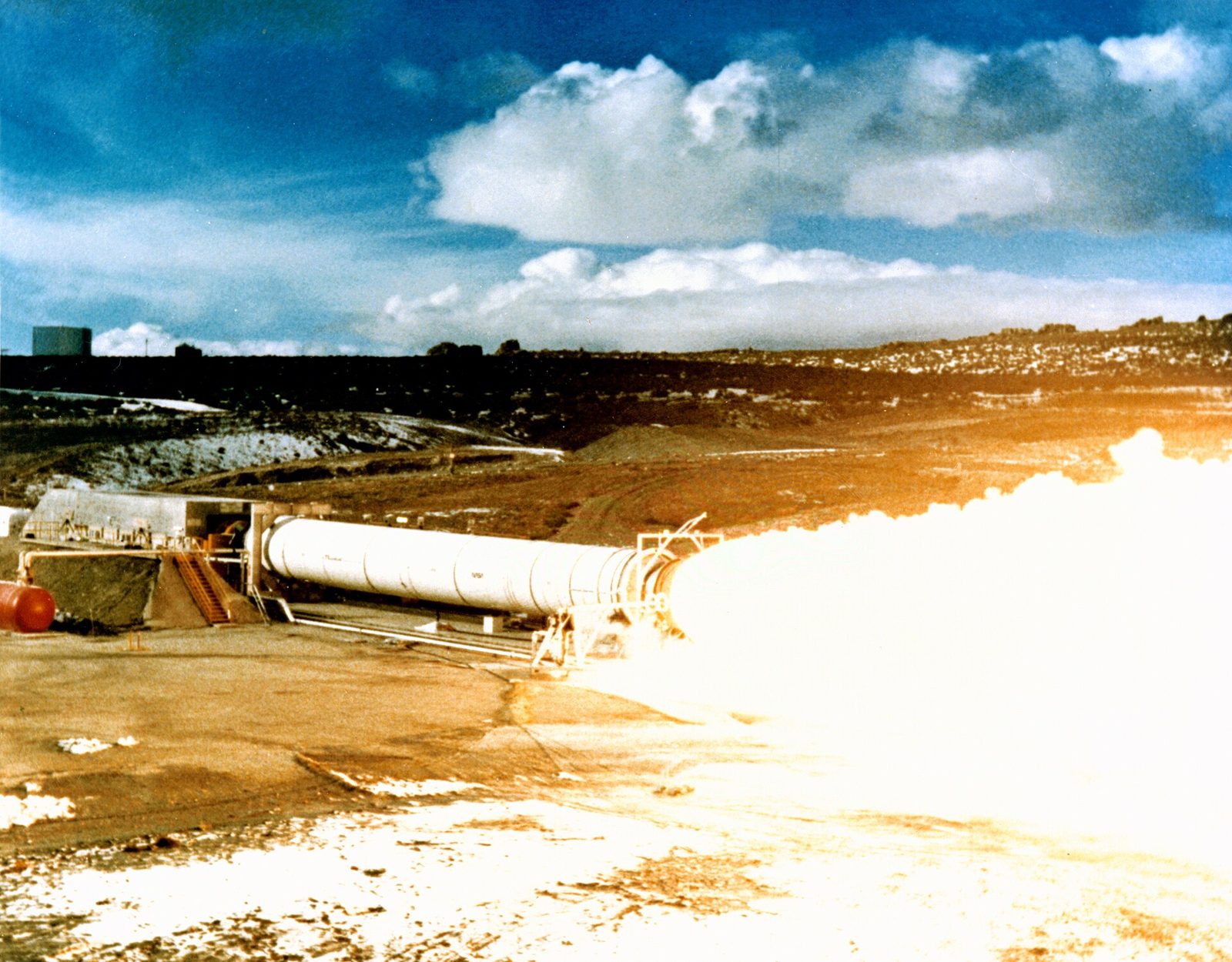
The Space Shuttle’s Solid Rocket Boosters were, per Wikipedia, “the first solid-propellant rocket to be used for primary propulsion on a vehicle used for human spaceflight.” Each is 149.16 ft long and 12.17 ft in diameter and weighed about 1.3 million lb at launch. Together they supplied about 85% of liftoff thrust; NASA gives the combined thrust at 5.3 million pounds. They were also the first solids designed for reuse: of 270 flown, all but four were recovered, and over 5,000 parts were refurbished (Wikipedia). Chamber pressure was about 907 psi (NASA history).

SLS Boosters: One More Segment 🌕
NASA’s SLS booster fact sheet gives the family resemblance and the upgrades: 177 ft long, 12 ft in diameter, 1.6 million lb, five segments (the Shuttle’s had four, so about 25% more propellant), PBAN-based, about 3.6 million lb of thrust each, 126 seconds burn, around 6 tons of propellant per second, and over 75% of SLS’s liftoff thrust. The final qualification test, QM-2, on June 28, 2016, fired a motor conditioned to 40 °F with about 6,000 °F inside the motor and 82 test objectives across 530 data channels (NASA). I’ll come back to why that cold matters.
GEM 63 and GEM 63XL: The Modern Strap-Ons ⚡
On Vulcan and Atlas V today, you’ll see Northrop’s carbon-composite GEM 63 and GEM 63XL, HTPB-binder motors in the graphite-epoxy family. From Northrop’s datasheet:
| Motor | Total mass | Propellant | Burn time | Thrust | Length |
|---|---|---|---|---|---|
| GEM 63 | 108,600 lb | 97,500 lb | 97.6 s | 370,835 lbf | 791 in |
| GEM 63XL | 117,700 lb | 105,900 lb | 87.3 s | 463,249 lbf | 864 in |
GEM 63 replaced Atlas V’s older AJ-60A (also HTPB-based) from November 13, 2020. The XL version first flew on Vulcan’s Cert-1 on January 8, 2024. ULA’s user guide quotes a slightly different burn time (about 90 s) and thrust (about 459,600 lbf), likely a rounding or condition difference.
There’s a wrinkle: on Cert-2, October 4, 2024, one booster lost its nozzle about 35 to 37 seconds into the flight, but the mission still reached orbit. The cause was reported as “manufacturing defects” (Wikipedia), while Ars Technica described an insulator failure. And on February 12, 2026, the USSF-87 launch reported a “significant performance anomaly” in one of four solid motors. For the full timeline, see my GEM 63XL deep dive and the Vulcan Centaur explainer. I’m not drawing conclusions the investigations haven’t.
For comparison, Ariane 5’s EAP boosters used a 68% AP / 18% Al / 14% HTPB propellant (7,080 kN, 130 s), and Ariane 6 and Vega C’s P120C carries about 142 tonnes of propellant for up to 4,650 kN (Wikipedia).
Safety, Handled Gently 🛡️
A solid motor is a controlled fire with no off switch, so the failure modes matter. Wikipedia lists fracture of the grain, failure of case bonding, and air pockets, all of which “produce an instantaneous increase in burn surface area and a corresponding increase in exhaust gas production rate and pressure, which may rupture the casing.” Another is casing seal failure: “once a seal fails, hot gas will erode the escape path.” That last one is the failure the Challenger investigation identified.
A lesson from Challenger
On January 28, 1986, Space Shuttle Challenger was lost shortly after liftoff, and the space community still remembers its crew with great respect. I’ll stick to what the investigation found, because the story is often told wrong.
The Rogers Commission concluded that “the cause of the Challenger accident was the failure of the pressure seal in the aft field joint of the right Solid Rocket Motor. The failure was due to a faulty design unacceptably sensitive to a number of factors”: temperature, physical dimensions, the character of materials, reusability, processing, and the joint’s reaction to dynamic loading. It also states that “no other element of the Space Shuttle system contributed to this failure.”
Key facts from the report:
- The propellant was not the cause. The failure was a joint and its seals, in hardware.
- Ambient temperature at launch was 36 °F, 15 °F lower than the next coldest previous launch, and the aft joint was estimated at about 28 ± 5 °F at the coldest point.
- The Commission concluded that the left booster, and all of the right booster except the right Solid Rocket Motor, “did not contribute to or cause the accident.”
My own takeaway, not the Commission’s: test for the worst-case conditions. NASA conditioned the SLS booster’s QM-2 motor to 40 °F for its qualification firing, which I read as a deliberate cold-weather check. I’m only reporting what the Commission wrote, and I won’t speculate beyond it.
Hybrid Motors: Halfway Between Solid and Liquid 🧬
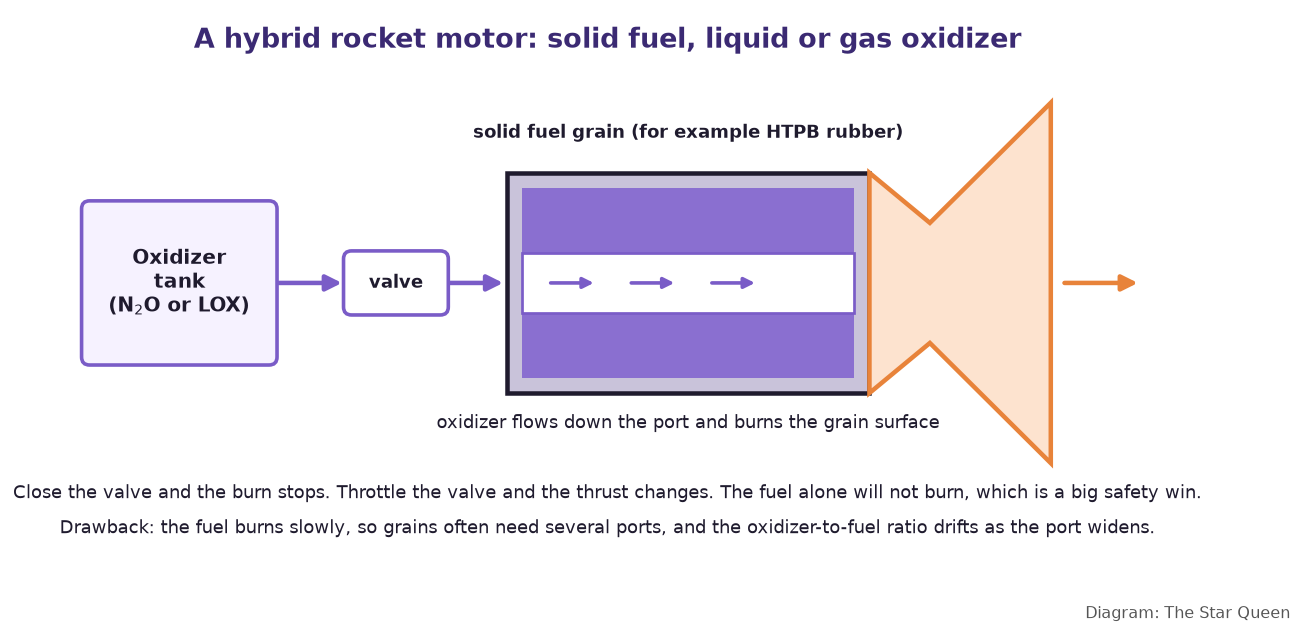
A hybrid rocket stores solid fuel and a liquid or gas oxidizer separately. A typical setup: a solid fuel grain (often HTPB) inside the motor case, and an oxidizer tank (nitrous oxide or liquid oxygen) feeding it through a valve. When oxidizer flows down the grain’s port, the fuel surface vaporizes and burns.
Why bother? Per Wikipedia’s hybrid page:
- Throttleable and restartable, since a valve controls the oxidizer flow.
- Safer to handle: fuel and oxidizer “do not burn when brought together” without a heat source, and failures tend to be milder.
- Simple: fewer plumbing parts than a bipropellant engine.
And why aren’t hybrids everywhere?
- Low regression rate: fuel burns slowly, so you often need multi-port grains. Regression depends on oxidizer mass flux (r = a · G^n), not on chamber pressure.
- O/F shift: as the port widens, the oxidizer-to-fuel ratio drifts over the burn, hurting efficiency.
- Combustion instability, and lower density-impulse than a solid (Braeunig: 290 vs. 474 kg·s/L theoretical).
Performance is murky. Braeunig’s theoretical N2O/HTPB figure is 248 s; a Wikipedia-cited US Rockets number is about 180 s delivered; SpaceShipOne’s page lists about 250 s; NASA’s small-spacecraft survey says 215 to 300 s for small hybrids. Take all of those as ranges.
SpaceShipOne used SpaceDev’s N2O/HTPB hybrid, rated around 88 kN (the same Wikipedia page lists both 88 and 73.5 kN) for about 87 s, and it couldn’t throttle (Wikipedia). Its successor, SpaceShipTwo, switched from HTPB to a polyamide (nylon) fuel in 2014, then back to HTPB in 2015. A 2007 nitrous-oxide test explosion killed three people (the oxidizer, not the burning motor, was the issue). The October 31, 2014 SpaceShipTwo breakup was the first flight on the nylon fuel, but the cause was premature feather deployment, so please don’t blame the motor. I mention both to be honest about hybrids’ real history. For more on hybrids with other oxidizers, see my beyond the big five post.
PROS and CONS
PROS 👍
- Simple. No turbopumps, no valves, few moving parts.
- Huge thrust for the size. Dense: Braeunig lists AP/Al/HTPB at about 474 kg·s/L density impulse, compared with 294 for LOX/kerosene (theoretical).
- Storable and ready. Cast, shipped and fired, no fueling day.
- Cheap per pound of thrust (Wikipedia: “high thrust for relatively low cost”).
- Great strap-on boosters: burn out and drop off while the liquid core carries on.
- Proven heritage: Shuttle, SLS, Atlas V, Vulcan, Ariane.
CONS 👎
- No throttle, no shutdown for simple motors.
- Lower Isp than hydrolox or methalox (about 240 to 270 s for big boosters).
- Failures can be sudden (grain cracks, bonding, seals).
- Hard to test for every flaw and expensive to scrap once cast.
- Corrosive exhaust: AP leaves hydrogen chloride in the plume. That’s why ADN is studied as a replacement oxidizer (Wikipedia).
- Hybrids add complexity: O/F shift, slow regression, instability.
Which Engines Use It 🚀
| Motor / vehicle | Propellant | Notes | Source |
|---|---|---|---|
| Shuttle SRB | AP / Al / PBAN | Reusable, 4 segments, 149 ft | NASA, Wikipedia |
| SLS booster | AP / Al / PBAN | 5 segments, 3.6 M lb thrust each | NASA |
| GEM 63 / 63XL (Atlas V, Vulcan) | AP / Al / HTPB | 370,835 lbf / 463,249 lbf | Northrop, Wikipedia |
| AJ-60A (Atlas V) | HTPB-based APCP | Replaced by GEM 63 from Nov 2020 | Wikipedia |
| Ariane 5 EAP | 68% AP / 18% Al / 14% HTPB | 7,080 kN, 130 s | Wikipedia |
| P120C (Ariane 6, Vega C) | Solid, composite case | 142 t propellant, 4,650 kN | Wikipedia |
| Orion / Apollo escape towers | Solid | Pulled capsule away from the rocket | Wikipedia |
| SpaceShipOne (hybrid) | N2O / HTPB | About 88 kN, unthrottleable | Wikipedia |
| Draco / SuperDraco | Not solid (MMH/NTO) | See my Draco post | SpaceX |
| Blue Origin, Relativity, Stoke | Not sourced | I found no solid-motor use | n/a |
Watch: Boosters Doing Their Thing 🎥
NASA Marshall’s preview of the full-scale SLS booster test:
Can’t see the video? Watch it on YouTube: Get Ready for the Final, Full-Scale SLS Booster Test (NASA’s Marshall Space Flight Center)
And a NASA eClips look at how solid boosters lift a rocket (an archived NASA education video):
Can’t see the video? Watch it on YouTube: Launchpad: Liftoff with Solid Rocket Boosters [Archived] (NASA eClips – ARCHIVE)
The Star Queen’s Take 👑
My loves, I find solids both humbling and lovely. Humbling because a design flaw in one joint was enough to lose a vehicle. Lovely because once you understand the little equations, you can see the thrust curve in the shape of the hole. A shape on a drawing board becomes thrust in the sky.
I don’t think solids are going away. They’re cheap, dense and ready, and strap-ons like GEM 63XL and the SLS boosters keep getting bigger. But I’d keep them where they shine, as boosters you can light and forget, and let liquids handle jobs that need control. The GEM 63XL anomalies are a reminder that even mature hardware keeps teaching us. Whatever the investigations conclude, I’ll trust the official findings over my guesses.
Want to compare solids to the liquids? Start with kerosene, methane and hydrogen, or see Vulcan’s other engines: RL10 and BE-4.
Sources
- NASA, SLS solid rocket booster fact sheet: https://www.nasa.gov/wp-content/uploads/2017/05/8690_sls_solid_rocket_booster_fact_sheetfinal03072015_508.pdf
- NASA, Boosters 101: https://www.nasa.gov/technology/space-travel-tech/school-is-in-session-welcome-to-boosters-101/
- NASA, SLS booster passes major test (QM-2): https://www.nasa.gov/news-release/nasas-space-launch-system-booster-passes-major-milestone-on-journey-to-mars/
- NASA, Space Shuttle SRB history: https://www.nasa.gov/space-shuttle-recordation/srb/
- NASA Glenn, Model solid rocket engine: https://www1.grc.nasa.gov/beginners-guide-to-aeronautics/model-solid-rocket-engine/
- Presidential Commission on the Space Shuttle Challenger Accident, Chapter IV: https://history.nasa.gov/rogersrep/v1ch4.htm
- Northrop Grumman, GEM 63 / GEM 63XL datasheet: https://cdn.northropgrumman.com/-/media/Project/Northrop-Grumman/ngc/what-we-do/space/propulsion/NG-GEM-63XL-2025-v5.pdf
- ULA, Vulcan User Guide (2023): https://www.ulalaunch.com/docs/default-source/rockets/2023_vulcan_user_guide.pdf
- Stanford AA284a, Lecture 11 (hybrid and solid ballistics): https://stanford.edu/~cantwell/AA284A_Course_Material/Karabeyoglu%20AA%20284A%20Lectures/AA284a_Lecture11.pdf
- Braeunig, Rocket Propellants: http://braeunig.us/space/propel.htm
- NASA, Small Spacecraft State of the Art, in-space propulsion: https://www.nasa.gov/smallsat-institute/sst-soa/in-space_propulsion/
- Wikipedia: Solid-propellant rocket, Ammonium perchlorate composite propellant, Space Shuttle Solid Rocket Booster, Space Launch System, GEM 63, AJ-60A, Vulcan Centaur, Castor (rocket stage), Ariane 5, Ariane 6, Hybrid-propellant rocket, Scaled Composites SpaceShipOne, SpaceShipTwo, Ammonium dinitramide (all at https://en.wikipedia.org/)
- Related posts on this site: GEM 63XL deep dive, Hypergolic propellants, Beyond the big five
- Images: Wikimedia Commons and NASA (credit and license in each caption). Diagrams by The Star Queen.